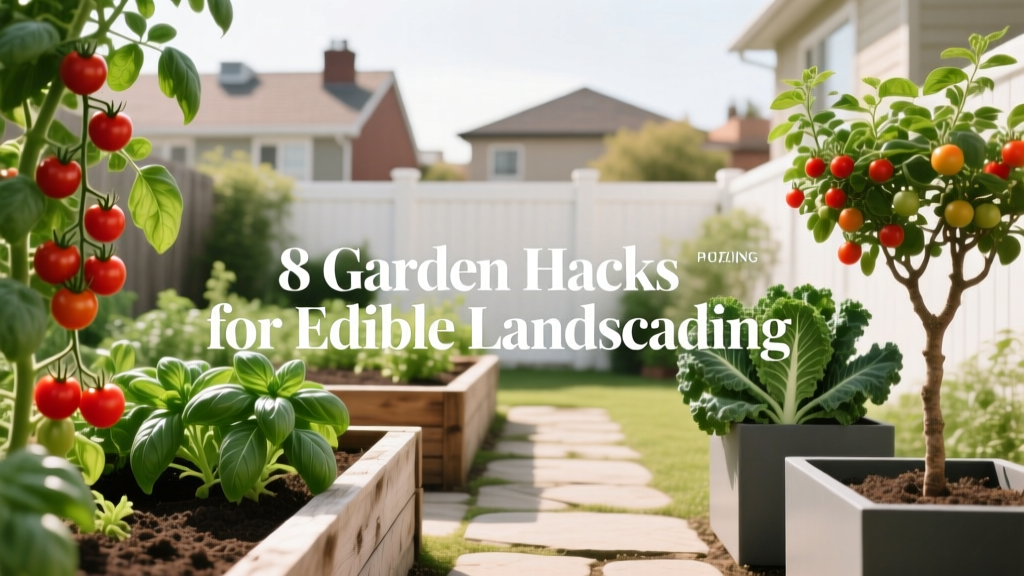
8 Garden Hacks for Edible Landscaping
The most common edible-landscaping mistake isn’t plant choice—it’s putting food plants in the “hardest” spots because they’re pretty. A sunny front bed next to a hot sidewalk might look perfect for basil, but reflected heat can scorch tender leaves and force you into daily watering. The fix isn’t to give up on edible landscaping; it’s to use a few layout and maintenance hacks so your yard stays attractive and productive with less effort.
Below are eight shortcuts I lean on when I’m designing edible beds for real people (busy schedules, tight budgets, and the occasional “oops, I forgot to water for a week”).
Group 1: Layout Hacks That Make Edibles Look Intentional (Not Like a Veg Patch Escaped)
1) Use the “60/30/10” Rule: Structure First, Then Edibles
If your edible landscape ever looks messy by midsummer, it’s usually because everything is doing the same job—lots of soft, floppy annuals and not enough year-round structure. Try a simple ratio: about 60% evergreen/woody structure (boxwood alternative like rosemary in mild climates, dwarf blueberries, currants), 30% seasonal edibles (kale, chard, peppers), and 10% flowers for pollinators (calendula, nasturtium). This keeps the bed “designed” even when lettuce bolts.
Example: In a 100 sq ft front bed, plant 3 dwarf blueberries (structure), edge with perennial thyme (structure + edible), then rotate 6–10 spots for seasonal favorites like peppers and basil.
2) Frame with Edible Edges: A 12-Inch Border Changes Everything
An edible border is the fastest way to make food plants look like landscaping on purpose. Create a crisp 12-inch edge using low, shearable edibles: thyme, oregano, chives, dwarf kale, or alpine strawberries. Keep it uniform—same plant, same spacing—so it reads like a formal border even if the center is a mix.
DIY shortcut: Use a string line and plant every 6–8 inches for thyme or every 8–10 inches for chives. In tight budgets, divide one nursery pot of chives into 6–10 clumps and plant them along the edge.
3) Replace “Foundation Shrubs” with Fruit Shrubs in Matching Pairs
Most edible landscapes fail curb appeal because the plants don’t repeat. The hack: swap standard foundation shrubs for edible shrubs and plant them in pairs or triples for symmetry. Blueberries, serviceberries, gooseberries, and dwarf figs (where hardy) can look as tidy as ornamentals—especially when you repeat the same variety on both sides of a walkway.
Case example (front-yard makeover): A homeowner replaced 6 tired yews with 6 blueberries (3 on each side). Cost was about $25–$45 per plant, but it eliminated yearly yew shearing and produced several pounds of berries once established.
Group 2: Soil + Water Shortcuts (Because Edible Landscaping Shouldn’t Mean Babysitting)
4) Build “Compost Pockets” Instead of Replacing Soil
You don’t need to excavate and replace an entire bed to grow edibles. Dig targeted “compost pockets” where heavy-feeding plants go: a hole about 12 inches wide and 10–12 inches deep, then backfill with a mix of 2 parts native soil : 1 part finished compost. This concentrates fertility where roots actually grow, saving money and labor.
Money saver: Replacing soil across a 100 sq ft bed at a 6-inch depth can take ~50 cu ft of material—often $150–$300 delivered. Compost pockets might use only 5–10 bags of compost (or a half-yard), depending on how many plants you’re installing.
For compost quality and safety, university extensions consistently recommend using finished compost and avoiding fresh manure close to harvest crops. Penn State Extension notes compost should be mature and stable before use to reduce plant and food safety issues (Penn State Extension, 2020).
5) Use a Soaker “Horseshoe” Around Each Shrub for Deep Watering
Drip systems are great, but you can get 80% of the benefit with a cheap hack: loop soaker hose in a horseshoe around shrubs, leaving a small gap at the trunk to prevent rot. Place it at the drip line (the outer edge of the canopy), then run it for 45–90 minutes once or twice a week depending on weather and soil.
Real-world scenario: In a dry summer, a gardener with three raised beds and mixed shrubs switched from hand-watering to two soaker loops on a timer. Watering time dropped from 20 minutes daily to 2 timer runs per week, and the tomatoes stopped cracking from uneven moisture.
6) Mulch Like a Pro: 3 Inches Deep, Keep a 3-Inch Gap
Mulch is the quiet hero of edible landscaping, but most people apply it too thinly or pile it against stems. Aim for 3 inches of mulch over soil, and keep a 3-inch mulch-free ring around plant crowns and trunks. Wood chips work especially well around fruit shrubs and perennials; straw is great for annual beds.
Evidence: Washington State University Extension highlights that organic mulches conserve soil moisture and reduce weeds—two big levers for low-maintenance edible beds (WSU Extension, 2019).
“Mulches are one of the most effective ways to conserve water in the garden while suppressing weeds—both of which reduce plant stress.” — Washington State University Extension (2019)
Group 3: Planting + Productivity Hacks (More Food Without Turning Your Yard Into Work)
7) Plant “Pretty + Productive” Combos in the Same Hole
If you want lush beds without micromanaging, pair plants that share water needs but use different layers. Try one “anchor” edible with one fast filler in the same planting zone: a pepper with basil, a kale with calendula, a blueberry with creeping thyme at its base. Space the anchor normally, then tuck the filler 6–10 inches away so it doesn’t crowd the main plant.
Example: Plant one tomato as your anchor, then add 2 basil plants 8 inches from the stem on either side. The basil acts like a living mulch, shading soil and giving you harvests while the tomato is still sizing up.
8) Use “Succession Slots” Instead of Replanting Whole Beds
The easiest way to keep edible landscaping looking good is to avoid big empty gaps when crops finish. Designate a few “succession slots” (think: 3–6 pockets) where you rotate plants on a schedule. For instance: peas in early spring, then basil in early summer, then garlic in fall—same spot, three harvest windows.
Timing hack: Plan around your first frost date. Many gardeners can sow fall greens 6–8 weeks before frost, and garlic goes in about 3–6 weeks before the ground freezes, depending on region. Write it on a calendar once and reuse the schedule every year.
Shortcuts That Save Money (and Keep Things Looking Clean)
Comparison Table: Store-Bought vs DIY Options for Edible Landscape Upgrades
| Upgrade | Store-Bought Option | DIY Alternative | Typical Cost | Best Use |
|---|---|---|---|---|
| Bed edging | Metal landscape edging | Trench edge (spade-cut) + mulch | $40–$120 per 50 ft vs ~$0 | Front-yard crisp lines |
| Weed suppression | Landscape fabric | Cardboard sheet mulch + 3" wood chips | $15–$60 vs ~$0–$20 | New beds over lawn |
| Irrigation | Drip kit | Soaker hose + timer | $60–$150 vs $25–$60 | Shrubs + mixed beds |
| Soil improvement | Bulk soil/compost delivery | Compost pockets + topdress | $150–$300 vs $20–$80 | Upgrading existing beds |
A quick note on weed barriers: cardboard under wood chips works shockingly well for starting new edible beds, and it breaks down over time. Skip glossy cardboard and remove tape; overlap sheets by 6 inches so grass doesn’t find a seam to sneak through.
Three Real-World Scenarios (and How These Hacks Play Out)
Scenario 1: The Hot, Sunny Front Strip by the Driveway
This spot bakes, dries out fast, and makes tender greens miserable. Use the structure-first ratio: install drought-tough edibles like rosemary (if hardy), sage, thyme edging, and blueberries or serviceberries where you can amend with compost pockets. Add mulch at 3 inches and run a soaker horseshoe 60 minutes twice weekly during heat waves.
What it looks like: Neat evergreen herbs define the edge, shrubs carry the “landscape” look, and you reserve just a couple of succession slots for heat lovers like peppers.
Scenario 2: The Shady Side Yard That “Can’t Grow Food”
Side yards often get 3–5 hours of sun—still useful. Put your limited sun toward leafy crops (kale, chard, sorrel) and shade-tolerant herbs (mint in a pot, chives, parsley). Use repetition (same plants, evenly spaced) so it reads intentional rather than accidental.
Hack that helps: Keep the border uniform—like a chive edge every 8 inches—and tuck leafy greens into compost pockets to make the most of slower growth in shade.
Scenario 3: The Busy Household That Forgets to Water
If watering consistency is your weak spot, design around it instead of fighting it. Prioritize perennials and shrubs (blueberries, currants, herbs) with deep mulch and a timer-driven soaker hose. Keep annuals limited to a few succession slots close to the hose path—so you’re not dragging sprinklers across the yard.
Result: You still get basil, tomatoes, and greens, but the “bones” of your edible landscape survive missed weeks without looking sad.
Extra Micro-Hacks to Make the Eight Tips Even Easier
Label once, harvest forever: Use aluminum tags and a ballpoint pen to label perennial edibles (variety + planting year). It helps when pruning, fertilizing, or troubleshooting later—especially with blueberries and fruiting shrubs.
Prune for shape, not just fruit: In edible landscaping, you’re pruning for curb appeal. A quick 10-minute tidy in late winter on fruit shrubs (removing dead wood and crossing branches) can keep them looking like intentional ornamentals all season.
Keep one “swap-out” nursery pot: If something finishes early (bolted lettuce) or looks ratty (spent cilantro), having a backup pot of basil, marigold, or parsley lets you plug the hole immediately. That one move keeps the bed looking designed.
Think in repeats of 3: Three identical plants in a row (three kale, three basil, three lettuces) looks landscaped; one lonely plant looks accidental. This is especially helpful in front-yard beds where you want order without losing the edible vibe.
Edible landscaping gets dramatically easier when you stop treating it like a vegetable garden that must produce nonstop everywhere. Give your yard some structure, put fertility only where it’s needed, automate deep watering, and keep a few succession slots ready to swap. You’ll end up with beds that look good in April, still look good in August, and quietly feed you the whole time.
Sources: Penn State Extension (2020), compost maturity and safe garden use guidance; Washington State University Extension (2019), benefits of organic mulches for moisture conservation and weed suppression.