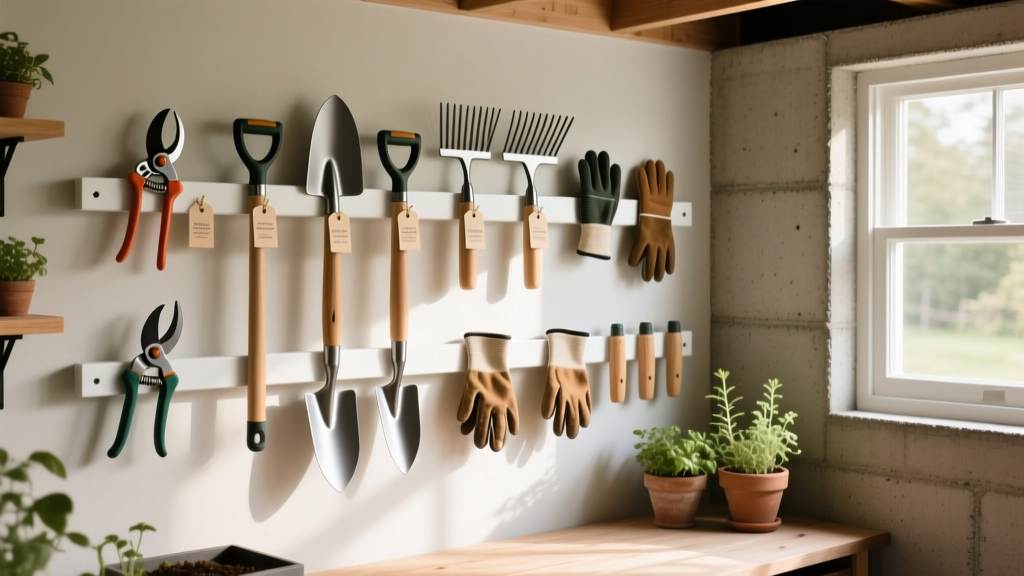
15 Garden Hacks for Garden Tool Organization
The fastest way to lose a Saturday in the garden isn’t weeds—it’s the “where did I put the pruners?” loop. Most tool chaos comes from one common mistake: storing everything by type (all hand tools together, all long tools together) instead of by how you actually use them (by task, season, and frequency). Fix that, and you’ll stop buying duplicates, stop tripping over rakes, and start getting to the fun part faster.
One more reality check: metal tools stored damp and dirty don’t just look messy—they age faster. University of Minnesota Extension notes that cleaning and drying tools after use helps prevent rust and wear (University of Minnesota Extension, 2019). Organization isn’t “aesthetic,” it’s tool life insurance.
Set up your “grab-and-go” system first (the 60-second rule)
1) Create a 60-second tool zone near the exit
If you can’t grab your top tools and get outside in under 60 seconds, the storage layout is working against you. Mount a small rack or pegboard within 3 feet of the door you use most—shed door, garage side door, or mudroom. Keep only the items you reach for weekly: hand pruners, gloves, twine, hori-hori, and a small trowel.
Real-world example: In a suburban garage setup, a 24 in x 36 in pegboard panel held the “daily five” tools; everything else moved deeper. The gardener stopped leaving pruners on the patio because they finally had a home on the way back in.
2) Organize by task, not tool type (three buckets that change everything)
Make three labeled bins: “Planting,” “Pruning,” “Cleanup.” Put the tools for that job together even if it feels weird at first—trowel with transplant fertilizer scoop, pruners with rubbing alcohol, rake gloves with leaf bags. This reduces mid-task hunting and makes it obvious what’s missing when you’re done.
DIY option: Reuse 5-gallon buckets (often $3–$6 each at hardware stores) and clip a label on the handle with a zip tie.
3) Duplicate the cheap stuff strategically (and stop duplicating the expensive stuff)
If you always misplace gloves or a hand trowel, buy a second set and store it where you actually use it—one set by the back door, one in the shed. Keep duplicates limited to low-cost items under $12; for pricier tools (like bypass pruners), avoid duplicates and instead assign a dedicated, labeled hook.
Case scenario: A community garden plot holder kept a “plot kit” (gloves, folding saw, snips) in a tote stored in the trunk. The tote cost $10, and it eliminated emergency purchases at the garden center.
Wall, ceiling, and vertical storage that actually holds up
4) Screw a 2x4 “tool rail” to studs—then use S-hooks
A simple 2x4 mounted horizontally into wall studs creates a strong anchor for heavy tools. Add 2–3 inch S-hooks for rakes, shovels, and hoes so handles don’t pile into a corner. Space hooks about 6 inches apart to prevent tangles when you pull one tool out.
Cost: A single 8-foot 2x4 is often $4–$8, and a pack of S-hooks is usually $6–$12. This beats flimsy adhesive hooks that drop tools at 2 a.m.
5) Use vertical “handle slots” made from PVC (cheap and weirdly satisfying)
Cut 3-inch PVC pipe into 6–8 inch sections, screw each section to a board, and you’ve got individual handle holsters for long tools. Angle the PVC slightly upward so handles don’t slide out. This hack shines for awkward tools like post-hole diggers and bulb planters.
DIY detail: A 10-foot length of 3-inch PVC is often $20–$30 and yields roughly 15–18 slots depending on your cut length.
6) Install a ceiling rack for seasonal tools (not the daily drivers)
Ceiling storage is perfect for things you use a few times a year: floating row cover hoops, spare stakes, empty pots, or the leaf blower in summer. Aim for at least 18 inches of clearance above your head and keep weight under the rack’s rated limit (commonly 200–600 lb depending on model). Save the wall space for tools you touch weekly.
Real-world example: A small shed reclaimed floor space by moving tomato cages and frost cloth totes to an overhead rack—suddenly the wheelbarrow rolled in without a three-point turn.
7) Put your wheelbarrow on the wall (yes, really)
A heavy-duty wall hook or bracket can store a wheelbarrow vertically, freeing up a surprising amount of floor space. Mount it into studs and position the hook so the barrow’s weight rests on the frame, not the handles. You’ll stop using the wheelbarrow as a “temporary storage table” (which is how it becomes a permanent junk shelf).
Cost comparison: A solid wall mount is often $15–$35, far cheaper than “needing a bigger shed.”
Small-tool control: stop losing pruners, snips, and gloves
8) Do the “shadow board” trick for hand tools
Trace your most-used hand tools on a board and outline them with paint or marker so missing items are obvious at a glance. This works especially well for pruners, snips, hand saws, and dibbers. If the tool isn’t in its outline, you know it’s still in the garden—or in your pocket headed to the wash.
Case scenario: In a school garden, the shadow board cut end-of-class cleanup time from 10 minutes to about 3 minutes because kids could “match the shape” quickly.
9) Clip pruners to a retractable badge reel (no more vanishing act)
Attach your hand pruners to a retractable badge reel clipped to your belt or apron. Choose one rated for 8–12 oz so it retracts cleanly without snapping back too hard. This is one of those tiny upgrades that prevents the classic “I set them down somewhere…” moment.
Budget note: Badge reels are often $6–$15. That’s a lot cheaper than replacing pruners—or wasting 20 minutes searching.
10) Make a “wash + oil station” so tools go back clean
Set up a small station with a stiff brush, a rag, and a light oil (or multi-purpose lubricant) next to your tool hooks. Spend 30 seconds brushing off soil and wiping metal before hanging tools up. Keeping tools clean and dry helps prevent rust; Iowa State University Extension also emphasizes cleaning tools to reduce wear and the spread of plant problems (Iowa State University Extension, 2021).
“Cleaning tools is one of the simplest ways to reduce rust and avoid carrying problems from one plant to another.” — Extension tool care guidance (Iowa State University Extension, 2021)
11) Use a “glove corral” that forces pairs to stay together
Gloves become singletons because we toss them into a bin loose. Install a small towel bar or hooks and clip gloves together with a clothespin or binder clip before hanging. If you’ve got multiple glove types, label hooks: “wet work,” “thorny,” “seed sowing.”
Real-world example: A rose grower hung thorn gloves on a dedicated hook near the pruning zone; the “where are my thick gloves?” problem disappeared overnight.
Containers, labels, and “tiny parts” that love to explode into clutter
12) Store fasteners in a tackle box—then label by size, not by name
Garden hardware (twist ties, zip ties, plant clips, landscape staples) looks organized until it spills. Use a tackle box or parts organizer and label compartments by measurable size: “6-inch zip ties,” “8-inch landscape staples,” “1/2-inch irrigation clamps.” When you’re mid-project, size is what you need, not brand names.
Cost saver: A parts organizer is often $10–$25, and it prevents buying duplicates you already own in a different drawer.
13) Bag small kits by project and tape the instructions right on
Keep irrigation emitters, timer manuals, spare gaskets, and mister parts in one zip bag per system, then tape the instructions or a cheat sheet to the outside. Include one extra gasket and a tiny dab of plumber’s grease in the same bag so repairs don’t stall. If you run drip irrigation, this single hack can save an hour of “which fitting is this?” frustration.
DIY detail: Write the install date on the bag (example: “Drip kit installed 4/2025”) so you know how old parts are when troubleshooting.
Safety, maintenance, and “protect your investment” organization
14) Store shovels and digging tools blade-up (and off damp concrete)
Leaning shovels blade-down on concrete traps moisture at the working edge and invites rust. Hang them blade-up, or store them on a rack where the metal isn’t sitting against a damp floor. If you must floor-store, place a 1-inch board underneath so metal never touches concrete.
Specific timing: Do a quick rust check every 2 weeks during rainy season—catching light rust early is far easier than sanding a whole blade later.
15) Mark tool handles with color bands to prevent “borrow drift”
If you share tools with neighbors, a community garden, or family, tools migrate. Wrap the top 4 inches of each handle with colored electrical tape (two stripes for your household, one stripe for a shared set). This makes it easy to spot your shovel across the beds and gently reclaim it without awkward guessing.
Case scenario: In a community garden with 30 plots, one gardener used bright teal double-stripes; by mid-season, “accidental borrowing” dropped because everyone could instantly see what wasn’t communal.
Quick comparison: which storage method fits your space?
| Storage method | Best for | Typical cost | Strengths | Watch-outs |
|---|---|---|---|---|
| Pegboard (24"x36" or larger) | Hand tools, small daily items | $20–$60 | Flexible layout; easy to see what’s missing | Needs solid anchors; cheap hooks can pop off |
| 2x4 rail + S-hooks | Long-handled tools, heavier items | $10–$25 | Very sturdy when mounted to studs; easy DIY | Less “fine control” for tiny tools |
| PVC handle slots | Long tools with bulky heads | $25–$45 | Prevents tangling; each tool gets a dedicated home | Takes planning; cutting PVC is a one-time project |
| Ceiling rack | Seasonal tools, bulky items | $40–$120 | Frees floor space dramatically | Keep weight limits in mind; avoid daily-use items overhead |
If you want the quickest win, start with the “60-second tool zone” and one wall system (2x4 rail or pegboard). Once your daily tools have a home, the rest of the shed suddenly feels easier—because you’re no longer reorganizing the same pile every weekend.
And if your space is tight (apartment patio, balcony, or micro-yard), steal the same ideas at a smaller scale: one weatherproof tote for “Planting,” one for “Cleanup,” and a single vertical hook strip behind a door. Organization isn’t about having a giant shed—it’s about giving every tool a predictable landing spot so you can get back to planting, pruning, and harvesting instead of hunting.
Sources: University of Minnesota Extension (2019) tool care guidance; Iowa State University Extension (2021) tool cleaning and maintenance recommendations.