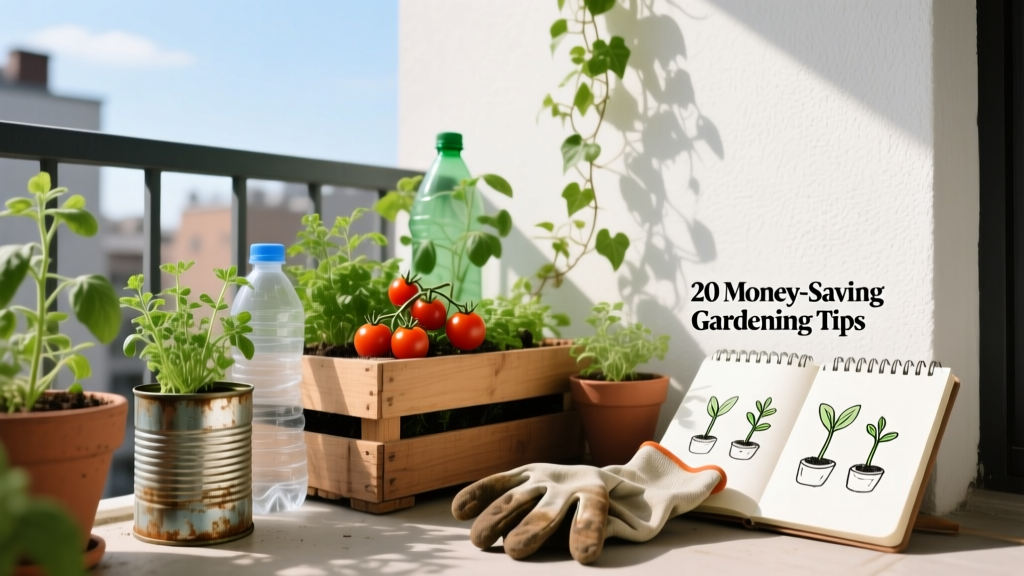
20 Money-Saving Gardening Tips
The fastest way to blow a garden budget isn’t buying a fancy tool—it’s buying the same inputs over and over because the system leaks. Most gardeners “solve” problems with bags (bagged soil, bagged fertilizer, bagged mulch), when the cheaper long-term fix is usually a habit: save seed, make compost, water smarter, and match plants to your site. A few small changes can turn a $40-per-season habit into a $5-per-season routine.
To keep this practical, each tip below is something you can do this weekend, with real numbers and examples from real gardens—not vague “do better” advice.
Start with soil and reduce repeat spending
1) Stop buying “garden soil” for raised beds—build a long-lasting mix
Bagged “raised bed soil” is convenient, but it’s one of the priciest ways to fill volume. For new beds, use a simple bulk blend: 50% screened topsoil + 30% compost + 20% aeration (pine fines, coarse sand, or perlite). Buying in bulk often drops cost from roughly $8–$12 per 1.5 cu ft bag to about $35–$60 per cubic yard delivered (1 cubic yard = 27 cu ft), depending on your area.
Example: Filling a 4' x 8' bed at 12" deep takes ~32 cu ft. That could be 22 bags at $9 each (~$198) versus just over 1 cubic yard bulk at $55–$75.
2) Compost the “expensive stuff” first (kitchen scraps + leaves)
Compost is the input you’ll use every year, so make it the one you stop buying. Aim for a 2:1 volume ratio of “browns” (dry leaves, shredded paper) to “greens” (kitchen scraps, fresh weeds) for steady breakdown and fewer smells. Keep the pile about 3' x 3' x 3' to hold heat; turn it every 2–3 weeks for faster finishing.
Scenario: A suburban family saving fall leaves (10–20 bags’ worth) can produce enough compost to top-dress two raised beds and several containers, replacing $60–$150 in bagged compost each season.
3) Use a cheap mulch rule: 2–4 inches, but never against stems
Mulch is weed control and moisture insurance—both save money. Apply 2–4 inches of shredded leaves, wood chips, or straw, keeping a 2–3 inch gap around plant stems to prevent rot. The payoff is fewer weeds (less time and fewer herbicides) and less watering, especially in heat.
Example: A free pile of municipal wood chips can cover a 10' x 20' garden at 3" deep with roughly 1.5–2 cubic yards—often delivered free by local tree crews.
4) Skip “weed fabric” under beds—use cardboard sheet mulch instead
Landscape fabric often fails by year two: weeds root on top, and the fabric tears when you pull them. Cardboard is free, blocks light immediately, and breaks down into soil. Lay overlapping cardboard (6" overlap), wet it thoroughly, then top with 3–4 inches of mulch or compost.
Example: For a new 4' x 12' bed, a few shipping boxes plus a wheelbarrow of chips can replace a $25–$40 roll of fabric and the frustration later.
5) Get a soil test before buying fertilizer (seriously)
Guessing nutrients is like buying paint before measuring the room: you’ll overspend and still get poor results. Many U.S. extension labs offer basic soil tests for about $10–$20, which can prevent wasted fertilizer and help you target what’s actually missing. The best part: you often discover you don’t need phosphorus at all, which saves money and reduces runoff risk.
Citation: University cooperative extension soil testing programs consistently recommend testing to guide lime and fertilizer rates (e.g., Penn State Extension, 2023).
Water smarter (and cheaper) without babying the garden
6) Install a $25 timer + soaker hoses to cut waste
Hand-watering is where money leaks: you water too little one day, too much the next, and plants swing between stress and rot. A basic hose timer (often $20–$35) plus soaker hoses or drip lines puts water at the soil surface, where it’s used. Run it early morning for 20–45 minutes, then adjust based on weather and soil type.
Example: One timer and two soaker hoses can cover a 4' x 8' bed and a 2' x 16' row for less than the cost of a single season of “rescue” plants you had to replace.
7) Use the “tuna can” method to calibrate sprinklers
Sprinklers are notorious for uneven coverage, which means you compensate by overwatering. Place 6–8 identical shallow containers (tuna cans or yogurt cups) around the spray zone, run the sprinkler for 20 minutes, then measure. If one area gets half as much, move the sprinkler or change the nozzle—don’t just water longer.
Example: If your goal is 1" per week and the cans show 1/2" after 20 minutes, you know you need 40 minutes total (or a better sprinkler layout) instead of guessing and wasting water.
8) Reuse household “gray water” selectively (and safely)
You can save water by using leftover dechlorinated aquarium water, cooled pasta water (unsalted), or water from rinsing produce. Apply it to ornamental beds or fruit trees rather than leafy greens, and avoid water with soaps or harsh cleaners. This is small-scale, but steady: a few gallons a week adds up over a dry summer.
Scenario: A container gardener saving 2 gallons/day of rinse water can redirect ~60 gallons/month—enough to keep several pots going without extra hose time.
9) Capture rain with the simplest setup: a barrel + screen
A rain barrel doesn’t have to be fancy. A food-grade barrel plus a screen to block mosquitoes can be a low-cost start; even one 55-gallon barrel can handle weeks of hand-watering for containers. Place it under a downspout and use a watering can; elevation helps, but it’s optional.
Example: If you water containers with 2 gallons/day, one full 55-gallon barrel covers about 27 days—longer if you mulch pots and group them in shade.
Plants: buy less, propagate more, and choose winners
10) Grow the pricey crops, buy the cheap ones
Not everything is worth garden space. Grow items that are expensive at the store (heirloom tomatoes, fresh herbs, specialty peppers) and buy the low-cost basics (onions, potatoes) when space is tight. This “value per square foot” mindset keeps you from wasting bed space on $1 crops.
Example: One indeterminate tomato can yield 10–20 lb in a season; at $3/lb for good tomatoes, that’s $30–$60 from one plant, versus a head of lettuce that might be $2–$3.
11) Take cuttings of “easy wins” instead of buying new plants
Many ornamentals and herbs root readily in water or damp potting mix: coleus, basil, mint (in pots), sweet potato vine, pothos for houseplants. Snip a 4–6 inch cutting below a node, remove lower leaves, and root it in water for 1–2 weeks or in moist mix under a loose plastic bag.
Example: Propagating six coleus cuttings can replace a $30 flat from the garden center.
12) Save seed from open-pollinated varieties (skip hybrids for saving)
Seed saving is a long game that gets cheaper every year. Start with the easiest: beans, peas, lettuce, and many tomatoes (open-pollinated varieties). Let pods dry on the plant, or ferment tomato seeds for 2–3 days, then dry thoroughly before storing.
Example: A single lettuce plant allowed to bolt can produce hundreds of seeds—enough for years—for the cost of one original packet.
13) Buy small perennials, not large pots (they catch up faster than you think)
A 1-gallon shrub looks impressive, but smaller sizes establish quickly and often outgrow the “instant” plant within a year or two. Buy perennials in 4-inch or quart pots, plant in spring or early fall, and mulch well. You’ll usually pay half (or less) compared to gallon-sized plants.
Example: If a 1-gallon perennial is $18 and a 4-inch pot is $7, planting six perennials saves $66 upfront.
14) Split perennials every 2–3 years to get free plants
Hostas, daylilies, ornamental grasses, bee balm, yarrow—many clump-formers beg to be divided. Dig in early spring or early fall, slice the clump with a spade into halves or quarters, and replant immediately with water. You get more plants and better flowering because crowded roots perform poorly.
Scenario: One overgrown daylily clump can become 4–6 plants, enough to edge a walkway without buying a single new plant.
Fertilizer and amendments: spend where it matters
15) Use targeted DIY fertilizer: compost tea for transplants, not as a cure-all
You don’t need expensive bottled “boosters” for everything. For transplant recovery, a mild compost steep (not a stinky brew) can help: mix 1 part finished compost to 5 parts water, stir, sit 12–24 hours, then water at the base. Use it once at planting and again a week later; don’t replace proper soil fertility with tea.
Example: Using compost you already made beats buying a $15 bottle that mostly ships water.
16) Use the right lime or sulfur only when a soil test calls for it
pH fixes are where people waste money fast. If your soil test recommends lime, use the specific type and rate (often given as pounds per 1,000 sq ft). Over-liming can lock out nutrients and create new problems you’ll “solve” by buying more fertilizer.
Citation: Soil pH adjustment and lime recommendations are commonly provided through extension testing guidance (e.g., Clemson Cooperative Extension, 2021).
17) Switch from routine feeding to “plant tells you” feeding in containers
Containers leach nutrients faster, but that doesn’t mean constant fertilizing. Use slow-release fertilizer at label rate once (usually lasting 8–12 weeks) and then watch: pale new growth and weak flowering are better cues than the calendar. This prevents the common pattern of weekly liquid feeds that burn plants and force replacements.
Example: One $12 container slow-release tub can cover multiple pots for a season, replacing several $8 bottles of liquid feed.
Tools and materials: buy once, improvise often
18) Make a DIY soil sifter and stop buying “fine compost”
If you like seed-starting or top-dressing, sift your own compost. Screw 1/2-inch hardware cloth to a simple 2x4 frame and shake compost through into a bin. You get fluffy, uniform material without paying extra for “screened” bags.
Example: A small sheet of hardware cloth and scrap wood can cost under $20–$30, and it pays back quickly if you’d otherwise buy $8 bags of screened compost.
19) Use a sharp hoe at the right time: “white thread” weeds only
Weeding is cheapest when weeds are tiny. The trick is timing: hoe when weeds are in the “white thread” stage (just germinated) and the soil surface is dry, so uprooted weeds desiccate. Ten minutes twice a week beats a 2-hour knee session and keeps you from buying weed controls out of frustration.
Example: A stirrup hoe used on a sunny afternoon can clear a 50 sq ft bed in minutes if you catch weeds early.
20) Borrow and share the rarely-used tools (and track them)
Many tools are “once a year” purchases: post-hole diggers, thatching rakes, bulb augers, large loppers. Start a neighborhood tool shelf or a simple check-out list with painter’s tape labels. It’s the easiest way to avoid spending $40–$120 on something that will sit 360 days a year.
Scenario: Three neighbors sharing a $90 pole pruner saves $180 immediately, and everyone gets cleaner cuts when the tool stays sharp and maintained.
Quick comparison: where DIY beats store-bought
| Garden Need | Store-Bought Approach | DIY / Low-Cost Approach | Typical Savings |
|---|---|---|---|
| Mulch | Bagged mulch at ~$4–$6 per bag | Shredded leaves or free arborist wood chips | $40–$150 per season (medium garden) |
| Raised bed fill | Bagged “raised bed soil” | Bulk topsoil/compost blend (50/30/20) | $100+ per bed (common) |
| Plants | Buying annuals each spring | Cuttings + dividing perennials | $30–$200 per season |
| Weed barrier | Landscape fabric roll | Cardboard + 3–4" mulch | $25–$60 plus less frustration |
“The best time to control weeds is when they are small.” — University of California Agriculture and Natural Resources (UC ANR), Integrated Weed Management guidance (2018)
Three real-world money-saving setups (steal these)
Setup #1: The “Two-Bed, No-Buy Compost” plan. A family with two 4' x 8' beds stops buying bagged compost by composting kitchen scraps + fall leaves. They top-dress each bed with 1 inch compost in spring (about 5.3 cu ft per bed), mulch with shredded leaves, and only buy a soil test every couple of years.
Setup #2: The “Container patio on a timer.” A renter with 10 containers adds one hose timer and a simple drip/soaker layout. They mulch pot tops with 1 inch of shredded leaves, use one slow-release feeding, and propagate basil and coleus from cuttings instead of buying replacements.
Setup #3: The “Front-yard perennial expansion” strategy. A homeowner buys small starter perennials (4-inch pots), plants them in early fall, and divides after 2–3 years. They fill gaps with divisions and only buy one or two “feature plants” each season, instead of redoing beds with mature plants every spring.
If you want the biggest bang for your effort, start with three habits: soil test once, mulch everything with something free, and propagate one plant you already love. A garden that feeds itself—even partially—will always beat a garden that depends on weekly shopping trips.