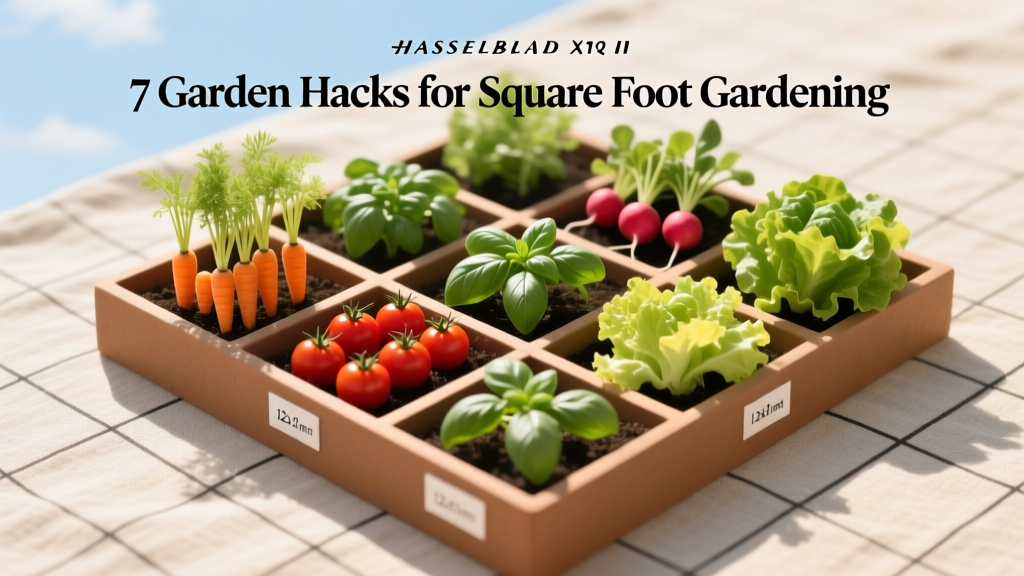
7 Garden Hacks for Square Foot Gardening
Most square foot gardens don’t fail because the gardener “doesn’t have a green thumb.” They fail because the grid looks tidy, but the math is off: too many plants per square, too little soil depth, and watering that never reaches the roots. A 4x4 bed can be wildly productive, but only if you treat each square like a tiny field with its own spacing, moisture, and nutrient plan.
Below are seven hacks I’ve seen save time, boost yields, and prevent the classic square-foot headaches (stunted carrots, bitter lettuce, tomatoes that topple, and soil that turns into a brick by July).
Group 1: Build the bed right so everything else gets easier
1) Make your grid permanent (and weatherproof) so spacing stays honest
Hack: Skip flimsy string grids that sag after the first watering. Build a permanent 12-inch grid using 1/2-inch PVC, cedar lattice strips, or even old yardsticks screwed to the frame, so every square stays exactly 12" x 12" all season.
This matters because spacing errors compound fast: one extra tomato in a square can shade 4–6 neighboring squares and tank your harvest. A permanent grid also lets you plan crop rotation square-by-square instead of guessing where you planted last month.
Real-world example: In a 4x8 bed (32 squares), a permanent grid makes it easy to keep “leafy greens” to 1–2 squares at a time while reserving 6 squares for summer crops—no crowding, no midseason reshuffle.
2) Use the “6-inch rule” for the frame, “12-inch rule” for the soil
Hack: Build the frame at least 6" tall, but fill most vegetable beds to 10–12" of growing mix (especially for carrots, beets, parsnips, and potatoes). Shallow beds are the #1 reason root crops fork, stall, or turn woody.
If you’re trying to save money, don’t skimp on depth—cut cost by filling the bottom 2–3" with finished compost or leaf mold, then top with your lighter, more expensive mix. The goal is a full 10–12" of workable texture, not just “something that looks like soil.”
Case scenario: A renter in Phoenix used two 2x4 beds at 6" deep and couldn’t grow decent carrots; switching to 12" (same footprint) turned “pencil carrots” into full-size roots in the next cool season.
3) Pre-load fertility with a simple “compost cup” system (cheaper than constant fertilizer)
Hack: Treat each square like a small container: before planting, mix in 1–2 cups of finished compost per square (that’s roughly 0.5–1 gallon). For heavy feeders (tomatoes, squash, peppers), add an extra cup at transplant time.
This keeps nutrients where the roots will actually grow, instead of broadcasting fertilizer across the whole bed. Research consistently supports compost as a soil builder; for example, USDA NRCS notes compost improves soil structure and water-holding capacity while supplying nutrients (USDA NRCS, 2020).
Money saver: A 40-lb bag of organic granular fertilizer can run $25–$40; making or buying bulk compost often costs less per season for a small bed. If you buy compost, a 1-cubic-foot bag typically covers about 7–8 squares at ~1–2 cups per square, depending on how generous you are.
Group 2: Planting shortcuts that prevent crowding and waste
4) Use “micro-blocks” inside each square for fast, accurate spacing
Hack: Instead of eyeballing 4, 9, or 16 plants per square, mark tiny sub-grids. Press a 12" ruler into the soil to make 3" or 4" divisions, or use a quick DIY “dibble board”: a scrap of wood with pegs spaced 3" apart.
This speeds planting and prevents the common mistake of clustering seeds in the center, which forces thinning and wastes seed. It also helps you hit the classic square-foot spacing targets: 16 radishes (3" spacing), 9 spinach (4"), 4 lettuces (6"), or 1 pepper (12").
Real-world example: In a school garden, kids planted 16 carrots in one square without a sub-grid and ended up with a tangled clump; with a 3" pegboard the next week, germination stayed evenly spaced and thinning was minimal.
5) Pair crops by “height + harvest time,” not just companion-plant lore
Hack: In square foot gardening, your best “companion planting” is strategic timing. Put slow, tall crops on the north side of the bed (tomatoes, pole beans on a trellis), and tuck quick crops into the sunny edges (radishes, arugula) that will be harvested before shading becomes an issue.
For example, sow 16 radishes in a square beside a tomato transplant: the radishes are usually ready in 25–35 days, long before the tomato casts serious shade. This keeps every square earning its keep instead of sitting empty while you wait for one plant to grow up.
Case scenario: A busy gardener in Ohio staggered their bed so spring squares held spinach and radishes first; by early June, those squares flipped to basil and bush beans. Same bed, two waves of harvest, zero “blank squares.”
Group 3: Watering and weed control that actually works in a 12-inch system
6) Install a $15 “gravity drip” so each square gets deep watering without babysitting
Hack: Square foot beds are dense, so overhead watering can leave dry pockets. A simple gravity drip setup—5-gallon bucket on a stand + 1/2" main line + 1/4" drip lines—can wet the root zone evenly without a faucet timer. Set the bucket 2–3 feet high, poke a small outlet hole, and let it slowly drip for 30–60 minutes.
Deep, less-frequent watering encourages deeper roots and reduces leaf disease compared to frequent splashing. University of Minnesota Extension notes that drip irrigation can reduce foliar diseases by keeping leaves dry and delivering water directly to the soil (University of Minnesota Extension, 2022).
Cost reality: A basic gravity kit can be cobbled together for ~$15–$30 (bucket often free), while a full faucet-timer drip system can run $60–$150. If you’re growing in 1–2 small beds, gravity is plenty.
DIY alternative: No tubing? Use buried “olla-style” watering: sink a porous terra cotta pot (or a DIY version using unglazed clay) in a corner of 4 squares; refill every 2–4 days in hot weather and let the soil sip moisture gradually.
7) Mulch like a square-foot gardener: a 1-inch compost blanket + targeted covers
Hack: Skip thick, messy mulch everywhere. Instead, apply a 1" layer of finished compost as a “living blanket” across open soil, then use targeted mulch (straw or shredded leaves) only under sprawling plants like squash or cucumbers.
This keeps squares tidy for succession planting and makes weeding almost laughably easy—most weeds pull out with two fingers when compost stays loose. It also protects soil moisture; fewer dry cycles means fewer cracked radishes and less bitter lettuce.
Real-world example: In a coastal California bed that dried fast in afternoon wind, a 1" compost blanket reduced watering from daily to every 2–3 days for greens, without changing the irrigation setup.
Tools and material choices that save money (and headaches)
Square foot gardening can get pricey if you buy everything “garden brand.” Here’s a quick comparison that reflects what I see most gardeners actually do.
| Need | Common “Garden Store” Option | DIY / Budget Option | What I’d pick (and why) |
|---|---|---|---|
| Grid | String grid ($5–$10) that sags | 1/2" PVC grid ($10–$20) or cedar lattice ($15–$30) | PVC if you want cheap + long-lasting; cedar if you want it pretty |
| Watering | Timer + drip kit ($60–$150) | Gravity drip ($15–$30) or olla pot ($8–$25) | Gravity drip for 1–2 beds; timer system if you travel often |
| Soil booster | Bagged “raised bed mix” only ($8–$12 per cu ft) | Bulk compost + aeration (perlite/pumice) blended at home | Blend your own if you have a truck or can split a bulk delivery with a neighbor |
| Plant labels | Plastic tags ($4–$10 per pack) | Cut-up yogurt lids or blinds + pencil | DIY labels—because you’ll replace them every season anyway |
“Drip irrigation applies water slowly and directly to the soil, improving water efficiency and reducing many foliar diseases compared to overhead watering.” — University of Minnesota Extension (2022)
Three common square-foot scenarios (and how these hacks fix them)
Scenario A: “My lettuce bolts fast and tastes bitter.”
Most of the time it’s heat + inconsistent moisture. Use the gravity drip or an olla so the root zone stays evenly moist, and plant lettuce at 4 per square (6" spacing) so each plant has airflow. In warm weather, put lettuce squares on the east side of taller crops so they get morning sun and afternoon shade—same bed, better flavor.
Scenario B: “My carrots fork or stay tiny.”
This is usually shallow or clumpy soil. Go straight to the 10–12" depth rule, and use the micro-block hack to space seeds (don’t dump them). For a 12" square, aim for 16 carrots only if your mix is rock-free and fluffy; otherwise do 9 per square (4" spacing) and you’ll get bigger, straighter roots with less thinning.
Scenario C: “My tomatoes take over the whole bed.”
A single indeterminate tomato can shade 6–9 squares if it’s not trained. Put it on the north edge, commit one square per plant, and trellis vertically from day one. If you’re short on space, consider switching to a determinate or dwarf variety and keep basil in the neighboring square; you’ll harvest from both without turning the bed into a jungle.
Quick-reference planting math (so you don’t overstuff squares)
When you’re tempted to cram “just one more” plant in, remember: crowding doesn’t double your harvest—it often halves it. A few reliable spacing targets for a 12" square:
- 1 per square: tomato (trellised), pepper, eggplant, broccoli
- 4 per square (6" spacing): head lettuce, kale, chard
- 9 per square (4" spacing): spinach, beets, bush beans
- 16 per square (3" spacing): radishes, carrots (best in deep, fluffy mix)
If you’re unsure, plant fewer and feed better. One healthy pepper in a square routinely outperforms two stressed peppers fighting for light and nutrients.
A few last insider moves that tie everything together
Label squares like a map. Instead of labeling plants, label the grid: A1–D4 for a 4x4 bed. It makes rotation and notes simple (“B3: spinach bolted at day 42”). A pencil on a scrap of vinyl blind lasts longer than marker in the sun and costs basically nothing.
Batch your succession planting. Put a repeating reminder on your phone every 14 days during your main season: re-sow one square of radish, one square of greens, one square of herbs. That small rhythm prevents the feast-or-famine harvest cycle that makes people “give up” midseason.
Don’t overcomplicate amendments. Compost + consistent moisture + correct spacing solves most square-foot problems. If you want one extra boost for fruiting crops, add a small handful (about 1–2 tablespoons) of a balanced organic fertilizer in the transplant hole and water it in well.
Square foot gardening shines when each square has a job, a plan, and a realistic amount of root space. Lock in a permanent grid, give plants true depth, feed with compost by the cup, and use a simple drip method that doesn’t demand daily attention. Once those pieces click, your “small” bed starts producing like it’s twice the size—without you working twice as hard.
Sources: USDA Natural Resources Conservation Service (NRCS), “Composting” (2020); University of Minnesota Extension, “Drip Irrigation in Home Gardens” (2022).