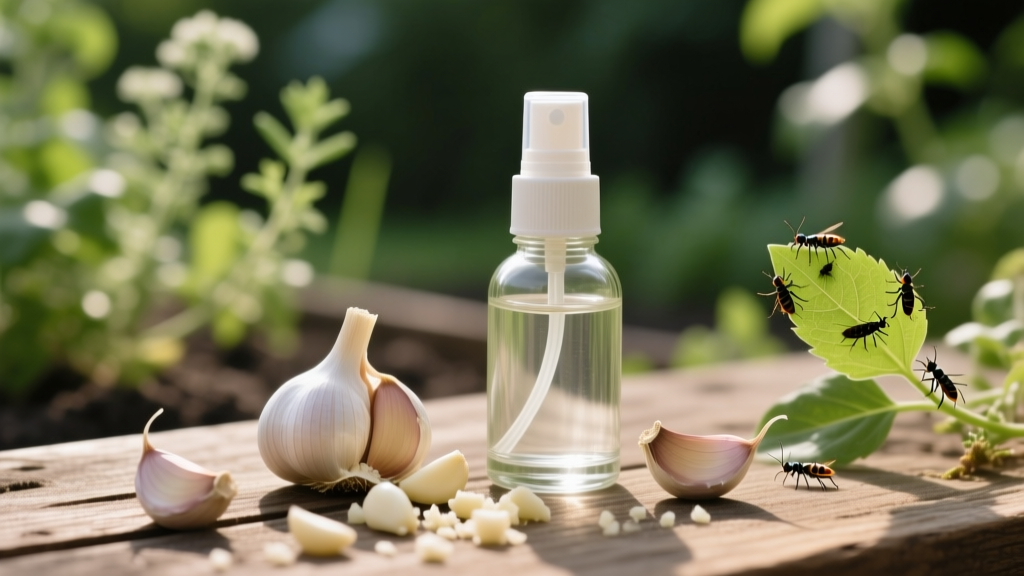
Garlic Spray for Deterring Garden Pests
The biggest mistake people make with garlic spray is treating it like a “set it and forget it” potion. It isn’t. Garlic works best as a behavior changer—a strong smell and taste cue that nudges pests to feed somewhere else—so timing, coverage, and reapplication matter more than making it painfully concentrated.
Done right, garlic spray is one of the cheapest, most flexible tools you can keep in your garden toolkit: it’s quick to mix, easy to adjust per crop, and surprisingly effective for soft-bodied pests and nibblers when you spray proactively. Done wrong, it can burn tender leaves, repel pollinators you want, or simply wash off before it does anything useful.
Get the Mix Right (So It Works and Doesn’t Fry Your Plants)
Tip: Start with a “1 bulb per quart” baseline
A reliable starting recipe is 1 whole garlic bulb (about 8–12 cloves) blended with 1 quart (4 cups) of water, strained, then diluted before use. This concentration is strong enough to deter many pests without instantly scorching leaves. If you’re spraying delicate crops (peas, lettuce, seedlings), dilute it 1:1 with water the first time.
Example: For a small raised bed, I’ll blend 1 bulb with 1 quart, strain, then add another quart of water—giving me 2 quarts of spray that covers both sides of leaves on about 40–60 square feet depending on plant density.
Tip: Add soap the right way (and don’t overdo it)
Garlic spray needs help sticking to waxy leaves. Add 1/2 teaspoon of mild liquid soap per quart (or 2 teaspoons per gallon) to act as a surfactant. More soap isn’t better—heavy soap mixes can strip leaf cuticles and cause spotting, especially in hot sun.
Example: If you’re battling aphids on kale, that tiny amount of soap helps the spray coat the colonies instead of beading and rolling off.
Tip: Cold-steep for 12–24 hours when you want maximum punch
If your spray seems weak, don’t automatically increase garlic—extend extraction time. A cold steep of 12–24 hours after blending pulls more sulfur compounds into the water without “cooking” the mix, which can dull the smell. Keep it in a jar in the fridge, then strain before using.
Example: When flea beetles show up fast in spring, a 24-hour steeped batch is noticeably stinkier and tends to push them off arugula and radishes quicker than a freshly blended-and-sprayed batch.
Tip: Strain like you mean it (or your sprayer will clog)
Clogged nozzles are the #1 reason people quit using DIY sprays. Strain through a fine mesh sieve, then again through a coffee filter or a double layer of cheesecloth. It takes an extra 3 minutes and saves you from scraping garlic paste out of a trigger sprayer at dusk.
Example: If you use a pump sprayer, a final coffee-filter strain can be the difference between a smooth fan spray and a sputter that drips garlic chunks onto your basil.
Apply It Like a Pro (Timing and Coverage Beat “More Garlic”)
Tip: Spray at dusk to protect leaves and pollinators
Apply in the evening when temperatures drop below about 80°F. This lowers the chance of leaf burn and avoids directly spraying active pollinators. Bonus: garlic odor hangs longer overnight, when many pests feed.
Example: On zucchini, I spray the undersides of leaves at dusk; by morning, cucumber beetles are often less active on treated plants.
Tip: Hit the undersides—most pests live there
Spraying the top of leaves only is like locking your front door and leaving the back wide open. Aphids, whiteflies, mites, and many eggs cluster under leaves where humidity is higher and predators can’t easily reach. Tilt leaves up and spray until the underside looks evenly misted, not dripping.
Example: On tomatoes, a quick underside pass on the lower 12–18 inches of foliage can reduce early whitefly pressure before it explodes.
Tip: Reapply on a schedule (and after rain)
Garlic spray isn’t systemic; it doesn’t stay active forever. Reapply every 5–7 days during active pest periods, and always after 1/2 inch or more of rain or any overhead watering that rinses leaves. If pests are already heavy, spray every 3 days for the first week to regain control.
Example: After a summer thunderstorm, a single “catch-up” spray the next evening can keep flea beetles from reinvading eggplant.
Tip: Test a small patch first—especially on tender crops
Even gentle mixes can spot leaves under certain conditions (heat, drought stress, or sensitive varieties). Spray one plant or a few leaves, wait 24 hours, and check for curling or burn. If you see damage, dilute your mix another 25–50% and spray at dusk only.
Example: Some basil varieties are drama queens—testing first prevents you from turning your pesto patch into speckled confetti.
Target the Right Pests (Garlic Is Great… for Some Things)
Tip: Use garlic spray for soft-bodied pests and “nibblers”
Garlic spray is most dependable for deterring aphids, whiteflies, spider mites (light pressure), flea beetles, and cabbage loopers when used early and consistently. It’s less reliable for hard-shelled beetles once they’re established, and it won’t solve soil-dwelling issues like cutworms by itself.
Example: If you see aphids starting on roses, an evening spray followed by another in 3–4 days can keep colonies from building to the point where leaves curl and ants move in.
Tip: Pair garlic with hand-picking for big pests
For hornworms, squash bugs, or Japanese beetles, think of garlic spray as support—not the main event. Hand-pick in the morning, then spray foliage that evening to discourage return feeding. This one-two punch is faster than spraying daily and hoping for a miracle.
Example: In a small tomato patch, removing 6–10 hornworms by hand does more immediate good than any spray; garlic helps keep the plants less “inviting” afterward.
Tip: For fungal issues, don’t assume garlic is a fungicide
Garlic has documented antimicrobial properties, but garden results against fungal diseases can be inconsistent. If you’re dealing with powdery mildew or blight, use garlic spray only as a minor add-on to proven steps like airflow, pruning, and targeted products labeled for disease control. University extension resources generally emphasize that home remedies vary widely in reliability.
Example: If powdery mildew hits cucumbers, garlic spray may reduce leaf-chewing pests that worsen stress, but you’ll still need to improve airflow and consider sulfur or potassium bicarbonate where appropriate.
Make It Cheaper, Easier, and Less Stinky (Without Losing Results)
Tip: Use garlic powder in a pinch (fast, consistent, not as strong)
No fresh garlic? Mix 1 tablespoon garlic powder per quart of warm water, let sit 30 minutes, strain, then add soap. It’s not as pungent as fresh cloves, but it’s quick and surprisingly decent for light pest pressure.
Example: When aphids pop up suddenly and the store is out of decent garlic, powder keeps you from losing a week while pests multiply.
Tip: Freeze garlic “spray cubes” for grab-and-go batches
Blend a bulk batch (for example, 4 bulbs with 1 gallon of water), strain well, then freeze in ice cube trays. Drop 2–4 cubes into a quart of water, add soap, and spray. This turns a messy prep into a 2-minute job.
Example: If you garden after work, frozen cubes mean you’ll actually keep up with the 5–7 day schedule instead of skipping sprays because you’re tired.
Tip: Cost it out—DIY is usually pennies per quart
Let’s do real numbers. If garlic costs about $0.60–$1.00 per bulb, a 1-bulb-per-quart concentrate comes out to roughly $0.60–$1.00 per quart before dilution; diluted 1:1, that’s $0.30–$0.50 per quart. Compare that to many ready-to-spray repellents at $10–$18 per bottle—DIY adds up fast over a season.
Example: Spraying weekly for 10 weeks could cost you roughly $3–$5 DIY versus $30–$60 in store-bought sprays, depending on coverage.
Choose Your Formula: Garlic Alone vs Garlic + Friends
| Mix | Best For | Typical Ratio | Smell Level | Notes |
|---|---|---|---|---|
| Garlic + water + mild soap | General deterrence; aphids/whiteflies light-to-medium | 1 bulb : 1 quart + 1/2 tsp soap | High | Great baseline; test on tender leaves |
| Garlic + hot pepper (capsaicin) | Leaf-chewing pests; rabbits sometimes | 1 bulb + 1 tsp cayenne : 1 quart | Very high | Wear gloves; don’t spray near eyes or on windy days |
| Garlic powder quick-mix | Emergency batches; light pressure | 1 Tbsp powder : 1 quart | Medium | Less potent; convenient |
| Commercial garlic-based repellent | Large gardens; consistent batches | Follow label (often 2–4 Tbsp/gal) | Medium–High | Costs more; usually better filtration and shelf life |
Three Real-World Scenarios (What I’d Do, Step by Step)
Scenario: Aphids on kale in a raised bed
Start with the baseline mix and spray at dusk, focusing on the undersides of the newest leaves where aphids cluster. Repeat in 3 days, then move to a weekly schedule once you see fewer clusters. If ants are “farming” the aphids, disrupt them too (a sticky barrier on bed legs or a quick ant bait station nearby), or the aphids often rebound.
Example: One gardener I worked with reduced aphid pressure in a 4x8 bed by combining two dusk sprays in the first week with a strong hose rinse in the morning—garlic spray kept recolonization down.
Scenario: Flea beetles shredding arugula and radishes
Flea beetles move fast, so you need a routine. Spray every 5 days from the moment seedlings have true leaves, and pair it with a lightweight row cover for the first 2–3 weeks if pressure is heavy. Garlic spray helps once you remove the cover too, especially if beetles are coming from weedy edges.
Example: In spring, spraying at dusk and keeping a row cover on until plants hit 4–6 inches tall often turns “lace leaf” arugula into harvestable greens.
Scenario: Cucumber beetles on young squash
Hand-pick adults early in the morning, then spray garlic that evening to make plants less appealing. Reapply after rain and consider adding 1 teaspoon cayenne per quart if leaf chewing continues (avoid overspray on flowers). If you’re seeing bacterial wilt risk in your area, garlic is a deterrent tool—not a guarantee—so combine it with row covers early season and remove covers at flowering.
Example: On a backyard patio garden, consistent dusk sprays plus morning hand-picking kept beetle damage low enough that plants grew past the “fragile” stage within 10–14 days.
Safety, Plant Sensitivity, and Don’t-Do-This Mistakes
Tip: Don’t spray open blossoms
Garlic odor can discourage pollinators from visiting flowers, and you don’t want residues where bees are working. Aim your nozzle at leaves, not blooms, and spray after pollinator activity slows. If you must treat a flowering plant, spray only foliage away from the flower clusters.
Example: On cucumbers, I spray the big leaves and skip the flowers entirely—fruit set stays more consistent.
Tip: Avoid spraying during heat, drought stress, or full sun
Any foliar spray can increase leaf spotting when plants are stressed. If plants are wilting by midday or temperatures are climbing, wait until evening and water the soil (not the leaves) earlier in the day. If a heatwave is pushing 90°F+, consider pausing sprays and using physical barriers like row cover or insect netting instead.
Example: Lettuce in summer is already on the edge—garlic spray at noon is a fast way to get bitter, speckled leaves.
Tip: Store it cold and toss it quickly
Homemade garlic spray can ferment and stink in a bad way. Store strained concentrate in the fridge and use within 3–5 days; if it smells sour or yeasty, dump it. Freezing in cubes is the easiest way to avoid wasted batches.
Example: If you leave a jar in the shed for a week, you’ll get a science project—not a reliable repellent.
What Research and Extension Folks Actually Say (And How to Use That)
University and expert sources generally place garlic-based sprays in the “repellent/short-lived contact” category: helpful in an integrated approach, not a silver bullet. For example, Cornell University’s Integrated Pest Management resources note that homemade botanical sprays vary in effectiveness and should be tested carefully on plants, with attention to potential phytotoxicity (Cornell Cooperative Extension, 2020). Likewise, UC Agriculture and Natural Resources emphasizes that soaps and botanicals require thorough coverage and repeat applications, and results depend heavily on timing and pest type (UC ANR, 2019).
“Home-made sprays made from garlic, peppers, or other household ingredients are not consistently effective, and they may injure plants. If you try them, test on a small area first and use only as part of an integrated approach.”
— Guidance commonly echoed across university IPM and extension materials
On the “why garlic might work” side, garlic’s sulfur-containing compounds (like allicin and related breakdown products) are widely documented for biological activity, which is why garlic extracts are studied in pest management contexts. The practical gardener takeaway is simple: keep concentrations reasonable, apply at the right time, and treat it as a repeatable routine, not a one-time blast.
DIY Alternatives When Garlic Isn’t Cutting It
Tip: Use insecticidal soap for heavy aphids (save garlic for prevention)
If aphids are already thick and leaves are curling, garlic alone may be too gentle. A labeled insecticidal soap can knock populations down faster; then you can switch to garlic weekly as a deterrent. This combo often costs less than repeated “stronger and stronger” DIY experiments.
Example: One $10 bottle of concentrate can make multiple gallons; use it once to reset aphids, then maintain with garlic every 7 days.
Tip: Row cover is the cheapest “spray” you’ll ever use
For flea beetles, cabbage moths, and early cucumber beetles, physical exclusion beats any spray. A basic floating row cover can cost $10–$20 and last multiple seasons if stored dry. Use garlic spray at the edges and after you remove the cover to reduce re-infestation.
Example: Covering brassicas for the first 4 weeks often prevents the first big wave of pests—garlic becomes backup instead of your only defense.
Tip: Neem-based products are stronger—but more finicky
Neem can work well for certain pests, but it’s more temperature-sensitive, can affect beneficial insects if misused, and must be applied carefully per label. Garlic spray is usually safer for quick, frequent use—especially when you’re spraying edible greens close to harvest (still wash produce, of course). If you choose neem, rotate approaches rather than spraying the same thing weekly for months.
Example: Use garlic most weeks, and reserve neem for a targeted outbreak window, then stop once the pressure drops.
Garlic spray shines when you treat it like brushing your teeth: small effort, done consistently, prevents bigger problems. Keep a baseline recipe you trust, spray at dusk, cover undersides, and reapply every 5–7 days (and after rain). Once you’ve got that rhythm, you’ll be surprised how often pests pick the neighbor’s plants instead of yours.
Sources: Cornell Cooperative Extension / Cornell IPM guidance on home remedies and plant-safe testing (2020); University of California Agriculture and Natural Resources (UC ANR) pest management guidance on soaps/botanicals and the importance of coverage and repeat application (2019).