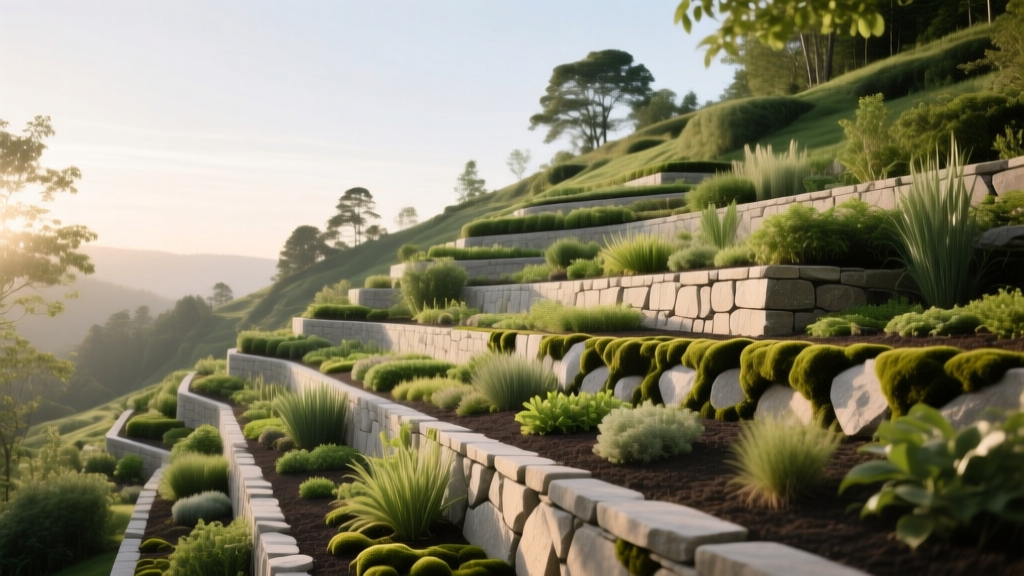
How to Build a Garden on a Slope Without Erosion
The most expensive “feature” in a sloped garden is the one you didn’t plan for: runoff. A single hard rain can peel off a surprising amount of topsoil—sometimes you’ll see the evidence as muddy water at the bottom and bare patches up top—and once the good stuff is gone, you’re basically gardening in subsoil. The common mistake is jumping straight to plants or pretty stonework without first deciding where water should slow down, soak in, and safely overflow.
If you set the slope up to manage water first, everything else becomes easier: fewer weeds, less irrigation, cleaner paths, and plants that don’t wash out. Below are proven, field-tested ways to garden on an incline without watching your soil migrate downhill.
Start With Water: The “Slow, Spread, Sink” Setup
Tip: Measure your slope before you buy anything
You don’t need a fancy transit to get useful numbers. Pound two stakes 10 feet apart, stretch a string level between them, then measure the vertical drop from the string to the downhill stake. A 1-foot drop over 10 feet is a 10% slope (roughly 6°), which helps you choose between light-duty fixes (mulch + groundcovers) and structural ones (terraces/retaining).
Example: If your yard drops 18 inches over 10 feet (15% slope), you’re in “plan for steps/terraces” territory for veggie beds—otherwise you’ll fight sliding soil all season.
Tip: Build one “safe overflow route” on purpose
Sloped gardens fail when water has no planned exit and starts cutting its own channel. Pick a route for overflow—often along a path edge or a rock-lined swale—and armor it with 2–4 inches of river rock or a strip of tough groundcover. Give water a predictable lane so it doesn’t carve through your planting beds.
Example: A 12-inch-wide rock-lined strip down one side of a slope can save you from the random gullies that form after a thunderstorm.
Tip: Use contour lines, not up-and-down rows
Any line that runs straight downhill becomes a water slide. Lay beds, borders, logs, and edging on contour (perpendicular to the slope) so they act like mini speed bumps that slow runoff. Even a gentle “smile curve” is better than a straight downhill channel.
Example: Planting strawberries in curved contour bands (instead of vertical rows) dramatically reduces soil splashing onto fruit and keeps crowns from washing loose.
Tip: Add infiltration with organic matter in the top 6 inches
Soils on slopes tend to crust and shed water, especially if they’re clay-heavy. Work in 1–2 inches of compost into the top 6 inches of soil where you’ll plant, and top with mulch (don’t skip the mulch). USDA NRCS notes that increasing soil organic matter improves aggregate stability and infiltration—two things that directly reduce erosion (USDA NRCS, 2020).
Example: On a compacted clay slope, mixing in 1 inch of compost plus a thick mulch layer often turns “runoff after 10 minutes” into “soaks in after 30 minutes.”
“Erosion control is really about managing runoff energy—slow it down, spread it out, and give it time to infiltrate.” — USDA Natural Resources Conservation Service (NRCS), 2020
Terraces, Steps, and Retaining: Choose the Right Structure (and Don’t Overbuild)
Tip: Pick the lightest structure that solves your problem
Not every slope needs a retaining wall. Under about 10% slope, you can often succeed with contour beds, mulch, and dense groundcovers. Around 10–25%, terraces or anchored beds become worth it; above that, you’re usually looking at engineered retaining, especially if you want flat veggie beds.
Example: A 12% slope can often be handled with 8–12 inch “mini-terraces” made from rot-resistant logs or stone edging—no heavy wall required.
Tip: Keep low retaining walls truly low (and cheaper)
Walls under 24 inches tall are easier, safer, and usually don’t require permits in many areas (always check locally). For a DIY garden terrace, multiple short walls beat one tall wall—less pressure, less risk, and easier drainage. Budget-wise, low segmental block walls often run roughly $15–$30 per square foot installed, while DIY stacked stone or reclaimed concrete can cut that significantly if you source locally.
Example: Three 16-inch terraces often cost less and outperform one 48-inch wall because each terrace intercepts runoff and reduces soil movement.
Tip: Always include drainage behind any wall
A retaining wall fails from water pressure more than soil pressure. Add a 12-inch band of gravel behind the wall, plus a perforated drain pipe (4-inch is common) that daylight-outs at a safe spot. Backfill in layers and don’t cap drainage outlets—your wall should “weep,” not hold water like a bathtub.
Example: If you see water staining or bulging after rain, that’s a drainage problem; adding gravel + a perforated pipe is usually cheaper than rebuilding later.
Tip: Use “crib” or anchored log terraces for a budget build
If you want a rustic look and fast install, build a crib terrace: two parallel timbers with cross-ties pinned using 1/2-inch rebar. Line the inside with landscape fabric (only behind the timber, not under planting zones), fill with soil, and plant immediately. Cedar, black locust, or pressure-treated rated for ground contact will last longer; untreated pine will rot fast on a wet slope.
Example: A 10-foot terrace using two 10-foot timbers plus cross pieces can often be built in a weekend, and it’s forgiving if your slope isn’t perfectly uniform.
Soil Armor: Mulch, Mats, and Groundcovers That Actually Hold
Tip: Use the right mulch depth—and “tack” it so it doesn’t slide
On slopes, mulch is erosion control, not decoration. Apply 3 inches of shredded bark, wood chips, or leaf mulch; avoid round bark nuggets that roll downhill. To keep mulch from migrating, water it in thoroughly and “tack” it with a light layer of compost or fines (think a 1/4-inch dusting) so it knits together after the first rain.
Example: On a 15% slope, shredded hardwood at 3 inches stays put far better than 2 inches of nuggets—nuggets act like ball bearings.
Tip: Use biodegradable erosion-control blankets for bare soil windows
Any time you have bare soil—new beds, fresh grading, newly seeded areas—use a jute/coir blanket or straw erosion mat, pinned every 2–3 feet with landscape staples. These blankets reduce raindrop impact (a major erosion trigger) and buy you time until plants root in. University extension erosion resources consistently recommend temporary covers during establishment phases (University of Minnesota Extension, 2023).
Example: After installing a new terrace, pin a coir blanket over exposed soil for the first 6–10 weeks while groundcovers establish.
Tip: Plant “root net” groundcovers in a tight spacing
On slopes, the plant that wins is the one that makes a dense root mat. Space groundcovers closer than you would on flat ground—think 8–12 inches on center for fast knit-in—so rain hits leaves, not soil. Great options (depending on climate) include creeping thyme, sedum, ajuga, native grasses, and low shrubs with fibrous roots.
Example: Creeping thyme planted 10 inches apart can knit into a living mulch that protects soil while still letting you tuck in bulbs or small perennials.
Tip: Use “chop-and-drop” pruning as free erosion control
If you grow shrubs or vigorous perennials on a slope, don’t export all that biomass. Prune lightly in late spring and again in mid-summer, then drop the clippings right under the plant as a mini mulch layer. You get soil armor, moisture retention, and fewer trips to the green bin.
Example: A row of rosemary or lavender on a sunny slope can supply its own mulch—just chop lightly and let the trimmings settle into place.
Build Beds That Don’t Move: Edging, Anchors, and Smart Shapes
Tip: Make beds shallow and wide, not tall and narrow
Tall raised beds on a slope act like a loaded wheelbarrow—gravity wants to push the whole mass downhill. Instead, build “bench” beds: 6–10 inches tall and at least 3 feet wide, cut into the slope so the uphill side is partially excavated. This reduces the amount of soil that can slump and makes watering more even.
Example: For vegetables, a 4-foot-wide bench bed with a level top is easier to irrigate than a narrow box perched on uneven ground.
Tip: Add “check dams” inside long beds
If you have a long terrace or bed (say 20+ feet), break the internal flow with mini barriers every 6–8 feet: a short row of stones, a timber offcut, or a thick band of grass plugs. These act like speed bumps for any water that enters the bed, reducing the chance of a blowout at the low end.
Example: In a long herb bed, a line of fist-sized rocks every few feet keeps soil from slowly creeping downhill over the season.
Tip: Stabilize edges with living borders
Hard edging alone can undercut if water runs along it. Pair any physical border (stone, timber, steel) with a living edge—low grasses, sedges, or creeping groundcovers—so roots stitch the edge in place. This is especially helpful where foot traffic compresses soil and increases runoff.
Example: A steel-edged path with mondo grass (or a locally appropriate native sedge) along the inside edge holds better than steel alone after repeated rains.
Watering Without Washouts: Irrigation Tricks for Slopes
Tip: Use dripline with closer emitter spacing than flat gardens
Sprinklers on slopes often create runoff before water can infiltrate. Dripline (or soaker hose) applies water slowly, right where roots can grab it; on slopes, choose closer emitter spacing (like 6–12 inches) so you don’t get dry pockets uphill and soggy pockets downhill. Run shorter cycles—two 15-minute cycles instead of one 30-minute cycle—to reduce surface flow.
Example: If water starts appearing at the bottom after 10 minutes, cut your runtime in half and do a second pass later in the morning.
Tip: Water “uphill first” in the morning
It sounds small, but timing and sequence matter on slopes. Watering uphill zones first lets moisture start infiltrating there, reducing the chance that later watering pushes runoff downhill. Morning watering also reduces evaporation and gives leaves time to dry, which helps prevent disease.
Example: In a three-terrace garden, run the top zone first, then middle, then bottom—each for shorter bursts.
Tip: Add a simple catchment at the bottom (and plant it)
Even well-designed slopes have some overflow during big storms. Create a small “catch” area at the bottom—think a shallow basin 4–8 inches deep—planted with water-tolerant perennials or natives. This turns a problem puddle into a mini rain garden and keeps sediment from leaving your property.
Example: A 6-inch-deep basin planted with iris and rushes can catch muddy runoff and drop sediment before it reaches a sidewalk or driveway.
Quick Comparison: What Works Best for Your Slope?
| Method | Best for | Typical DIY cost | How fast it controls erosion | Main “gotcha” |
|---|---|---|---|---|
| Mulch + dense groundcover | Gentle slopes (<10–12%) and ornamental areas | $0.50–$2/sq ft (mulch varies) | Fast (days to weeks) | Mulch can slide if too chunky or too thin |
| Contour beds + mini check dams | Moderate slopes (10–20%) with mixed planting | $1–$5/sq ft | Fast (weeks) | Needs careful layout to avoid low-end blowouts |
| Terraces (multiple <24" walls) | Veggies and flats on 15–30% slopes | $10–$25/sq ft (materials vary) | Immediate once built | Drainage behind walls is non-negotiable |
| Erosion-control blanket + seeding | Newly disturbed soil, quick stabilization | $0.75–$3/sq ft | Immediate protection; roots stabilize in 6–10 weeks | Must be pinned well (every 2–3 ft) |
Three Real-World Scenarios (and Exactly What I’d Do)
Scenario 1: A rainy-climate backyard that turns into a muddy slip-n-slide
If you’re in a place with frequent downpours, your priority is intercepting runoff early and often. I’d install two or three shallow contour swales (even 4–6 inches deep) spaced 8–12 feet apart, then mulch everything at 3 inches with shredded chips. Plant a fast root-mat groundcover (like sedum or native grasses) at 10–12 inches on center, and protect any bare spots with a coir blanket for the first 6–10 weeks.
Money-saver: Many tree services will drop wood chips free or cheap; you might pay $0–$50 for delivery versus hundreds in bagged mulch.
Scenario 2: A sunny slope where you want a productive vegetable garden
Vegetables want level soil and consistent moisture, which is hard on a continuous slope. I’d build 2–4 bench terraces, each 4 feet wide, with low retaining (under 24 inches) and proper gravel + drain pipe behind any wall sections. Add dripline with 6–12 inch emitter spacing, and run two shorter cycles rather than one long one to prevent runoff.
Shortcut: If budget is tight, start with one “hero terrace” closest to your water source, get it stable for a season, then add the next terrace the following year.
Scenario 3: A front-yard slope where you need it to look good and stay low-maintenance
Front slopes fail when they’re fussy—too many thirsty plants and too much exposed soil between them. I’d use a simple pattern: repeating shrubs (spaced 3–5 feet apart depending on mature size), underplanted with a single tough groundcover at 10–12 inches on center. Mulch at 3 inches, edge beds on contour, and create one rock-lined overflow lane that looks intentional (a “dry creek” vibe) while quietly handling stormwater.
Example: A repeating drift of dwarf shrubs plus creeping thyme underneath can look designed, suppress weeds, and hold soil with almost no babysitting after the first season.
Extra Hacks That Save Your Back (and Your Budget)
Tip: Use rocks you already have as micro-terraces
You don’t need a perfect wall to slow erosion—small rock lines work surprisingly well. Place fist- to football-sized stones in a gentle arc on contour, partially buried so they don’t roll. Backfill upslope of the rocks with soil and mulch; these mini “sills” catch sediment that would otherwise move downhill.
Example: After one season, you’ll often see soil built up behind each rock line—proof it’s working.
Tip: Turn pruning waste into wattles (DIY erosion tubes)
If you have access to flexible branches (willow, dogwood, long shrub prunings), bundle them into 6–8 inch thick “wattles,” stake them on contour, and tuck mulch uphill of them. They function like store-bought straw wattles but cost basically nothing. Replace or reinforce as they break down over a year or two.
Example: After clearing an overgrown hedge, use the trimmings as two contour wattles instead of hauling everything away.
Tip: Don’t fight foot traffic—design it
People naturally walk the shortest path, and on slopes that becomes a dirt trench fast. Install steps or a switchback path early, even if it’s temporary: 12–18 inch deep step treads with gravel or flat stones reduce slipping and protect surrounding soil. Put the path where you already walk, not where you wish you’d walk.
Example: A simple switchback with three small landings often eliminates the single straight “scar trail” that turns into an erosion chute.
Planting Timing That Prevents Washouts
Tip: Plant right before the “reliable moisture window”
Establishment is the vulnerable phase: roots are small and soil is exposed. In many regions, early fall is ideal—soil is warm, rain returns, and plants root in with less irrigation. If you must plant in spring, cover all exposed soil immediately (mulch or blanket) and use drip irrigation so you’re not blasting soil loose.
Example: Plant groundcovers 4–6 weeks before your typical first frost so they can root before winter rains or snowmelt.
Tip: Seed slopes only if you can protect the seed
Broadcast seed on a slope and the first storm will rearrange it into the bottom corner. If you seed, rake lightly, then cover with a thin layer of straw and pin an erosion blanket over the top. University of Minnesota Extension (2023) emphasizes protecting bare soil during establishment to reduce erosion risk—this is where blankets pay for themselves.
Example: If you’re reseeding a patch, blanket it and staple every 2–3 feet; otherwise you’ll reseed again after the next heavy rain.
Common Slope-Garden Fails (and Quick Fixes)
Tip: If you see rills (tiny channels), patch immediately with “mulch + staple”
Those little rivulets are erosion starting to organize. Fill rills with compost, cover with shredded mulch, then pin a small piece of jute/coir blanket over the area like a bandage. Waiting turns rills into gullies, and gullies are a shovel-and-wheelbarrow project.
Example: After a storm, spend 20 minutes fixing two rills and you can save yourself a weekend of rebuilding later.
Tip: If mulch keeps sliding, switch materials and add a border
Sliding mulch usually means it’s too chunky, too thin, or the slope is steeper than you think. Switch to shredded mulch (not nuggets), increase to 3–4 inches, and add a subtle border on contour—rocks, a timber, or even a wattle—to physically catch it. This is often cheaper than buying netting products that can become a mess later.
Example: A single contour row of stones can stop a year’s worth of mulch migration in one afternoon.
Tip: If a terrace slumps, fix the drainage before you rebuild the face
A bulge or slump is often water pressure or saturated backfill. Before you re-stack blocks or stones, add gravel and a drain outlet, or you’ll repeat the failure. It’s painful to redo work, but correcting the cause is the difference between a permanent fix and an annual repair ritual.
Example: A 4-inch perforated pipe that daylight-outs can be a $30–$60 fix that prevents a $600 rebuild.
Sloped gardens don’t have to be fragile or high-maintenance. When you give water a plan (contours, overflows, infiltration), armor the soil (mulch, blankets, root mats), and only add as much structure as the slope truly needs, the whole system settles down. The best part is that once your slope is stable, you can finally spend your weekends planting fun stuff—rather than chasing your soil down the hill.
Sources: USDA Natural Resources Conservation Service (NRCS), 2020; University of Minnesota Extension, 2023.