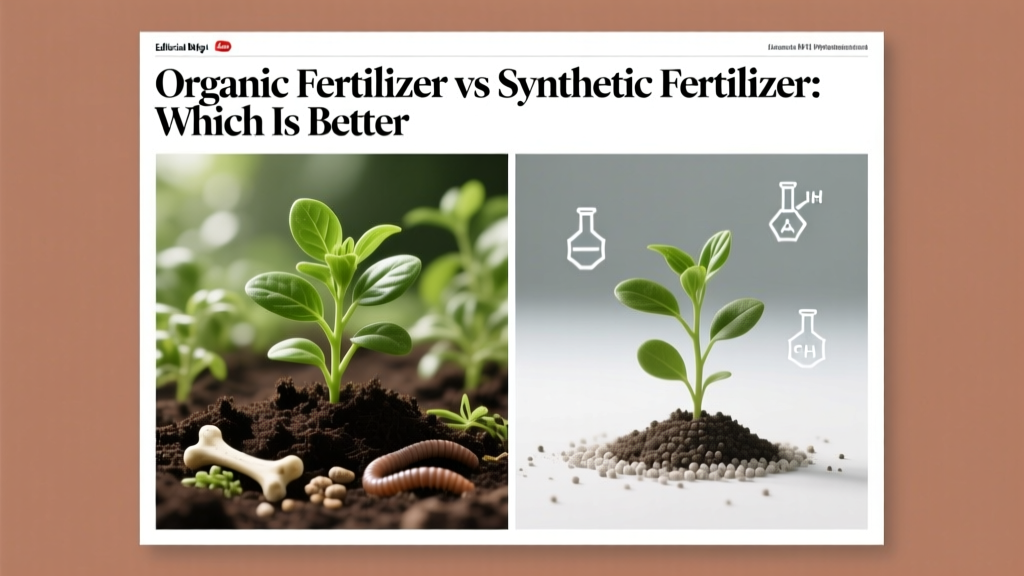
Organic Fertilizer vs Synthetic Fertilizer: Which Is Better
One of the most expensive gardening mistakes is “feeding by vibe.” You see a sad tomato, dump on a handful of fertilizer, and hope for the best—then wonder why you get lush leaves and zero fruit, or why your seedlings stall for weeks. The surprise: plants don’t care if nutrients are “organic” or “synthetic.” They care about the nutrient form, the dose, the timing, and whether the soil can actually hold onto it long enough for roots to drink it in.
This isn’t a moral debate. It’s a tool choice. Organic fertilizers shine when you need steady feeding and better soil structure. Synthetic fertilizers are hard to beat for precise, fast corrections. Most high-performing gardens use a little of both—intentionally.
“Nutrients from organic or synthetic fertilizers are taken up by plants in the same inorganic forms… the main differences are in how quickly nutrients become available and the added benefits to soil health.” — University of Minnesota Extension (2020)
First, a quick reality check: what “organic” and “synthetic” actually mean in your garden
Tip: Think in “release speed,” not ideology
Headline: Match fertilizer speed to the problem you’re solving.
Organic fertilizers (compost, manures, meals) rely on microbes to convert nutrients into plant-available forms, so they tend to be slower and steadier. Synthetic fertilizers (like 10-10-10, urea, calcium nitrate) dissolve quickly, so you get a rapid response—great for hungry crops or deficiencies. If your basil is pale today, compost won’t green it up by Saturday; a small dose of soluble nitrogen can.
Tip: Read the bag like a recipe, not a slogan
Headline: The N-P-K numbers tell you concentration—and how easy it is to overdo it.
A 10-10-10 synthetic is 10% nitrogen, while many organic blends are 3-2-2 or 4-4-4. That means you might need 2–3× more product (by weight) to deliver the same nutrients with organic options—often worth it for soil benefits, but not always cheaper. Example: to apply 0.5 lb of nitrogen, you’d need 5 lb of 10-0-0, but about 12.5 lb of a 4-0-0 source.
Tip: Don’t assume “organic” means gentle
Headline: Some organic fertilizers burn just as fast as synthetics.
Blood meal, fresh manure, and high-nitrogen guanos can spike nitrogen quickly. If you side-dress with blood meal near seedlings, you can absolutely scorch roots or push leafy growth at the wrong time. Real-world example: a pepper bed hit with heavy blood meal often looks amazing in June and disappointing in August (plants stay leafy and delay fruiting).
When organic fertilizer wins (and the shortcuts that make it work faster)
Tip: Use compost for “battery life,” not instant power
Headline: Compost is a soil-builder and a slow buffet—plan it 2–4 weeks ahead.
Apply 1–2 inches of finished compost on beds in spring (or fall) and lightly incorporate the top 2–3 inches of soil. You’re not “feeding the plant” as much as feeding microbes that feed the plant. Example: top-dressing a squash bed with 1 inch compost at planting often reduces blossom-end rot risk by improving moisture buffering (even before you touch calcium).
Tip: Make organic nitrogen more predictable with a split application
Headline: For heavy feeders, feed twice instead of dumping once.
Organic nitrogen release depends on temperature and microbial activity, so it can lag in cool springs and surge in hot weather. A practical hack: apply half at planting and half 4–6 weeks later. Example: corn or tomatoes do better with a second side-dress timed when plants hit knee-high (corn) or first fruit set (tomatoes).
Tip: Pelletized poultry manure is the “fast organic” cheat code
Headline: Use pelletized manure when you want organic convenience with fewer surprises.
Pelletized poultry manure is typically around 3-2-3 to 4-3-2 and breaks down faster than many meals, especially in warm soil. It’s also easier to spread evenly than raw manure and often costs less per application than fancy blends. Example: a 25 lb bag commonly covers roughly 1,000–2,000 sq ft depending on label rates—handy for big beds.
Tip: Turn kitchen scraps into “fertilizer tea” the safe way (DIY)
Headline: Skip sketchy anaerobic brews—make a quick aerated compost tea instead.
If you want a DIY boost, steep finished compost in water with aeration for 12–24 hours, then apply as a soil drench around plants (not as a leaf spray on edible greens). Use roughly 1 part compost to 5 parts water and strain. Example: after transplant shock, an aerated compost tea drench can help get microbial activity moving without blasting plants with salts.
Tip: Use organic fertilizers to fix “dead soil” problems synthetics won’t touch
Headline: If your soil crusts, compacts, or dries fast, organic matter is the real fertilizer.
Synthetics can feed plants in the short term, but they don’t add carbon that improves structure and water holding. If you’re fighting hard clay or sandy soil that can’t hold nutrients, compost and other organic amendments are your long game. Texas A&M AgriLife Extension notes that building soil organic matter improves aggregation and water infiltration over time (Texas A&M AgriLife Extension, 2019).
When synthetic fertilizer wins (and how to use it without wrecking your soil)
Tip: Use synthetics for fast deficiency fixes—then go back to steady feeding
Headline: Treat synthetics like a “first aid kit,” not the whole diet.
If plants are pale from nitrogen deficiency, a water-soluble feed can green them up within 3–7 days. Follow up with compost or a slow-release source so you’re not chasing symptoms weekly. Example: container cucumbers often need a quick soluble feed mid-season, even if you started with compost-heavy potting mix.
Tip: Measure synthetic fertilizer like you measure medication
Headline: A kitchen scale beats “a handful” every time.
Over-application is the #1 way gardeners waste money and stress plants. Weigh your fertilizer and treat the label rate as a ceiling, not a suggestion. Example: if the label says 1 tablespoon per gallon for soluble feeding, start at 1/2 tablespoon for seedlings and leaf crops, then adjust.
Tip: Pick a slow-release synthetic when you want fewer applications
Headline: Coated fertilizers can feed for 8–12 weeks with less leaching.
Polymer-coated or sulfur-coated products release nutrients gradually, especially in warm weather. They’re useful in containers where frequent watering can wash nutrients out quickly. Example: mixing a slow-release fertilizer into container soil at planting can reduce liquid feeding from weekly to monthly for many crops.
Tip: Protect your soil biology with a “salt-awareness” habit
Headline: If you use synthetics often, flush and mulch to avoid salt buildup.
Some synthetic fertilizers raise soil salinity, especially in containers and dry climates. Every 4–6 weeks in pots, water deeply until you get 10–20% runoff to leach salts, then top with a thin mulch layer to reduce evaporation. Example: basil and strawberries are quick to sulk when salts climb—leaching plus mulch usually perks them up within a week.
Organic vs synthetic: quick comparison table (what you’re really choosing)
| Factor | Organic fertilizer | Synthetic fertilizer |
|---|---|---|
| Speed | Usually slow to moderate (microbe-driven) | Fast (water-soluble forms available quickly) |
| Precision | Less precise; nutrient analysis varies | Highly precise; consistent label analysis |
| Soil improvement | Adds carbon/organic matter (compost, manures) and supports structure | Generally doesn’t add organic matter |
| Burn risk | Usually lower, but can burn (blood meal, fresh manure, strong guano) | Higher if overapplied; salts can accumulate |
| Cost per pound of nutrient | Often higher; larger application amounts | Often lower; smaller amounts deliver same N-P-K |
| Best use | Building soil, steady feeding, long-term fertility | Correcting deficiencies, heavy feeders, containers, quick response |
The hybrid approach: the “best of both” playbook
Tip: Build the bed with organic, tune the season with synthetic (or soluble organic)
Headline: Use compost as your base layer and targeted feeds as your steering wheel.
A reliable system is: compost or composted manure at bed prep, then small targeted feedings during growth spurts. This keeps soil improving every year while preventing mid-season nutrient crashes. Example: tomatoes often do best with compost at planting plus a measured side-dress at first fruit set.
Tip: Use the “spoon-feeding” trick for high-yield crops
Headline: Feed smaller amounts more often to reduce waste and cracking.
Instead of one big fertilizer hit, apply light doses every 10–14 days during peak growth for crops like tomatoes, cucumbers, and peppers (especially in containers). This evens out nutrient and water uptake and can reduce issues like tomato cracking caused by boom-bust growth. Example: a container tomato given a half-strength soluble feed every 2 weeks often outperforms one fed a full dose monthly.
Tip: Pair nitrogen with mulch to keep it from disappearing
Headline: Mulch is a fertilizer multiplier—especially for nitrogen.
Mulch reduces evaporation and moderates soil temperature, which helps microbes release organic nutrients steadily and keeps synthetic nitrogen from cycling too wildly. Aim for 2–3 inches of straw, shredded leaves, or bark (keep it an inch away from stems). Example: mulched beds typically need fewer “rescue feedings” in July heat.
Money-saving moves (because fertilizer is getting expensive)
Tip: Buy nutrients, not branding
Headline: Compare cost per pound of nitrogen—your wallet will thank you.
Fertilizers are often priced for convenience and marketing, not nutrient value. If Product A is $18 for 4 lb of 4-4-4, you’re buying only 0.16 lb of nitrogen; if Product B is $18 for 20 lb of 10-10-10, you’re buying 2 lb of nitrogen (and a lot more P and K). Example: for large vegetable plots, basic blends or farm-store fertilizers are usually the budget winner.
Tip: DIY leaf mold is “free compost” for soil performance
Headline: Turn fall leaves into a moisture-holding amendment that makes fertilizers work better.
Bag or bin shredded leaves, keep them damp, and let them break down for 6–12 months. Leaf mold isn’t high in nutrients, but it improves water retention and reduces how quickly nutrients leach—especially in sandy soil. Example: mix leaf mold into beds before planting carrots to keep the root zone evenly moist (less splitting, better germination).
Tip: Don’t overbuy phosphorus—most gardens already have plenty
Headline: Excess P is a common waste (and can create micronutrient issues).
Many gardens accumulate phosphorus from repeated “balanced” fertilizers. Several extension services warn that unnecessary phosphorus applications can contribute to runoff issues and may interfere with micronutrient uptake (see University of Maryland Extension nutrient management guidance, 2021). Example: if your soil test shows high P, switch to something like 10-0-0 (or an organic nitrogen source) instead of another 10-10-10.
Real-world scenarios: what to use, when, and exactly how
Scenario 1: Raised bed tomatoes that look amazing—but won’t set fruit
Tip headline: If the plant is “all leaves,” stop pushing nitrogen and switch timing.
Too much nitrogen (organic or synthetic) can delay flowering. Back off nitrogen-heavy feeds and side-dress lightly at first fruit set instead, using a product with modest N and higher K, or simply compost plus a small amount of sulfate of potash if needed. Example: gardeners who apply manure plus a high-N feed often fix fruiting by skipping nitrogen for 3–4 weeks and focusing on consistent moisture.
Scenario 2: Container herbs that keep turning yellow mid-summer
Tip headline: Containers need more frequent, lighter feeding—nutrients wash out fast.
Pots leach nutrients every time you water, and organic nutrients may not mineralize quickly in potting mix. Use a half-strength soluble fertilizer every 10–14 days, or add a slow-release synthetic at planting for an 8–12 week baseline. Example: a 5-gallon pot of basil often needs regular spoon-feeding; compost alone rarely carries it through August.
Scenario 3: New garden in rough soil (compacted clay or lifeless subsoil)
Tip headline: Use organic matter to fix the “soil bank account” before spending on precision fertilizer.
If roots can’t penetrate and water sits on top, nutrients won’t be used efficiently. Start with 2 inches of compost and 2–3 inches of mulch, and consider a cover crop in the off-season; then use small, targeted synthetic feeds only when plants show real need. Example: in compacted clay, gardeners often see bigger gains from compost + mulch in the first year than from any fancy fertilizer program.
Scenario 4: Fast-growing greens (lettuce, spinach, kale) with bitter flavor
Tip headline: Don’t “over-N” greens—use tiny doses and stop feeding before harvest.
Too much nitrogen can push watery growth and contribute to off flavors, especially as weather heats up. Apply a light feed early, then stop nitrogen applications 2 weeks before heavy harvesting and focus on cool soil with mulch. Example: a small early dose of nitrogen gets kale moving, but constant feeding into hot weather often makes leaves tougher and more pungent.
Safety and timing habits that prevent the classic fertilizer fails
Tip: Keep fertilizers off stems and away from direct root contact
Headline: The “ring method” avoids burn and rot.
Whether organic or synthetic, place fertilizer in a ring 3–6 inches from the plant stem and water it in. Direct contact with stems can invite rot and concentrate salts. Example: side-dressing corn in a shallow band next to the row works better than dropping granules into the whorl area.
Tip: Treat manure like a timing-sensitive ingredient
Headline: Use composted manure, and apply raw manure only in the off-season.
Fresh manure can carry pathogens and can be too “hot” for plants. Many food safety recommendations advise applying raw manure well before harvest—commonly 90–120 days depending on whether the edible portion contacts soil. Example: if you want manure benefits for a summer veggie bed, apply it in fall, then plant in spring.
Tip: Soil test once every couple years—then stop guessing
Headline: A $20–$40 soil test can save more than that in wasted fertilizer.
Testing tells you if you’re already high in phosphorus or potassium and whether pH is blocking nutrient uptake. The best fertilizer in the world won’t fix iron chlorosis if your pH is too high for iron availability. Example: gardeners often “fertilize” yellow leaves for months when the fix is pH adjustment, not more nutrients.
So which is better—organic or synthetic? The better one is the one that matches your timeline and your soil. Use organic inputs to build a soil that holds water and nutrients, then use precise, measured synthetic (or fast-acting organic) feeds when plants need a specific correction. If you want the simplest shortcut: compost as your annual foundation, targeted feeding during growth spurts, and a soil test every couple years to keep you honest.
Sources: University of Minnesota Extension (2020), “Organic fertilizers”; Texas A&M AgriLife Extension (2019), soil organic matter and soil structure resources; University of Maryland Extension (2021), nutrient management and phosphorus guidance.