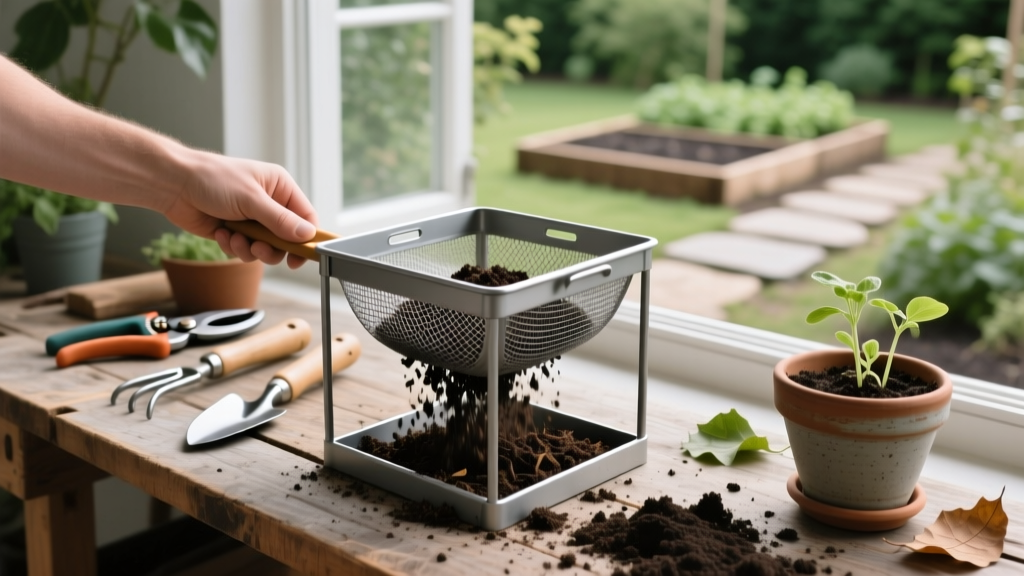
Building a Garden Compost Sifter
The most common compost “upgrade” mistake isn’t buying the wrong bin—it’s waiting until you’re ready to spread compost before you think about screening it. Then you’re stuck picking out avocado pits and half-rotted sticks by hand (or worse, spreading chunky compost that makes seedbeds lumpy and miserable to plant). A simple sifter built in an afternoon can turn rough compost into fluffy, top-dress-ready gold—and it can do it for under $30 if you’re even a little bit strategic.
Below are practical, field-tested tips for building a compost sifter that fits your space, your compost style, and the way you actually garden.
Start with the real goal: what “finished” means in your garden
Tip: Match your screen size to what you’re using compost for
If you’re top-dressing perennials or mulching around shrubs, a coarse screen is faster and totally fine. If you’re making potting mixes, seed-starting blends, or leveling a lawn, you’ll want a finer screen so you’re not fighting chunks later. A great two-screen combo is 1/2 inch (12 mm) for general garden beds and 1/4 inch (6 mm) for containers and seed work.
Real-world example: For my tomato beds, I sift through 1/2 inch to keep it fast; for patio pots, I run a second pass through 1/4 inch so the mix doesn’t dry out unevenly around wood bits.
Tip: Don’t over-screen compost you plan to use as mulch
Screening takes time, and chunky compost works well as a soil cover where microbes and worms can finish the job. Save your screening effort for the compost that needs to be uniform (containers, seedbeds, lawn topdressing). You can screen only the top third of a pile that’s clearly finished and leave the rest to keep curing.
Real-world example: If you have a 3 ft x 3 ft pile, skim off the top 12 inches to screen for spring planting, and let the lower layer keep cooking for summer.
Tip: Compost maturity matters more than your sifter (seriously)
If compost is still “hot,” it clumps, smears across the mesh, and makes you think your sifter design is bad. Aim for compost that has cooled near ambient temperature and smells earthy, not sharp or ammonia-like. Turning time varies, but many backyard piles are ready to screen around 3–6 months depending on how they’re managed.
Composting basics like proper carbon-to-nitrogen balance (often near 25–30:1) strongly influence how quickly materials break down and how screenable they become—an old but still-cited benchmark in compost science (Cornell Waste Management Institute, 2020).
Build the frame so it doesn’t rack, twist, or shed staples
Tip: The sweet-spot size for a handheld sifter is 2 ft x 3 ft
A 2 ft x 3 ft frame (about 24" x 36") is big enough to move material fast but small enough to shake without destroying your wrists. If you go larger, you’ll end up setting it down and pushing compost through—fine, but that’s a different style of sifter. This size also fits neatly over most wheelbarrows.
Cost note: Two 8-foot 2x4s can often build one 24" x 36" frame with leftover bracing, usually $8–$16 depending on lumber prices.
Tip: Use 2x4s on edge, not flat
Mounting the 2x4s “tall” (3.5" vertical) makes the frame much stiffer, especially when you’re shaking 20–30 pounds of damp compost. It also gives you room to sink screws without splitting the wood. If your compost is heavy, stiffness is comfort.
Real-world example: A flat 2x4 frame flexes and loosens staples; a 2x4-on-edge frame stays square after a season of weekend screening.
Tip: Square it up like a picture frame before you attach the mesh
If the frame is even slightly skewed, the mesh won’t tension evenly and you’ll get sagging and bouncing (which slows screening). Measure diagonals corner-to-corner: when both diagonals match, it’s square. This takes 60 seconds and saves a lot of rework.
Tip: Add a single cross brace if your mesh is finer than 1/4 inch
Fine mesh carries more compost at once, which makes the middle bow. A simple 2x2 or ripped 2x4 brace across the center reduces flex and keeps tension. Screw it in from the outside so you can replace mesh later without fighting buried fasteners.
Real-world example: If you’re screening for potting mix through 1/4 inch, a center brace prevents the “hammock dip” that makes everything roll to the middle and clog.
Pick mesh that screens fast and survives weather
Tip: Hardware cloth beats chicken wire for compost, and it’s not close
Chicken wire deforms, snags, and lets through long splinters that you’ll regret in potting mixes. Galvanized hardware cloth stays rigid and keeps openings consistent. Plan to spend roughly $10–$25 for a 2 ft x 5 ft roll depending on gauge and opening size.
Tip: Use 19-gauge for longevity, 23-gauge for lighter work
If your compost is mostly leaves and kitchen scraps, lighter gauge can be fine. If you compost woody material, corn stalks, or you screen damp compost, sturdier wire pays off because it won’t “oil-can” or tear at the staples. Think of 19-gauge as the “buy once” option if you screen often.
Tip: Staple smarter: a double row + batten strip is the no-rip method
Most DIY sifters fail where the mesh meets the frame. Use 1/2 inch galvanized staples every 1–1.5 inches, then screw a thin wood strip (a 1x2 batten) over the mesh edge like a clamp. The batten spreads stress so the mesh doesn’t tear around staple points.
Money-saving detail: Batten strips can be made from scrap wood; this one trick can keep you from replacing mesh yearly.
Tip: Don’t skip gloves—cut mesh is basically a razor
Hardware cloth ends are sharp enough to slice skin fast. Wear gloves and fold the cut edge over itself with pliers, or trap the edge under the batten strip. Your hands will thank you on the second project of the day when you’re not bandaged up.
Choose the sifter style that matches your workflow
There are two main DIY styles that actually get used: the “shake over wheelbarrow” sifter and the “stand + rake” sifter. One isn’t better; they’re different tools for different bodies and compost volumes.
| Feature | Shake-Style (Handheld Frame) | Stand-Style (Angled Screen on Legs) |
|---|---|---|
| Best for | Small/medium batches, quick cleanup | Large batches, less lifting |
| Typical size | 24" x 36" | 30" x 48" screen surface |
| Speed | Fast per scoop, slower over hours | Steady, high volume |
| Body strain | More wrists/forearms | More back/shoulder if height is wrong |
| Approx. DIY cost | $20–$45 | $35–$80 |
Tip: If you already own a wheelbarrow, build around it
The easiest “upgrade” is making your sifter sit securely on the wheelbarrow rim. Aim for a frame that’s slightly larger than the barrow opening so it can’t fall through, like a 24" x 36" sifter for many standard wheelbarrows. Screening straight into the barrow saves a full transfer step.
Real-world example: Screen into the wheelbarrow, roll it to the beds, top-dress immediately—no extra buckets, no second mess pile.
Tip: For stand-style sifters, build the legs so the screen sits at belly-button height
If the screen is too low, your back takes the hit; too high and your shoulders fatigue. A practical target is around 36–40 inches from ground to top edge for many adults, but measure your own comfortable raking height. Use screws (not nails) so you can adjust the legs after a test run.
Tip: An angle of 25–35 degrees is the “doesn’t bounce, still flows” zone
Too steep and compost races down without screening; too flat and it sits there and clogs. Set your stand so the screen is angled around 30°, then fine-tune based on your compost moisture. If it’s sticky, reduce the angle slightly and feed smaller amounts.
Speed tricks: screen more in less time (without working harder)
Tip: Let compost dry slightly before screening—just not bone-dry
Compost that’s dripping wet smears and blocks mesh openings. Spread it on a tarp in a 1–2 inch layer for 1–3 hours on a breezy day, then screen. You’re aiming for “crumbly brownie” texture, not dusty powder.
Scenario: After a rainy week, screen only what you need and pre-dry it on a tarp in the garage doorway or under an eave to keep it from re-wetting.
Tip: Feed small loads—think 2–3 shovels at a time
Overloading the screen is the fastest way to slow down, because the fine compost can’t fall through when it’s buried. Add a small batch, shake or rake until it stops raining down, then add more. This keeps mesh open and your pace steady.
Tip: Use a rubber mallet tap instead of aggressive shaking for fine screens
For 1/4 inch mesh, a couple of light mallet taps on the frame can move fines through without tearing up your wrists. Tap the long sides, rotate the frame, and repeat. It’s calmer, quieter, and surprisingly quick.
Tip: Keep a “rejects” bucket next to you and recycle immediately
Everything that doesn’t pass the screen is not trash—it’s compost fuel. Toss sticks, pits, and fibrous chunks right back into the active pile as you go, ideally with a sprinkle of greens (grass clippings) to keep it moving. This one habit keeps your work area clean and your compost pipeline continuous.
Make it last outdoors: weatherproofing and maintenance that matters
Tip: Seal the wood where it touches wet compost
The bottom edges of the frame get soaked and will rot first. A quick coat of exterior paint, deck sealer, or even boiled linseed oil on the lower edge adds seasons of life. If you want the cheapest rot defense: wrap the bottom edges in leftover flashing tape.
Cost note: A small can of exterior sealer is often $10–$20, and you’ll have plenty left for stakes and tool handles.
Tip: Don’t store the sifter flat on the ground
Ground contact keeps the wood damp and invites warping. Hang it on two screws in a shed, or lean it off the floor with a spacer so air can move behind it. If the mesh stays dry, it stays tight and rust-free longer.
Tip: Replace mesh without rebuilding the whole thing
This is why battens and screws are worth it. When the mesh eventually loosens or rusts, you remove the batten strips, swap mesh, and reattach—no prying hundreds of staples. Plan for maintenance at build time and your future self will feel like a genius.
Dial it in for your compost type (three real-life setups)
Scenario 1: Leaf-heavy compost that screens like a dream
If your pile is mostly shredded leaves with some kitchen scraps, it’ll screen fast and fluffy—often through 1/2 inch with almost no effort. Your main issue is volume, not clogs, so build a larger stand-style sifter if you have more than 20–30 gallons to process at once. A 30" x 48" screen on a simple A-frame can keep up with autumn cleanup.
Scenario 2: Woody, “chunky” compost that refuses to cooperate
If you’re composting sticks, pruning debris, or corn stalks, screen size isn’t the only lever—pre-processing matters. Chop or shred bulky material before it enters the pile, or expect more rejects during screening. University of California Agriculture and Natural Resources notes that particle size affects composting speed; smaller pieces break down faster and more uniformly (UC ANR, 2019).
Hack: Keep a separate “coarse compost” bin for woody rejects and let it go an extra 2–3 months; screen it later when it’s darker and crumbly.
Scenario 3: Compost for a lawn topdress (where lumps cause real headaches)
Lawn topdressing is where screening pays off immediately—chunks can catch in a spreader or sit on the grass and smother it. Use 1/4 inch mesh, and aim for compost that’s dry-ish and fully cured. Many extension sources recommend applying compost in thin layers on lawns; a common range is about 1/4 to 1/2 inch depending on the goal and turf condition (Washington State University Extension, 2020).
Money saver: Bagged “lawn compost” can run $4–$8 per bag; screening your own for a 1,000 sq ft lawn can easily avoid $50–$150 in purchases depending on how thick you topdress.
DIY alternatives when you don’t want to build a full sifter
Tip: The “milk crate + mesh” mini-sifter for small gardens
Zip-tie 1/4 inch hardware cloth over the opening of a plastic milk crate and you’ve got a compact sifter for container mixes. It’s not elegant, but it works—and it stores easily. You can sift straight into a tote by setting the crate across it.
Tip: A soil sieve (gold pan style) for tiny batches and seed starting
If you only need a few gallons of fine compost, a round soil sieve is quick and easy. They’re often $15–$35, and they’re great for making a smooth seed-starting blend. This is the right tool when you’re picky about texture but not processing wheelbarrows of material.
Tip: Repurpose an old window screen—only for already-finished compost
Old window screen is too fine and too fragile for rough compost, but it can work for a final pass on fully cured material. Think of it as a “finisher” screen for seed trays, not a workhorse. If it tears, you’re out basically nothing, which is the point.
“The more uniform the particle size, the more consistent the composting process—and the easier it is to screen and apply evenly.” — Cornell Waste Management Institute (2020)
Small upgrades that make a homemade sifter feel like a pro tool
Tip: Add simple handles where your hands naturally land
Two scrap 1x2s screwed on as side handles reduce grip fatigue, especially when wearing gloves. Place them about 6–8 inches from each end so you’re not fighting leverage. Your wrists stay straighter, and you can shake longer without that “tingly hand” feeling.
Tip: Put a lip on one end for stand-style sifters
A 1-inch lip at the top edge keeps compost from sliding off before it screens. This is especially helpful when you’re raking material down the mesh. One scrap strip and four screws turns a slippery screen into a controlled feed zone.
Tip: Build a two-stage sifter without doubling your storage space
Instead of two separate sifters, build one frame and make two interchangeable mesh panels that attach with screws. Swap 1/2 inch mesh for quick bed compost, then switch to 1/4 inch when you’re mixing containers. You’ll spend a little more on mesh, but you won’t store two bulky frames.
Tip: Keep your screened compost covered so it stays “alive” and usable
After screening, compost dries out fast, and dusty compost is annoying to spread and can blow away. Store it in a lidded tote or cover a pile with a tarp that’s weighted down, leaving a little air gap so it doesn’t turn anaerobic. If it gets too dry, mist lightly and mix—don’t soak it.
If you build your sifter to match how you actually move compost—wheelbarrow, tarp, buckets, whatever—you’ll use it all the time instead of once a year. The payoff isn’t just prettier compost; it’s faster planting days, smoother seedbeds, and the quiet satisfaction of turning “almost finished” scraps into something that looks like it came from a premium garden center (without paying premium garden center prices).