Homemade Seed Starting Mix Recipe
The fastest way to kill seedlings isn’t “forgetting to water”—it’s starting them in the wrong stuff. Regular potting soil (or worse, garden soil) seems harmless until it compacts like concrete, stays soggy around delicate stems, and turns your tray into a fungus party. A seed starting mix is supposed to be boring: airy, consistent, and predictable every single time.
What surprises most gardeners is that a good seed mix is less about “fertility” and more about physics: air space, water-holding, and drainage. Seeds carry enough energy to sprout; your job is to keep the environment stable and disease-resistant until true leaves show up.
The Base Recipe (Use This Before You Start Tweaking)
Tip: Mix a “2-1-1” base that balances air + moisture
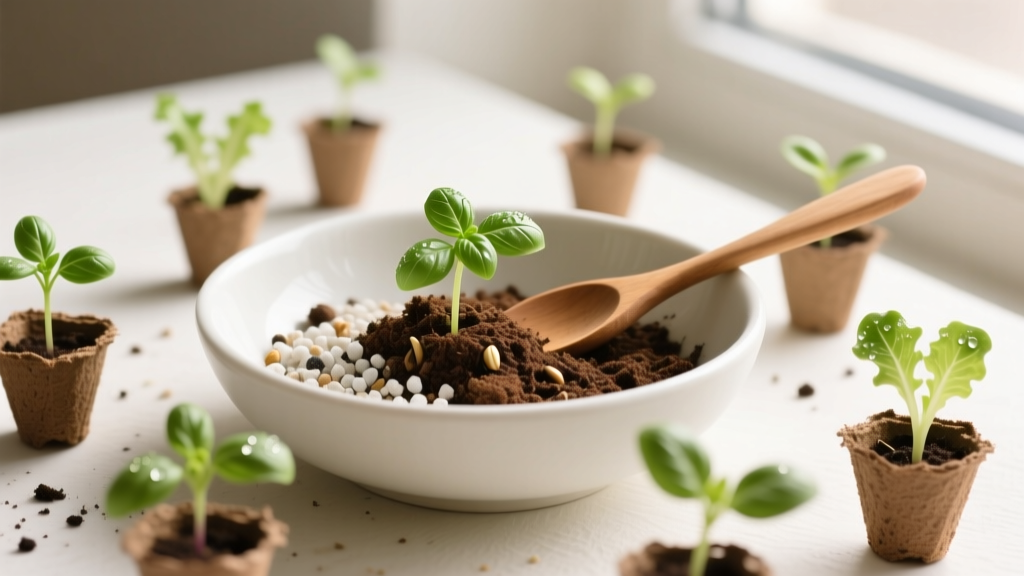
Start with this reliable ratio: 2 parts coco coir (or peat moss), 1 part perlite, 1 part vermiculite. It holds water evenly (coir/peat), drains fast (perlite), and keeps the surface from crusting (vermiculite). For a standard 10x20 tray, you’ll use roughly 10–12 quarts of finished mix depending on cell size.
Example: In a 5-gallon bucket, combine 10 quarts coir, 5 quarts perlite, and 5 quarts vermiculite—stir until the color looks uniform and no “white pockets” of perlite are clumped together.
Tip: Add lime only if you’re using peat, and measure it
If you choose peat moss, you’ll want to buffer pH with lime because peat is naturally acidic. A practical home rate is 1 tablespoon of finely ground dolomitic lime per gallon of finished mix (that’s 16 tablespoons per cubic foot). Coco coir is closer to neutral, so skip lime unless you’ve tested and know you need it.
Example: Making 4 gallons of peat-based mix for pepper starts? Add 4 tablespoons dolomitic lime, mix dry first, then moisten.
Tip: Pre-moisten to “wrung sponge” before filling cells
Dry coir/peat repels water at first, and watering after filling trays often leaves the top wet and the bottom dry. Add warm water slowly and mix until a squeezed handful releases only 1–2 drops. That moisture level makes seeds settle in evenly and prevents sinking later.
Example: For one compressed coir brick, plan on roughly 3–4 quarts of water (varies by brand) before it fluffs, then adjust with small splashes until it passes the squeeze test.
Ingredients That Matter (and Smart Substitutions)
Tip: Pick coir when fungus gnats are your sworn enemy
Coco coir tends to arrive cleaner and more uniform than many peat bales, and it re-wets easily after drying. If fungus gnats have been a recurring indoor issue, coir plus good airflow is often a noticeable improvement because it’s less likely to bring hitchhikers. Bonus: coir bricks store neatly and don’t explode dust in your garage.
Example: If you’re starting seeds in a basement grow area, swap peat for coir and top the cells with a 1/4-inch layer of coarse vermiculite; that dry-ish cap makes it harder for gnats to lay eggs.
Tip: Use perlite for “air,” pumice for “weight,” and rice hulls for “cheap”
Perlite is the classic aeration ingredient because it’s light and widely available. Pumice does a similar job but is heavier—great for top-heavy seedlings like tomatoes under strong fans. Parboiled rice hulls are a budget-friendly aerator that also adds a little silica as they break down.
Example: If your trays tip over when you brush past them, replace half the perlite with pumice: in a 2-1-1 mix, do 2 coir : 1/2 perlite : 1/2 pumice : 1 vermiculite.
Tip: Keep compost out of seed mix unless you can screen it
Compost sounds like a good idea, but most home compost is too variable for tiny seedlings: salts, uneven particles, and hidden fungus gnat snacks. If you insist, screen it through 1/8-inch hardware cloth and limit it to 10% by volume. Even then, use it for sturdier seedlings (brassicas, not petunias).
Example: For a “compost boost” batch: 9 quarts base mix + 1 quart screened compost. If the tray starts growing mushrooms, you’ll know you pushed it.
Cleanliness and Disease Prevention (Without Being Paranoid)
Tip: Pasteurize DIY mixes only when you’re reusing materials
If your ingredients are fresh (new coir/peat, perlite, vermiculite), pasteurizing isn’t usually necessary. But if you’re reusing old mix or adding compost, pasteurization reduces damping-off risk. Aim for 160–180°F for 30 minutes (not higher; “sterilizing” can create other problems).
Example: Put damp mix in an oven-safe pan, cover with foil, insert a thermometer, and bake at 200°F until the center hits 160°F, then start your 30-minute timer.
Tip: Don’t skip tray sanitation—10 minutes saves weeks
Old trays can carry disease even if they “look clean.” Soak flats and cell packs in a solution of 1 part household bleach to 9 parts water for 10 minutes, then rinse and air dry. This simple step is routinely recommended by extension services for reducing seedling disease pressure.
Example: If you’re reusing 20 cell packs, stack them in a tote, pour in bleach solution until submerged, and set a phone timer—done before your coffee cools.
“Sanitation is one of the most effective ways to prevent damping-off and other seedling diseases in the greenhouse.” — University of Minnesota Extension (2020)
That sanitation advice isn’t just academic—most damping-off disasters trace back to contaminated trays, overly wet media, or both.
Moisture Control Hacks (The Difference Between “Sprouted” and “Survived”)
Tip: Top-dress with vermiculite to prevent crusting and algae
After sowing, dust the surface with 1/8 inch of fine or medium vermiculite. It holds moisture around the seed while keeping the surface from forming a hard crust that traps tiny seedlings. It also reduces algae by drying faster at the very top.
Example: With slow germinators like parsley, this top-dress helps keep the surface evenly moist for the full 14–21 days it can take to sprout.
Tip: Bottom-water until germination, then switch to “light sips”
Bottom-watering (adding water to the tray and letting cells wick it up) keeps the surface drier, which discourages fungus and gnats. Once most seeds germinate, stop flooding the tray—switch to smaller, more frequent bottom-waters so stems don’t stay constantly humid. A good target is watering when the tray feels noticeably lighter, not when the top looks pale.
Example: For 72-cell trays, add about 1/4 to 3/8 inch of water to the bottom tray, wait 20 minutes, then dump any leftover.
Tip: Use a fan like a “disease vaccine” (gentle is enough)
Still, humid air is what turns an okay seed mix into a problem. Run a small fan on low so seedlings barely wiggle; that movement helps dry the surface and strengthens stems. This is especially useful if you’re starting seeds at 65–75°F indoors where evaporation is slower than you’d think.
Example: In a spare-room setup, point a clip fan toward the wall so it bounces airflow around instead of blasting the trays directly.
Fertility: When “Rich Soil” Backfires (and What to Do Instead)
Tip: Start feeding only after true leaves, and use a measured dilution
Most seeds don’t need fertilizer to germinate, and nutrient-heavy mixes can burn tender roots. Once seedlings have 1–2 sets of true leaves, start a gentle feed: liquid fertilizer at 1/4 strength every 7–10 days. This approach matches what many extension programs recommend for seedling nutrition management.
Example: If the label says 1 teaspoon per gallon, use 1/4 teaspoon. Tomatoes and peppers respond quickly—leaves shift from pale to healthy green in about 5–7 days.
Tip: If you use coir, plan for calcium/magnesium support
Coir can tie up calcium and sometimes comes pre-buffered (or not), which is why seedlings may look fine then stall. If you’re seeing twisted new growth or weak stems, add a cal-mag supplement at label rate once true leaves appear, or use a fertilizer that includes Ca and Mg. This is less about “more nutrients” and more about preventing a specific bottleneck.
Example: For pepper seedlings that suddenly look cramped and wrinkly at the top, a cal-mag feeding can correct the issue within 7–14 days depending on severity.
Batching, Storage, and Cost: Make It Once, Use It All Season
Tip: Mix in “tray-sized” batches so your ratio stays consistent
Gardeners get inconsistent results because they eyeball ingredients differently every time. Use a dedicated scoop—like a 1-quart yogurt container—and stick to it. If your recipe is 2-1-1, that’s 2 scoops coir, 1 scoop perlite, 1 scoop vermiculite—repeat until you have enough.
Example: For two 1020 trays of 72-cells, you might do 12 scoops coir, 6 scoops perlite, 6 scoops vermiculite.
Tip: Store finished mix slightly dry, not damp
Damp stored mix can grow mold long before you ever sow a seed. Store it dry-ish in a lidded tote, and re-moisten right before use. Label the tote with the date so you’re not guessing what’s inside next spring.
Example: If you pre-mix in February, store it until April in a tote with the lid cracked 1/4 inch in a dry area to prevent condensation buildup.
Tip: Compare DIY cost per gallon before you buy another bag
DIY isn’t always cheaper—but it often is if you buy in bulk. A typical DIY mix using coir, perlite, and vermiculite often lands around $0.60–$1.20 per gallon depending on local prices, while small branded seed-starting bags commonly run $1.50–$3.00 per gallon. The bigger win is consistency: once you like your mix, you can repeat it exactly.
| Option | Typical Cost per Gallon | Consistency | Best For | Common Gotcha |
|---|---|---|---|---|
| DIY 2-1-1 (coir/peat + perlite + vermiculite) | $0.60–$1.20 | High (if measured) | Most vegetables, herbs, flowers | Forgetting lime with peat; inconsistent moisture if not pre-wet |
| Bagged seed-starting mix (brand-name) | $1.50–$3.00 | Medium (varies by batch) | Small-scale sowing, convenience | Can arrive too fine or too wet; fungus gnats occasionally |
| Potting soil (regular container mix) | $0.80–$2.00 | Medium | Potting up seedlings later | Often too “hot” or too heavy for germination trays |
Troubleshooting: Fast Fixes for the Most Annoying Problems
Tip: If your mix stays soggy, increase aeration by 25%
A mix that stays wet invites damping-off and algae, especially under domes. The quickest fix is to bump perlite (or pumice/rice hulls) up by 25% in the next batch. Also reduce how long you keep humidity domes on—remove them as soon as you see consistent sprouting.
Example: If you used 4 quarts perlite in a batch, go to 5 quarts next time and take the dome off within 24–48 hours of germination.
Tip: If the surface turns green, stop top-wetting and add a dry cap
Green algae means the surface is staying wet and bright—algae itself isn’t deadly, but it signals conditions that can be. Switch to bottom-watering only and add a 1/8-inch cap of coarse vermiculite or even clean, coarse sand. Then increase airflow slightly.
Example: In lettuce trays under lights, algae pops up fast; the sand cap dries the surface so you can keep moisture below where roots need it.
Tip: If seedlings fall over at the soil line, treat it like an emergency
That classic “pinched stem” is damping-off. Immediately improve airflow, stop domes, and let the surface dry a bit more between waterings; discard the worst-hit cells so the problem doesn’t spread. Many extension services emphasize prevention because treatment is limited once symptoms show.
Example: If 6 out of 72 cells collapse, toss those plugs and the surrounding 6 cells, then dust the remaining surface with dry vermiculite and run a fan continuously for 48 hours.
Citation: Damping-off prevention practices (sanitation, moisture management, airflow) are widely recommended by university extension programs; see University of Minnesota Extension (2020) and Penn State Extension (2019) guidance on seedling disease prevention and greenhouse sanitation.
Real-World Scenarios (So You Can Copy What Works)
Scenario: Tiny apartment setup with low light and high humidity
If you’re starting seeds on a kitchen counter with marginal light, your biggest enemy is slow drying. Use the base 2-1-1 mix, but push aeration: make it 2 parts coir : 1.25 parts perlite : 0.75 parts vermiculite. Skip domes unless your home is extremely dry, and run a fan on low from day one.
Result you’re aiming for: A surface that dries slightly between waterings while the root zone stays evenly moist, cutting fungus gnat pressure dramatically within 1–2 weeks.
Scenario: Heat mats and fast germinators (tomatoes, basil, brassicas)
Heat mats speed germination, but they also speed evaporation at the top while keeping the bottom warm and wet—an awkward combo. Pre-moisten mix thoroughly, sow, then bottom-water lightly and remove the dome the moment most seeds pop (often 3–5 days for tomatoes at warm temps). Don’t fertilize until true leaves, even if they sprout fast.
Shortcut: Write the sow date on painter’s tape right on the tray; if you see sprouts on day 4, set a reminder to remove the dome by day 5.
Scenario: Starting slow, finicky seeds (celery, onions, lavender)
Slow germinators punish inconsistent moisture. Use the standard 2-1-1 mix, then top-dress with 1/8 inch vermiculite to keep the surface from drying and cracking. Mist only if you must; bottom-water instead, and keep temperatures steady rather than “cooking” them on a mat.
Example: Onion seed can take 7–10 days to germinate; a vermiculite cap prevents the surface from turning hydrophobic midway through the wait.
DIY Alternatives When You Can’t Find the “Perfect” Ingredients
Tip: No vermiculite? Use more coir plus a surface cap
If vermiculite is unavailable, increase coir/peat slightly and rely on a top-dress (coarse vermiculite if you can find it, or clean sand if you can’t). A workable ratio is 2.5 parts coir : 1 part perlite. You’ll need to be more attentive to moisture because vermiculite is the ingredient that smooths out swings.
Example: For a quick emergency batch: 5 quarts coir + 2 quarts perlite. Top with 1/8 inch sand after sowing.
Tip: No perlite? Use parboiled rice hulls at the same volume
Parboiled rice hulls are a solid perlite substitute for seed starting because they’re clean and fluffy. Swap 1:1 by volume, but expect them to break down over time—fine for seedlings that will be potted up in 3–6 weeks. If you’re growing long-term in the same cells, perlite or pumice lasts longer.
Example: For spring lettuce starts you’ll transplant quickly, rice hulls work great and often cost less per volume than perlite.
Tip: If you must use bagged mix, “cut it” so it behaves like seed mix
Some bagged seed mixes are too fine, and some potting soils are too rich. You can fix both by blending in perlite at 20–30% by volume and screening out big wood chunks. This one tweak often turns a frustrating bag into a usable medium.
Example: Mix 7 quarts bagged mix with 3 quarts perlite. If seedlings were stalling before, this extra air usually brings them back to life.
Seed starting gets a lot less mysterious when your mix is predictable. Nail the base recipe, measure like you mean it, and adjust only one variable at a time. Once you find the texture that gives you steady moisture without sogginess, you’ll stop “hoping” seeds make it and start expecting full trays.
Sources: University of Minnesota Extension (2020) on greenhouse sanitation and seedling disease prevention; Penn State Extension (2019) guidance on damping-off management and cultural controls in seedling production.