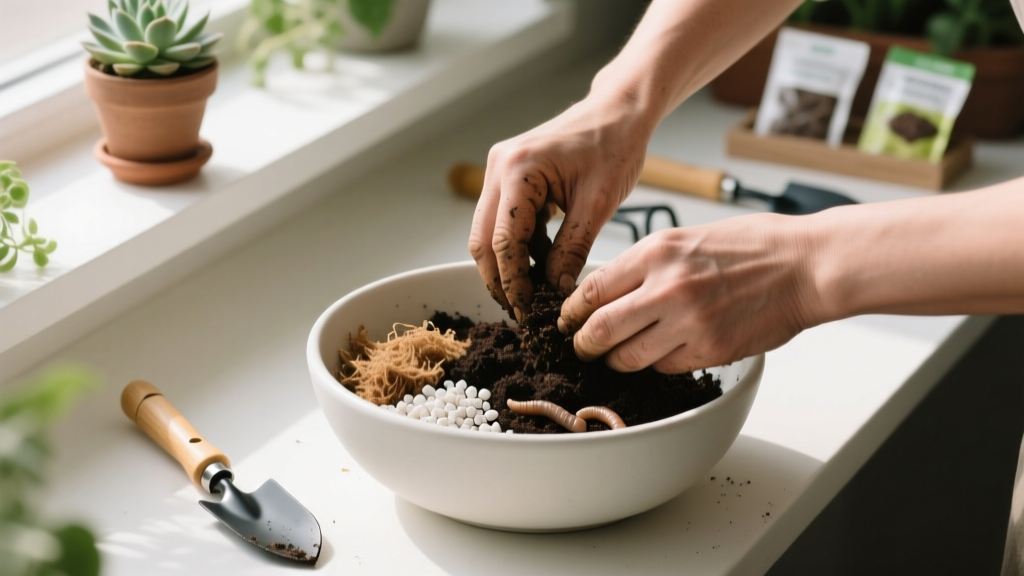
Making Your Own Potting Soil Mix
The #1 mistake I see with DIY potting soil is thinking “soil is soil,” then scooping garden dirt into a pot and wondering why the plant stalls out or dies. Containers are a different universe: the roots need air as much as they need water, and plain ground soil compacts fast, squeezing out oxygen. Potting mix is really an engineered balance of drainage, water-holding, and nutrition—and you can absolutely make it yourself without guessing.
Below are field-tested tips organized by what matters most: structure (air + drainage), moisture management, nutrition, and safety. I’ll give you specific ratios, how to tweak them for real situations, and a couple of cost-saving hacks that can shave real money off spring planting.
Start With Structure: Air + Drainage Is the Whole Game
Tip: Use the “3-Part Base” as Your Default
Headline: 1 part peat or coco coir + 1 part compost + 1 part aeration (perlite/pumice/bark).
This 1:1:1 base mix is a reliable starting point for most houseplants, annuals, and patio containers because it balances water-holding (peat/coir), biology and nutrients (compost), and air pockets (perlite/pumice). If you only memorize one ratio, make it this one. Example: For a 15-gallon batch, mix 5 gallons coir, 5 gallons compost, and 5 gallons perlite.
Tip: Match Aeration to Pot Size (Small Pots Need More Air)
Headline: Add 10–20% extra perlite/pumice for pots under 8 inches wide.
Small containers dry unevenly and compact quickly; extra aeration keeps roots from sitting in a soggy core. For tiny pots, aim closer to 40% aeration overall (perlite/pumice/bark combined). Example: For a 6-inch herb pot, try 2 cups coir, 1.5 cups compost, and 2 cups perlite.
Tip: Skip Sand Unless You’re Using Coarse “Grit”
Headline: Fine sand can make a cement-like mix in containers.
In pots, fine sand often fills the air spaces you’re trying to create, leading to compaction and slow drainage. If you want “sand-like” weight, use coarse horticultural grit or small pumice (around 2–5 mm). Example: For top-heavy rosemary in a windy spot, add 1 quart of 1/8-inch grit per 5-gallon batch.
Tip: Use Bark Fines for Long-Lasting Air Pockets
Headline: Swap 1/3 of your perlite for pine bark fines when potting perennials.
Perlite works great, but it can float and shift over time. Pine bark fines (often sold as “soil conditioner”) hold structure longer and are especially helpful for shrubs and perennials living in pots for more than one season. Example: A patio blueberry in a half-barrel does better with 20–30% bark fines to keep the mix springy all year.
Choose Ingredients Like a Pro (Without Paying Boutique Prices)
Tip: Peat vs. Coir—Pick Based on Water and pH, Not Trends
Headline: Peat holds water well and is acidic; coir rewets easier and is closer to neutral.
Peat moss typically trends acidic (often helpful for blueberries), while coco coir tends to be closer to neutral and is famously easier to re-wet after drying out. The right choice depends on what you’re growing and how often you forget to water. Example: If your hanging baskets dry into bricks by July, coir is usually more forgiving than peat.
Tip: If You Use Coir, Buffer It (Especially for Sensitive Plants)
Headline: Rinse or “pre-charge” coir to reduce salt and balance calcium/magnesium.
Some coir can carry excess soluble salts depending on processing. A simple hack: soak coir in water, drain, then re-soak with a light calcium source (like gypsum) before mixing. Example: For a 5-gallon bucket of expanded coir, mix in 1 tablespoon gypsum and let it sit 30 minutes before combining with compost and perlite.
Tip: Compost Quality Matters More Than “Organic” on the Label
Headline: Use mature, screened compost; keep it at 20–35% of the mix.
Compost that’s still breaking down can steal nitrogen and heat up, stressing roots. Aim for compost that smells earthy (not sour), with few recognizable chunks, and keep it under about one-third of the total volume to prevent heaviness. Example: For seedling mix, drop compost to 10–15% and lean on coir/peat for cleanliness.
Tip: Add a Wetting Step So Your Mix Doesn’t Fight You
Headline: Pre-moisten until it clumps like a wrung-out sponge.
Dry peat or coir can repel water at first, causing annoying runoff down the sides of the pot. Mix your ingredients dry, then add water slowly until a squeezed handful holds together but no water drips out. Example: For a 20-gallon tote of mix, start with 1–2 gallons of water, stir, then adjust.
Dial in Nutrition Without Burning Roots
Tip: Add Lime (or Don’t) Based on What Your Base Is
Headline: Peat-based mixes usually need lime; coir-based mixes often need less.
Many peat-based potting mixes are amended with limestone to moderate acidity, and DIY mixes often benefit from the same approach. A common starting rate is 1 tablespoon dolomitic lime per gallon of peat-based mix, then adjust based on plant response. Example: If your pelargoniums show weak growth and pale leaves despite feeding, pH could be off—lime is a cheap first fix.
Tip: Use a “Low-and-Slow” Fertilizer Rate to Avoid Salt Shock
Headline: Start with 1/2 the label rate for slow-release fertilizer in fresh mixes.
DIY mixes vary in compost richness and coir/peat buffering, so full-strength fertilizer can spike salts. If you’re adding a slow-release granular fertilizer, begin at 50% of the recommended rate, then top-dress later if plants ask for more. Example: For tomatoes in a 10-gallon container, you can top-dress at week 4 instead of front-loading everything on planting day.
Tip: Use Worm Castings Like a Seasoning, Not a Main Ingredient
Headline: Keep castings to 5–10% of the mix for steady benefits without sogginess.
Worm castings are great, but too much can make a mix heavy and moisture-holding. Treat them like a supplement for biology and micronutrients rather than your primary “compost” fraction. Example: In a 10-gallon batch, 1 gallon of castings is plenty.
“A container medium must provide both water and air to the root zone; over time, mixes with insufficient large pores lose aeration and root function declines.”
— North Carolina State Extension (2019)
Use Purpose-Built Recipes (So You’re Not Reinventing the Wheel)
Tip: Seed-Starting Mix That Doesn’t Dampen Off
Headline: 2 parts coir/peat + 1 part perlite + 1 part vermiculite (plus optional 5% compost).
Seedlings need consistent moisture and cleanliness more than high nutrition. This blend stays light, holds water evenly, and drains well so stems aren’t sitting wet. Example: For 8 standard 10x20 trays, mix about 12 quarts coir/peat, 6 quarts perlite, and 6 quarts vermiculite.
Tip: Tomato & Pepper Container Mix for Heavy Feeders
Headline: 2 parts coir/peat + 1 part compost + 1 part pumice/perlite + a slow-release fertilizer at half-rate.
Fruit crops in pots burn through nutrients and need a mix that stays open even with frequent watering. Keep compost around one-quarter to one-third so it feeds without turning the pot into a swamp. Example: In a 20-gallon grow bag, this mix plus a midseason top-dress often outperforms bargain bagged potting soil.
Tip: Cactus/Succulent Mix That Won’t Rot
Headline: 1 part coir/peat + 1 part compost + 2 parts pumice/perlite + optional grit.
Succulents die from staying wet too long, not from being “dry.” Push aeration up to 50–65% and use a faster-draining mineral like pumice if you can find it. Example: For a jade plant in a 10-inch pot, use 3 cups coir, 3 cups compost, and 6–7 cups pumice.
Tip: Acid-Loving Mix for Blueberries and Some Hydrangeas
Headline: 2 parts peat + 1 part pine bark fines + 1 part perlite; avoid lime.
Blueberries prefer a lower pH and hate “heavy” mixes that stay wet and warm. Peat and bark keep things acidic and airy, and skipping lime prevents creeping pH increase. Example: For a patio blueberry, water with rainwater when possible and refresh the top 2 inches of mix each spring.
Shortcuts, Hacks, and Money Savers
Tip: Buy Ingredients by the Compressed Bale (That’s Where the Savings Are)
Headline: A compressed 3.0 cu ft bale is usually cheaper per gallon than small bags.
If you’re filling more than a couple containers, big bales win on cost. A 3.0 cubic foot bale equals about 22.5 gallons; compare that to multiple 1.5 cu ft bags that often cost more total. Example: If small bags run $10–$12 each, a bale at $18–$25 can cut your per-gallon cost by a third.
Tip: Use Leaf Mold as a Compost Substitute (Free if You’re Patient)
Headline: Bag fall leaves and wait 6–12 months for a fluffy, fungal-rich amendment.
Leaf mold is basically slow composting of leaves; it’s lighter than compost and fantastic for water retention without heaviness. Shred leaves first to speed breakdown, then keep bags slightly moist. Example: Replace half the compost portion in your 1:1:1 mix with leaf mold for houseplants that hate soggy roots.
Tip: “Recharge” Old Potting Mix Instead of Tossing It
Headline: Reuse last year’s mix by adding 25–33% fresh compost and 10–20% new aeration.
Old mix often collapses and loses nutrients, but the base materials are still useful. Break up roots, remove chunks, then restore structure and fertility with fresh components. Example: If you have 15 gallons of used mix, add 4–5 gallons compost and 2–3 gallons perlite/pumice to bring it back to life.
Tip: Mix in a Tote With a “Layer and Flip” Method
Headline: Layer dry ingredients in a 27-gallon tote, then flip with a small shovel 6–8 times.
This is faster than stirring forever and gives surprisingly even results. Put coir/peat first, compost next, then aeration on top; wet lightly between layers so dust stays down. Example: In a 27-gallon tote, six flips usually mixes well enough that you won’t find perlite pockets.
Safety and Quality Control (Because Containers Amplify Problems)
Tip: Pasteurize Homemade Compost Only When You Must
Headline: If you suspect weed seeds or pathogens, heat to 160°F (71°C) for 30 minutes.
Most of the time, mature compost is fine. But if you had disease issues last year or your compost pile ran cool, pasteurizing prevents nasty surprises in seed trays and greenhouse pots. Example: Spread damp compost in a roasting pan, cover with foil, and use a thermometer—don’t guess.
Tip: Watch for Fungus Gnats Before They Explode
Headline: Let the top 1 inch dry and use sticky traps early.
Gnat larvae love consistently wet, organic-rich potting mixes. Drying the surface breaks their life cycle, and yellow sticky traps catch adults before the problem becomes a cloud. Example: If you see even 3–5 gnats per day on a trap, tighten watering and add a bit more perlite next batch.
Tip: Don’t Assume “Sterile” Is Better for Everything
Headline: Sterile mixes help seedlings; living mixes help long-term container plants.
Seed starting benefits from cleaner inputs, but longer-term pots often do better with some compost biology. The trick is using mature compost and not overdoing it. Example: Basil seedlings start in low-compost mix, then get potted up into a richer 1:1:1 once they have 2–3 sets of true leaves.
For container media fundamentals—especially the importance of aeration and particle size—university extension guidance is refreshingly blunt: container “soil” is not field soil. See Penn State Extension’s container media recommendations (2021) and NC State Extension’s notes on air space and drainage (2019) for the underlying science that makes these DIY recipes behave predictably.
Quick Comparison Table: Two Popular DIY Approaches
| Mix Style | Best For | Standard Ratio | Big Strength | Common Failure | Budget Note |
|---|---|---|---|---|---|
| Peat-based (with lime) | General containers, many ornamentals | 1 peat : 1 compost : 1 perlite (+ ~1 Tbsp dolomitic lime/gal) | Great water-holding; easy to find materials | Hydrophobic when bone-dry; pH off if lime skipped | Often cheapest in big bales |
| Coir-based (buffered) | Hanging baskets, forgetful waterers, indoor pots | 1 coir : 1 compost : 1 pumice/perlite (+ optional gypsum) | Re-wets easily; nice texture | Salt issues if low-quality coir; can stay too wet if aeration is low | Coir bricks can be cost-effective, especially bulk |
Real-World Scenarios (How to Tweak Your Mix Without Starting Over)
Scenario: The Apartment Gardener With 20 Balcony Pots
Tip: Make one base mix, then “micro-adjust” per pot type.
If you’re filling lots of containers in a small space, mixing five different recipes is a headache. Make a big tote of 1:1:1, then scoop portions into a second bucket and add extra perlite for herbs or extra compost for tomatoes. Example: Out of a 27-gallon tote, set aside 5 gallons and add 1 extra gallon perlite for your smaller basil and thyme pots.
Scenario: The Gardener Reusing Last Year’s Grow Bag Mix
Tip: Fix structure first, then feed—don’t just dump fertilizer on it.
Used mix typically fails because it collapses, not because it’s “out of food.” Rebuild fluff with fresh perlite/pumice and a bit of bark, then add compost and a modest fertilizer charge. Example: For two 10-gallon grow bags of old mix, add a total of 3 gallons compost and 2 gallons aeration, then plant and top-dress at week 4.
Scenario: The Overwaterer Who Keeps Killing Houseplants
Tip: Raise aeration to 45–55% and choose pumice over perlite if possible.
If you water on a schedule (or just love your plants a little too much), build a mix that forgives you. More mineral aeration means faster dry-down and more oxygen at the roots. Example: For pothos and philodendron, try 1 part coir, 1 part compost, and 2 parts pumice; you’ll notice fewer yellow leaves within a couple weeks.
Scenario: The Heat-Wave Patio (Black Pots, Full Sun)
Tip: Add a moisture “buffer” layer and use coir for easier rewetting.
Hot pots dry from the edges inward, and peat-heavy mixes can become stubbornly water-repellent. Use coir as the base, and consider blending in 10% vermiculite to hold moisture evenly during 90°F+ stretches. Example: In a sun-baked geranium pot, a coir-forward mix can reduce the “water runs straight through” problem after a missed day.
If you want the fastest path to a DIY mix you can trust, do this: make a 1:1:1 batch, pre-moisten it properly, and plant one “test pot” for two weeks before you commit to filling everything. A single 10-inch pot will tell you if drainage is too slow, if it’s drying too fast, or if compost is too rich—then you can tweak the next batch by adding 10–20% more aeration or cutting compost back.
Once you get your personal base recipe dialed in, write it on the lid of your mixing tote with a permanent marker. Future-you, standing in the yard with a shovel in one hand and a half-open bag of perlite in the other, will be very grateful.