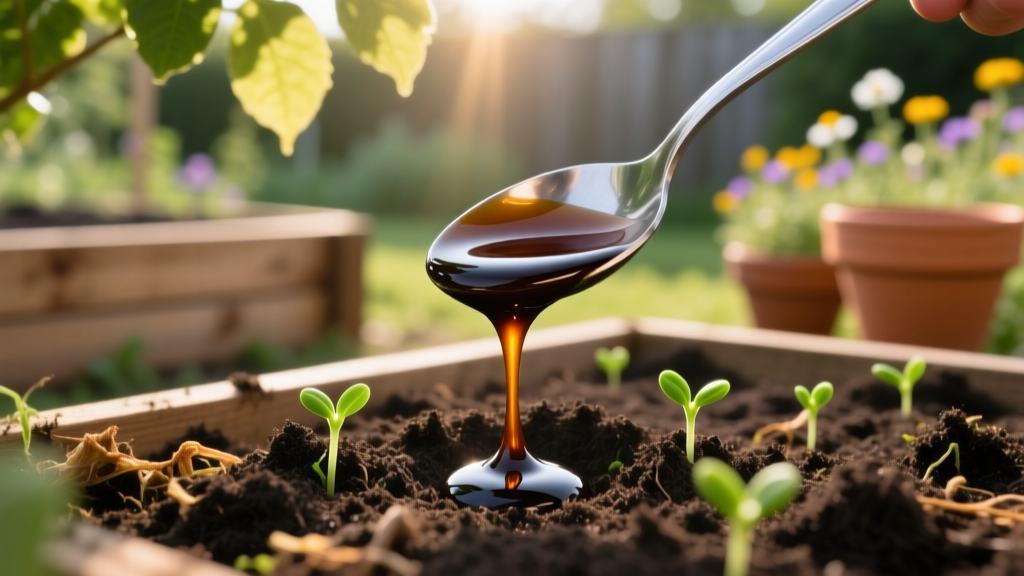
Molasses as a Soil Booster for Gardens
One of the quickest ways to mess up “natural” soil improvement is to treat molasses like a fertilizer. It’s not. Molasses is basically sugar and minerals—so if you dump it on dry soil thinking it’ll “feed” plants directly, you can actually feed the wrong microbes, create a sticky, smelly mess, and invite fungus gnats to the party.
Used the right way, though, molasses is a handy shortcut for waking up soil biology, speeding composting, and helping beneficial microbes do their job. Think of it as an energy drink for your soil’s microbial workforce—not plant food, but a tool to make nutrients cycle faster.
Start with the rules that keep molasses from backfiring
Tip: Use unsulfured blackstrap when you want soil biology, not mystery additives
Buy unsulfured molasses so you’re not adding sulfur dioxide preservatives that can interfere with microbial activity. Blackstrap has the most minerals (like potassium, calcium, and iron), which is why gardeners favor it. A typical price is $6–$10 for a 32 oz bottle, and that can last a surprisingly long time if you’re mixing correctly.
Example: If you’re treating four 4x8 raised beds twice a month, a single 32 oz bottle can cover most of a season at low doses (more on dosing below).
Tip: Always dilute—molasses straight on soil is a magnet for pests
Molasses should be diluted in water before it ever hits soil or compost. Straight molasses can crust over, reduce oxygen at the soil surface, and encourage pest insects that love sugar. The safe “general use” dilution is 1 tablespoon per gallon of water for soil drenching.
Example: If you see ants suddenly farming aphids on your peppers after a molasses application, it’s often because the mix was too strong or spilled undiluted around the base.
Tip: Apply when soil is already moist, not bone-dry
Microbes need moisture and oxygen. Applying a molasses drench to dust-dry soil often causes the liquid to channel down cracks instead of spreading through the root zone—plus microbes can’t respond quickly without moisture. Water lightly first, then apply your diluted mix so it infiltrates evenly.
Example: In midsummer, do a quick 5–10 minute sprinkler run or a light hose soak, then follow with the molasses solution.
Tip: Don’t treat it like a weekly habit—timing matters
Molasses is most helpful in pulses, not constant feeding. A solid schedule is every 2–4 weeks during active growth, or right after adding compost, mulching, or planting transplants. Overdoing it can cause anaerobic smells (a sign you’re tipping the soil toward low oxygen).
Example: If your raised bed smells sour after an application, back off to once a month and use a lighter rate (like 1–2 teaspoons per gallon).
Mixing hacks: get the benefits without the sticky headaches
Tip: Dissolve molasses in warm water first so it doesn’t clog cans or sprayers
Molasses is thick. Mix it into a jar with 1–2 cups of warm water, shake until fully dissolved, then pour into your watering can and top off to a gallon. This prevents the “molasses glob” that sits at the bottom and creates uneven dosing.
Example: If you’ve ever had a hose-end sprayer stop pulling solution halfway through, undissolved syrup is often the culprit.
Tip: Add it to compost tea only if you’re actively aerating
Molasses is often used as a microbial food in compost tea, but only when you’re keeping the brew oxygenated with an air pump. Without aeration, sugar can fuel anaerobic bacteria—exactly what you don’t want near roots. If you’re brewing, keep it short: 24 hours is plenty for most home setups.
Example: A simple bucket tea: 5 gallons of water, a mesh bag of compost, an aquarium air pump, and 1 tablespoon unsulfured molasses added after the pump is running.
Tip: For lawns or big areas, use a hose-end sprayer with a known rate
If you’re treating a big patch (like a lawn renovation area), measuring matters. Many hose-end sprayers can be calibrated so you apply roughly 2–4 tablespoons per 1,000 sq ft in a single watering. Do a test run with plain water first to learn how fast it empties.
Example: For a 2,000 sq ft back lawn, you might apply 6 tablespoons total, split into two passes for even coverage.
Where molasses shines: the best use-cases in real gardens
Tip: Use molasses to “wake up” compost-amended beds after planting
Fresh compost plus a small molasses drench is a classic combo: compost brings microbes, molasses gives them quick energy, and your soil gets faster nutrient cycling. Apply 1 tablespoon per gallon around the root zone 7–10 days after transplanting—not on day one, when roots are still adjusting.
Case example: In a tomato bed amended with 1–2 inches of compost, a molasses drench at day 10 often improves early vigor—especially if the bed was previously low in organic matter.
Tip: Speed up slow compost piles with a measured “sugar kick”
If your compost pile is heavy on browns (dry leaves, straw, shredded cardboard), it can stall. A diluted molasses watering can help microbes get going, but only if you also correct the carbon-to-nitrogen balance. Use 2 tablespoons per gallon to moisten new layers, and add a nitrogen source (fresh grass clippings, manure, or a shovel of “green” material).
Case example: A fall leaf pile that sits cold can heat up within a week after you add greens plus a molasses-moistened turning—especially when daytime temps are still above 55°F.
Tip: Help sandy soils hold onto nutrition by boosting biology, not by over-fertilizing
Sandy soils leak nutrients fast. Molasses won’t fix sand structure alone, but it can support microbial glues that help form aggregates when paired with compost and mulch. Use 1 tablespoon per gallon once every 3–4 weeks during the growing season, and keep a 2–3 inch mulch layer on top.
Case example: If your carrots in sandy beds look “hungry” two weeks after fertilizing, that’s often leaching—adding organic matter plus occasional molasses can help nutrients cycle more steadily.
Tip: After heavy rain, use molasses as a gentle reset for container mixes (with restraint)
Containers get flushed hard by rain or overwatering. A light molasses drench can re-energize microbial activity in potting mixes that include compost, but keep it mild: 1 teaspoon per gallon, once, then wait two weeks and observe. Containers can go anaerobic faster than beds if you overdo it.
Case example: Patio basil in a 5-gallon pot that’s been rained on for a week may perk up after a light feeding schedule—molasses is best paired with a balanced organic fertilizer, not used alone.
What the research and pros say (and what they don’t)
Most of the solid support for molasses in gardening is indirect: we know microbes respond to easily available carbon sources, and molasses is a readily available carbon source. The key is using it to support microbial processes—not imagining it replaces compost, fertilizer, or good soil structure.
“Simple sugars can stimulate microbial activity, but excessive additions can deplete oxygen and create anaerobic conditions.” — Soil microbiology principle commonly emphasized in extension guidance on organic amendments (see Cornell University Cooperative Extension resources on composting and soil health, 2019).
Washington State University Extension notes that microbial activity is strongly driven by available carbon and proper aeration/moisture in compost systems (WSU Extension, 2015). And USDA NRCS soil health materials emphasize keeping soils biologically active with organic inputs and minimizing practices that harm aggregation (USDA NRCS, 2020). Molasses can fit into that framework as a small, targeted carbon boost—especially when compost or mulch is already present.
Smart dosing: quick reference you can actually use
| Goal | Molasses rate | How often | Best paired with | Watch-outs |
|---|---|---|---|---|
| Boost soil biology in beds | 1 tbsp / gallon | Every 2–4 weeks | Compost + mulch | Don’t apply to dry soil |
| Gentle container reset | 1 tsp / gallon | Once, then wait 2 weeks | Compost-based potting mix | Overuse can cause sour smell |
| Compost pile kickstart | 2 tbsp / gallon | At turning/layering | Greens (N source) | Needs oxygen—turn the pile |
| Hose-end sprayer for large areas | 2–4 tbsp / 1,000 sq ft | Monthly | Topdressing compost | Calibrate sprayer first |
Money-saving moves (and when not to bother)
Tip: Compare molasses cost per application to store-bought “microbe boosters”
A 32 oz bottle has 64 tablespoons. At 1 tablespoon per gallon, you get 64 gallons of drench. If the bottle costs $8, that’s about $0.12 per gallon of finished solution—often cheaper than boutique soil stimulants that run $15–$30 a quart.
Example: If you’re drenching 8 beds with 2 gallons each (16 gallons total) once a month, you’re spending roughly $2/month on molasses at that rate.
Tip: Skip molasses if you don’t have organic matter in the system yet
Molasses works best when you already have compost, leaf mold, worm castings, or mulch to support a diverse soil food web. If your bed is basically depleted dirt with no organic inputs, spend your money on a $5–$8 bag of compost first, then use molasses as a helper. Sugar without a microbial “team” behind it is mostly wasted.
Example: New construction soil with rubble and low organic matter: you’ll get more mileage from adding 2 inches of compost than from any amount of molasses.
Tip: DIY alternative—use diluted rinse water from brewing or cooking (only if unsalted)
If you’re already using unsulfured molasses in the kitchen, the warm rinse water from measuring spoons/cups can be poured into a watering can and topped off—think of it as “free” micro-dosing. Just keep it light and avoid anything with salt or oils, which can harm soil structure and roots.
Example: After making a batch of gingerbread, rinse the measuring spoon into a gallon can, then water ornamentals—don’t do this on seedlings.
Common problems and quick fixes
Tip: If you get fungus gnats, reduce dose and let the top inch dry between waterings
Fungus gnats thrive in consistently wet, microbe-rich surfaces—molasses can add fuel if you’re already overwatering. Drop to 1 teaspoon per gallon and apply less frequently, and use a thin layer of coarse sand or mosquito bits as a targeted control if needed.
Example: Indoor seed-starting trays: avoid molasses entirely until plants are up-potted and airflow is strong.
Tip: If soil smells sour, you’ve likely gone anaerobic—add air, not more inputs
A sour or rotten smell after a drench is a red flag for low oxygen. Stop molasses applications, lightly cultivate the surface (or poke holes with a garden fork), and let the bed dry slightly before your next normal watering. In containers, consider repotting into a more airy mix with extra perlite.
Example: A raised bed covered with plastic plus heavy molasses drenching is a classic “anaerobic sandwich.” Remove the cover and let it breathe.
Tip: If plants look worse after molasses, check nitrogen—not “more sugar”
Microbes can temporarily tie up nitrogen while they multiply, especially in beds loaded with woody mulches or carbon-heavy materials. If your plants pale out after you start molasses, back off and apply a gentle nitrogen source (like fish emulsion) at label rate. Molasses isn’t the fix for a nutrient imbalance—it can amplify it.
Example: Straw-mulched potatoes that yellow after repeated molasses drenches often respond better to a measured nitrogen feed than to any additional microbial stimulant.
Three real-world garden scenarios (how to use molasses like a pro)
Scenario 1: The tired raised bed that “eats fertilizer”
If you fertilize and the bed still looks weak, it’s often because the soil biology and organic matter are low, so nutrients aren’t cycling well. Topdress with 1 inch compost, water it in, then apply 1 tablespoon molasses per gallon around the planting zone every 3 weeks for two cycles. Keep a 2-inch mulch layer to maintain moisture and microbial habitat.
Scenario 2: The compost pile that refuses to heat
A cold pile is usually a balance problem: too dry, too brown, or not enough oxygen. Wet the pile evenly (not soggy) using 2 tablespoons per gallon molasses water as you turn it, and mix in nitrogen-rich greens in thin layers. If you can grab a handful and only a drop or two comes out when squeezed, you’re in the right moisture zone.
Scenario 3: The heavy clay bed that stays sticky and slow
Clay needs aggregation, not sugar. Work in compost, avoid compaction, and use molasses only as a light helper once the bed is managed with organic matter. Apply 1 tablespoon per gallon monthly during warm weather, and pair it with a broad mulch layer so the soil doesn’t crust between waterings.
Practical note: If you’re walking on clay beds when wet, stop—no molasses trick will undo compaction as fast as it happens.
Little extras that make molasses work better
Tip: Pair molasses with kelp for a “microbes + micronutrients” one-two punch
If you already use kelp extract, a small amount alongside molasses can be useful: kelp brings trace minerals and plant hormones, molasses feeds microbes that help cycle nutrients. Keep both modest—don’t turn it into a sugary soup. A common home mix is 1 tablespoon molasses + 1 teaspoon kelp extract per gallon applied once a month.
Example: This combo is popular in transplant weeks for peppers and tomatoes—especially in beds that are compost-amended but still waking up in late spring.
Tip: Use it after mulching to reduce that “nitrogen dip” effect
Fresh wood chips and straw can trigger nitrogen tie-up near the soil surface. A light molasses drench can help microbes process mulch more evenly, but don’t skip nitrogen if your crops need it. Apply 1 tablespoon per gallon after mulching, then monitor leaf color over the next 10–14 days.
Example: If you mulch around young brassicas and they start paling, add a nitrogen feed—molasses alone won’t supply what they’re missing.
Tip: Keep a “small-dose” bottle for precision instead of eyeballing from a jug
Overapplication is the #1 molasses mistake. Pour some molasses into a squeeze bottle and label it with your favorite rate (like “1 tbsp/gal”). You’ll use it more consistently and waste less—especially when you’re mixing multiple cans in a week.
Molasses is one of those garden tools that looks too simple to matter, but it can be a real helper when you use it like a microbial nudge instead of a magic potion. Keep it diluted, use it in pulses, pair it with compost and mulch, and watch the soil do what healthy soil does: cycle nutrients faster, hold moisture better, and grow sturdier plants with fewer “mystery issues.”
Sources: Washington State University Extension composting guidance (WSU Extension, 2015); USDA NRCS Soil Health resources emphasizing biological activity and aggregation (USDA NRCS, 2020); Cornell Cooperative Extension soil health and composting resources discussing microbial stimulation and aeration principles (Cornell CCE, 2019).