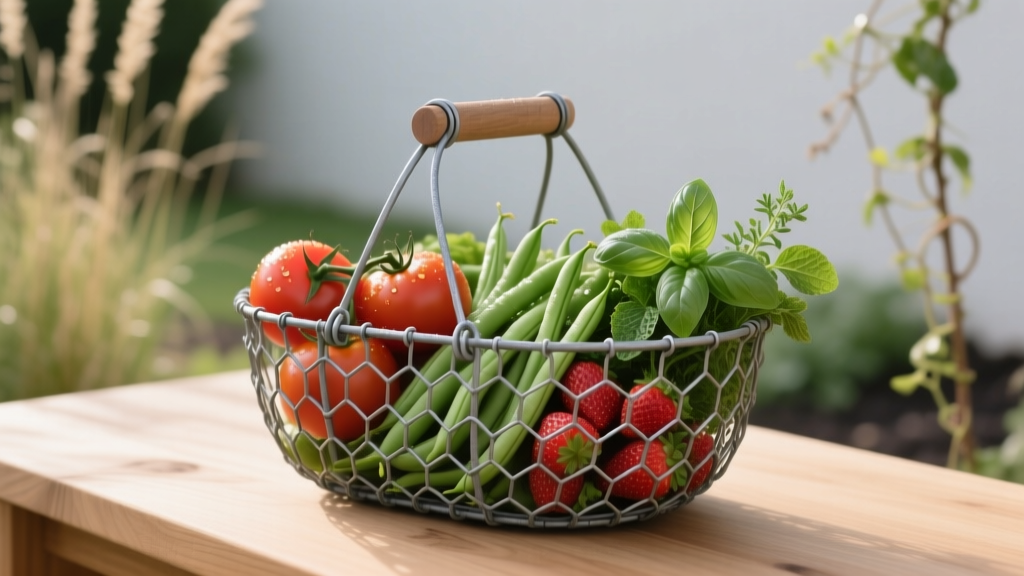
DIY Garden Harvest Basket from Wire
Most harvest baskets fail for one boring reason: the handle and the body are built like two separate projects. You pick up 8–12 lb of tomatoes or potatoes, the basket flexes, the handle twists, and suddenly you’re doing the “one arm under the bottom” carry all the way back to the shed. A wire harvest basket fixes that—if you build it so the handle load transfers into the frame instead of ripping at a couple of weak attachment points.
This is a tips-and-tricks article, so instead of a long build tutorial, you’ll get the insider moves: wire gauge choices that actually hold up, basket shapes that don’t bruise produce, fast ways to form clean curves, and little add-ons that make a DIY basket feel like a tool you’d buy.
Start with the Right Materials (So It Doesn’t Turn Into a Wobbly Sculpture)
Use two wire “strength zones” instead of one wire for everything
Tip: Build the rim and handle with thicker wire than the basket walls. The rim takes the twisting force and the handle takes the full load, so don’t ask lightweight wire to do heavy work. A great combo is 9–10 gauge galvanized wire for the rim/handle and 12–14 gauge for the basket sides and bottom.
Example: For a 14" x 10" basket that routinely carries onions and winter squash, using 9-gauge for the rim keeps the mouth from “oval-ing” after a season of use.
Pick galvanized wire if you wash produce in the basket
Tip: Choose galvanized (or stainless) if the basket will get wet. Bare steel can start rusting fast if you’re rinsing muddy carrots right in the basket. Galvanized wire is usually the sweet spot for cost and longevity, while stainless is premium-priced but nearly bombproof.
Cost reality: A 50 ft coil of galvanized utility wire is often $10–$20, while stainless can jump to $25–$60+ depending on gauge and supplier.
Don’t skip food-contact common sense
Tip: Smooth the cut ends or cap them. Wire ends can snag kale leaves, puncture tomatoes, and slice fingers when you’re moving fast. A quick fix is to file ends smooth and add a dab of epoxy, or slide on short pieces of vinyl tubing (even aquarium tubing works).
Example: If you harvest raspberries, one sharp wire tip can turn a basket into a berry-masher—tubing caps prevent the “mystery squish” at the bottom.
Design Tricks That Make Harvesting Faster (and Gentler on Produce)
Choose a shape that matches what you grow most
Tip: Use a shallow, wide basket for tender crops; deeper for rugged crops. Tomatoes, peaches, and cucumbers bruise when stacked too deep; potatoes and onions don’t care. For mixed harvests, aim for 4–6 inches of depth so you don’t crush the bottom layer.
Scenario: If your summer harvest is mostly tomatoes and peppers, a wide 16" x 12" footprint lets you spread fruit in one layer, reducing bruising on the walk back to the kitchen.
Build the handle so it can’t twist loose
Tip: Run the handle wire down the sides and under the bottom. Instead of attaching the handle at two points on the rim, create a continuous “U” that becomes part of the frame. This spreads a 10 lb load across the whole basket and keeps the handle from wobbling over time.
Example: When harvesting winter squash (often 3–5 lb each), a through-frame handle keeps the basket stable when you set it down on uneven ground.
Use a “double rim” to stop deformation
Tip: Wrap the rim twice or add a second ring. A single ring can bend into an oval after a season of hard use; a second ring stiffens the opening dramatically. Space the rings about 1/2 inch apart and tie them together every 2 inches with thin wire wraps.
Real-world use: If you’re the type who hangs tools from the basket handle while harvesting (pruners, knife), the double rim keeps the mouth from sagging.
Building Shortcuts That Save Time (and Look Cleaner)
Make a simple bending jig from scrap wood
Tip: Screw two scrap blocks to a board to form consistent bends. Place them the width of your desired curve apart (like a DIY wire “corner”) and pull the wire around them. This saves you from fighting the wire with pliers and gives you repeatable corners.
Numbers that help: For a basket with a 14" x 10" top opening, make your jig corners with a 1.5" radius so the corners aren’t sharp (sharp corners catch stems and tear gloves).
Pre-cut and label wire lengths before you start twisting
Tip: Cut everything first and bundle by part. It’s faster to measure once and cut a set of matching pieces than to stop mid-build and keep re-measuring. Use masking tape tags like “RIM,” “BOTTOM RUNS,” and “SIDE UPRIGHTS.”
Example: Cut 8–10 bottom wires at the same length so the spacing stays even and the basket sits flat without rocking.
Twist ties neatly with a drill (yes, really)
Tip: Use thin tie wire and a cordless drill for uniform wraps. Cut 4–6 inch pieces of 16–18 gauge tie wire, hook the ends, and spin slowly with a drill to get tight, even wraps. Stop as soon as the wrap is snug—over-twisting makes brittle break points.
Scenario: If you’re building two baskets (one for you, one for a neighbor), drill-wrapping can cut your assembly time by an hour and the finished joints look surprisingly “store-bought.”
Spacing, Lining, and Produce Protection (So Your Basket Doesn’t Beat Up Your Harvest)
Use spacing based on what falls through
Tip: Set wire spacing to your smallest common crop. For general use, 1/2 inch spacing on the bottom keeps cherry tomatoes and small shallots from slipping through, while still letting soil fall out. If you mainly harvest potatoes, you can open it up to 3/4 inch and the basket will shed dirt faster.
Example: A “potato basket” with wider spacing is a joy during harvest: you shake once and half the soil drops out before you even leave the row.
Add a removable liner instead of building a fussy fine-mesh basket
Tip: Line it only when needed. A wire basket is ideal because it ventilates and rinses clean, but berries and beans like to poke through. Keep a removable liner: a cut piece of burlap, an old pillowcase, or a sewn tote insert with clips.
Cost hack: A thrift-store cotton pillowcase is often $1–$3 and makes a perfect “berry mode” liner without changing the basket.
Go easy on padding—airflow matters more than people think
Tip: Don’t permanently pad the inside with foam. Foam holds moisture, which speeds spoilage and can encourage mold. Produce quality depends heavily on temperature and humidity management; breathable containers help you cool and dry harvest faster.
“Rapid removal of field heat is critical to maintaining quality and shelf life in most fresh fruits and vegetables.” — UC ANR Postharvest Technology Center (UC Davis), 2015
Example: After harvesting greens on a warm morning, a wire basket lets air move around leaves so they don’t turn slimy before you can wash and chill them.
Make It Comfortable to Carry (Because You’ll Use It More)
Wrap the handle so it doesn’t bite your hand
Tip: Add a grip that can be replaced. Bare wire handles get painful fast once you pass about 8 lb of produce. Wrap with jute twine, bicycle handlebar tape, or slip on a piece of old garden hose (split lengthwise) and secure with zip ties.
Scenario: If you harvest daily during peak season, a cushioned grip keeps your hand from getting sore and makes one-trip hauling realistic.
Balance the handle position before you lock it in
Tip: Test balance with real weight. Before you permanently twist and crimp the handle connections, load the basket with something like a 10 lb bag of potatoes (or a couple of bricks) and lift. Adjust the handle anchor points until the basket hangs level; even a 1 inch shift can stop annoying tipping.
Example: A slightly front-heavy basket will dump beans and cherry tomatoes when you crouch—balance testing prevents that heartbreak.
Rust, Cleaning, and Food-Safe Finishes (So It Lasts for Years)
Skip paint on interior surfaces; use cold galvanizing on repairs
Tip: Avoid thick coatings where produce rubs. Paint can chip, and chips end up in your harvest basket. If you need touch-up, use a cold galvanizing compound on exposed steel spots and let it cure fully per label directions (often 24 hours).
Example: If you cut and reshape the basket next season, hit the new cut ends with cold galvanizing and cap them—no rust blooms, no snag points.
Clean with a quick sanitize when you’ve hauled anything questionable
Tip: Use a bleach solution when the basket gets contaminated. If you’ve used it for rotting fruit cleanup or anything that smells “fermenty,” sanitize: 1 tablespoon unscented bleach per 1 gallon of water, then air-dry. This aligns with common food-contact sanitation recommendations used in home and farm settings.
Citation: The CDC’s guidance for sanitizing food-contact surfaces includes bleach-and-water solutions in appropriate dilutions (CDC, 2020).
Example: After a tomato split-and-mold incident, a quick sanitize prevents that smell from becoming permanent.
Smart Add-Ons That Feel Like Cheating
Add “feet” so the basket doesn’t sit in mud
Tip: Bend four small feet from leftover wire. Create 1 inch standoffs at the corners or add two runners along the bottom. It keeps your harvest out of wet soil when you set the basket down between rows.
Scenario: In spring gardens with damp paths, feet keep lettuce clean when you pause to cut a few heads.
Clip-on divider for mixed harvest days
Tip: Make a removable divider from hardware cloth. Cut a panel to fit, fold edges over so they’re not sharp, and attach with binder clips. This stops potatoes from bruising tomatoes when you’re doing “one pass” harvesting.
Example: Half the basket for beans, half for peppers—no bean ends poking and no pepper scuffs.
Hang a tool loop off the rim (and stop losing your snips)
Tip: Twist a small loop on the rim for pruners. A 2 inch loop of thinner wire gives you a dedicated spot for snips so they’re not buried under cucumbers. Place it near the handle so weight stays centered.
Scenario: If you harvest cut-and-come-again greens, that loop saves you from setting your knife down in the bed and “donating” it to the compost pile for a week.
Three Real-World Builds (Choose the One That Matches Your Garden Life)
The “Salad Night” basket (lightweight, gentle, fast)
Build idea: Aim for a 12" x 8" footprint and 4" depth with 1/2" bottom spacing and a pillowcase liner. Keep the wire light (12–14 gauge sides) so it’s easy to carry one-handed while you pinch herbs with the other.
When it shines: Quick evening harvests of lettuce, basil, and cherry tomatoes—easy rinse, quick dry, no crushed leaves.
The “Root Crop Shake-Out” basket (built to get dirty)
Build idea: Go 16" x 12" and 7–8" deep, with 3/4" spacing on the bottom and stout rim wire (9–10 gauge). Add bottom runners so you can set it down in the furrow without it tipping.
When it shines: Potato and onion harvest days—shake once, dirt drops, and you’re not hauling half your garden soil back to the house.
The “Farmstand-ready” basket (pretty enough to display)
Build idea: Add a double rim, uniform drill-twisted wraps, and a removable fabric liner in a neutral color. Keep dimensions around 14" x 10" so it fits on a counter, and wrap the handle with jute for a finished look.
When it shines: If you sell or gift produce, a tidy wire basket doubles as packaging—customers love the “crate look” without the splinters.
Wire Basket vs. Common Alternatives (What You Gain and What You Give Up)
| Basket Type | Typical Cost | Best For | Watch Outs |
|---|---|---|---|
| DIY wire harvest basket | $15–$35 (materials) | Rinsing, airflow, durability | Needs smoothed ends; can bruise tender fruit without liner |
| Plastic colander-style basket | $8–$25 | Lightweight, easy cleaning | UV brittleness; handles can crack under 10–15 lb loads |
| Wicker basket | $20–$60 | Gentle on produce, looks great | Harder to sanitize; can mold if stored damp |
| 5-gallon bucket | $5–$10 | Bulk harvest, weeds, hauling | Zero airflow; stacks weight and bruises easily |
Money-Saving Sourcing Tricks (Because New Hardware Adds Up Fast)
Buy wire in the “utility” aisle, not the craft aisle
Tip: Skip decorative wire pricing. Craft wire is nice, but you’ll pay for color and softness you don’t need. Utility galvanized wire (often sold for fencing repairs) gives more feet per dollar and holds shape better.
Example: If you’re building two baskets, the price difference between craft wire and utility wire can easily cover a new pair of snips—think $15–$30 saved depending on local pricing.
Use scavenged materials safely
Tip: Old fencing is fine if it’s clean and not chemically treated. Avoid unknown coated wires and anything that was in contact with chemicals. If you can’t confirm the source, use it for a tool basket instead of food harvest.
Citation: Many extension services emphasize using food-safe materials and avoiding contamination risks when handling produce (e.g., University of Minnesota Extension postharvest handling guidance, 2019).
Troubleshooting: Fix the Annoying Stuff Before It Gets Worse
If the basket rocks, your bottom wires aren’t in one plane
Tip: Flatten by over-bending, then relaxing. Flip the basket upside down on a flat surface, find the high corner, and gently over-bend it past level, then let it spring back. Wire has “memory,” so small corrections work better than big yanks.
Example: A rocking basket on a patio table is a guaranteed tomato-rolling machine—flatten it once and you’ll stop chasing produce.
If joints loosen, you used the wrong tie wire (or didn’t cinch it)
Tip: Match tie wire to the stress level. Use 16–18 gauge for most wraps and add extra wraps near the handle anchors. If a joint is already loose, re-wrap it rather than trying to tighten a fatigued twist (that’s how snaps happen).
Scenario: A basket that carries apples in fall needs more reinforcement at the rim than a summer herb basket—seasonal use matters.
If you’re snagging leaves, you’ve got one sharp point somewhere
Tip: Do the “rag test.” Drag a scrap of cotton fabric around the inside and rim; it will catch on burrs instantly. File, cap, or fold the offending end back into a wrap so it can’t grab plant material.
Example: If your kale keeps tearing on the way out of the garden, it’s almost always a single wire tail you missed.
A good wire harvest basket ends up feeling like a shortcut you use every day: pick, shake, rinse, carry, set down—no babying required. Build it like a tool (reinforced rim, through-frame handle, smooth ends), then customize it like a gardener (liner when needed, feet for mud, divider for mixed harvests). Once you’ve carried one balanced, comfortable basket back from the garden with 10–15 lb of produce and no bruising, it’s hard to go back to buckets.