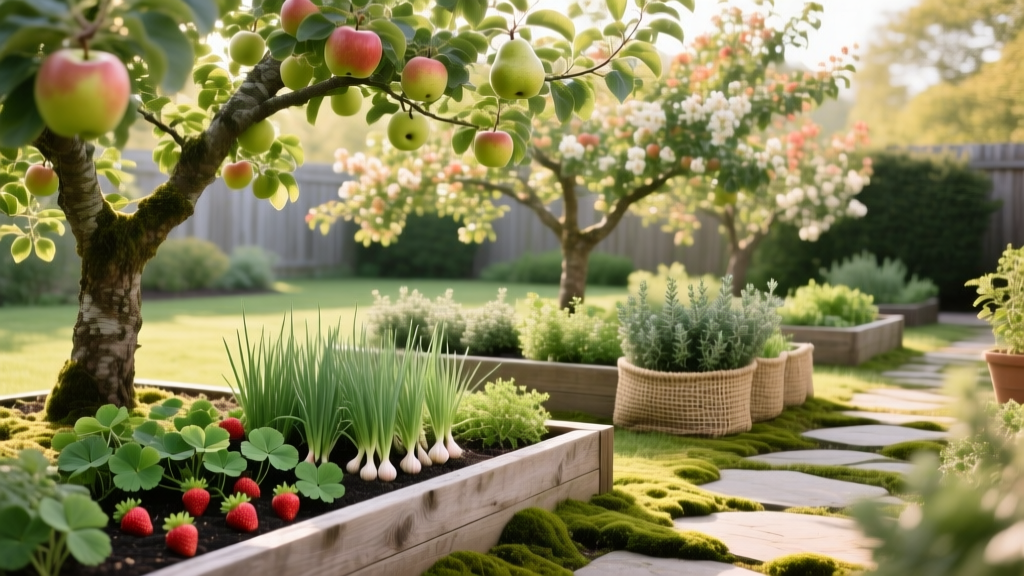
Backyard Orchard Underplanting Ideas
You planted the fruit trees because you wanted spring blossoms, summer shade, and the satisfaction of picking a warm peach right off the branch. Then reality set in: bare soil under the canopy turns to mud in winter, dust in summer, and weeds any time you look away for a week. The space should be productive, beautiful, and easy to care for—but it often becomes the hardest part of the yard.
Underplanting is the designer’s fix for that awkward zone between trunk and dripline. Done well, it stabilizes soil, suppresses weeds, invites pollinators, and creates a “garden room” beneath your trees. Done poorly, it competes for water, encourages pests, and makes harvest annoying. Let’s lay it out like a project: clear geometry, plant layers with specific jobs, and a maintenance rhythm you can actually keep.
Design principles that keep trees healthy and the underplanting lush
Start with the tree’s “no-crowd zone”
Fruit trees need airflow and dry bark at the base. Keep a planting-free ring around the trunk, then build outward. A practical rule for most backyard trees:
- Keep a 12–18 inch (30–45 cm) radius clear around the trunk (no plants, no mulch touching bark).
- Mulch beyond that ring with 2–4 inches of wood chips or shredded leaves.
- Place the most water-demanding plants at the outer half of the canopy (closer to the dripline), not right next to the trunk.
This aligns with common extension guidance to keep mulch from contacting tree trunks to reduce disease and rodent damage (e.g., University of Maryland Extension, 2023).
Design in layers: groundcover, herb layer, “support” flowers
The easiest underplanting looks intentional because it repeats layers:
- Groundcover layer (weed suppression, soil cooling): low, spreading, mowable or step-tolerant if you harvest frequently.
- Herb layer (beneficial insects, kitchen harvest): clumping plants you can cut back and re-grow.
- Flower layer (pollinators, pest confusion): small perennials/annuals that bloom in waves.
Think of it like furnishing a room: the groundcover is your rug, herbs are the seating, flowers are the art.
Sunlight math: orchard shade is not “full shade”
Most backyard fruit trees create dappled light, especially if you summer-prune. Measure what you actually have:
- Full sun: 6–8+ hours direct sun (best for strawberries, thyme, many flowers).
- Part sun/part shade: 3–6 hours (great for chives, mint in containers, many native woodland-edge plants).
- Bright shade: under dense canopies; choose tough groundcovers and skip thirsty annuals.
If you can, prune to allow light and airflow. The USDA notes that pruning improves light penetration and can increase fruit quality (USDA ARS, 2015).
Access paths are part of the planting plan
Underplanting fails when you can’t comfortably pick fruit, thin apples, or set a ladder. Build a simple layout:
- A 24–30 inch wide access path between underplanting zones (mulch, stepping stones, or clover you can mow).
- A 3-foot “drop zone” near the tree where you can set a harvest basket or small ladder without crushing plants.
A designer trick: curve the path slightly so it feels intentional, not like you avoided planting.
Water strategy: dripline beats sprinklers under trees
Competing roots are the main worry. Your fix is targeted water and mulch:
- Run 1/2-inch drip line or soaker hose in a ring near the dripline.
- Plan to deliver 1 inch of water per week during dry spells (including rainfall), adjusting for your soil.
- Mulch 2–4 inches deep to reduce evaporation.
“Mulches moderate soil temperature, conserve moisture, and can significantly reduce weed pressure—benefits that compound in perennial systems like orchards.” — Linda Chalker-Scott, Washington State University Extension (2019)
Layout strategies you can copy (and tweak)
The “donut bed” for single trees
For one tree in lawn (common for renters with permission, or homeowners with a mixed yard), create a donut-shaped bed:
- Inner clear ring: 12–18 inches radius.
- Planted ring: from 18 inches out to 4–6 feet radius (depending on canopy size).
- Outer edge: crisp spade-cut circle or metal edging for easy mowing.
This keeps the trunk safe, gives you enough planting area to matter, and makes the orchard feel designed rather than accidental.
The “strip understory” for multiple trees in a row
If you have 3–6 fruit trees spaced in a line, treat the space as an understory garden strip:
- Keep a 2–3 foot wide mulch-only band around trunks and along the row for easy irrigation checks.
- Plant a repeating mix between trees, leaving a 24-inch access lane on one side.
Spacing reference point: many semi-dwarf apples are often planted 12–15 feet apart; dwarf apples can be 8–10 feet apart (varies by rootstock and training). Match underplant density to the space you truly have, not the Pinterest version.
The “guild wedges” for mixed species orchards
Mixed orchards (apple + plum + cherry) have different bloom times and shade patterns. Use wedges—like slices of pie—so each tree gets a tailored mix. A wedge might be:
- One nitrogen-fixer (like white clover).
- One deep-rooted mineral accumulator (like comfrey—use sterile cultivars where recommended).
- Two insectary flowers (like yarrow and alyssum).
- One culinary herb (like thyme).
Wedges let you adjust plant choices without redesigning the whole orchard when one tree grows faster than the others.
Step-by-step setup (a practical weekend plan)
- Map the canopy: on a sunny day, note where the shadow falls at 10 a.m., 1 p.m., and 4 p.m. Write down estimated sun hours (aim to identify zones of 3–4 hours vs 6+ hours).
- Mark the trunk ring: measure 12–18 inches from trunk and mark a circle—this stays plant-free.
- Remove turf/weeds: sheet-mulch with cardboard plus 3 inches of compost and 2–4 inches of wood chips, or cut sod and flip it upside down under mulch.
- Install irrigation: a drip ring near the dripline (not at the trunk). Budget $30–$80 per tree for basic tubing, connectors, and a timer, depending on complexity.
- Place plants in pots first: set them on top of mulch and walk your harvest route. Adjust so you’re not stepping on strawberries with a basket of pears.
- Plant in layers: groundcover first, then herbs, then flowers. Water in deeply.
- Mulch gaps: keep mulch off stems; top up where sunlight hits bare soil.
Plant selection: specific varieties that behave well under fruit trees
Groundcovers that suppress weeds without bullying the tree
White clover (Trifolium repens) is a classic living mulch. It tolerates mowing and foot traffic and helps support pollinators. Keep it trimmed before it smothers small plants. Good for orchard paths and outer rings.
Creeping thyme (Thymus serpyllum ‘Elfin’ or ‘Coccineus’) stays low, handles dry soil once established, and smells amazing when stepped on. Ideal for the sunnier outer half of the canopy. Space plants 10–12 inches apart for quicker fill.
Wild strawberry (Fragaria vesca ‘Alexandria’) gives a tidy groundcover with edible berries, tolerating part sun. It’s less aggressive than some standard strawberry runners and fits small beds. Space 12 inches apart.
DIY alternative: If budgets are tight, sow clover seed (often $8–$15 for enough to cover several trees’ worth of rings) instead of buying flats of groundcovers.
Herbs that thrive on neglect (and help the orchard)
Chives (Allium schoenoprasum) and garlic chives (Allium tuberosum) are underplanting workhorses: clumping, drought-tolerant, and attractive to beneficial insects when flowering. Plant in groups of 3–5 clumps, spacing 8–12 inches.
Oregano (Origanum vulgare ‘Greek’) is tough and pollinator-friendly. Keep it at the outer canopy edge so it doesn’t creep into your trunk ring. Space 12–18 inches.
Mint (Mentha spp.) is useful but risky. If you want it, plant it only in containers sunk into the soil (a 10–12 inch pot works) to prevent takeover.
Comfrey (Symphytum) is often used in orchard systems for biomass mulch. If you choose it, look for sterile selections like Symphytum × uplandicum ‘Bocking 14’ and place it 3–4 feet from the trunk so it doesn’t crowd young trees. Cut leaves 2–4 times per season and lay them as mulch (a free fertility loop).
Flowers that support pollination and beneficial insects
Sweet alyssum (Lobularia maritima ‘Carpet of Snow’) is a small annual that blooms for months, drawing hoverflies and tiny beneficial wasps. Tuck it along edges; it reseeds gently in many climates.
Yarrow (Achillea millefolium ‘Paprika’) is drought-tolerant and a strong beneficial insect plant. Its flat flower clusters are easy landing pads for predators of aphids. Place yarrow where it gets 6+ hours sun.
California poppy (Eschscholzia californica) (or a regional native poppy) handles dry soil and brings early color. Let it self-sow in the outer ring and pathways.
Borage (Borago officinalis) is a pollinator magnet and a great companion near strawberries. It can self-seed heavily; deadhead if you prefer a tidier look.
Quick comparison: underplanting “styles” and how they behave
| Underplanting style | Best for | Typical spacing | Water needs | Maintenance | Watch-outs |
|---|---|---|---|---|---|
| Living mulch (white clover + thyme) | Weed control + walkable harvest routes | Seed clover; thyme 10–12 in. | Low after establishment | Trim 1–2x/month in spring | Can compete with young trees if not irrigated properly |
| Edible understory (wild strawberry + chives + herbs) | Small spaces, frequent picking | Strawberry 12 in.; chives 8–12 in. | Moderate | Weekly harvest keeps it tidy | Strawberries attract slugs; use mulch and monitoring |
| Insectary ring (alyssum + yarrow + native flowers) | Reducing pest pressure naturally | Alyssum 6–8 in.; yarrow 18–24 in. | Low–moderate | Cut back 1–2x/year | Self-seeding can look messy without edging |
Budget planning: what it really costs (and where to save)
For a single mature tree with a 6-foot radius underplant zone (about 113 sq ft), here’s a realistic range:
- Compost: 8–10 bags (1.5–2 cu ft) at $5–$8 each = $40–$80
- Mulch: 10–15 bags at $3–$6 each = $30–$90 (or free/cheap chip drops in many areas)
- Plants: 12–24 starts at $4–$12 each = $50–$200 depending on density and perennials
- Drip parts: $30–$80 per tree zone
DIY savings: swap purchased plants for seed (alyssum, clover, poppies) and divisions (chives split from a neighbor, oregano cuttings). Use cardboard from shipping boxes for sheet-mulch. Ask local arborists for wood chips—often free.
Three real-world scenarios (with layouts you can picture)
Scenario 1: Small urban yard with two semi-dwarf apples
Space: a 20 ft × 30 ft backyard. Two semi-dwarf apples planted 12 feet apart, with a fence along one side that creates afternoon shade.
Design move: create a shared understory strip between the trees and a narrow access lane. Use a living mulch that can handle foot traffic.
- Underplant palette: white clover (path + filler), creeping thyme ‘Elfin’ (sunny edges), chives (near the path for easy snipping), sweet alyssum (season-long bloom).
- Spacing: thyme at 12 inches, chives in clumps every 2–3 feet.
- Harvest access: a 30-inch mulch path on the fence side so you can prune and thin without stepping in plants.
Why it works: you get a clean layout that reads as “designed,” and the clover/thyme mix forgives missed watering better than a dense perennial border.
Scenario 2: Renter-friendly patio orchard with containers and one in-ground plum
Space: a rental with a small lawn and a paved patio. Landlord allows one tree in-ground and container plantings.
Design move: keep the in-ground area simple and move the edible complexity into pots you can take with you.
- In-ground plum underplant: wild strawberry ‘Alexandria’ + sweet alyssum + a clear 18-inch trunk ring.
- Container “understory” on patio: mint (in a pot), thyme, calendula, and basil in summer.
- Cost control: buy 6-packs of alyssum and start strawberries from seed or small plugs.
Why it works: the plum gets weed suppression and pollinator support, while your higher-maintenance herbs stay close to the kitchen hose. If you move, your best plants come with you.
Scenario 3: Suburban mixed orchard with heavy clay and inconsistent irrigation
Space: three trees (pear, peach, apple) in clay soil that cracks in summer and holds water in winter.
Design move: prioritize soil structure and plants that tolerate “wet feet” in winter and dryness in summer, with clear mulch basins.
- Soil prep: sheet-mulch and add compost, but avoid over-tilling clay (it can clod). Maintain a mulch layer year-round at 3–4 inches.
- Plant palette: yarrow ‘Paprika’ (outer ring), chives, oregano ‘Greek’, and clover kept trimmed. Add borage sparingly where you want biomass and pollinators.
- Spacing: yarrow at 18–24 inches to prevent a humid tangle.
Why it works: you’re choosing resilient plants and using mulch as the main soil tool. Clay improves through surface organic matter over time, not through constant disturbance.
Maintenance expectations: what you’re signing up for
A well-designed underplanting should reduce overall work, not add a new chore list. Here’s a realistic rhythm:
- Weekly (growing season): 20–40 minutes per tree zone for checking drip lines, pulling a few weeds, and harvesting herbs/berries.
- Spring (1–2 sessions): top up mulch, divide chives/oregano if crowded, re-seed alyssum or poppies if desired.
- Early summer: cut back aggressive growers (oregano, comfrey if used) and keep a clear harvesting path.
- Late summer: refresh irrigation schedule; remove any fallen fruit promptly to reduce pest buildup.
- Autumn: chop-and-drop spent flowers, add leaves under the canopy as an extra mulch layer (shred them if possible so they mat less).
- Winter: prune trees for light and airflow; check that mulch hasn’t drifted against trunks.
One honest note: underplanting can hide dropped fruit. If codling moth or other pests are an issue in your area, you’ll want a habit of quick cleanups after windstorms and during harvest windows.
Common pitfalls (and how designers avoid them)
Pitfall: planting thirsty annuals right against the trunk.
Fix: keep that 12–18 inch clear ring, then plant drought-tolerant perennials closer in and thirstier plants toward the edge where you can water them without soaking the trunk.
Pitfall: choosing “cute” groundcovers that become a solid mat you can’t walk through at harvest.
Fix: keep a 24–30 inch access lane, use stepping stones, or pick mowable living mulch like clover.
Pitfall: creating a slug resort with dense mulch and strawberries in deep shade.
Fix: use coarser mulch (wood chips), open the canopy with pruning, and keep strawberries in the brighter outer ring.
A sample planting plan you can implement this month
For one apple tree with a roughly 10-foot canopy diameter:
- 0–18 inches from trunk: bare soil + light mulch kept off bark
- 18 inches–4 feet radius: chives (6 clumps) + oregano (2 plants) + alyssum (one 6-pack dotted in)
- 4–5 feet radius: creeping thyme (8–12 plants) + yarrow (2–3 plants)
- Path: a 30-inch mulch lane on the side you approach most often
It reads clean, it flowers for beneficial insects, and it doesn’t ask you to baby it daily. After one season, you’ll see where the shade truly falls and can nudge the palette—more thyme where it’s sunny, more clover where you walk, fewer flowers where harvest traffic is heavy.
The goal isn’t to stuff every inch with plants. The goal is to make the space under your orchard work like a designed landscape: stable soil, easy access, and a planting mix that earns its keep—week after week, year after year.
Sources: University of Maryland Extension (2023), “Mulching Trees and Shrubs”; USDA Agricultural Research Service (2015), research summaries on pruning/light interception and fruit quality; Washington State University Extension (2019), Linda Chalker-Scott publications on mulch benefits.