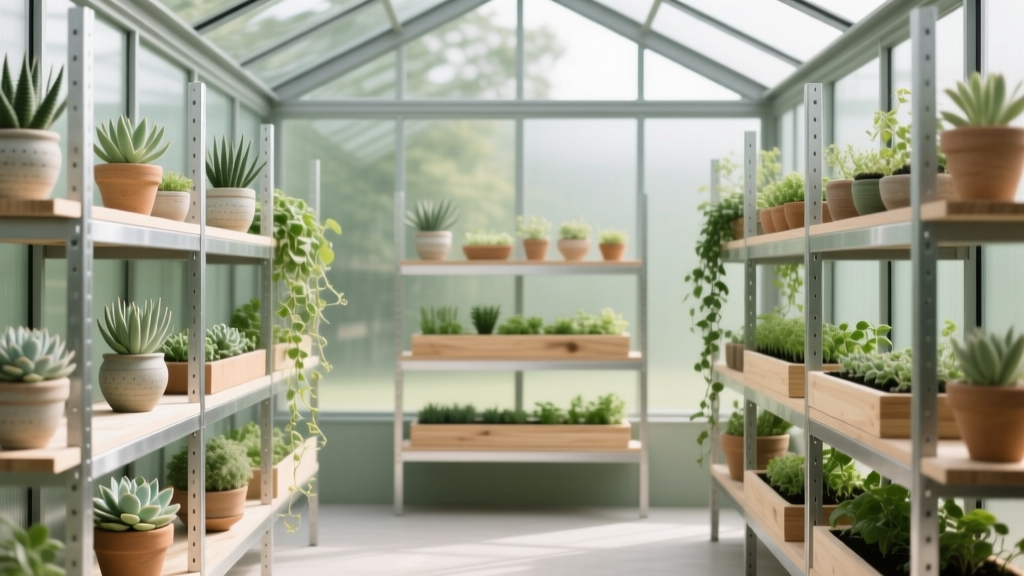
Greenhouse Shelving and Layout Tips
It’s a cold March morning, and you step into your greenhouse with a mug of coffee, expecting that comforting hit of warm soil and green promise. Instead: trays stacked on the floor, seed packets buried under a potting mix avalanche, and a lanky tomato start leaning sideways because it’s chasing the only clean shaft of light. You can grow plants in chaos—but you can’t grow well in chaos for long. A greenhouse is a tiny building with big ambitions, and the way you arrange shelves, pathways, and plant zones decides whether it feels like a calm studio…or a cramped storage unit with leaves.
Let’s design your greenhouse the way a landscape designer would: start with the “bones” (circulation, light, and airflow), then layer in shelves and work surfaces, then choose plants that match the microclimates you create. I’ll walk you through layouts that work for homeowners and renters, with real numbers, costs, and a few case examples you can borrow outright.
Start with the three non-negotiables: light, access, airflow
Before you buy another rack or hang another pot, treat your greenhouse like a small room that needs a functional floor plan. In every successful greenhouse layout I’ve designed or helped troubleshoot, the same three principles win: maximize usable light, keep access simple, and keep air moving.
Light: place shelves where the sun can actually feed plants
Most greenhouse crops want 6–8 hours of direct sun or very bright light to stay compact and productive (especially fruiting plants like tomatoes and peppers). In northern climates, winter sun is lower and weaker, so tall shelving along the sun-facing side can cast long shadows. A practical default is:
- Keep the brightest wall for the shortest plants (seedlings, lettuces, herbs).
- Put tall plants on the north side (in the Northern Hemisphere) so they don’t shade everything else.
- Choose wire or slatted shelves to avoid creating dark “caves” under solid surfaces.
For reference, the Royal Horticultural Society notes the importance of ventilation and managing heat build-up in greenhouses, which directly affects plant performance and can compound light stress when temperatures spike (RHS, 2023).
Access: design the walkway first, then fit shelving around it
If you can’t reach it comfortably, you won’t water it evenly, scout pests early, or rotate trays for uniform growth. A good walkway width is:
- 18–24 inches for a tight, single-person pass (fine for renters with a mini greenhouse).
- 30 inches if you want to carry trays without turning sideways.
- 36 inches if you’ll use a small cart or need accessibility clearance.
Pathways are not wasted space; they’re your maintenance lane. I’d rather see one fewer shelf and a clean, comfortable aisle than a greenhouse you dread entering.
Airflow: leave breathing room around plants and shelves
Airflow prevents fungal issues and helps stems grow sturdier. A simple rule: allow 2–4 inches between trays/pots and the greenhouse wall, and don’t pack plants leaf-to-leaf once they’re past the seedling stage. If you use plastic-covered shelving, treat it like a windbreak, not a sealed box.
“Good air movement is one of the most effective tools to reduce humidity-related diseases in protected cultivation—often as important as chemical controls.” — University of Minnesota Extension, Greenhouse disease management guidance (2020)
Even a small 6-inch clip fan can make a measurable difference in leaf drying time after watering. Budget $15–$30 for a basic model.
Measure your greenhouse like you’re fitting cabinetry
A greenhouse layout improves fast once you stop guessing and start measuring. You don’t need fancy software—just a tape measure and painter’s tape.
Quick measuring checklist (numbers that matter)
- Interior width and length (example: 6 ft x 8 ft, 8 ft x 10 ft).
- Peak height and sidewall height (headroom affects hanging baskets and tall crops).
- Door swing and clearance zone (often a hidden space thief).
- Vent locations (roof vents, louvers) and where air actually moves.
- Sun path: which wall gets strongest midday light.
Then mock up shelf footprints on the floor using painter’s tape. A common shelving depth is 18 inches (efficient for standard 10x20 trays), while 24 inches is comfortable for pots but can force awkward reaching unless the shelf is accessible from both sides.
Shelving systems that work (and what they cost)
Think of shelving as your greenhouse’s “vertical real estate strategy.” The best choice depends on humidity, weight loads, and whether you need flexibility.
| Shelving Type | Best For | Typical Size | Price Range (USD) | Design Notes |
|---|---|---|---|---|
| Wire rack (powder-coated or stainless) | Seed trays, airflow-sensitive crops | 48" W x 18" D x 72" H | $60–$180 | Great circulation; add plastic liners under seedlings to catch drips. |
| Plastic resin shelf | High humidity, easy cleaning | 36" W x 18" D x 72" H | $40–$120 | Stable and rust-free, but can block light below if shelves are solid. |
| DIY cedar/pine slat bench | Custom fit, sturdy pot culture | Build to fit (common: 24" D x 72" L) | $50–$200 in materials | Use slats (1/2" gaps) for drainage; seal wood for longevity. |
| Hanging rail + baskets | Strawberries, herbs, overflow plants | Rail runs 4–8 ft | $15–$60 | Keeps floor clear; watch shading and dripping onto plants below. |
If you’re renting, prioritize freestanding wire racks and tension-rod hanging systems so you can remove everything without leaving holes or permanent modifications.
Layout strategies you can copy (with dimensions)
Now for the part that makes everything click: pairing shelving with a layout that matches how you actually move, water, and harvest. Here are practical layouts with real footprints.
Strategy 1: The “single bench + service aisle” (best for narrow greenhouses)
Use one long bench and one clear aisle. In a 6 ft x 8 ft greenhouse, place an 18-inch-deep shelf along the brightest long wall, leaving a 30-inch aisle. You’ll have room for a slim potting cart and you won’t feel trapped.
Pro trick: add a 12-inch upper shelf only over the first half of the bench for seed trays. This creates a “nursery zone” without turning the entire bench into a shadowed tunnel.
Strategy 2: The “U-shaped potting studio” (best for homeowners with 8x10 or larger)
In an 8 ft x 10 ft greenhouse, a U-shape gives you continuous workspace and keeps your center aisle open. Use 18–24 inch deep benches on three sides, with a 30–36 inch center walkway. Put your potting station on the shadiest side so prime sun stays for plants.
Include one dedicated “dirty zone” (mixing soil, filling pots) and one “clean zone” (seedling propagation). Your greenhouse gets calmer instantly when mess has an address.
Strategy 3: The “double-decker propagation lane” (best for seed-starting density)
If your main goal is seed starting, use vertical space efficiently with two shelf tiers. Standard wire racks at 48 inches wide fit two 1020 trays per shelf. Keep vertical spacing at:
- 12–16 inches between shelves for seedlings under lights.
- 18–24 inches for larger starts that need airflow and headroom.
If you add LED shop lights, aim for the manufacturer’s target distance (commonly 6–12 inches above seedlings). This is where a rack system shines: easy height adjustments as plants grow.
Step-by-step setup: a layout you can build in a weekend
This is the workflow I use when helping clients turn a greenhouse from “stuff storage” into a working growing space.
- Empty the greenhouse completely. Sweep and hose down hard surfaces. (Plan: 1–2 hours.)
- Measure and tape your aisle. Mark a 30-inch path from door to back wall so circulation is guaranteed.
- Place your largest shelf/bench first. Start with an 18-inch-deep unit on the brightest wall.
- Add a work surface near the door. A 24" x 48" folding table works well and costs about $40–$80.
- Create a watering station. One lidded bin for tools, one bucket for mixing fertilizer, and a catch tray under the leakiest pots.
- Install airflow. Clip fan at mid-height; open vents whenever temperatures rise. (RHS, 2023).
- Assign zones with labels. “Germination,” “Grow-on,” “Quarantine,” and “Harvest.” A roll of painter’s tape and a marker is enough.
That zoning step looks simple, but it prevents the classic mistake: mixing brand-new plants (pest magnets) with your clean seedlings and paying for it later.
Plant selection that matches greenhouse microclimates (with varieties)
Once shelving and layout create distinct light and temperature pockets, plant choice gets easier. Here are reliable varieties that play nicely with common greenhouse constraints like limited root space, variable heat, and shelf height.
Top shelf / warmest zone: compact fruiting plants
Heat rises, and upper shelves often run warmer and brighter. Choose compact or container-friendly varieties so you’re not wrestling a jungle overhead.
- Tomato ‘Sungold’ (cherry): Heavy producer and forgiving; best in a 5–10 gallon container with vertical string support. Works when you can give 8+ hours of bright light.
- Pepper ‘Shishito’: Productive in pots, less fussy than many bell peppers, and easy to harvest in tight quarters.
- Cucumber ‘Diva’: Parthenocarpic (sets fruit without pollination), a big advantage in enclosed spaces where pollinators are scarce.
Spacing note: give tomatoes and cucumbers at least 18–24 inches between containers so you can reach in to prune and spot pests early.
Mid-level shelves: steady salad crops and herbs
This is your “high-use” shelf height—easy to water, easy to harvest. Fast crops keep you motivated.
- Lettuce ‘Little Gem’: Compact romaine type; excellent for succession sowing every 2–3 weeks.
- Spinach ‘Tyee’: Handles cool greenhouse shoulder seasons and bolts slower than many types.
- Basil ‘Genovese’: Loves warmth; keep it on the brighter side and pinch weekly for bushiness.
- Parsley ‘Italian Flat Leaf’: Reliable, tolerates cooler conditions, and doesn’t demand perfect light.
For greens, plan on 6–8 inches between plants (or thin seedlings aggressively). Crowding on shelves is the fastest route to mildew.
Lower shelves / cooler edge: propagation and shade-tolerant starts
Lower shelves and corners often run cooler and slightly dimmer—perfect for germination trays, rooted cuttings, and plants that dislike intense heat.
- Viola ‘Sorbet’ series: Cool-season flowers that brighten the greenhouse and tolerate lower light.
- Strawberry ‘Albion’ (day-neutral): Great in hanging baskets or troughs; steady production if you keep feeding consistent.
- Seed-starting trays: Use a humidity dome for germination, then remove it once most seeds sprout to prevent damping-off.
The U.S. Environmental Protection Agency emphasizes that greenhouse gas and energy use are real considerations in heated spaces; thoughtful zoning (warm crops where heat collects, cool crops near edges) can reduce unnecessary heating demand (EPA, 2024).
Three real-world scenarios (and the layouts that solve them)
Scenario 1: The renter with a 6x4 lean-to greenhouse and no power
You’re limited on space and can’t run lights or heaters. The best move is a single 18-inch shelf plus hanging space. Place the shelf on the brightest wall, keep a 18–24 inch aisle, and use reflective insulation board (cut to size, temporarily leaned behind plants) to bounce light without permanent installs.
Budget approach: one resin shelf ($50), one pack of S-hooks ($8), and two hanging baskets ($12–$25 each). Grow cold-tolerant greens and hardy herbs, and use the greenhouse as a season extender rather than a tropical paradise.
Scenario 2: The homeowner with an 8x10 greenhouse who wants tomatoes and seedlings
This is where the “U-shaped potting studio” works beautifully. Put tall tomatoes on the north/back run so they don’t shade your seedlings. Use one corner as a propagation bay: a wire rack with two tiers for seed trays, plus a clear bin for seed-starting supplies.
Design detail: Keep the tomato containers 24 inches off the main seedling rack so you’re not brushing leaves every time you water—mechanical contact spreads pests faster than people realize.
Mid-range budget: two wire racks ($120–$300 total), one folding table ($60), one fan ($25), and trays/bins ($30–$60).
Scenario 3: The busy household using a greenhouse as a year-round salad bar
If you want quick harvests with minimal fuss, design for speed: one main shelf at waist height, one shallow upper shelf for starts, and a clear bin system for soil, labels, and fertilizer. Grow greens in consistent containers (like 6-inch pots or rectangular troughs) so watering is predictable.
Plant plan: ‘Little Gem’ lettuce, ‘Tyee’ spinach, arugula, and ‘Genovese’ basil in warmer months. Succession sow every 14–21 days so something is always ready. This layout thrives on repetition—same pot sizes, same spacing, same shelf positions.
Budget considerations and DIY alternatives (without sacrificing function)
A greenhouse can be outfitted in layers. Start with what improves function immediately, then add refinements as you learn how you use the space.
- DIY bench from concrete blocks + 2x6 lumber: inexpensive, adjustable height, and renter-friendly. Often $30–$90 depending on lumber prices and bench length.
- Repurpose a baker’s rack: great for trays, but add a waterproof liner under shelves to protect floors.
- Use cafeteria trays as drip catchers: cheaper than specialty greenhouse trays and easy to clean.
- Skip “pretty” pots for production shelves: uniform nursery pots water more evenly and pack efficiently.
If corrosion is a concern, prioritize plastic or stainless components where water constantly drips (lower shelves, watering stations). Powder-coated wire racks are fine, but expect wear over time in very humid houses.
Maintenance expectations: the schedule that keeps the layout working
The best greenhouse layout is the one you can maintain without resentment. Here’s a realistic baseline for a small-to-mid home greenhouse:
- Weekly time: 45–90 minutes total for watering, quick pruning, and checking pests.
- Every 2 weeks: wipe algae off shelves and trays, sanitize propagation tools, and rotate trays for even light.
- Monthly: deep tidy—discard weak seedlings, consolidate similar watering needs, and clean fan guards and vent screens.
- Seasonal (spring/fall): remove everything once, wash surfaces with soapy water, and inspect for mold in corners and under benches.
Design supports maintenance when you leave a “quarantine spot” (one small shelf or bin) for new plants and when you keep the floor mostly clear. If your floor becomes storage, humidity spikes and pests get hiding places.
Small tweaks that make a greenhouse feel twice as big
When space is tight, the wins are usually simple. Use vertical hanging for lightweight crops, keep uniform containers for efficient spacing, and avoid deep shelves you can’t reach. If you’re deciding between adding another shelf or widening your aisle, widen the aisle—you’ll gain usability immediately.
Once your shelves are placed with the sun in mind, your walkway is comfortable, and your plants are grouped by similar needs, the greenhouse stops feeling like a juggling act. It becomes a room you can work in: sow a tray, pot up seedlings, harvest a bowl of greens, and still have space to set down your coffee without knocking over basil. That’s the goal—design that disappears into daily life, quietly making everything grow better.
Sources: Royal Horticultural Society (RHS), greenhouse ventilation and temperature management guidance (2023). U.S. Environmental Protection Agency (EPA), greenhouse gases/energy considerations and emissions context (2024). University of Minnesota Extension, greenhouse disease management guidance emphasizing airflow and humidity control (2020).