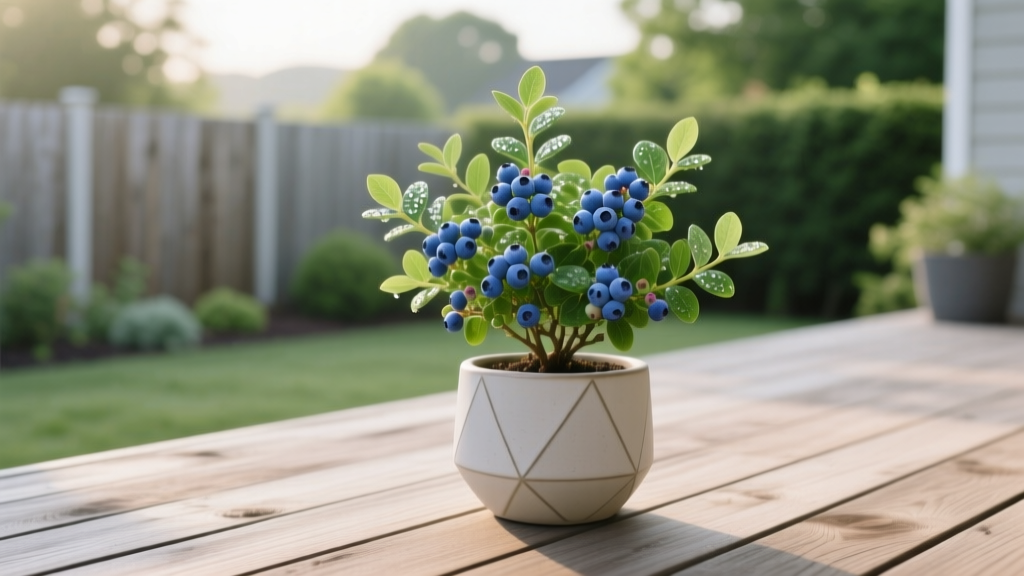
Deck Potted Blueberry Bush Setup
The deck looks perfect from inside the house—until you step out with your coffee and realize it’s a lot of “brown-and-gray emptiness.” Maybe there’s a grill in one corner, a chair that never feels quite placed, and a lonely pot that dries out by noon. You want something lush, edible, and structured enough to make the deck feel designed… but you’re renting, the yard is shaded, or the soil outside is clay. This is where potted blueberries shine: they’re architectural shrubs with spring flowers, summer berries, and fiery fall color—while staying completely container-contained.
What follows is the same process I’d use if I were standing on your deck with a tape measure and a sketchpad—planning circulation, sun angles, and container placement first, then choosing blueberry varieties that actually fruit in pots.
Start with the deck “problem”: circulation, sun, and wind
Before buying plants, define what the deck must do. Blueberries are generous plants, but they do take up space and need consistent care. If you build the layout around how you walk and sit, the plants feel intentional instead of cluttered.
Measure your usable footprint (and protect your walkways)
On most decks, the most common mistake is putting big containers where feet need to pass. Keep a clear “walking lane” of 36 inches minimum from the door to seating or stairs. If your deck is narrow, 30 inches can work, but it will feel tight when you’re carrying a tray.
Blueberry containers work best grouped along an edge or in corners, where they can act like living railings. Plan for each mature pot to occupy a circle about 24–30 inches wide (container plus a little elbow room).
Sunlight: count hours, don’t guess
Blueberries fruit best with strong light. Aim for 6–8 hours of direct sun for reliable harvests; 4–6 hours can still produce berries, but expect fewer and smaller fruit, especially in containers. If you’re not sure, take three quick checks (morning, noon, late afternoon) and note whether the deck is fully sunny, dappled, or shaded by nearby buildings.
Also consider reflected heat: south- and west-facing decks can bake pots. That’s not a dealbreaker, but it changes container material and watering strategy.
Wind and heat: the hidden container stressors
Decks are often windier than ground-level gardens, and containers dry fast. A blueberry in a pot is essentially living in a controlled environment—great for soil pH, but unforgiving about moisture swings. If your deck is exposed, plan a windbreak: a railing planter, a lattice panel, or even clustering pots so they shelter one another.
“The most successful container plantings treat the container as a microclimate—managing heat, wind, and water as carefully as soil.” —University of Illinois Extension, Container Gardening (2020)
Layout strategies that make potted blueberries look designed
Blueberries have a naturally tidy shrub form, which makes them excellent “structural plants” on hard surfaces. The trick is to place them with intention—like outdoor furniture.
Strategy 1: The “living corner anchors” plan
If your deck feels visually unbalanced, place one blueberry pot in each of two far corners (or one corner plus the opposite side of the stairs). This frames the space and makes everything else—chair, table, grill—feel more grounded.
- Best for: small decks, renters, minimalist setups
- Spacing: keep pots 18–24 inches from walls to allow air circulation and easier watering access
- Container size: 20–24 inch diameter, 15–20 gallon volume for long-term success
Strategy 2: The “railing hedge” (without planting a hedge)
For decks with railings, a row of blueberry containers creates privacy and a soft green boundary. Instead of lining them up like soldiers, stagger slightly: one pot 6–10 inches forward, the next back. The rhythm feels designed and gives you room to reach the berries.
- Best for: medium decks, privacy needs, urban views
- Pot-to-pot spacing: 24–36 inches depending on variety vigor
- Minimum plants: 3 looks intentional; 5 starts to read as a green wall
Strategy 3: The “edible lounge” vignette
If you have a seating area, flank it with blueberries the way you would place lamps beside a sofa. Two matching pots on either side of a bench create symmetry; three pots (two large + one medium) create a pleasing asymmetry.
- Best for: entertaining decks, design-forward homeowners
- Keep berries reachable: place the fruiting side toward the seating area, not pressed against a wall
- Add underplanting: low herbs or trailing plants in separate small pots to soften the base
Container specs, soil mix, and irrigation: the practical backbone
Blueberries are acid-loving plants with fine roots. Containers let you control pH and drainage—two things that are hard to “fix” in many yards.
Choose the right pot size (bigger is easier)
For most deck setups, start with 15–20 gallon containers. A smaller pot can work short-term, but it will require more frequent watering and repotting. A good target is 18–24 inches wide and at least 16 inches deep.
Material matters:
- Resin/plastic: lighter, holds moisture longer, often $25–$60 per large pot
- Terracotta: beautiful, but dries faster and can crack in freeze-thaw climates
- Fabric grow bags (15–20 gal): budget-friendly at $8–$18, excellent drainage; plan for faster drying and a more casual look
Soil mix that blueberries actually like
Blueberries prefer acidic soil, roughly pH 4.5–5.5. A reliable container blend is:
- 60% peat moss (or a peat-reduced acidic potting mix)
- 30% fine pine bark (often sold as “pine bark fines”)
- 10% perlite for airflow and drainage
For an off-the-shelf shortcut, look for an “acid-loving plant” potting mix and amend it with extra pine bark for structure. North Carolina State Extension notes blueberries require acidic soils and are sensitive to poor drainage (NCSU Extension, 2023).
Watering: plan for consistency, not heroics
Expect to water 3–5 times per week in summer, and potentially daily during heat waves if your deck is south-facing. Drip irrigation makes container blueberries dramatically easier.
A basic DIY drip setup can cost around $35–$80 (timer, 1/2" tubing, 1/4" lines, and 2 GPH emitters per pot). Put 2 emitters in each container so water distributes evenly.
Blueberry variety picks that perform well in pots
For containers, choose cultivars with compact habits, reliable fruiting, and appropriate chill-hour requirements for your region. If you can fit two varieties, you often get better pollination and bigger yields.
Best container-friendly varieties (with design and harvest notes)
‘Top Hat’ (half-high): A true container favorite—compact, typically 18–24 inches tall, great for small decks. Its neat form reads like a decorative shrub even when it’s not fruiting.
‘Jelly Bean’ (southern highbush): Very compact and ornamental, with a dense habit that looks polished in modern planters. Good choice where space is tight and aesthetics matter.
‘Sunshine Blue’ (southern highbush): Semi-evergreen in mild climates, attractive foliage, and a manageable size for large pots. Works well as a “feature plant” beside seating.
‘Patriot’ (northern highbush): More vigorous and larger, but can thrive in a 20–25 gallon container. If you want bigger harvests and can spare the space, it’s a workhorse.
‘Pink Lemonade’ (rabbiteye hybrid): Grown as much for conversation as for fruit. Best in larger pots and warmer regions; it’s a design-forward choice when you want your deck garden to feel curated.
Cross-pollination: the easy yield upgrade
Some blueberries can set fruit alone, but many produce better with a partner that blooms at the same time. If your deck can accommodate 2 plants, pick two compatible varieties. If you only have room for one pot, choose a cultivar advertised as self-fertile and focus on excellent care.
Comparison table: choose plants based on your deck constraints
| Variety | Best For | Typical Container Size | Approx. Mature Size | Design Note |
|---|---|---|---|---|
| Top Hat | Small decks, edging, tight corners | 10–15 gal (better: 15 gal) | 18–24 in | Looks naturally “bonsai-like” and tidy |
| Jelly Bean | Modern planters, compact look | 10–15 gal | 24–36 in | Dense foliage reads as intentional structure |
| Sunshine Blue | Feature pot near seating | 15–20 gal | 3–4 ft | Evergreen tendency in mild winters adds year-round presence |
| Patriot | Bigger harvests, colder climates | 20–25 gal | 4–5 ft | Use as an “anchor” plant in a corner |
| Pink Lemonade | Conversation piece, warm regions | 20 gal | 4–5 ft | Pair with dark pots to make fruit color pop |
For chill hours and regional fit, check your local extension guidance. Blueberry requirements vary widely by type (highbush vs. southern highbush vs. rabbiteye). The USDA notes blueberries are Vaccinium species with specific climate and soil needs (USDA NRCS Plant Guide, 2015).
Step-by-step: set up a deck blueberry pot like a pro
This is the clean, repeatable method that prevents the most common container failures (drying out, poor drainage, and pH drift).
- Place pots first, then plant. Set empty containers in position, confirm a 36-inch walkway, and check sun exposure for a day.
- Add pot feet or risers. Lift each container 1/2–1 inch off the deck to improve drainage and prevent staining.
- Use mesh, not rocks. If your pot has large drainage holes, place a piece of mesh screen to keep mix from spilling out. Skip gravel layers—they don’t improve drainage in containers.
- Fill with acidic mix. Moisten the mix as you fill so it settles evenly, stopping about 2 inches below the rim for watering space.
- Plant at the correct height. Set the blueberry so the top of its root ball is level with the soil surface (or slightly above if your mix tends to settle).
- Water deeply. Water until it drains freely from the bottom. This also helps eliminate dry pockets.
- Mulch the surface. Add 2 inches of pine bark mulch to slow drying and protect roots from heat.
- Install drip (optional but excellent). Add 2 emitters per pot (around 2 GPH each) and connect to a timer.
- Fertilize lightly. Use an acid-lover fertilizer according to label rates; in containers, lighter and more frequent is safer than heavy feeding.
Three real-world deck scenarios (and what I’d do)
Scenario 1: The tiny rental balcony (6 ft x 10 ft)
On a 6x10 balcony, floor space is precious and every pot must earn its keep. I’d use two 15-gallon fabric grow bags with ‘Top Hat’ blueberries placed in the far corners to frame the balcony. That leaves the center open for a small bistro set.
Design trick: choose matching dark charcoal grow bags and add simple saucers or trays to protect the surface. Include one slim vertical trellis planter (not for the blueberries) to add height without stealing floor area.
Cost snapshot: two plants at $25–$45 each, two grow bags at $10–$15 each, soil components around $35–$60. Total: roughly $105–$180 depending on what you already have.
Scenario 2: The sunny family deck with a grill zone (12 ft x 16 ft)
Here the deck has multiple “rooms”: cooking, eating, and lounging. I’d build a blueberry row along the railing on the side that gets the best sun, using three 20-gallon resin pots with ‘Sunshine Blue’ + ‘Jelly Bean’ + ‘Sunshine Blue’ for repetition and a cohesive look.
Spacing: keep pots about 30 inches apart center-to-center so foliage can fill in without crowding. Keep them at least 4 feet from the grill to avoid heat blasts and greasy residue on leaves.
DIY upgrade: add a drip timer so you’re not hand-watering during summer travel weeks. Expect the irrigation add-on to be $50–$80.
Scenario 3: The windy rooftop deck (full sun, high exposure)
Rooftops are intense: wind, sun, and fast evaporation. Here, I’d go bigger on containers—25-gallon if you can manage the weight—and cluster pots in groups of three to reduce wind impact. Use heavier resin or fiberglass pots rather than terracotta.
Variety choice: ‘Patriot’ (if you have winter chill) in one large anchor pot, paired with a second compatible variety in another pot for better fruiting. Add a third pot with an ornamental grass or low evergreen for wind buffering and visual balance.
Care reality: expect daily watering in hot, windy stretches unless you install drip. Mulch is non-negotiable—keep that 2-inch layer refreshed.
Budget-conscious builds and smart DIY swaps
A deck blueberry setup can be polished or scrappy—both work if the root zone is right. Here are practical ways to spend where it counts.
Where to invest
- Soil mix quality: good structure and acidity prevents slow decline.
- Bigger containers: fewer watering emergencies and less temperature stress.
- Drip timer: it’s the difference between thriving shrubs and “crispy leaf” summers.
DIY alternatives that still look good
- Grow bags inside decorative baskets: hide the fabric in an inexpensive weatherproof basket for a higher-end look.
- Secondhand large pots: check local listings; just confirm drainage holes exist (or drill them).
- Simple wind screen: a $20–$40 reed fence panel zip-tied to a railing can cut drying winds dramatically.
If your budget is tight, start with one excellent plant in a 20-gallon container rather than two struggling plants in undersized pots. You can add a second variety next season.
Maintenance expectations: what it actually takes
Potted blueberries are not “plant and forget,” but they are very manageable with a rhythm. Plan for 30–60 minutes per week during the growing season (less with drip irrigation), plus a couple of seasonal work sessions.
Weekly (spring through early fall)
- Water check: soil should be evenly moist, not soggy. In heat, check daily even if you don’t water daily.
- Quick inspection: look for pale leaves (often nutrient/pH issues) and crispy edges (drying).
- Harvest cleanup: remove dropped berries to avoid attracting pests.
Seasonal tasks
- Early spring: light pruning—remove dead wood and thin crowded stems. Feed with an acid-lover fertilizer as growth begins.
- Late spring: top up mulch to maintain the 2-inch layer.
- Mid-summer: monitor watering closely; containers can go from fine to stressed in 24 hours during heat waves.
- Fall: enjoy foliage color, then reduce fertilizing so plants harden off.
- Winter (cold climates): protect pots from deep freezes—cluster containers against the house, wrap pots with burlap, or insulate with straw bales. Containers expose roots to colder temperatures than in-ground plantings.
Repotting and long-term care
Expect to refresh the top few inches of mix each year and consider repotting every 2–3 years if growth slows or roots circle densely. Container blueberries can live for many years, but they appreciate a periodic reset: fresh acidic media, a slightly larger pot if needed, and a careful root tease.
Finishing touches: make the blueberry pots feel like part of the deck
Once your shrubs are placed, add two small moves that make the layout feel intentional. First, repeat materials: if your deck furniture is black metal, echo it with black or charcoal pots. Second, add lighting: a warm string light line above or two solar uplights aimed at the blueberry foliage turns the shrubs into evening features.
The best part is that the design improves over time. Blueberries fill out, their leaves gloss up, and the deck stops feeling like an outdoor hallway. It becomes a room—one where breakfast includes a handful of berries you grew a few steps from the kitchen door.
Sources: North Carolina State Extension, Blueberry growing requirements and site considerations (2023); University of Illinois Extension, Container Gardening principles and microclimate considerations (2020); USDA NRCS Plant Guide for Vaccinium (blueberry) species overview (2015).