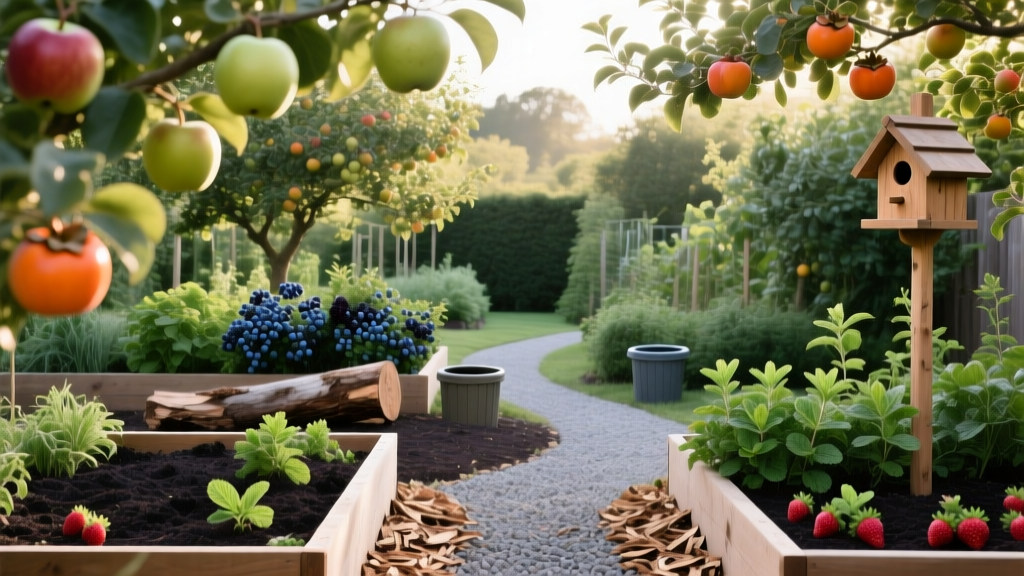
Backyard Permaculture Food Forest Design
The back door clicks shut behind you and you step into a yard that’s trying its best… but it’s stuck. The lawn dries out by July, the patio bakes, the compost bin is hidden like an embarrassment, and the only thing that really thrives is the neighbor’s maple throwing shade where you didn’t ask for it. You want fruit, herbs, and flowers for pollinators—without turning weekends into endless chores or building a farm where your dog used to run.
A backyard food forest is how we turn that stuck space into a layered, edible landscape that feeds you and gets easier each year. Think of it as a designer’s approach to permaculture: we’ll work with sunlight, water, and microclimates, then choose plants that cooperate (not compete) and build a layout you can actually maintain.
Start With the Site: A Quick “Designer’s Read” of Your Backyard
Before we talk plants, we need to see the yard the way a landscape designer does: light, wind, water, circulation, and views. This is where food forests succeed or fail—not because someone chose the “wrong” apple variety, but because the apple ended up in 4 hours of light behind a fence.
Sunlight: Map Your Hours, Not Your Hopes
Most fruiting plants want 6–8 hours of direct sun for consistent yields. If your yard gives you only 4–6 hours, we can still do a productive food forest—just lean harder on shade-tolerant edibles (currants, gooseberries, hardy kiwi on a brighter edge, perennial greens, culinary herbs).
Do this: pick one weekend day and check sun at 9am, noon, 3pm. Mark sunny zones on a sketch. This simple “sun audit” is more useful than any app if you’re renting and can’t remove trees.
Soil: One Jar Test and One Shovel Test
Permaculture designs build soil rather than replace it. If you do nothing else, do two checks:
- Jar test: soil + water in a jar; shake; let settle overnight. You’ll see sand/silt/clay layers.
- Shovel test: dig a 12-inch hole and look for compaction layers and earthworms.
Plan on adding 2–4 inches of compost over time (not all at once if you’re on a budget). A food forest thrives with a fungal-leaning soil network; wood chips and leaf mold are your long game.
Water: Design for “Soak In,” Not “Run Off”
Water is expensive and time is more expensive. Capturing rain and slowing runoff is one of the highest-return moves. Even simple basins around trees reduce summer stress. For rainfall planning, the U.S. EPA notes that rain barrels can help reduce stormwater runoff and provide water for landscaping (EPA, 2023).
Design Principles That Make a Backyard Food Forest Feel Intentional
Food forests can look messy if you skip structure. The trick is using a few strong layout moves so the garden reads as designed—even when it’s lush.
Principle 1: Put Access First (Paths, Gates, and Carry Distance)
If you can’t get a wheelbarrow to it, you won’t mulch it. Make at least one primary path that’s 36 inches wide (comfortable for a cart). Secondary paths can be 18–24 inches. If you’re squeezing between beds now, your future self will prune less, harvest less, and enjoy it less.
Principle 2: Layer Vertically, Then Repeat in “Guilds”
A classic food forest uses layers: canopy, understory, shrub, herb, groundcover, root zone, and vines. In a backyard, we usually compress the canopy layer (dwarf trees or large shrubs) to avoid shading the whole yard.
“Perennial polycultures can reduce soil disturbance and build resilience, but they still require thoughtful design and management to match site conditions.” — D. Van Tassel et al., research on perennial grain systems (2017)
The takeaway for homeowners: diversity helps, but only when plants are placed with light, spacing, and long-term size in mind.
Principle 3: Edge Is Productivity
Edges—fence lines, patio borders, the sunny strip between a shed and lawn—are where a food forest makes the most sense in small spaces. Train berries and grapes along fences, tuck herbs near the kitchen door, and put taller shrubs where they won’t shade vegetables.
Principle 4: Choose a “Messy Zone” and a “Tidy Zone”
If your whole yard is wild, it can feel stressful. If your whole yard is formal, it’s too much work. I like a tidy, mulched path with clearly defined planting pockets, and one back corner where leaves, wood chips, and a brush pile quietly feed the system.
Three Layout Strategies (Pick One, Then Customize)
Here are three real layouts I use depending on yard shape and restrictions. Each supports permaculture function without sacrificing usability.
Layout A: The Perimeter Food Forest (Best for Small Yards)
Scenario: A 20 ft × 30 ft backyard, patio in the middle, kids or pets need open space.
Design: Plant the forest on the perimeter: dwarf fruit trees at corners, berry shrubs between, herbs and groundcovers along the edge. Keep the center open for play or seating.
Spacing guide: dwarf trees 8–10 ft apart; shrubs 3–5 ft apart; herb clumps 12–18 in.
Layout B: Two Sun Pockets + One Shade Pocket (Best for Mixed Light)
Scenario: You have one sunny side yard that gets 7 hours, a back corner that gets 5 hours, and a shaded strip that gets 3–4 hours.
Design: Put your highest-sugar crops (apples, peaches, grapes) in the 7-hour zone. Use the 5-hour zone for berries and plums. Use the shade strip for currants, mint in pots, sorrel, and compost/leaf mold production.
Layout C: The Rental-Friendly Container Food Forest (Best if You Can’t Dig)
Scenario: Renting, HOA restrictions, or contaminated soil concerns.
Design: Use 15–25 gallon containers for dwarf trees, 7–10 gallon for berries, and long planters for herbs/groundcovers. Add a trellis that can be removed.
Reality check: Containers dry faster. You’ll likely water 2–4 times/week in summer unless you add drip irrigation.
Step-by-Step Setup: Build the Bones First
This is the workflow I’d use on a client project, scaled for DIY. Do it in phases so you’re not spending everything (money or energy) in one season.
- Sketch your base map (even a rough one). Mark fences, buildings, gates, utilities, and existing trees. Add sun zones (6–8 hours, 4–6 hours, 2–4 hours).
- Lay out paths with a hose or string. Commit to a 36-inch main path before you place plants.
- Place trees first. Think mature size and shade direction. Keep fruit trees at least 6–8 ft from fences to avoid pruning battles (or choose columnar forms if space is tight).
- Add shrubs and vines. Shrubs fill volume quickly and give earlier yields than many trees.
- Install water strategy: a simple drip line, a rain barrel, or basin-and-mulch rings. Even one 50-gallon rain barrel can meaningfully reduce summer hose time.
- Sheet mulch planting zones: cardboard + 3–6 inches wood chips. Leave a gap around trunks to prevent rot.
- Plant groundcovers and herbs to close the soil and reduce weeding.
Plant Selection: Specific Varieties That Perform in Backyards
Below are plants I reach for because they’re productive, adaptable, and available in many regions. Always confirm hardiness for your USDA zone, but the design logic holds: mix long-lived structure (trees) with fast-return plants (berries, herbs) and support species (nitrogen fixers, pollinator plants).
Canopy/Small Tree Layer (Choose Dwarf or Semi-Dwarf)
Apple: Malus domestica ‘Liberty’ (disease-resistant; great for backyard spraying avoidance). Plant 10 ft apart on dwarf rootstock.
Peach: ‘Reliance’ (cold-hardy peach with reliable crops in many temperate areas). Give it your sunniest spot: 8+ hours if possible.
Asian pear: ‘Shinseiki’ (crisp fruit, often easier than European pears in some climates). Train as an open center for light penetration.
Serviceberry: Amelanchier ‘Autumn Brilliance’ (edible berries + ornamental value; handles partial sun). Excellent “bridge plant” when you want beauty and food.
Understory and Shrub Layer (Your Fastest Payback)
Blueberry: ‘Duke’ (early), ‘Bluecrop’ (midseason). Blueberries love acidic soil; if your soil is neutral/alkaline, grow in containers with pine bark-based mix. Space 4–5 ft apart.
Raspberry: ‘Heritage’ (everbearing; long harvest window). Put raspberries where you can contain runners; a simple edging barrier helps. Space canes 18–24 in apart in rows.
Gooseberry: ‘Invicta’ (heavy producer; tolerates partial shade). Great for the 4–6 hour zones where blueberries may struggle.
Currant: ‘Red Lake’ (red currant; productive in cooler, less sunny corners). Currants can be a secret weapon for shaded backyards.
Herb Layer (Design It Like a Kitchen Extension)
Comfrey: ‘Bocking 14’ (sterile cultivar; chop-and-drop mulch; deep roots mine nutrients). Plant 3 ft away from small trees; it gets big.
Chives + garlic chives: pest confusion around fruit trees; early pollinator support. Tuck at bed edges and near paths for easy harvest.
Oregano: tough groundcover herb for hot, dry edges; great near patios where reflected heat is high.
Groundcover and Root Layer (Where Weed Control Gets Real)
Strawberry: ‘Seascape’ (everbearing) as a living mulch in sunny pockets. Space 12–18 in.
Creeping thyme: a walkable-ish groundcover near stepping stones; drought tolerant once established.
Jerusalem artichoke: high-yield tuber, but aggressive—use as a seasonal screen in a contained bed, not everywhere.
Vines (Vertical Food Without Losing Floor Space)
Grape: ‘Reliance’ (seedless, cold hardy). Train on a sturdy trellis along a fence; plan 6–8 ft between vines.
Hardy kiwi: Actinidia arguta ‘Issai’ (self-fertile; strong growth). Give it a serious support structure; it’s not a delicate vine.
Comparison Table: Three Backyard Food Forest Approaches
| Approach | Best For | Upfront Cost (Typical) | Water Needs | Time to Noticeable Harvest |
|---|---|---|---|---|
| In-ground perimeter planting | Small yards with open center space | $300–$1,200 (trees, shrubs, mulch) | Moderate after year 1 | 6–18 months (berries/herbs), 2–4 years (trees) |
| Mixed sun-pocket design | Yards with uneven light | $400–$1,500 (more plant variety) | Low–moderate with good mulching | Fast in pockets; slower in shade zones |
| Container-based (rental-friendly) | Renters, patios, contaminated soil | $250–$900 (pots, soil, trellis) | High in summer unless drip installed | Immediate herbs; 1–2 years for berries; 2–3 years for dwarf trees |
Three Real-World Scenarios (With Design Moves That Solve Them)
Let’s walk through three situations I see constantly, with practical layouts that avoid common mistakes.
Case 1: The Narrow Side Yard (4 ft × 30 ft) That Feels Useless
This is prime edible real estate. A 4-foot-wide strip can’t hold a full-size tree—but it can hold a trellis, espalier fruit, and a ribbon of herbs.
Plan: Install a wall trellis or wire system and espalier an apple like ‘Liberty’ or a pear like ‘Shinseiki’ at 6–8 ft intervals. Underplant with chives, thyme, and strawberries. Mulch with wood chips to keep the corridor walkable.
Why it works: You’re using vertical space, keeping airflow (reducing disease), and turning a maintenance headache into a harvest lane you can walk down with a bowl.
Case 2: The Big Tree Shade Problem (Only 3–4 Hours of Sun)
When a mature tree dominates the backyard, fighting it is expensive and often impossible. Design around it.
Plan: Put your “forest edge” at the drip line where you get the most light. Use currants (‘Red Lake’), gooseberries (‘Invicta’), serviceberry, and perennial greens like sorrel near the shadiest zones. Keep a leaf-mold pile behind shrubs to turn the tree’s leaves into future soil.
Why it works: Shade-tolerant edibles are underused, and they make shaded yards feel abundant instead of limiting.
Case 3: The Busy Household (You Can Spare 1–2 Hours/Week, Not 6)
Low-maintenance doesn’t mean no maintenance—it means maintenance that stays predictable. Perennials help, but only if you mulch heavily and keep plant choices manageable.
Plan: Focus on: 2 dwarf trees, 6–10 berry shrubs, a simple herb strip, and one trellis vine. Sheet mulch everything. Install a basic drip line on a battery timer.
Why it works: You get a real harvest with fewer pruning demands than a “collector’s garden” full of unusual species that all want different care.
Budget, Costs, and DIY Alternatives (Where to Spend and Where to Save)
A backyard food forest can be built on a tight budget or scaled up with instant impact. Here are realistic numbers that help you plan.
Typical costs: A dwarf fruit tree is often $35–$75. Berry shrubs run $12–$35 each. Bulk wood chips are frequently free from arborists, or $25–$60 per cubic yard delivered depending on your area. A basic 50-gallon rain barrel can cost $70–$150. Drip kits often start around $30–$80 for small gardens.
DIY savings moves:
- Source wood chips free via local tree services (ask for “clean chips,” not mixed construction debris).
- Propagate easy plants: currants and gooseberries from cuttings, strawberries from runners, herbs from divisions.
- Start with smaller stock: a 1–2 year bare-root tree is cheaper and often establishes faster than an oversized potted tree.
- Build trellises from conduit or reclaimed wood, but don’t skimp on anchors—grapes get heavy.
For renters, put money into containers and soil that can move with you. For homeowners, spend more on trees and irrigation because those are hardest to retrofit later.
Maintenance Expectations: What It Actually Takes
A well-designed backyard food forest is not a no-work garden, but it is a “less work over time” garden. Plan for 1–3 hours per week in the growing season once established; during the first year, it may be 2–5 hours per week while you water, weed, and adjust.
Weekly Rhythm (Spring Through Early Fall)
- 10–20 minutes: quick walk-through—look for wilting, pests, broken stems.
- 20–40 minutes: harvest and light pruning (especially berries).
- 20–60 minutes: mulch touch-ups and weeding (drops dramatically once groundcovers fill in).
Seasonal Tasks
- Late winter: prune apples/pears for structure; remove crossing branches.
- Spring: top-dress with compost (1 inch around shrubs, a bit more around heavy feeders); check irrigation.
- Summer: “chop-and-drop” comfrey; thin fruit if branches overload.
- Fall: add leaves as mulch, plant garlic or cover crops in open spots.
One practical note: the National Academies’ report on pollinators emphasizes that habitat and diverse floral resources support pollinator health (National Academies of Sciences, Engineering, and Medicine, 2007). In backyard terms, a long bloom season—from chives and currants through late flowers—improves fruit set and overall garden vitality.
Putting It All Together: A Sample “Backyard Package” You Can Copy
If you want a solid starter design that fits many suburban lots, here’s a layout that balances yield, beauty, and manageability. Imagine a 30 ft × 40 ft backyard with a patio near the house and a fence perimeter.
Planting plan: two dwarf trees (‘Liberty’ apple + ‘Reliance’ peach) on the sunniest back edge, spaced 10 ft apart; four blueberries (‘Bluecrop’/‘Duke’) in a slightly raised, mulched bed; two currants + two gooseberries in partial shade; one grape ‘Reliance’ on a fence trellis; comfrey ‘Bocking 14’ near each tree (but not touching); thyme and strawberries as groundcover in sunny openings; chives along paths for easy snips on the way to the grill.
What it feels like: You walk out, step onto a clear path, pass herbs you can harvest without bending too far, and arrive at berry bushes that act like living walls. The trees frame the yard instead of swallowing it. By year two, you’re harvesting enough that the garden starts to pay you back in meals—not just in “potential.”
Once the structure is in, you’ll find yourself making small, satisfying upgrades: another shrub where a gap stays sunny, a second rain barrel if you’re enjoying the rhythm, a patch of native flowers to extend bloom. That’s the sweet spot of backyard permaculture—designing something that grows more generous while asking less of you each season.