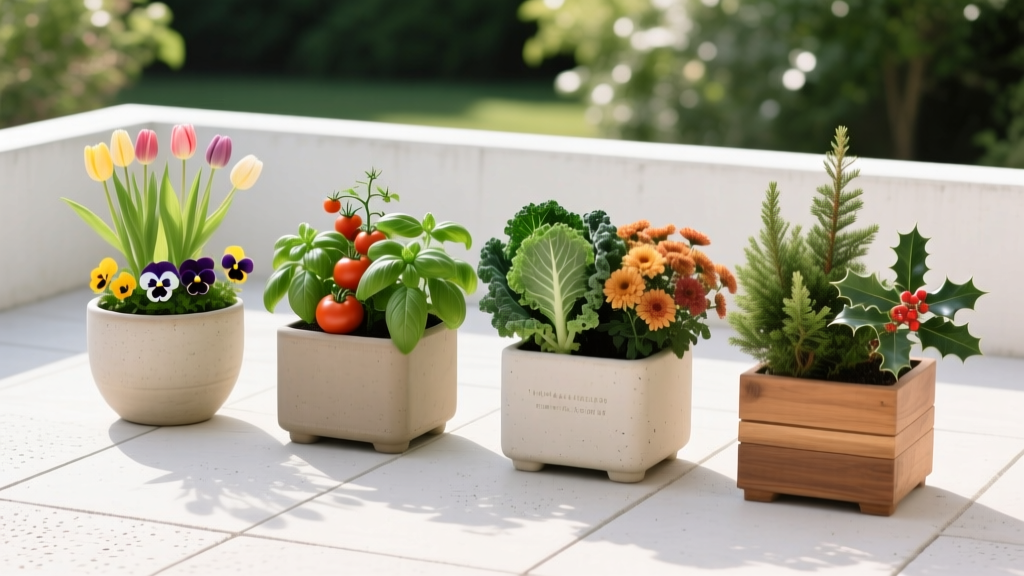
Container Garden Recipes for Every Season
The week you finally scrub the patio clean is always the week the wind knocks over your sad, leggy pot of petunias. The porch looks bare, the sun hits hard at 3 p.m., and you’re standing there thinking: “I don’t need more plants—I need a plan.” Containers can look like a random collection of nursery impulse-buys, or they can read like a designed room: balanced, layered, and seasonal, with the flexibility to swap pieces as the year turns.
Think of this article as a set of “recipes” the way a landscape designer thinks—repeatable formulas that fit real spaces: a 4 ft x 8 ft balcony, a townhouse stoop, a small rental patio with strict rules, or a sunny driveway corner that bakes in July. You’ll get layouts, plant mixes with specific varieties, and seasonal change-outs that keep your containers looking intentional from January through December.
Design principles that make containers look designed (not accidental)
Start with a “room plan”: anchor, edges, and traffic
Before picking plants, map how you move through the space. Leave at least 24 inches of clear walkway (a comfortable passing width on a balcony or patio). Place tall containers where they won’t snag shoulders—usually against a wall, railing, or in a corner. Then “frame” the view from indoors: one strong container near the door is worth three scattered pots.
Designer trick: build a triangle. Place one tall focal container (your anchor), two lower supporting containers (the edges), and keep the center open for circulation or a chair.
Choose container sizes like furniture, not décor
Small pots dry out fast and read as clutter. For most seasonal recipes, use:
- 18–22 inch diameter pots for mixed plantings (best balance of volume and manageability).
- 12–14 inch pots for “supporting actors” (herbs, a single specimen, or repeating color).
- 24 inch tubs for small shrubs, grasses, or year-round structure (heavier, but fewer replacements).
Costs vary widely, but for planning purposes: a quality 20-inch resin pot runs about $35–$70, while a comparable glazed ceramic pot can be $60–$150+. If your budget is tight, a 5-gallon nursery pot slipped into a basket or wood crate is a perfectly acceptable “designer fake-out” that still performs.
Use the thriller–filler–spiller framework (then refine it)
The classic formula works because it creates a readable silhouette:
- Thriller: vertical height or bold shape (1 plant)
- Filler: mid-layer body (2–3 plants)
- Spiller: trailing edge softener (1–2 plants)
Refinement that elevates the look: repeat one plant or color in at least 3 containers across the space. Repetition is what makes the whole patio feel “designed.”
Sunlight is your scheduling tool
Don’t guess—observe. Most flowering annuals want 6–8 hours of direct sun. Many leafy containers and winter mixes are happiest at 3–5 hours. If your space gets intense reflected heat (south/west exposure near glass or stucco), treat it as “full sun + wind” and plan for extra watering and sturdier plants.
“Container plants are essentially growing in a confined root environment, so water management and potting media selection are critical to success.” — University of Minnesota Extension, Container Gardening (2021)
Layout strategies for small spaces (balconies, stoops, patios)
The 4x8 balcony blueprint (renter-friendly)
Imagine a balcony that’s 4 ft deep x 8 ft long. You want greenery, privacy, and a place to sit. Here’s a layout that avoids the “pots lined up like soldiers” look:
- Corner anchor: one 24-inch container in the far corner (creates depth and privacy).
- Railing rhythm: 2 railing planters or narrow troughs spaced evenly along the rail (keeps floor space open).
- Entry statement: one 18–20 inch mixed pot near the door (the “hello” moment).
- Seat sidekick: a 12–14 inch pot by the chair for fragrance or herbs.
Budget note: you can build a convincing railing trough using a 36-inch plastic window box ($15–$25) inside a simple wood sleeve made from fence boards.
The stoop that gets baked (sun + heat + concrete)
Concrete stoops often cook roots. Use double-potting: keep plants in a nursery pot, then drop it into a decorative container with a 1-inch air gap around the sides. This buffer reduces heat stress and makes seasonal swaps fast. Also, favor light-colored pots or resin over black plastic in full sun.
The tiny patio “outdoor living room” trick
If you have a 10 ft x 10 ft patio, treat containers like corners of a rug. Put two larger pots on opposite corners (visual balance), and use two medium pots to flank a grill or door. Leave the center open—negative space is part of the design.
Seasonal container recipes (with varieties that earn their spot)
Each recipe below is designed for a standard 20-inch diameter pot (about 5–7 gallons of soil volume). Plant spacing is based on typical nursery 4-inch or 1-quart plants; tuck them in with 4–6 inches between centers for a full look.
Spring recipe: “Bright Shade Edge” (part shade, 3–5 hours)
Color story: chartreuse + blush + deep burgundy. This is for the porch that gets morning sun then shade—classic renter territory.
- Thriller: Heuchera ‘Obsidian’ (dark foliage reads as a “shadow anchor” and stays tidy).
- Filler: Brunnera macrophylla ‘Jack Frost’ (silver leaves brighten shade; spring flowers are a bonus).
- Filler: Primula ‘Danova Rose’ (reliable early color; compact habit).
- Spiller: Lamium maculatum ‘Aureum’ (chartreuse trail; handles shade and cool nights).
Why it works: foliage carries the design even when spring bloom cycles shift. This mix also transitions well into early summer—swap primrose for begonias when heat arrives.
Spring recipe: “Edible Cool-Season Mix” (sun, 5–7 hours)
Best for: people who want beauty and dinner. This container looks ornamental but harvests like a mini garden bed.
- Thriller: Tuscan kale ‘Lacinato’ (upright, architectural, cold-tolerant).
- Filler: Swiss chard ‘Bright Lights’ (stems add color; keeps producing with steady picking).
- Filler: Lettuce ‘Red Sails’ (fast, pretty, and forgiving).
- Spiller: Nasturtium ‘Alaska’ (trailing leaves + edible flowers; attracts pollinators).
Maintenance: harvest weekly to keep it lush. Expect 20–30 minutes/week for watering, snipping, and re-sowing a few lettuce plugs.
Summer recipe: “Pollinator Party” (full sun, 6–8 hours)
This is the container for the sunny driveway corner or the balcony that turns into an oven. Choose varieties that don’t collapse by July.
- Thriller: Salvia ‘Black and Blue’ (strong vertical lines; hummingbird magnet; heat tolerant).
- Filler: Zinnia ‘Profusion Cherry’ (compact, disease-resistant, nonstop color).
- Filler: Lantana ‘Bandana Lemon Zest’ (handles drought once established; long bloom season).
- Spiller: Calibrachoa ‘Superbells Cherry Red’ (constant flowers; better heat performance than many petunias).
Spacing tip: give salvia the center, then plant fillers at the 10 o’clock and 2 o’clock positions, with spillers near the rim. This keeps the pot balanced as growth accelerates.
Summer recipe: “Tropical Shade Lounge” (bright shade, 3–5 hours)
For the covered patio that never quite gets enough sun for flowers: go lush, not bloom-dependent.
- Thriller: Colocasia ‘Black Magic’ (dramatic leaves; instant designer look).
- Filler: Begonia ‘Dragon Wing Red’ (shade-tolerant, blooms steadily, handles humidity).
- Filler: Coleus ‘ColorBlaze Wicked Witch’ (deep color without sun).
- Spiller: Dichondra ‘Silver Falls’ (silver cascade brightens shade; elegant texture).
Note: Colocasia drinks water. Plan for watering 3–5 times/week in hot spells, or use a self-watering insert.
Fall recipe: “Autumn Front Door” (sun to part sun, 4–7 hours)
This is the pot that makes your entry look intentional from September through frost.
- Thriller: Pennisetum setaceum ‘Rubrum’ (purple fountain grass; movement + height).
- Filler: Chrysanthemum ‘Matchsticks’ (modern color; tight habit).
- Filler: Sedum ‘Autumn Joy’ (structure and late-season blooms; tough in containers).
- Spiller: Sweet potato vine ‘Marguerite’ (chartreuse trail; fast coverage).
DIY alternative: If ornamental grass is pricey in your area, use a bundle of decorative millet stems or dried grasses from a craft store ($8–$15) pushed into the soil as a temporary thriller.
Winter recipe: “Evergreen + Berries” (bright light, cold-tolerant)
Winter containers are less about “planting” and more about building a durable arrangement. In many climates, you can use cut greens and branches for a long-lasting display.
- Structure: dwarf Alberta spruce (Picea glauca ‘Conica’) in a 24-inch pot, or cut evergreen boughs if you don’t want a live conifer.
- Color: red twig dogwood stems (Cornus sericea) + winterberry holly stems (Ilex verticillata, cut).
- Texture: pinecones, eucalyptus (if mild winters), and dried seed heads.
Why it works: strong silhouettes read from indoors. You’re designing for low sun angles and gray days—contrast and structure matter more than flowers.
A quick comparison: seasonal swap vs. “all-season framework” pots
| Approach | Best for | Typical cost range (per 20–24" pot) | Swap frequency | Weekly maintenance |
|---|---|---|---|---|
| Seasonal “recipe swaps” (annual-heavy) | Maximum color, renters who like change | $45–$120 (plants + soil refresh) | 3–4x/year | 30–60 min/week in summer |
| All-season framework (shrub/grass + seasonal understory) | Homeowners, less replanting, consistent structure | $80–$200 upfront, then $20–$60 per season | 1–2x/year | 20–40 min/week in summer |
| Minimalist evergreen + accents (winter focus) | Cold climates, low winter effort | $25–$90 (greens/stems vary) | 1x/year (refresh as needed) | 5–15 min/week |
Real-world scenarios: three spaces, three seasonal game plans
Scenario 1: A strict rental balcony with weight limits
The constraint: you can’t load the balcony with heavy ceramic, and you may not be allowed to drill or hang brackets.
The solution: use lightweight resin planters and a repeating palette. Pick 3 matching 18-inch pots and run one recipe across them, changing only the seasonal accents. For spring, do the “Bright Shade Edge.” For summer, swap primrose and brunnera for coleus and begonias, keeping the heuchera and lamium if they’re still happy. For fall, drop in a mum and a small grass in place of heat-loving plants.
Budget move: buy perennials like heuchera once ($12–$18 each in many markets) and reuse them as the “bones” across years.
Scenario 2: A sunny front stoop that needs curb appeal fast
The constraint: it’s the first thing people see, and it can’t look thin or messy.
The solution: go larger and symmetrical. Two 22-inch pots flanking the door, each planted with the “Autumn Front Door” recipe in fall, “Pollinator Party” in summer, and a winter greens arrangement after frost. Symmetry reads as intentional architecture, even when plant choices shift.
Time expectation: plan on 10 minutes, 3x/week in peak summer heat (watering is most of it). Add a slow-release fertilizer once every 8–10 weeks during the growing season for consistent performance.
Scenario 3: A small patio used for cooking and dining
The constraint: you need clear paths and you don’t want plants shedding petals onto food prep areas.
The solution: place herbs and fragrant foliage near seating; keep heavy bloomers away from the grill zone. Build an “all-season framework” with one evergreen or grass in a 24-inch pot (corner), then use two 20-inch seasonal recipe pots where they won’t crowd chairs.
Best plant picks: rosemary ‘Arp’ (more cold-hardy in many regions than standard rosemary), thyme ‘Doone Valley’ for edges, and dwarf fountain grass for movement without messy flowers.
Step-by-step: set up a container like a pro (so it lasts all season)
- Pick the right pot and drainage: ensure at least 1–2 drainage holes. If none, drill them or use the pot as a cachepot (decorative outer pot) with a nursery pot inside.
- Use potting mix, not garden soil: choose a quality potting mix designed for containers. The U.S. Environmental Protection Agency notes that compost improves soil structure and water-holding capacity (EPA, 2023), but in containers you still want a light, airy blend—mix in compost modestly (about 20–30% by volume) rather than filling a pot with dense material.
- Skip the gravel layer: it doesn’t improve drainage the way people think; it can reduce effective soil volume. Focus on good potting mix and open holes.
- Mock up placement before planting: set empty pots in place, stand back from the street/door, and confirm walkway clearance (24 inches minimum).
- Stage plants while still in their nursery pots: arrange the thriller, then fillers, then spillers. Rotate the pot and check all sides.
- Plant and firm gently: keep the top of the root ball about 1 inch below the rim for watering space.
- Water deeply: water until it runs out the bottom. First watering should fully saturate the mix.
- Mulch lightly (optional): a 1/2-inch layer of fine bark can reduce evaporation and finish the look, especially on sunny balconies.
Maintenance expectations (so your recipes stay camera-ready)
Containers reward consistency more than intensity. Most failures come from irregular watering and under-feeding during peak growth.
- Watering: in summer, expect daily watering for small pots and every 1–2 days for 20-inch pots in full sun. In part shade, it may drop to 2–3 times/week.
- Fertilizing: use a slow-release fertilizer at planting, then supplement with a liquid feed every 2–4 weeks for heavy bloomers (calibrachoa, lantana, petunias).
- Grooming: deadhead zinnias and mums weekly; pinch coleus tips every 10–14 days for bushiness.
- Seasonal tasks:
- Spring: refresh top 2 inches of potting mix; clean pots; check drainage.
- Summer: rotate pots weekly for even growth; watch for aphids on tender growth.
- Fall: remove tired annuals; add a grass or mum; reduce fertilizer as nights cool.
- Winter: protect ceramic pots from freeze-thaw cracking; elevate pots on pot feet so drainage holes don’t ice over.
A realistic weekly time budget: 30–45 minutes/week total for a small set of 4–6 containers (watering not counted if you’re doing quick daily checks). If you travel often, prioritize drought-tolerant recipes (lantana, rosemary, sedum) and consider a simple drip kit—basic patio setups often start around $35–$60 for tubing, emitters, and a timer.
Plant selection notes you’ll be glad you knew
Choose varieties bred for containers and disease resistance
Not all zinnias are equal. ‘Profusion’ types are widely used because they resist common leaf issues better than older tall varieties, which matters in tight, humid patio corners. Calibrachoa tends to keep blooming without constant deadheading, while many petunias need regular trimming to avoid getting lanky.
Match root vigor to pot size
Big-leaf tropicals (colocasia) and shrubs (spruce, rosemary) need larger soil volume. Put them in 24-inch pots and treat them as the long-term framework. Save the 12–14 inch pots for herbs, accent color, or a single showy plant.
Wind is a “hidden climate” on balconies
Wind strips moisture and snaps tall growth. If your balcony is gusty, swap fountain grass for a sturdier thriller like cordyline ‘Red Star’ (in mild climates) or keep height lower and rely on bold foliage contrast.
Citations and sourcing (so you can dig deeper)
Practical container success is heavily tied to potting media, drainage, and watering practices. Two helpful references:
- University of Minnesota Extension. “Container Gardening.” 2021.
- U.S. Environmental Protection Agency (EPA). “Composting At Home.” 2023.
The best part of seasonal container “recipes” is that they’re modular. Once you know your space’s light hours and your real tolerance for weekly maintenance, you can design like a pro: pick a few sturdy framework plants, repeat a color note across pots, and swap in seasonal stars when the calendar changes. Your patio stops looking like a plant holding area—and starts looking like the outdoor room you meant to create.