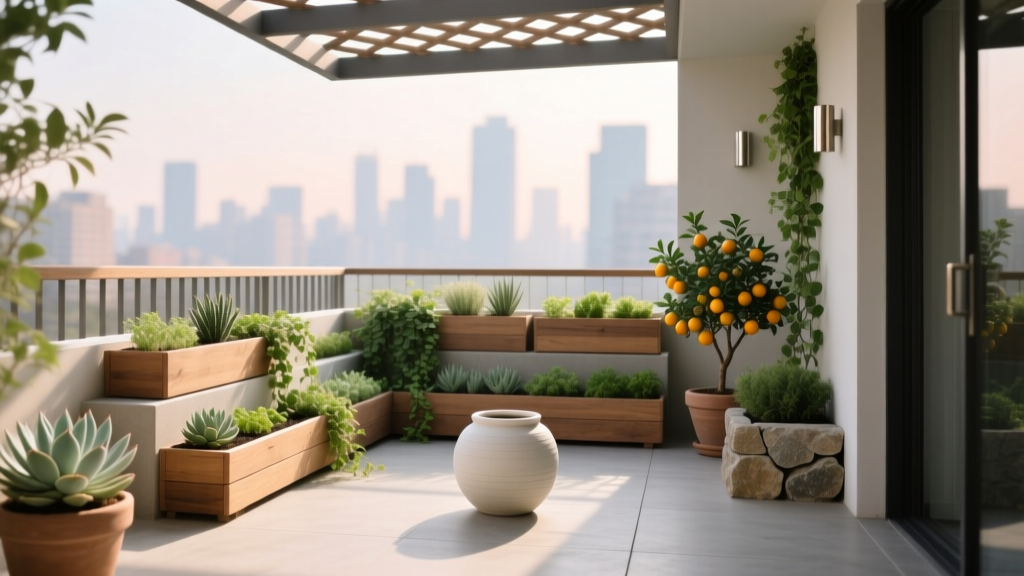
Balcony Garden Design Ideas for Small Spaces
The door slides open, and there it is: a balcony just wide enough for you to turn sideways with a mug of coffee. The railing’s hot by noon, the wind whips around the corner, and the only “garden” right now is a lonely plastic chair. You want fragrance, privacy, and something alive—without turning your walkway into an obstacle course or annoying the downstairs neighbor with dripping planters.
Designing a small balcony garden is less about cramming in plants and more about building a layout that behaves: it stays stable in wind, drains cleanly, leaves a clear path, and puts the right plants in the right light. Think of this like a micro-landscape project—just measured in inches instead of yards.
Start with a balcony “survey”: the measurements that decide everything
Before buying a single pot, take five minutes with a tape measure. Small-space design rewards accuracy.
- Depth (wall to railing): Common small balconies range from 0.9–1.2 m (3–4 ft). If yours is 1.0 m deep, a 30 cm (12 in) planter still leaves a workable 70 cm (28 in) passage—enough for comfortable movement.
- Length: Even a 2.4 m (8 ft) run can hold a full design if you think vertically.
- Railing height: Often 90–110 cm (36–43 in). This matters for trellis height and for setting planter boxes at a level that screens neighbors without blocking light.
- Sun hours: Track direct sun for a day. A practical rule: 6+ hours supports most fruiting crops; 3–5 hours supports leafy greens and many herbs; <3 hours calls for shade plants and foliage displays.
- Wind exposure: Corner units and high floors behave like wind tunnels. Plan for heavier containers, windbreaks, and flexible staking.
Safety note: Be mindful of load. Many residential balconies are designed around a live load in the range of ~60 lb/ft² (about 2.9 kPa) depending on local codes and building design; check your building guidelines if you’re planning lots of large pots or a water-filled reservoir. For context, ACI’s building code requirements reference balcony/live load design values in this neighborhood for some occupancies (American Concrete Institute, 2019).
Design principles that make small balconies feel bigger
1) Protect the “walking lane” first
Your balcony needs a clear strip so you can step out, water, harvest, and turn around. Aim for a consistent 60–75 cm (24–30 in) path. That single decision prevents the common mistake of placing pots in a way that forces you to shuffle sideways (and knock plants over).
Layout trick: Put the deepest containers along the railing (they’re already in the “no-walk” zone), and use slimmer items—like wall pockets or a narrow bench—against the building wall.
2) Use vertical planes like a designer: railing, wall, and ceiling line
Small spaces gain “square footage” by using surfaces. A balcony gives you three vertical planes:
- Railing plane: railing planters, trellis panels, clipped screens
- Wall plane: wall-mounted pots, grid panels, shelving
- Upper line: hanging baskets (if allowed), overhead tension rods, lightweight shade cloth
Keep the vertical system tidy: repeat materials (same pot color, same trellis style) so the garden reads as intentional rather than cluttered.
3) Create one focal point, then support it
Pick one “hero” element—an upright olive-like form, a flowering climber, a bold foliage pot—and let the rest play supporting roles. In tiny gardens, too many focal points feel chaotic.
“In small outdoor spaces, strong structure matters more than plant quantity—repeat a limited palette of containers and forms, then let seasonal plants rotate in and out.” — Susan Morrison, landscape architect, quoted in a design discussion on small-space landscapes (Morrison, 2018)
4) Plan drainage like it’s part of the design (because it is)
Balcony gardens fail when water management is messy. Use saucers, self-watering planters, or hidden trays. If you hang railing boxes, choose models with internal reservoirs or add a liner tray so runoff doesn’t drip.
For potting mix, skip heavy garden soil. Container media should drain quickly while holding moisture. University of Minnesota Extension notes that container growing needs a lightweight, well-drained medium rather than garden soil, which compacts in pots (University of Minnesota Extension, 2020).
Layout strategies that work in real balconies
The “Railing Border + Corner Tower” layout
Best for: narrow balconies where you still want a clear walkway.
- Run 3–4 railing planters along the sunniest edge (each about 60 cm/24 in long).
- In the windiest corner, place one heavy anchor container: 40–50 cm (16–20 in) diameter.
- Add a trellis (about 120–150 cm / 4–5 ft tall) in that anchor pot for vertical bloom or edible vines.
Why it works: the railing planters create a “border” effect like a ground-level garden bed, while the corner tower provides height and privacy without narrowing the passage.
The “Bench Garden” layout (a designer’s favorite for renters)
Best for: renters who can’t drill into walls and want seating.
- Use a narrow bench: about 30–35 cm (12–14 in) deep.
- Slide 2–3 medium pots under it (shade-tolerant foliage or storage for tools).
- Place 2 statement pots at bench ends to frame it like an outdoor room.
Why it works: you gain a functional “destination” (a seat) and your plants become the walls of that little room.
The “Wall Grid” layout for maximum vertical planting
Best for: balconies with limited floor space but decent wall area.
- Mount or lean a coated metal grid panel sized around 60 × 120 cm (2 × 4 ft).
- Hang 6–10 small pots (10–15 cm/4–6 in) for herbs or trailing plants.
- Keep one larger floor pot per grid to anchor the composition visually.
Why it works: you turn a blank wall into a living panel while keeping the floor mostly open.
A quick comparison: choose containers that match your habits
| Container Type | Typical Size | Best For | Watering Frequency | Ballpark Cost (USD) |
|---|---|---|---|---|
| Railing Planter (with reservoir) | 60 cm (24 in) long | Herbs, lettuces, trailing flowers | 2–4×/week in summer | $25–$60 each |
| Fabric Grow Bag | 19 L (5 gal) | Tomatoes, peppers, dwarf citrus (short-term) | 3–7×/week in heat | $5–$12 each |
| Self-Watering Pot | 30–40 cm (12–16 in) diameter | Busy schedules, thirsty plants | Refill weekly (varies) | $30–$90 each |
| Long Trough Planter | 90 cm (36 in) long | Mini “border” planting, grasses | 2–5×/week | $40–$120 each |
Plant selection that behaves in small spaces (with varieties that earn their keep)
Balcony plants must tolerate: container life, wind, reflected heat, and irregular watering. Choose plants with either compact genetics or easy pruning response.
For sunny balconies (6+ hours of direct sun)
1) Patio tomatoes (fruit + vertical habit)
- ‘Patio Choice Yellow’: compact, productive in pots; cheerful color reads well in tight spaces.
- ‘Tiny Tim’: true dwarf cherry tomato, suitable for 25–30 cm (10–12 in) pots.
- Spacing: one plant per 15–20 L container; stake to 90–120 cm.
2) Peppers (upright, ornamental, heat tolerant)
- ‘Lunchbox’ (mini sweet peppers): compact plants; great for snacking harvests.
- ‘Basket of Fire’: small hot peppers; also looks good in mixed containers.
- Spacing: one per 10–15 L pot; allow 30 cm (12 in) between pots for airflow.
3) Mediterranean herbs (fragrance + drought tolerance)
- Rosemary ‘Arp’: cold-hardy rosemary; upright structure can act like a mini-shrub.
- Thyme ‘Doone Valley’: trailing edge softens hard lines of rail planters.
- Oregano ‘Hot & Spicy’: vigorous; keep in its own pot to prevent takeover.
For part sun balconies (3–5 hours)
1) Leafy greens (fast, forgiving, shallow-rooted)
- ‘Black Seeded Simpson’ lettuce: quick harvest; repeats well in succession sowing.
- ‘Red Russian’ kale: attractive purple stems; tolerates cooler spells.
- Spacing: lettuce at 15–20 cm (6–8 in); kale at 25–30 cm (10–12 in).
2) Compact hydrangea for a focal pot (if your balcony is cooler and bright)
- Hydrangea macrophylla ‘Cityline Paris’: bred to stay compact; big color impact in one pot.
- Container: at least 40 cm (16 in) wide with consistent moisture.
3) Nasturtiums (edible + trailing + low effort)
- ‘Jewel Mix’: classic blend for rail planters; trails nicely and fills gaps.
- Why it works: it softens balcony edges and gives you edible flowers and leaves.
For bright shade (<3 hours direct sun)
1) Foliage that reads as “lush” without sun
- Heuchera ‘Caramel’ or ‘Obsidian’: color-rich leaves; compact mounds in pots.
- Ferns (like Boston fern): great for hanging baskets where they can drape.
- Carex oshimensis ‘Evergold’: grass-like texture; brightens shade and moves in breezes.
2) Fragrance option in shade
- Sweet alyssum (‘Snow Crystals’): tolerates part shade; honey scent near seating.
Three real-world balcony scenarios (and how I’d design them)
Scenario 1: A 3 ft × 8 ft renter balcony with morning sun (about 4 hours)
Goal: breakfast nook + herbs + no drilling.
Layout: bench garden. A 30 cm (12 in) deep folding bench against the wall, two end pots (35 cm / 14 in diameter) to frame it, and two railing planters for herbs.
Planting: basil ‘Genovese’ (in its own pot), thyme ‘Doone Valley’ trailing over the rail, chives, and a pot of ‘Red Russian’ kale for texture.
Budget: bench ($60–$120), two medium pots ($25–$40 each), two rail planters ($30 each), soil + fertilizer ($25). Expect roughly $200–$300 to start, less if you thrift containers.
Scenario 2: A windy 4 ft × 10 ft high-rise balcony with harsh afternoon sun (6–7 hours)
Goal: privacy + heat-tough plants + fewer tipping incidents.
Layout: railing border + corner tower. Use heavier, wider-base containers (or add gravel at the bottom only if drainage remains strong). Add a 150 cm (5 ft) trellis in the corner anchor pot as a wind-filtering screen.
Planting: rosemary ‘Arp’ as the backbone, ‘Basket of Fire’ pepper for color, and trailing lantana or nasturtium to cascade and soften the rail. If edibles are your priority, add ‘Patio Choice Yellow’ tomato in a 19 L (5 gal) container with a sturdy stake.
Extra protection: a breathable balcony privacy screen can reduce wind stress; keep it taut so it doesn’t become a sail.
Scenario 3: A shaded courtyard balcony with bright light but only 1–2 hours of sun
Goal: lush look + low-flower reliance + year-round structure.
Layout: wall grid + one focal pot. A 60 × 120 cm grid with small herb pots (mint, parsley) plus one large pot with a bold heuchera pairing and a carex for movement.
Planting: heuchera ‘Obsidian’ for dark drama, Carex ‘Evergold’ for contrast, Boston fern in a hanging basket if allowed, and sweet alyssum near the door for scent.
Note: mint is vigorous—keep it in its own container to prevent it from taking over.
Step-by-step setup: build a balcony garden that looks designed (not improvised)
- Measure and sketch: Mark your balcony depth and length. Draw a 60–75 cm walking lane first.
- Pick a layout template: choose one of the three layouts above and commit to it (this prevents clutter creep).
- Choose container sizes intentionally: one or two 40–50 cm “anchor” pots, then medium pots, then small accents. Keep colors consistent for cohesion.
- Buy or mix potting media: use container mix; add slow-release fertilizer if desired. Avoid digging soil from the ground (it compacts in containers), consistent with container-growing recommendations from Extension guidance (University of Minnesota Extension, 2020).
- Set up drainage control: add saucers, trays, or reservoir planters before filling with soil. If dripping is a concern, test-water over a bucket first.
- Plant in layers: start with your tall/structural plant (rosemary, compact shrub, trellis vine), then mid-height plants, then trailing edges.
- Mulch lightly: a 1–2 cm layer of fine mulch or decorative gravel reduces evaporation and makes pots look finished.
- Add lighting and one comfort piece: a small outdoor lantern, string light, or a single chair turns the garden into a place you’ll actually use.
Budget-smart design: where to spend and where to DIY
Spend on: stable containers (especially in wind), good potting mix, and one or two self-watering planters if you travel or forget to water. A single quality self-watering pot at $40–$90 can save a season of stressed plants.
Save with DIY:
- Upcycle nursery pots inside a prettier cachepot (thrift store or discount retailer). You get the look without paying $60 per container.
- Make a trellis with bamboo stakes and garden twine. A simple 120 cm bamboo teepee can cost $8–$15 versus $40+ for a decorative metal trellis.
- Use a tension rod (if allowed) to hang lightweight planters without drilling—just keep weight modest and check stability weekly.
Cost reality check: A small but polished balcony garden typically lands around $150–$450 depending on container choices, with the biggest variable being planters and whether you add irrigation helpers.
Maintenance expectations: how much time this really takes
Balcony gardens are concentrated ecosystems. They dry faster than in-ground beds, and wind accelerates moisture loss. Plan on:
- Weekly time: 30–60 minutes total for watering checks, deadheading, and quick pruning. In heat waves, watering can be 5–10 minutes/day.
- Feeding: for edibles, apply a liquid fertilizer about every 2–4 weeks during active growth (follow label rates). Slow-release pellets can reduce effort.
- Summer: pinch basil weekly to prevent flowering; tie tomatoes/beans to supports; remove yellowing leaves for airflow.
- Fall: refresh tired annuals, sow cool greens if you have part sun, and clean trays/saucers to prevent algae and pests.
- Winter (if cold): group pots together for insulation, raise them off cold concrete with pot feet, and protect sensitive plants. Even hardy perennials in pots are more exposed than those in the ground.
Expect to rework at least 20–30% of your planting seasonally—small gardens shine when they’re allowed to evolve. Keep your structural elements (anchor pots, trellis, a consistent container palette) and rotate “seasonal color” plants in and out.
Small-space finishing touches that make it feel like an outdoor room
Privacy with plants: Instead of a solid wall of tall pots (which gets heavy), aim for partial screening: one trellis plant plus a grass-like carex and a trailing edge. This filters views without blocking all light.
Color discipline: Choose one main flower color and one foliage contrast. For example: deep burgundy heuchera + chartreuse carex + white alyssum. Repetition reads as designed.
Scent placement: Put fragrance within arm’s reach of the door or seat: sweet alyssum, rosemary, or a pot of basil right where your hand brushes it.
When your balcony garden is working, it doesn’t feel like a collection of pots—it feels like a tiny landscape with structure, edges, and a place for you to stand. Start with the path, build upward, choose compact varieties that match your sun hours, and spend your budget where it reduces daily hassle. The result is a small space that earns its keep every morning you step outside.
Sources: American Concrete Institute (ACI). Building Code Requirements for Structural Concrete (ACI 318), 2019. University of Minnesota Extension. “Growing vegetables in containers,” 2020.