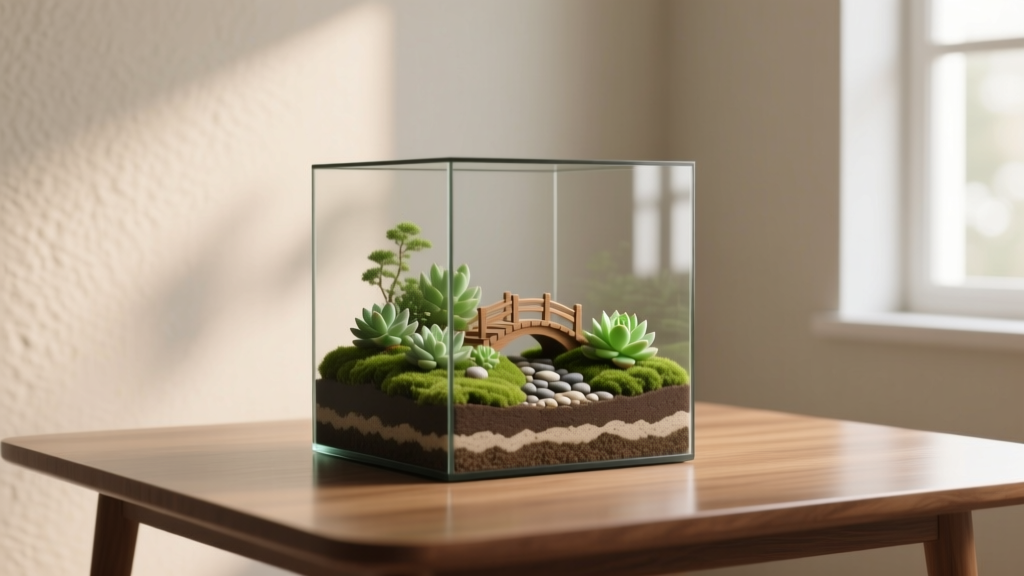
Indoor Terrarium Building Guide
The corner of your kitchen counter is getting crowded again: a fruit bowl, a stack of mail, and that one sad houseplant that never quite recovered from the last heat blast. You want something green, but not another pot to tip over, not another saucer to stain the wood. What you really want is a small, self-contained landscape—something designed, not just placed. That’s where a terrarium shines: a contained garden you can build to fit a windowsill, a desktop, or a rental apartment where wall hooks are questionable and floor space is precious.
Think of a terrarium the way a landscape designer thinks about a courtyard: define the boundaries, engineer drainage, set a focal point, then plant for scale and longevity. The goal isn’t “stuffing plants in glass.” The goal is a tiny ecosystem with a layout that looks intentional from every angle you’ll see it—standing at the sink, sitting at your desk, passing by in a hallway.
Start with the footprint: design around your real space
Before you buy anything, decide where the terrarium will live and measure that surface. A terrarium that’s perfect in theory can feel like clutter if it blocks a cabinet door or steals your only prep space.
Recommended container dimensions for common home “dead zones”
Use these as practical starting points (you can go larger, but these sizes fit most rental-friendly surfaces without dominating them):
- Desk terrarium: 8–10 in (20–25 cm) wide container; keep height under 12 in (30 cm) so it doesn’t visually crowd your monitor.
- Kitchen counter terrarium: 10–14 in (25–36 cm) wide; place it where it won’t be splashed daily.
- Narrow windowsill terrarium: a long trough container 16–24 in (40–60 cm) long and 4–6 in (10–15 cm) deep.
Budget-wise, a simple glass jar can cost $8–$15, while a purpose-built glass terrarium with a lid commonly runs $25–$60. Plan an all-in project cost of $35–$120 depending on plants and container choice.
Closed vs. open terrariums: choose the right “microclimate”
This is your first big layout decision because it affects plant palette, hardscape, and maintenance rhythm.
| Feature | Closed Terrarium (with lid) | Open Terrarium (no lid) |
|---|---|---|
| Best for | Humidity-loving plants (ferns, mosses) | Drier plants (succulents, cacti) |
| Sunlight target | Bright, indirect; avoid hot direct sun | Brighter light tolerated; still avoid scorching glass heat |
| Watering frequency | Often every 3–8 weeks (small sips) | Often every 7–14 days (let soil dry) |
| Common failure | Mold/rot from too much water, poor airflow | Stretching/etiolation from low light |
| Ideal container shape | Wide mouth for planting; lid to retain humidity | Bowl or geometric terrarium with wide opening |
One science-backed reason closed terrariums work so well is that they recycle water through evaporation and condensation—essentially a miniature water cycle. NASA’s classic indoor air research also reminds us that plant micro-environments interact strongly with moisture and air conditions; healthy indoor planting is about balancing biology and environment, not just adding greenery (NASA, 1989).
Layout strategy: design it like a tiny landscape
A terrarium looks “designed” when it has readable structure: a foreground, midground, and background, plus a focal point. Your job is to scale those layers to a container that might only be 10 inches wide.
Use the rule of thirds for instant composition
Place the tallest element (a driftwood piece, a stone, or your tallest plant) roughly one-third from the left or right, not dead center. This simple move creates depth and makes even a small jar look intentional.
Build a slope to fake distance
In landscapes, a gentle grade change suggests depth. In terrariums, a 1–2 inch (2.5–5 cm) soil rise from front to back makes the back plants appear further away and gives roots more volume where taller plants sit. Keep the front lower so you can still see details and so condensation doesn’t obscure everything.
Design negative space on purpose
Not every inch needs to be planted. Leave a small “clearing”—a patch of sand, fine gravel, or exposed moss—so the eye can rest. This is especially important in containers under 1 gallon (3.8 L) where crowding happens fast.
Materials and soil engineering (this is where terrariums succeed or fail)
A terrarium is a container without drainage holes—so you must engineer drainage and soil structure. Extension specialists consistently stress that poor drainage and overwatering are the top drivers of indoor plant decline (University of Maryland Extension, 2019).
“Overwatering is the most common cause of houseplant failure; roots need oxygen as much as they need water.” — University of Maryland Extension, 2019
Recommended layer dimensions
- Drainage layer: 1–1.5 in (2.5–4 cm) of rinsed pea gravel, lava rock, or LECA balls.
- Charcoal layer (optional but helpful): 0.25–0.5 in (0.6–1.2 cm) of horticultural charcoal to reduce odors and keep the system fresher.
- Soil layer: 2–4 in (5–10 cm) depending on plant roots and container height.
- Top dressing: a thin finish layer of moss, sand, or fine gravel to control splash and add design polish.
Cost snapshot (typical big-box or local garden shop pricing): a 2-quart bag of LECA runs about $8–$12, horticultural charcoal about $7–$15, and a small bag of indoor potting mix about $6–$12. If you’re on a budget, clean aquarium gravel and a pinch of crushed lump charcoal can work as DIY substitutes.
Step-by-step build: a practical workflow that avoids mess
Set yourself up like a designer doing an install: protect the table, stage materials, and work cleanly. A simple funnel made from rolled paper or a cut plastic bottle keeps the glass tidy.
- Measure your container opening so you know if your hand fits; if not, plan to use long tweezers or chopsticks.
- Add drainage material to a depth of 1–1.5 inches, leveling it with a spoon.
- Add a thin charcoal layer (0.25–0.5 inches) if you’re building closed or semi-closed.
- Add pre-moistened soil (moist like a wrung sponge, not wet). Build a 1–2 inch slope toward the back.
- Place hardscape first (stones/wood). Turn the container as you place items; design it from the front and from the side you’ll see most.
- Plant from largest to smallest. Dig holes with a spoon handle; keep plant crowns above soil line to prevent rot.
- Top-dress with moss, sand, or fine gravel to finish edges and reduce soil splash.
- Water lightly: for a closed terrarium, start with 1–3 tablespoons for a small jar; for open succulent bowls, water until the soil is evenly damp but not pooling.
- Clean the glass inside with a microfiber cloth wrapped around a chopstick.
- Place in correct light and watch for 7–10 days before adjusting watering again.
Plant selection: specific varieties that behave well in glass
Choose plants for scale, growth rate, and humidity preference. In terrariums, slow and compact beats dramatic and fast every time. Aim for 3–7 plants depending on container size; in a 10-inch bowl, four plants usually look fuller and healthier than eight crammed together.
Best plants for closed terrariums (humid, stable, low-mess)
- Fittonia albivenis (nerve plant) — Stays compact, loves humidity, and gives strong leaf pattern for “design pop” in small spaces.
- Peperomia caperata ‘Rosso’ — Corrugated texture adds contrast; tolerates lower light than many terrarium favorites.
- Selaginella kraussiana (spikemoss) — Looks like miniature groundcover; great for a lush “forest floor” effect.
- Nephrolepis exaltata ‘Duffii’ (lemon button fern) — Fine texture, manageable scale; especially good as a soft background layer.
- Miniature moss mixes (sheet moss, cushion moss) — Best used as a top dressing and foreground “carpet,” not buried under taller plants.
Best plants for open terrariums (drier air, brighter light)
- Haworthia cooperi — Compact rosette, tolerant of indoor light; perfect focal plant for a 10–12 inch bowl.
- Gasteria ‘Little Warty’ — Slow-growing, sculptural texture; reads like a living stone in modern interiors.
- Crassula ovata ‘Gollum’ (small forms) — Use sparingly; choose a small specimen and prune to keep scale.
- Sedum morganianum ‘Burrito’ (small cuttings) — Trailing accent over a rock edge; works best near the rim where airflow is highest.
Spacing rule: leave 1–2 inches (2.5–5 cm) between plants at install. It will look slightly sparse on day one and perfectly balanced by week six.
Light planning: place it like a designer, not like a plant hoarder
Most terrarium plants want bright, indirect light. Aim for 6–8 hours of bright indirect light daily near an east or north window. If you only have a dim room, design for it: choose peperomias and fittonias, and reduce plant count so airflow and soil balance are easier to manage.
For renters with limited window access, a small LED grow light is a clean solution. A modest bar-style LED can cost $20–$40 and run 10–12 hours per day on a timer. Keep the light 10–14 inches above the terrarium to reduce heat buildup and algae growth.
Three real-world layouts (and what I’d build in each)
Scenario 1: A renter’s low-light desk (no plant casualties, please)
Space: 24-inch wide desk corner, window across the room. Container: 1-gallon wide-mouth jar, about 8–9 inches wide. Design: a gentle back slope, one focal stone set one-third from the side, and an open “clearing” of moss at the front.
Plant palette: Fittonia (1), Peperomia caperata ‘Rosso’ (1), Selaginella (1), cushion moss. These tolerate lower light better than many ferns and won’t rocket into the glass.
Maintenance rhythm: 10 minutes/week to wipe glass and check condensation; water about once every 4–6 weeks (tiny amounts). If the jar is fogged all day, crack the lid for 2–4 hours to vent.
Scenario 2: A bright kitchen windowsill that gets morning sun
Space: 5-inch deep sill, east-facing. Container: trough terrarium 18 x 5 x 6 inches. Design: “riverbed” layout—sand and small stones forming a winding negative space from front left to back right.
Plant palette: lemon button fern at the back (2 small plants, spaced 3 inches apart), fittonia in the midground (2), sheet moss along the “banks.” Morning sun can be intense through glass; pull the terrarium back 6–12 inches from the pane if you see midday overheating or crispy edges.
Budget note: A trough container may cost $35–$55, but you can DIY with a long glass baking dish from a thrift store for $6–$12—just keep it away from direct cooking splatter.
Scenario 3: A homeowner’s living room statement piece (but still manageable)
Space: sideboard near a north-facing window. Container: 2–3 gallon glass terrarium with a lid, roughly 12–16 inches wide. Design: a “fallen log” hardscape with one branching wood piece creating height, plus a stone cluster at the base for a grounded, natural feel.
Plant palette: one lemon button fern as background, peperomia as midground, fittonia as color accent, selaginella as groundcover, and moss to knit everything together. Keep taller plants toward the back third; leave a front viewing corridor so the scene reads from across the room.
Maintenance rhythm: 15 minutes/week. Plan a seasonal reset every 3–4 months: trim back runners, remove old leaves, wipe mineral spots, and rotate the container a quarter turn for even growth.
Budget choices and DIY alternatives that still look high-end
A terrarium doesn’t need boutique supplies to look intentional—what matters is proportion, restraint, and clean installation.
- Container: thrifted cookie jars, beverage dispensers (spigot removed), or fishbowls can substitute for pricier terrarium vessels.
- Drainage: aquarium gravel or rinsed pea gravel works as well as specialty media; aim for that 1–1.5 inch depth.
- Tools: long tweezers are nice, but bamboo chopsticks plus a spoon handle can plant an entire jar.
- Hardscape: one strong rock and one piece of wood is often enough; buying fewer, larger statement pieces avoids the “craft store scatter” look.
If you’re watching costs, allocate your budget intentionally: spend on the container (it’s the frame), then on healthy plants; save on decorative extras. A clean layout with two textures and one focal point will read more expensive than a crowded mix of mini figurines.
Maintenance expectations: what you’re signing up for
A well-built terrarium is low effort, not no effort. Plan for 10–20 minutes per week depending on size and whether it’s open or closed.
Weekly checklist (keeps problems small)
- Scan for condensation: In closed terrariums, light morning fog is fine; heavy fog all day means too much water or too little light.
- Remove shed leaves: dead material is mold’s best friend.
- Rotate for even growth: a quarter turn every 1–2 weeks if light comes from one direction.
- Check soil moisture: touch the top inch; if it feels wet in a closed terrarium, don’t add water.
Seasonal tasks (every 2–4 months)
- Prune for scale: cut fittonia back above a node; pinch peperomia tips to keep a compact silhouette.
- Refresh the “view”: wipe the glass, re-tuck moss edges, and re-expose a bit of your negative space so the design stays readable.
- Assess crowding: if leaves are pressing against glass constantly, remove a plant rather than fighting nature.
Common troubleshooting rule: if you see mold in a closed terrarium, remove affected leaves, open the lid for 24–48 hours, and stop watering. If plants are stretching, increase light to reach that 6–8 hours of bright indirect exposure (or add an LED for 10–12 hours daily).
Final design touches that make it feel like a “room,” not a jar
When the planting is done, step back and look at it the way you’d look at a garden bed from the patio. Does your focal point read clearly? Is there a calm open area? Do you have at least two contrasting textures (say, fern fronds against fittonia leaves)? If the answer is yes, you’ve built a terrarium that will look better in a month than it does today.
Place it where you’ll actually enjoy it: eye level beats hidden on a shelf. Give it the light it needs, then let the system settle. A terrarium rewards patience—less watering, fewer fussy adjustments, more quiet observation. In a home short on outdoor space, it’s one of the most satisfying ways to claim a little landscape of your own.
Sources: NASA (1989) Interior Landscape Plants for Indoor Air Pollution Abatement. University of Maryland Extension (2019) Houseplants: Overwatering and Drainage Guidance.