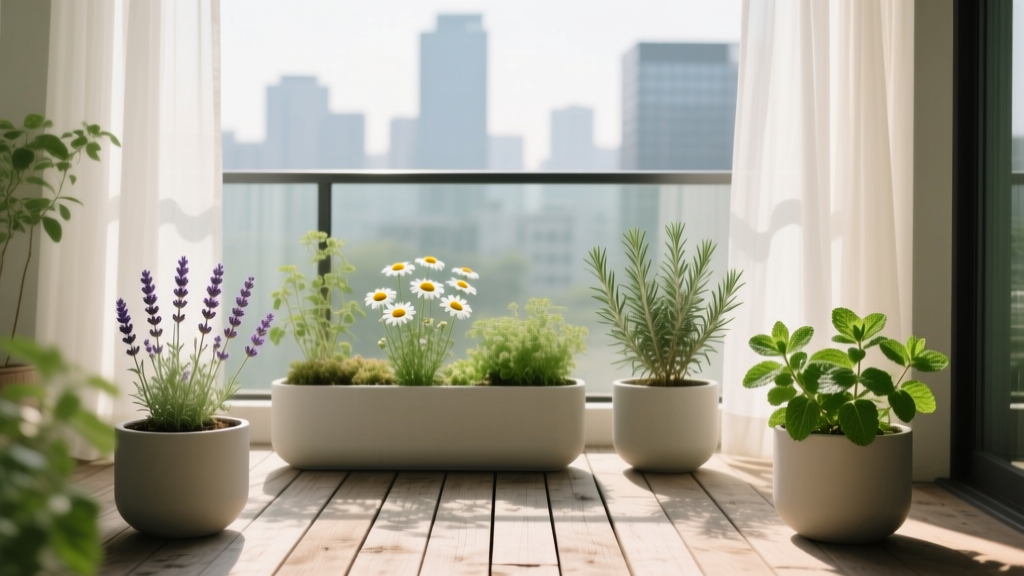
Balcony Medicinal Herb Apothecary Garden
The first time you notice it, it’s usually after a long day: the balcony door is open, the city air is warm, and you want something soothing—tea for the throat, a calming scent for sleep, a leaf for a small burn in the kitchen. You have a few random pots, maybe a leggy basil and a mint that keeps trying to escape. What you don’t have is an organized little apothecary—one that fits your balcony, respects sun and wind, and gives you reliable harvests without turning your outdoor space into clutter.
Let’s design a balcony medicinal herb apothecary garden like a landscape designer would: start with the constraints (light, wind, weight, and circulation), choose a layout that makes harvesting easy, then plant for function—sleep, digestion, skin, colds—using compact, container-friendly varieties.
Design principles for a balcony apothecary (the “clinic” mindset)
1) Put “access” before “aesthetics”
Medicinal herbs work best when you actually use them. That means a layout that lets you reach plants daily without moving furniture. On most balconies, the sweet spot is a 24–30 inch clear walking lane (enough to turn with a watering can). If your balcony is narrow, aim for 18 inches minimum clearance and keep containers tight to the railing and walls.
Design rule: keep your most-used herbs within one step of the door—think lemon balm for tea, thyme for steam inhalations, aloe for minor skin issues.
2) Read your balcony’s light in hours, not in adjectives
“Bright” can still mean only 2 hours of direct sun. Before buying plants, take one day and note direct sun exposure: morning to afternoon. Most culinary/medicinal Mediterranean herbs want 6–8 hours of direct sun; many “tea” herbs tolerate 3–5 hours with bright ambient light.
Keep in mind container soil heats faster than ground soil, so a south- or west-facing balcony can behave like a little heat island.
3) Create microzones: dry, moderate, and moist
The fastest way to lose herbs is to water everything the same. Group by moisture preference:
- Dry zone: thyme, oregano, sage, rosemary, lavender (sharper drainage, less frequent watering)
- Moderate zone: calendula, basil (medicinal types), chamomile
- Moist zone: lemon balm, mint (in its own pot), gotu kola if you’re adventurous and have warmth
4) Design for wind and weight (especially for renters)
Balconies are wind tunnels. Tall, top-heavy pots tip first, and herbs like basil can shred in constant gusts. Choose wider bases, add weight low (a few clean stones at the bottom only if drainage remains strong), and secure railing planters. If you rent, assume you’ll need a no-drill setup: freestanding shelves, railing hooks rated for outdoor use, and plant caddies for mobility.
Also remember that wet soil is heavy. If you’re unsure about load limits, keep containers smaller (10–12 inch diameter) and distribute them rather than clustering everything in one corner.
Layout strategies that feel intentional (not like a pot collection)
The “U-Shape Dispensary” (best for 5–7 ft wide balconies)
If your balcony is roughly 5 ft x 10 ft (a common apartment size), a U-shape creates a pocket garden you can step into. Place two narrow shelving units (each 12–14 inches deep) along the side walls, and one line of railing planters across the front. Leave the center open as your work lane.
This layout gives you three tiers: floor pots (deep-rooted), middle shelf (daily harvest), and top/railing (sun-lovers).
The “One-Wall Pharmacy” (best for narrow balconies and fire-escape rules)
For a balcony that’s only 3 ft deep, keep everything on one wall so you preserve safe passage. Use a 48-inch wide metal shelving rack (often $35–$70) and add trays beneath to catch drips. Put the thirstier herbs on lower shelves where they’re shaded and don’t dry out as fast.
If your building restricts railing planters, this still looks lush without breaking rules.
The “Mobile Clinic” (best for windy balconies or people who travel)
Use plant caddies with wheels under 12–14 inch pots so you can roll everything back from the railing in storms or heat waves. Set up a cluster of 6–8 matching pots in two rows, leaving a 24-inch path. This is the lowest-commitment design: easy to reconfigure, easy to move at lease-end.
“Good planting design is less about selecting ‘pretty plants’ and more about organizing relationships—access, maintenance, and the way plants share resources like light and water.” — Nigel Dunnett, planting design researcher and author (2016)
Step-by-step setup (a designer’s build order)
- Measure and sketch. Note balcony length/width, door swing, and where you can’t block vents or drains. Mark a 24–30 inch walking lane.
- Track sun for one day. Count direct sun hours (e.g., 4 hours morning sun). This decides your plant palette.
- Choose containers by root depth. Aim for:
- 12–14 inch pot for rosemary, sage, lavender (deeper roots, stability)
- 10–12 inch pot for lemon balm, calendula, echinacea (if space allows)
- 8–10 inch pot for thyme, oregano, chamomile
- Mint: always its own pot (minimum 10 inch)
- Use a light, durable soil mix. A quality potting mix plus 10–20% pumice/perlite improves drainage for Mediterranean herbs. Avoid heavy garden soil in containers.
- Set up irrigation habits. If you hand-water, group thirsty plants together so you’re not “spot watering” every day. If you travel, consider a simple drip kit (often $25–$60).
- Plant in functional zones. Dry-zone herbs together; moist-zone herbs together. Label everything with weatherproof tags.
- Add one working surface. A small folding bistro table or wall shelf gives you a place to snip, bundle, and set a tray for drying.
Plant selection: compact medicinal herbs that behave in containers
Below are plants chosen for medicinal tradition, container performance, and real balcony constraints (wind, variable sun, limited soil volume). Always confirm safety for your household—especially with pregnancy, medications, pets, and allergies.
Core “apothecary” plants (reliable, forgiving)
1) Calendula (Calendula officinalis)
Variety: ‘Pacific Beauty’ or ‘Resina’ (often grown for resinous flower heads). Calendula is a workhorse for salves and skin-focused infusions. It flowers well in containers and keeps producing when you deadhead. Spacing: 8–10 inches between plants; one plant per 10–12 inch pot works beautifully.
2) German chamomile (Matricaria chamomilla)
Variety: ‘Bodegold’ (a common high-flowering type). Chamomile is great for tea and fits into an 8–10 inch pot. Give it 4–6 hours of sun for best bloom; it will tolerate less with fewer flowers.
3) Lemon balm (Melissa officinalis)
Variety: ‘Quedlinburger Niederliegende’ (compact habit when pinched) or look for any “compact” lemon balm start. This is one of the most-used balcony tea herbs: calming, bright flavor, and resilient. Put it in a 10–12 inch pot; harvest weekly to prevent legginess.
4) Thyme (Thymus vulgaris)
Variety: ‘German Winter’ thyme for cold tolerance and strong flavor. Thyme likes a drier zone and excellent drainage. One plant can fill an 8–10 inch pot over time. Great for steam inhalations and as a culinary-medicinal crossover herb.
5) Sage (Salvia officinalis)
Variety: ‘Berggarten’ (broad leaves, compact growth) or ‘Compacta’. Sage is a balcony staple for teas/gargles and dries well. Give it a 12 inch pot and keep it on the sunnier, drier side.
6) Aloe vera
Variety: standard Aloe vera (look for a healthy, unblemished plant rather than a named cultivar). Aloe is the balcony first-aid plant for minor skin irritation. It needs bright light; indoors it sulks, but on a protected balcony it thrives. Use a gritty cactus mix and a pot around 10–12 inches.
If you have strong sun (6–8 hours): add these “Mediterranean pharmacy” plants
Lavender (Lavandula angustifolia)
Variety: ‘Munstead’ (compact) or ‘Hidcote’ (tight mound, deep color). Lavender is a drying plant—literally and aesthetically—so keep it in the driest zone, in a 12–14 inch pot with sharp drainage. It’s excellent for sachets and calming scent. In humid climates, airflow is essential.
Rosemary (Salvia rosmarinus)
Variety: ‘Arp’ (cold-tolerant) or ‘Tuscan Blue’ (upright, strong stems). Rosemary can be a balcony “shrub” if you give it a stable pot (14 inches wide is ideal) and don’t overwater. Wind protection helps prevent branch breakage.
Oregano (Origanum vulgare)
Variety: ‘Greek’ oregano for a compact, pungent plant. Excellent in a dry zone; one plant per 8–10 inch pot is plenty.
If you have part sun (3–5 hours): add these adaptable healers
Holy basil / Tulsi (Ocimum tenuiflorum)
Variety: ‘Kapoor’ (often grown for tea). Tulsi appreciates warmth and consistent moisture. In part sun, it still performs if the light is bright and the potting mix stays evenly moist. Plan on a 10–12 inch pot and pinch weekly.
Mint (Mentha spp.)
Variety: ‘Moroccan’ mint for tea or peppermint (Mentha × piperita) for strong menthol notes. Mint is vigorous—keep it contained. One 10–12 inch pot, and trim hard to prevent it from shading neighbors.
Gotu kola (Centella asiatica)
Variety: often sold simply as gotu kola. This is for warm balconies (or summer-only) and people who enjoy leafy herbs. It prefers consistent moisture and a wider pot. If your balcony is windy and dry, skip it.
Quick comparison: pick plants that match your light and watering style
| Herb | Sun target | Container size | Watering style | Balcony advantage |
|---|---|---|---|---|
| Calendula | 4–8 hrs | 10–12 in pot | Moderate | Long bloom window; easy to dry |
| Chamomile | 4–6 hrs | 8–10 in pot | Moderate | Compact; quick harvest cycles |
| Lemon balm | 3–6 hrs | 10–12 in pot | Moist | Productive even in part sun |
| Thyme | 6–8 hrs | 8–10 in pot | Dry | Wind-tolerant; doesn’t flop |
| Lavender | 6–8 hrs | 12–14 in pot | Dry | Fragrance + pollinators |
| Aloe vera | Bright light; some direct sun | 10–12 in pot | Dry (infrequent) | First-aid utility; tidy form |
Three balcony scenarios (real-world design solutions)
Scenario 1: The windy, south-facing high-rise (hot, bright, drying)
Problem: Leaves tear, pots dry out fast, and tall plants topple in gusts.
Layout move: Use the “Mobile Clinic” cluster pulled 12–18 inches back from the railing, with heavier pots on the outside as a wind buffer. Add a simple reed screen or outdoor fabric panel on the windiest side (freestanding if rentals rules apply).
Plant palette: thyme ‘German Winter’, oregano ‘Greek’, sage ‘Berggarten’, lavender ‘Hidcote’, rosemary ‘Arp’ in a heavier pot, plus calendula for color. Skip delicate basil unless you can shelter it.
Water strategy: Deep water 2–3 times per week in peak summer; Mediterranean herbs still like a soak, then a dry-down. Consider a $35 drip kit if you travel.
Scenario 2: The shaded, north-facing rental (bright shade, limited direct sun)
Problem: Plants grow slowly and get leggy; flowering herbs underperform.
Layout move: Choose the “One-Wall Pharmacy,” placing the sun-hungriest pots on the top shelf closest to the brightest edge. Use reflective surfaces strategically: a light-colored wall or a simple white panel behind the shelf can increase usable brightness.
Plant palette: lemon balm, mint (contained), tulsi (if warm), parsley (as a supportive fresh herb), and aloe near the brightest spot. Calendula may flower lightly; chamomile may be sparse—grow them if you’re okay with modest yields.
Expectation setting: In 2–3 hours of direct sun (or none), focus on leafy harvest (balm, mint) rather than blossoms (calendula/chamomile).
Scenario 3: The small balcony that also has to be a seating area (multi-use, tidy look)
Problem: You want an herb garden, but you also want to sit down with coffee without stepping around pots.
Layout move: Build a “U-Shape Dispensary” but keep the floor clear by using vertical space: two slim shelves and railing planters. Reserve one corner for a 16–18 inch diameter feature pot (rosemary or lavender) to anchor the design visually like a mini shrub border.
Plant palette: calendula and chamomile on the railing for sun, thyme and oregano on the top shelf, lemon balm and mint on a lower shelf where they hold moisture longer, aloe near the door for quick access.
Tidy trick: Choose matching pots (even inexpensive plastic in one color) to make the garden feel designed. The visual calm is worth it.
Budgeting the balcony apothecary (and smart DIY swaps)
A balcony medicinal garden can be elegant on a modest budget. Here’s a realistic cost sketch for a starter apothecary with 8 containers:
- 8 pots (10–12 inch): $5–$18 each depending on material (plastic vs terracotta vs composite)
- Potting mix (2–3 bags): $12–$20 per bag
- Herb starts (8–10 plants): $4–$8 each at a local nursery; seeds cost less but take time
- Simple shelf unit: $35–$70
- Pruners + labels: $12–$25
DIY alternatives that look intentional:
- Use food-safe buckets or storage bins as planters (drill drainage holes) and sleeve them with a woven basket for a cleaner look.
- Turn a sturdy wooden crate into a riser shelf—just add a pond liner offcut or tray to protect the floor.
- Make plant labels from blinds or cut-up plastic containers; write with paint pen.
Spacing and planting density (so plants stay healthy)
Container crowding is the stealth problem on balconies: leaves stay damp, airflow drops, pests move in. Use these spacing anchors:
- Thyme/oregano: 1 plant per 8–10 inch pot
- Lavender/sage: 1 plant per 12–14 inch pot
- Calendula: 1–2 plants per 12 inch pot (keep 8–10 inches between stems)
- Chamomile: 2–3 plants per 12 inch pot if you want a fuller look, but thin if airflow drops
- Mint/lemon balm: 1 plant per pot; pinch often for bushiness
If you want the “apothecary abundance” look quickly, underplant one larger pot with a trailing thyme instead of cramming multiple upright plants together.
Using and storing your harvest (small-batch, balcony-friendly)
Keep your processing simple: snip, rinse if needed, and dry on a mesh rack indoors. A small rack costs about $15–$30 and prevents mold better than piling herbs on a plate.
For herbs commonly used as teas (lemon balm, mint, tulsi, chamomile), harvest in the morning after dew dries. For calendula, pick flower heads when fully open; dry quickly to retain color.
Maintenance expectations (what it really takes)
Plan on 30–60 minutes per week total maintenance for a balcony apothecary once it’s established, plus a slightly longer seasonal reset. The work is light, but consistency matters more in containers.
- Weekly (10–15 minutes, 2–3 times): check moisture, water deeply as needed, pinch fast growers (mint, lemon balm, basil/tulsi), deadhead calendula.
- Every 2 weeks (15 minutes): inspect for aphids/spider mites (especially in hot, dry balconies), rotate pots a quarter turn for even growth.
- Monthly (20 minutes): light feeding for heavy harvesters (lemon balm, tulsi). Mediterranean herbs prefer minimal feeding—too much fertilizer reduces aromatic oils.
- Seasonal (60–90 minutes): refresh top 1–2 inches of potting mix, prune lavender after flowering (don’t cut into old woody stems), and decide what overwinters indoors.
Safety notes and evidence-based sourcing (quick but important)
Medicinal herbs are powerful plants, and “natural” can still interact with medications. For home apothecary use, stick to gentle, widely used herbs unless you’ve checked safety for your situation.
Two solid, accessible references worth keeping on your shelf:
- National Center for Complementary and Integrative Health (NCCIH), Herbs at a Glance pages (updated regularly; cite specific herb monographs). For example, NCCIH discusses chamomile safety considerations and potential allergy issues (NCCIH, 2022).
- Royal Horticultural Society (RHS) plant profiles and cultivation guidance—helpful for container culture and pruning timing (RHS, 2023).
If you want one research-backed design insight to guide your maintenance rhythm, remember this: healthy growth is usually a function of light, spacing, and consistent water management—exactly the factors you control most tightly on a balcony. A well-organized layout reduces plant stress and reduces your workload.
When your balcony apothecary is working, it feels less like “gardening” and more like having a living pantry: a pot you can reach for when your throat is scratchy, when you want a calming cup at night, or when you need a few petals for a simple infused oil. Start with a tight palette, place plants where you’ll actually touch them, and let the design do the heavy lifting—so the herbs can do theirs.