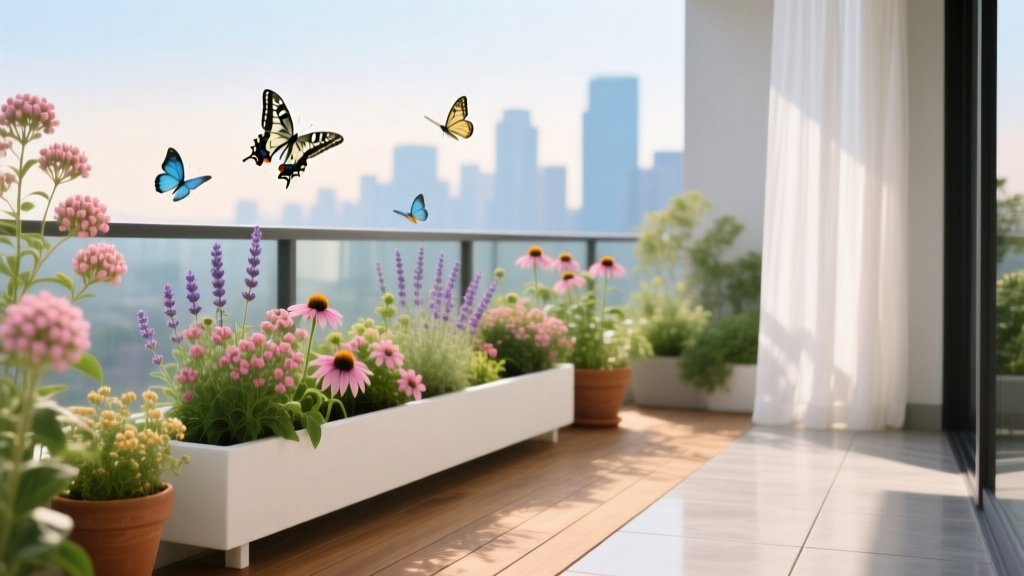
Balcony Butterfly Garden Setup
The first time you notice it, it feels like a mistake: you step onto your balcony with a mug of coffee and see leaves riddled with tiny holes, a curled edge here, a chewed corner there. Then the “mistake” lifts off—an orange flicker, a swallowtail glide, a small skipper that hovers like a wind-up toy. Suddenly your balcony isn’t just outdoor storage. It’s habitat. The trick is designing it so butterflies can find it, feed, and linger—without turning your limited square footage into a cluttered jungle or a watering chore you resent by July.
Below is a balcony butterfly garden setup the way a landscape designer would approach it: start with light and wind, map a layout you can actually live with, then layer nectar plants, host plants, and a few small “comfort” features that make butterflies stay. We’ll keep it renter-friendly, container-based, and flexible—because balconies change: new neighbors, new rules, a new lease, a new sun pattern.
Read Your Balcony Like a Site Plan (Before You Buy Anything)
Butterfly gardening on a balcony is less about “more plants” and more about placing the right plants where they’ll actually perform. Two measurements matter most: sunlight hours and usable floor depth.
Sunlight targets (and what’s realistic)
Most top nectar plants need 6+ hours of direct sun to bloom heavily. If you only get 3–4 hours, you can still build a butterfly stopover, but you’ll lean into part-shade bloomers and accept fewer flowers at any one time.
Practical benchmark: if you can read a book outside without squinting for at least half the day, you can likely hit the flower density butterflies notice from the air.
Wind, heat, and the “balcony canyon” effect
Balconies run hot and windy. Wind can shred wings and dry containers fast; heat bakes soil in dark pots. Plan for wind buffering and stable moisture. A simple windbreak (bamboo screen, trellis with a vine, or even a tall grass in a heavy planter) can reduce plant stress dramatically.
Quick measuring sheet
- Clear walking lane: aim for 24 inches minimum so you’ll actually use the balcony.
- Deep planters: 12–18 inches soil depth for perennials and host plants with substantial roots.
- Pot spacing: leave 3–6 inches between containers for airflow and watering access.
- Watering frequency in summer sun: expect 3–5 times/week for small pots; 2–3 times/week for large, mulched containers.
Design Principles That Make Butterflies Stay
1) Build a “landing strip” of flowers at rail height
Butterflies cruise at about railing level, especially in urban settings where wind funnels above and below. Arrange your most nectar-rich flowers in a visual band from 30–48 inches high (railing planters, tall pots, plant stands). This creates an easy-to-spot target and keeps blooms out of the hottest reflected heat near the balcony floor.
2) Cluster by color and bloom shape (don’t scatter singles)
From the air, one pot of flowers can disappear. Three pots together reads as a patch. Repeat colors (purple, pink, yellow) in clusters. A useful rule: group 3–5 of the same plant or color family within a 2–4 ft span to improve visibility.
3) Layer nectar + host plants (and hide the “chewed” zone)
Nectar plants feed adults; host plants feed caterpillars. Host plants can look ragged by design—so place them slightly behind or to the side, with nectar blooms in front. This keeps the garden looking intentional even when caterpillars are doing their job.
Real-world note: The Xerces Society emphasizes that butterflies require both nectar and host plants to complete their life cycles (Xerces Society, 2023).
4) Add a warm perch and a safe sip
Butterflies need places to bask. A flat stone or ceramic tile that warms in morning sun works beautifully. For water and minerals, skip deep dishes (drowning risk) and make a shallow “puddling” tray: a saucer with sand and a few pebbles kept just damp.
“The simplest way to increase butterfly use is to create sunny, wind-sheltered feeding zones with continuous bloom—think patches, not specimens.” — Advice commonly reflected in habitat design guidance from the Xerces Society (2023)
Three Layout Strategies (Pick One That Matches Your Balcony)
The Rail + Corner Anchor (best for narrow balconies)
Use railing planters as your main nectar band, then add one heavy corner container as a windbreak and vertical “anchor.” Keep the opposite corner open for a chair or small bistro set.
- Ideal for balconies around 3 ft x 10 ft (30 sq ft)
- Railing planters: 24–30 inches long each
- Anchor pot: 18–22 inch diameter, 16+ inches deep
The U-Shape Room (best for larger balconies with seating)
Frame the balcony edges with plants, leaving a central open “room” for movement and furniture. Butterflies like the protected feel of a green perimeter, and you get a space that feels designed, not crowded.
- Ideal for 6 ft x 10 ft (60 sq ft) and up
- Two tall planters near the doorway create a soft threshold (and keep flying insects from feeling “in your face”)
The Vertical Nectar Wall (best for strict floor-space limits)
If your floor area is tiny or building rules limit planters, build upward: a trellis, wall-mounted pots (where permitted), and one or two deep containers for host plants at the base.
- Ideal for 3 ft x 6 ft (18 sq ft)
- Use a trellis around 5–6 ft tall to break wind and provide structure
Comparison Table: Container Options for Balcony Butterfly Gardens
| Container Type | Best Use | Typical Size | Pros | Watch-outs | Approx. Cost (USD) |
|---|---|---|---|---|---|
| Railing planter | Nectar “landing strip” at rail height | 24–30 in long, 6–8 in deep | High visibility, space-saving | Dries fast; check weight limits | $15–$35 each |
| 18–22 in deep pot (resin or ceramic) | Host plants, shrubs, tall perennials | 18–22 in diameter, 16–20 in deep | Stable moisture, supports perennials | Heavy when wet; needs drainage | $35–$90 |
| Fabric grow bag | Budget host plant containers | 10–20 gal | Cheap, good aeration | Dries quickly in wind; looks informal | $6–$18 |
| Self-watering container | High-sun balconies, frequent travel | 12–16 in wide | Buffers moisture swings | Still needs checks; algae if overfilled | $25–$70 |
Plant Selection: Specific Varieties That Perform in Containers
Your best balcony butterfly garden has continuous bloom (spring through fall) and at least one host plant for caterpillars. When possible, prioritize natives—many butterflies are adapted to native host plants. The National Wildlife Federation notes that native plants support more native insects, which in turn support wildlife (National Wildlife Federation, 2020).
Nectar plants (container-friendly workhorses)
These are chosen for long bloom, strong nectar value, and performance in pots.
- Lantana camara ‘Miss Huff’ (warm climates; perennial in some zones): relentless summer nectar, tolerates heat and drought once established. Use a 14–18 inch pot.
- Salvia (choose by climate):
- Salvia nemorosa ‘Caradonna’: upright purple spires, reblooms with deadheading. Space 12–18 inches.
- Salvia guaranitica ‘Black and Blue’: tall, dramatic, loved by pollinators; use a heavy pot and stake in wind.
- Verbena bonariensis: airy purple clusters butterflies can land on; great for the back layer; can reach 3–4 ft in a large container.
- Zinnia ‘Profusion’ series: compact, nonstop bloom in sun; excellent for railing planters; pinch early for branching.
- Echinacea ‘PowWow Wild Berry’: sturdy coneflower for medium-deep pots; seed heads also support birds later.
- Milkweed relative for nectar (not host): Asclepias incarnata (swamp milkweed) can do well in a consistently moist container; fragrant and butterfly-magnetic.
Host plants (choose 1–2 that match local butterflies)
Host plants are the heart of the project—and the part that surprises people. Yes, they will be chewed. That’s success. Keep host plants in their own pots so you can manage appearance and pests without spraying your nectar plants.
- Asclepias tuberosa (butterfly weed): host for monarch caterpillars; prefers drier soil; use a 12–16 inch deep pot and don’t overwater.
- Asclepias incarnata (swamp milkweed): monarch host; better for containers that stay evenly moist.
- Foeniculum vulgare (fennel): host for swallowtails; feathery texture adds design softness; use a deep pot and expect height.
- Passiflora incarnata (maypop passionflower): host for gulf fritillary and others in suitable regions; needs a trellis; check local invasiveness notes before planting.
- Parsley and dill: easy annual hosts for swallowtails; perfect renter option; tuck into railing planters or small pots.
Part-sun alternatives (3–5 hours of sun)
- Fuchsia ‘Gartenmeister Bonstedt’: nectar-rich flowers; best in bright shade; consistent watering.
- Heliotrope ‘Marine’ (in mild climates/annual elsewhere): fragrant purple blooms; more flowers with more sun, but can manage part sun.
- Begonia boliviensis (tubular flowers): not a traditional “butterfly magnet” everywhere, but can provide nectar in shadier balconies where zinnias fail.
Three Real-World Balcony Scenarios (and Exactly How I’d Set Them Up)
Scenario 1: The rental balcony with strict rules (no drilling, limited weight)
You have a 4 ft x 8 ft balcony, morning sun for 4 hours, and a lease that prohibits attaching anything to railings. The goal is a light, movable setup.
Design: Two slim rectangular planters on the floor along the rail (not attached), one vertical plant stand, and one host pot tucked in the back corner.
- Rectangular planters: 24 in x 8 in each with zinnia ‘Profusion’ + compact salvia
- Host pot: 5-gallon grow bag with parsley/dill succession plantings
- Cost range: $80–$180 depending on planter material and whether you buy starts or seeds
Scenario 2: The windy high-rise corner (full sun, drying fast)
You’re on the 12th floor with 7+ hours of sun. Wind is the limiting factor, not light.
Design: Create a windbuffer first: one heavy “screen” planter with ornamental grass and a trellis, then cluster nectar pots in its lee.
- Windbreak pot: 22-inch diameter with Panicum virgatum ‘Northwind’ (or a non-invasive clumping grass suited to your region)
- Nectar cluster: lantana ‘Miss Huff’, salvia ‘Caradonna’, verbena bonariensis (3 pots grouped within 3 ft)
- Mulch: 1 inch of fine bark to reduce evaporation
- Cost range: $150–$320 (heavier pots cost more but pay you back in stability)
Scenario 3: The family balcony that must still function (seating + butterflies)
This is a 6 ft x 10 ft balcony with a small table and two chairs. You need clear circulation and no thorny plants at kid height.
Design: U-shape layout around the perimeter, leaving a 3 ft wide center lane. Nectar at the rail, host plants in a back corner behind a taller pot.
- Railing planters: zinnia ‘Profusion’, trailing verbena, compact basil (bonus nectar when it flowers)
- Back corner host: butterfly weed (asclepias tuberosa) in a 16-inch pot
- Mid-layer: echinacea ‘PowWow Wild Berry’ in a 14–16 inch pot
- Cost range: $120–$260
Step-by-Step Setup (A Designer’s Order of Operations)
- Sketch the footprint. Mark the door swing, a 24-inch clear walking lane, and where you can place one “anchor” pot without blocking egress.
- Confirm sun hours. One day of checking at breakfast, midday, and late afternoon is enough. Write down whether you get 3–4, 5–6, or 7+ hours.
- Select containers by function. One deep container for host plants (12–18 inches deep), 2–4 medium containers for nectar, optional railing planters for the landing strip.
- Use a high-quality potting mix. For most nectar plants: potting mix + a handful of compost. Avoid heavy garden soil. Add slow-release fertilizer if you prefer low-maintenance.
- Plant in layers. Tall/windbreak at the back, medium bloomers in the middle, low/trailing plants toward the rail edge. Cluster matching colors.
- Add a basking and puddling station. Place a flat stone/tile in sun. Make a shallow saucer with sand and pebbles, kept just damp.
- Water deeply and mulch. First watering should run out the drainage holes. Add 1 inch mulch to larger pots to slow evaporation.
- Plan succession blooms. Every 4–6 weeks in summer, refresh one container with a new flowering annual if something fades.
Budget, DIY Alternatives, and Where to Spend
If you’re trying to keep costs sane, spend on soil volume and stability. Big, stable containers keep roots cooler and reduce watering stress, which translates to more blooms (and more butterflies).
- Budget setup ($60–$120): Use fabric grow bags (10–15 gal), seeds (zinnia, dill), and one nursery perennial (salvia or echinacea). DIY puddling tray with a recycled saucer.
- Mid-range ($120–$250): Add 2 railing planters, one ceramic/resin anchor pot, and 6–10 established plants for immediate impact.
- Higher-investment ($250–$450): Self-watering containers, larger perennials, a trellis/screen, and a cohesive pot style for a designed look.
DIY tip: Turn a plain plastic pot into a “designer” container by slipping it into a lightweight outer cachepot (or wrap with reed fencing). You get the look without the weight and cost of all-ceramic.
Maintenance Expectations (So This Stays Fun)
Plan on 30–60 minutes per week during the growing season for watering checks, deadheading, and quick grooming. In peak summer heat, watering time becomes the main task.
Weekly rhythm
- Watering: 2–5x/week depending on sun, wind, and container size. Deep soak beats frequent sips.
- Deadheading: 10 minutes/week for zinnias and salvias to keep blooms coming.
- Pest check: 5 minutes/week. If you see aphids, blast with water. Avoid broad insecticides—those can harm butterflies and caterpillars.
Seasonal tasks
- Spring (setup + refresh): Top-dress containers with compost, replace any winter losses, and plant early bloomers.
- Summer (peak bloom): Fertilize lightly every 4–6 weeks for heavy bloomers in containers (follow label rates). Keep the puddling tray lightly damp.
- Fall (extend and tidy): Let some flowers go to seed. Reduce fertilizer. If you grow perennials, protect pots from freeze-thaw by grouping them together and insulating with burlap if needed.
- Winter (renter-friendly overwintering): Move tender plants indoors near a bright window, or treat them as annuals and start fresh next year.
Small Details That Make the Garden Feel Designed (Not Random Pots)
A balcony butterfly garden is still part of your home. Give it a clean structure: repeat pot colors, keep a clear lane, and use one “signature” material (terracotta, matte black resin, or woven baskets with inner pots). Butterflies don’t care what your pots look like—but you will, and you’re more likely to maintain a space you enjoy stepping into.
Also, don’t underestimate scent and evenings: flowering herbs (basil, thyme, lavender in suitable sun) make the space pleasant when butterflies are less active. And when the wind picks up, that windbreak pot becomes the unsung hero that keeps everything else from looking tired.
Once your plants settle in, you’ll start noticing patterns: butterflies arrive at the same sunny corner around the same time of day, they prefer the clustered purple blooms over the scattered yellow ones, and they pause longer when the balcony feels sheltered. That’s the payoff of a layout-first approach. You didn’t just add plants—you designed a tiny corridor of habitat, right outside your door.
Sources: Xerces Society for Invertebrate Conservation (2023); National Wildlife Federation (2020).