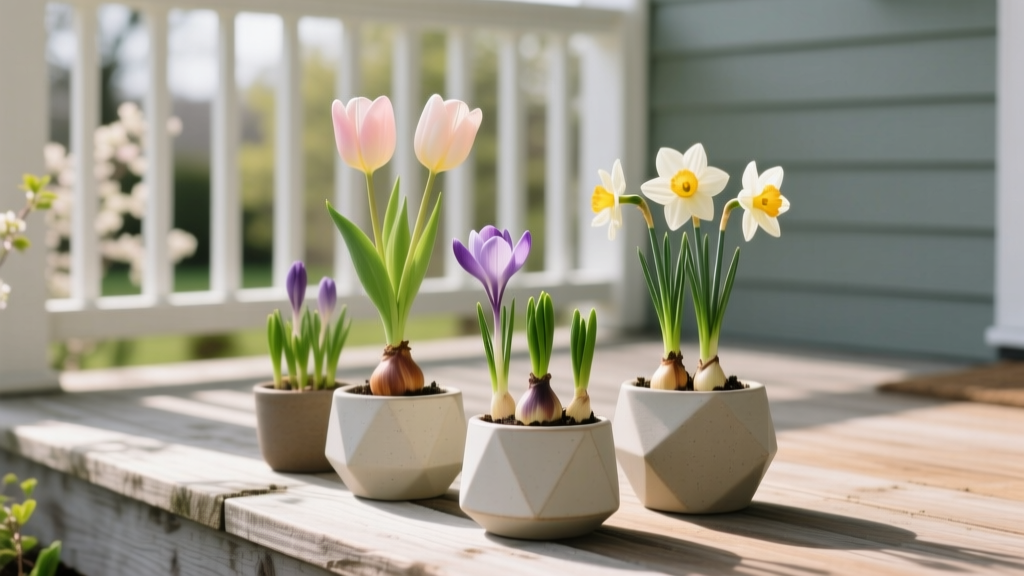
Porch Spring Bulb Forcing Display
It’s late February, the light is finally stretching past dinner, and your porch still looks like winter forgot to clean up after itself—salt-stained doormat, empty pots, and a view that feels more “waiting room” than welcome. You want spring now, not in six weeks. The trick is to make your porch behave like a tiny stage set: bulbs rooting quietly in the cold, then stepping into the spotlight right where you can see them from the kitchen window and every time you come home.
A forced-bulb porch display is part garden design, part timing, part theater. Done well, it reads as intentional—layered heights, repeating color, clean pathways—and it works for homeowners and renters because it relies on containers, not permanent beds. Let’s lay out a porch plan you can build in an afternoon, then keep running for 6–10 weeks with minimal fuss.
Start with a simple porch “floor plan”
Before we talk flowers, we need a layout that respects how people actually use the space: doors swing, packages land, boots pile up, and wind funnels around corners. A great forcing display feels lush but never blocks the everyday choreography.
Measure two things: the walking lane and the viewing lane
On most porches, you’re designing around a clear path to the door and a “view corridor” from indoors. Aim to keep 30–36 inches clear for the main walking lane. If your porch is tight, 24 inches can work, but it will feel pinched when you’re carrying groceries.
For the viewing lane, stand inside where you most often look out (kitchen sink, sofa) and note the sightline height. Containers between 12–26 inches tall tend to read best from indoors without blocking railings or windows.
Pick one of three layout patterns (and stick to it)
Consistency is what makes a small space look designed instead of cluttered. Choose one pattern and repeat it.
- Gateway Pair: two matching planters flanking the door for symmetry and instant “spring is here.”
- Rail Run: narrow troughs or window boxes along the railing, leaving the floor open for traffic.
- Corner Cluster: a grouped trio of pots (tall/medium/low) in a protected corner, great for windy porches.
Design rule: repeat, then accent
Use repetition as your backbone—one main bulb variety repeated in at least 3 containers. Then add a small accent bulb (or two) for sparkle. This keeps costs predictable and prevents the “every pot is different” look that reads chaotic in tight quarters.
“Repetition is one of the simplest ways to bring unity to a planting design—especially in small spaces where too many different elements can quickly feel busy.” — Royal Horticultural Society, container gardening guidance (RHS, 2023)
Light, temperature, and timing: the practical realities of forcing bulbs
Forcing is basically a schedule: bulbs need a cold rooting period, then moderate warmth and bright light to finish. Most spring bulbs require a chilling period; extension services consistently emphasize pre-chilling for reliable bloom in containers.
According to the University of Minnesota Extension, many hardy bulbs need about 12–16 weeks of cold to bloom well when forced (University of Minnesota Extension, 2020). That chilling can happen in a refrigerator (away from fruit) or an unheated garage/shed that stays roughly 35–45°F.
Sunlight target for the porch stage
Once you bring pots onto the porch to bloom, aim for 4–6 hours of bright light. Morning sun with afternoon shade is ideal because it prolongs bloom. Full blazing afternoon sun can shorten the show—think of it as playing your flowers on fast-forward.
Temperature target for longer bloom
When buds show color, cooler is better. If your porch stays around 45–60°F during the day, blooms last longer than if it’s consistently above 70°F. On warm spikes, pull pots closer to the house wall or into shade.
Container strategy: stable, windproof, and easy to swap
Porches are windy and dry. Containers topple, and small pots heat and cool too fast. Your design should prevent accidents and make the display modular so you can rotate peak bloom to center stage.
My go-to container sizes (with spacing that works)
- 12–14 inch diameter pot: great for 10–15 tulips or 15–20 crocus (tight spacing is normal for forcing).
- 16–18 inch diameter pot: perfect for 15–25 daffodils or a layered “lasagna” planting.
- 24–30 inch trough: reads clean along a railing; plan on 25–40 small bulbs depending on depth.
Spacing for forced containers is closer than in-ground planting. Place bulbs about 1/2–1 inch apart (nearly touching) for a full look. Depth matters more than spacing: plant bulbs at roughly 2–3x the bulb height, with at least 2 inches of soil beneath.
Soil and drainage details that prevent disappointment
Use a potting mix with good drainage (not garden soil). If your containers lack drainage holes, treat them as decorative sleeves: keep bulbs in a plastic nursery pot inside, so excess water can drain. A bag of quality potting mix (about 2 cubic feet) typically fills two 14-inch pots with some left over.
Plant selection: varieties that force beautifully and look designed
A porch display needs plants that bloom on cue, stand upright in containers, and look good at close range. Here are reliable performers and why they work.
Top bulb choices for porch forcing
- Daffodil ‘Tête-à-Tête’ (Narcissus): compact (about 6–8 inches), sturdy in wind, classic yellow that reads cheerful even on gray days.
- Daffodil ‘Thalia’: creamy white, elegant, lightly fragrant; looks high-end against dark doors and brick.
- Tulip ‘Apricot Beauty’: soft warm tone that flatters most house colors; strong designer vibe without being loud.
- Tulip ‘Purple Prince’: saturated color that reads from the street; great as an “accent note” repeated in small doses.
- Hyacinth ‘Delft Blue’: heavy fragrance for a porch; use sparingly because a little scent goes a long way near a front door.
- Crocus ‘Flower Record’: early, vivid purple; excellent for shallow bowls or trough edges.
- Muscari armeniacum (grape hyacinth): easy, reliable, and perfect as a “color base layer” under tulips.
Color palettes that look intentional (not accidental)
Palette 1: Quiet Spring — ‘Thalia’ daffodils + white crocus + muscari. Reads calm, modern, and brightens a shaded porch.
Palette 2: Warm Welcome — ‘Tête-à-Tête’ + ‘Apricot Beauty’ tulips + a small hit of ‘Purple Prince’. Friendly, cottage-adjacent without being messy.
Palette 3: High Contrast — white daffodils + deep purple tulips + dark containers. Great for contemporary homes and black railings.
Comparison table: picking bulbs by porch conditions
| Bulb | Typical chilled weeks | Height range | Best porch use | Design note |
|---|---|---|---|---|
| Narcissus ‘Tête-à-Tête’ | 12–14 | 6–8 in | Door flankers, windy spots | Compact and sturdy; doesn’t flop |
| Tulip ‘Apricot Beauty’ | 14–16 | 16–20 in | Center-stage pots | Warm tone; reads “designer” |
| Hyacinth ‘Delft Blue’ | 10–12 | 8–12 in | Near seating, not right at the door | Fragrance is strong; use as an accent |
| Muscari armeniacum | 10–12 | 6–8 in | Edges, underplanting | Great “color carpet” in bowls and troughs |
| Crocus ‘Flower Record’ | 10–12 | 4–6 in | Shallow containers, early pop | Opens widest in sun; place where light hits |
Chilling ranges vary by cultivar and local conditions. For general forcing guidance and chilling requirements, see University of Minnesota Extension (2020) and RHS forcing and indoor bulb advice (RHS, 2023).
Three real-world porch scenarios (with layouts you can copy)
Let’s translate the principles into actual spaces people have.
Scenario 1: Rental apartment stoop (3' x 5') with one sunny edge
You’ve got a narrow landing, a railing on one side, and your lease doesn’t allow hanging hooks. The win here is vertical layering without stealing foot space.
Layout: Rail Run + one Corner Cluster.
- One 24-inch trough along the railing: muscari + crocus for an early ribbon of color.
- A stacked trio in the far corner: a 16-inch pot (tulips), a 12-inch pot (‘Tête-à-Tête’), and a shallow bowl (crocus).
Why it works: The trough keeps the walkway clear, and the corner cluster gives height and presence without feeling like an obstacle course.
Scenario 2: Suburban covered porch (6' x 10') with shade and wind
Covered porches run cooler and shadier, which can actually extend bloom time. Wind is the bigger issue—pots tip, stems snap, and the display looks battered.
Layout: Gateway Pair + weighted base.
- Two matching, heavy planters 18 inches wide flanking the door: ‘Thalia’ + muscari.
- One low, wide pot (14–16 inches) near a wall: hyacinths for scent, placed out of the wind funnel.
Design tweak: Use gravel or a paver at the bottom of large planters (not as “drainage,” but as ballast) to prevent tipping.
Scenario 3: Tiny porch with pets and heavy traffic (front door is a runway)
If you’ve got dogs, kids, or frequent deliveries, anything fragile in the walking lane will get knocked. Here the design goal is “lush but armored.”
Layout: Wall-hugging cluster + door-side negative space.
- Keep the first 36 inches around the door clear.
- Group containers tight against the wall: one tall pot in back, two medium in front. Use shorter, sturdier narcissus rather than tall tulips in the front row.
Plant choice: ‘Tête-à-Tête’ and muscari take bumps better than tall tulips. Save tulips for the back pot where they’re protected.
Step-by-step: build the forcing display (timed like a designer’s install)
You can run this like a small project: prep, chill, stage, swap. The swap is key—rotating pots from “backstage” (cool storage) to “frontstage” (porch) keeps the display looking peak longer.
- Count backward from your target bloom date. For a March 15 porch moment, start chilling around late November (12–16 weeks, depending on bulbs).
- Plant bulbs in containers. Fill pots halfway with potting mix, set bulbs 1/2–1 inch apart, cover to proper depth, water once thoroughly until it drains.
- Label every pot. Use painter’s tape: variety + date planted. You’ll thank yourself later.
- Chill in the dark at 35–45°F. Check monthly; soil should be slightly damp, not wet.
- Move to a cool bright spot when shoots are 1–2 inches tall. A garage window or enclosed porch works for the transition week.
- Stage on the porch when buds form. Place tallest containers at the back/near walls, shortest at the edge. Keep the walking lane 30–36 inches clear.
- Swap in fresh pots every 7–10 days. Keep some pots cooler to slow them down; bring forward the ones that are coloring up.
Budget: what this costs, and how to do it for less
Let’s put real numbers on it so you can plan without guesswork. Prices vary by region and season; these are typical retail ranges.
- Bulbs: $8–$15 per 25-pack for crocus/muscari; $12–$20 per 10–15 tulips; $10–$18 per 10 daffodils.
- Containers: $10–$25 for basic 12–14 inch pots; $30–$80 for larger, heavier planters.
- Potting mix: $10–$18 for a 2 cu ft bag.
A practical mid-size display (two 18-inch door pots + one 24-inch trough) often lands around $90–$220 depending on container quality and bulb varieties.
DIY alternatives that still look polished
- Use nursery pots inside thrifted baskets (line with a plastic tray). You get the warm texture of basketry without water damage.
- Make a “pot collar” from cedar fence boards to dress up plain plastic containers.
- Buy bulbs in larger bags and repeat fewer varieties for a designer look and lower per-bulb cost.
Maintenance expectations: small, regular check-ins
This is not high-maintenance gardening, but it does reward consistency.
Weekly time: plan on 10–20 minutes per week. Most of that is checking moisture and deadheading spent blooms.
- Watering: In cool porch conditions, containers may need water only every 7–10 days. Water when the top inch is dry; avoid constant sogginess.
- Deadheading: Snip spent flowers to keep pots tidy. Leave foliage until it yellows if you hope to save bulbs (though many forced bulbs are best composted or planted out as a “maybe”).
- Temperature management: If a hard freeze is forecast (below 25°F), slide pots closer to the house wall or into an unheated garage overnight to protect buds.
After the show: what to do with forced bulbs
If you own your place and have a garden bed, you can plant forced bulbs outdoors once the soil is workable. They may skip a year or bloom lightly as they recover. If you rent or lack a bed, consider composting them and using the containers for summer annuals—your porch becomes a season-by-season stage set instead of a one-time event.
Small design moves that make it look “installed” (not just potted)
These are the details I lean on when I want a porch display to look intentional in photos and in real life.
- Limit container finishes to two. For example: matte black pots + one natural basket texture.
- Echo color at least twice. If you use purple tulips, repeat purple in a second pot (even a small bowl) so it reads like a decision.
- Hide the soil line. Top-dress with moss, fine bark, or pea gravel for a clean look and reduced splash.
- Use height intentionally. One tall element per cluster (a taller pot or a simple twig bundle) makes the arrangement read “designed” from the street.
Spring forcing on a porch isn’t about tricking nature so much as scheduling beauty where you’ll actually enjoy it. When your first crocus opens at the railing while the yard is still asleep, it changes how the whole day feels—coffee tastes better, keys turn in the lock with a little more optimism, and the porch finally does its job: it welcomes you home.
Sources: University of Minnesota Extension (2020), bulb forcing and chilling guidance; Royal Horticultural Society (RHS, 2023), container design and bulb forcing recommendations.