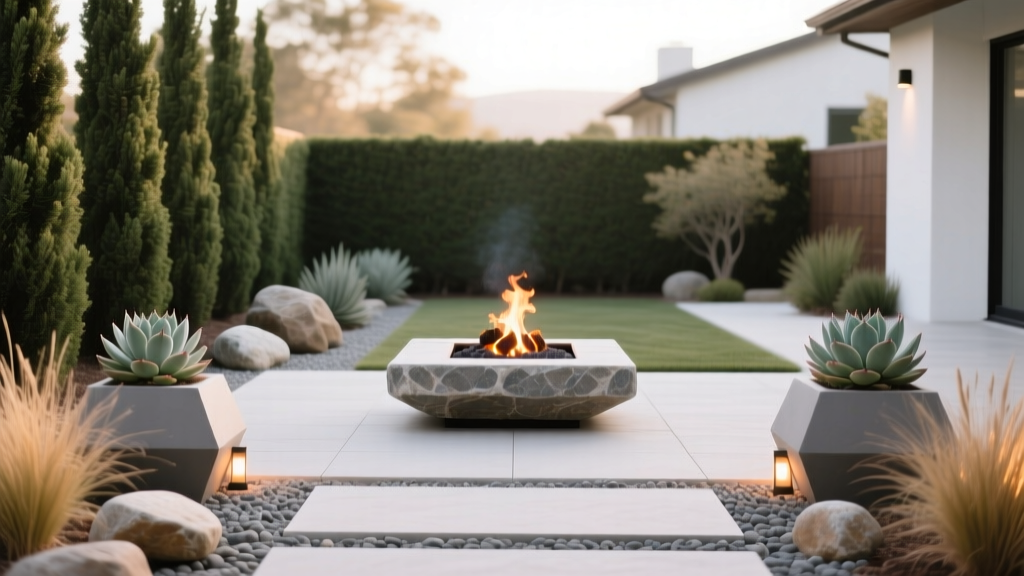
Patio Fire-Safe Landscaping Choices
The first time a stray ember lands in a dry planter, it feels like time slows down. You smell it before you see it: a sharp, papery burn coming from last week’s crispy leaf litter tucked under a rosemary pot. Someone shifts in their chair, the fire pit pops, and suddenly your “cozy patio night” becomes a mental checklist: What’s closest to the flame? What’s bone-dry? What will catch first?
Fire-safe landscaping isn’t about stripping your patio down to bare pavers. It’s about designing a space where flame, heat, and wind have fewer chances to turn an evening into an emergency—while still looking inviting. I’m going to walk you through layout moves, material choices, and plant selections that behave well around heat. You’ll see real spacing numbers, cost ranges, and a few case examples you can steal for your own patio.
Start with a simple goal: slow heat, stop embers, break fuel paths
Patio fire safety is mostly design physics: reduce fine, dry fuels near ignition sources, interrupt continuous plant mass, and choose materials that don’t ignite easily. A helpful baseline comes from defensible space guidance; for example, CAL FIRE emphasizes creating and maintaining defensible space and reducing ignitable material near structures (CAL FIRE, 2023). The same thinking applies to patios—your “structure” might be a home wall, fence, or wood deck edge.
“The vulnerability of a home to wildfire is determined by the characteristics of the home and everything within 100 feet of it—this is called the Home Ignition Zone.” — Jack Cohen, USDA Forest Service research scientist, summarized in Cohen (2000)
Even if your risk is a backyard fire pit rather than a wildfire, the concept holds: treat the patio area like a mini “ignition zone.”
Layout strategies that look good and behave better around flame
1) Set a clear noncombustible core around heat sources
Give your fire pit or chiminea a hardscape “landing pad” that catches embers and prevents heat from baking plant roots. For a typical 30–36 inch fire pit bowl, I like a minimum noncombustible radius of 36 inches from the outer edge of the pit to any plant foliage or mulch. If you have space, 48 inches is more forgiving when wind shifts.
Materials that work: decomposed granite, concrete pavers, mortared stone, or compacted gravel. Avoid bark mulch or dry pine straw near the pit; fine fuels ignite fast and creep under pots.
2) Break the “fuse”: avoid continuous planting bands
Think of a continuous hedge or packed row of shrubs as a wick. Instead, use “islands” of planting separated by hardscape or irrigated groundcover. On patios, that can be as simple as: pot + paver gap + pot, rather than pots touching rim-to-rim.
A workable spacing rule: keep 12–18 inches of open mineral surface (paver, gravel, stone) between containers, especially if you’re using herbs or grasses that can dry out quickly.
3) Respect heat and smoke patterns
Most patios have a prevailing airflow—often funneled between house walls and fences. Place your fire feature so smoke exits the seating zone and embers don’t blow toward planters. Practically, that means:
- Put the fire feature 6–10 feet downwind from the most plant-dense area (use your local wind direction as the guide).
- Keep it 10 feet away from wood fences or sheds whenever possible; if you can’t, increase noncombustible surfacing and reduce plant mass near the fence line.
4) Use “hydration zones” as design features
Fire-safe doesn’t mean water-wasting, but it does mean being intentional. A narrow drip line under key planters, or a small irrigated strip between patio and fence, can keep the most vulnerable areas from becoming tinder.
If you’re renting, a simple DIY alternative is a 5-gallon watering can routine for the nearest-to-flame pots (more on maintenance later). If you own, a basic drip kit often runs $35–$75 for a small patio zone and makes consistency easier.
Three patio scenarios (and how I’d design each)
Scenario A: Small rental balcony (6 ft x 10 ft) with a tabletop fire bowl
You’ve got limited square footage, likely composite or concrete underfoot, and rules about open flames. If a tabletop unit is allowed, treat it like a “centerpiece with a safety halo.”
Layout move: Place the fire bowl on a noncombustible table, then create a 24-inch clear perimeter with no trailing foliage. Use two narrow planters (about 8–10 inches wide) along the railing, not clustered near the flame.
Planting idea: Choose compact, high-moisture foliage plants and culinary herbs that tolerate containers without getting twiggy and dry. Add one sculptural succulent (non-woody) as a focal point, away from the flame.
Scenario B: Suburban paver patio (12 ft x 16 ft) with a wood-burning fire pit
This is the classic hangout zone: seating, maybe a pergola, and planters softening the edges. Here, your best design tool is zoning.
Layout move: Create a “hardscape core” in the center: fire pit + seating on pavers. Keep planting mostly at the perimeter, but don’t ring the patio in a continuous bed. Instead, place three planting bays separated by 2–3 feet of open paver or gravel to interrupt fuel continuity.
Material tweak: If you currently have bark mulch in perimeter beds, swap the first 3 feet nearest the patio edge to gravel or stone mulch. This is one of the highest impact changes for the least money.
Scenario C: Tight urban backyard with a wood fence and a gas fire table
When fences are close, radiant heat and ember risk matter more. Gas reduces embers, but heat is still heat—and plants still dry out.
Layout move: Run a noncombustible strip (gravel, pavers, or concrete) along the fence line, 18–24 inches wide, and keep plants in containers set forward from the fence by at least 12 inches so airflow can pass behind them.
Planting approach: Use fleshy-leaved plants and tidy perennials that don’t create dry thatch. Keep vines off the fence near the fire feature; they can act like ladders for flame.
Plant selection: what to plant near a patio (and what to push farther back)
No plant is “fireproof.” Some simply ignite less readily, produce less dead litter, and hold moisture better. Many extension services emphasize selecting low-flammability plants and keeping them maintained and irrigated, especially close to structures (University of California Agriculture and Natural Resources, 2020).
Better choices for the patio zone (containers and near hardscape)
These are practical performers that stay relatively tidy, have higher moisture content in leaves, and don’t shed lots of dry material—when cared for properly.
- Lavender (Lavandula angustifolia ‘Hidcote’): Compact form, predictable shape, tolerates heat. Keep it away from direct ember zones and prune yearly to reduce woody buildup. Great in 14–16 inch pots with 18–24 inches between plants.
- Ice plant (Delosperma cooperi): Succulent groundcover for sunny edges; doesn’t form a dry thatch the way some grasses do. Works in shallow bowls; space 12 inches apart.
- Hens-and-chicks (Sempervivum tectorum): Small, tidy rosettes that don’t create a lot of dead litter. Use as a “gravel garden accent” in pots at least 12 inches from any flame feature.
- Society garlic (Tulbaghia violacea): Strap-like leaves, purple flowers, good container plant. Space 12–18 inches. Cut back old leaves seasonally to remove dry material.
- Daylily (Hemerocallis ‘Stella de Oro’): Reliable clumps, easy maintenance, good for perimeter beds beyond the immediate ember zone. Space 18 inches.
- Stonecrop (Sedum spurium ‘Dragon’s Blood’): Low, succulent, and tough. Great for sunny borders; space 10–12 inches.
Plants to use carefully (or keep farther from flames)
Some favorites are more problematic near patios because they accumulate dry material or contain resins/oils that can burn more intensely.
- Ornamental grasses: Many hold dry blades and thatch—beautiful, but place them farther back (think 6–10 feet from the fire feature) and comb out dead growth.
- Junipers and other resinous conifers: Often cited as more flammable in defensible-space discussions; keep them well away from the patio fire zone.
- Dense, woody herbs (older rosemary): Fresh growth is useful, but older plants can get twiggy with internal dead zones. If you love rosemary, keep it pruned and not tucked under the fire pit wind path.
Quick comparison: patio-friendly plant traits
| Plant (example variety) | Best light | Suggested spacing | Why it behaves well near patios | Watch-outs |
|---|---|---|---|---|
| Delosperma cooperi (Ice plant) | 6–8 hours sun | 12 in | Succulent foliage, low litter, great along hardscape edges | Needs drainage; avoid soggy pots |
| Tulbaghia violacea (Society garlic) | 6+ hours sun | 12–18 in | Tidy clumps; easy to clean up old leaves | Cut back dry tips to reduce tinder |
| Lavandula ‘Hidcote’ (Lavender) | 6–8 hours sun | 18–24 in | Predictable shape, drought-tolerant when established | Can get woody; prune annually, keep away from embers |
| Sedum spurium ‘Dragon’s Blood’ | 6+ hours sun | 10–12 in | Low-growing, succulent, minimal dead litter | Can spread; edge-trim as needed |
| Hemerocallis ‘Stella de Oro’ (Daylily) | 4–8 hours sun | 18 in | Easy clumps for perimeter bays | Remove spent leaves in fall |
Materials and details that quietly make a big difference
Choose the right mulch near patios
If you do only one upgrade, do this: replace flammable mulch closest to the patio with stone. A 2-inch layer of gravel in a 3-foot band around your patio edge reduces ember ignition points and looks crisp. For a 3 ft x 12 ft strip (36 sq ft), expect roughly 6 cubic feet of gravel; cost is often $25–$60 depending on local pricing and bag vs. bulk.
Container strategy: fewer, larger pots beat many tiny ones
Small pots dry out fast. Fast-drying soil means stressed plants and crispy leaf litter. On patios, I’d rather see three 18-inch diameter pots than ten 8-inch pots. Larger containers hold moisture longer and are less likely to be knocked over near a heat source.
Lighting and accessories: keep cords, mats, and decor honest
Outdoor rugs and fabric cushions belong outside the ember radius. Keep a 36–48 inch clear zone around any wood-burning feature—no rugs, no baskets, no dried wreaths. If you store firewood on the patio, keep it at least 10 feet from the fire feature and ideally in a metal rack.
Step-by-step: design and set up a fire-safer patio planting plan
- Measure your patio. Note length/width and where doors, grills, and seating sit. Mark a circle around the fire feature with a 36-inch minimum no-plant zone.
- Map wind and pinch points. Stand outside on two different evenings; notice where smoke drifts. Keep the densest plants out of that downwind ember path.
- Create planting bays. Aim for 2–4 “islands” instead of one continuous bed. Separate bays with 24–36 inches of hardscape or gravel.
- Swap the first 3 feet of mulch. Replace bark with gravel/stone mulch nearest the patio edge, especially near the fire feature zone.
- Select plants by behavior, not just looks. Prioritize low-litter, easy-clean plants. Put woody, resinous, or thatchy plants farther back.
- Install drip or commit to a routine. If no irrigation: schedule two deep waterings weekly during hot months for the closest pots. If drip: install a simple kit and test flow for 10–20 minutes per zone.
- Finish with maintenance access. Leave yourself at least 18 inches of walkway so you can prune, sweep, and remove dead material easily.
Budget notes and DIY alternatives (so this works for renters, too)
A fire-safer patio refresh can be modest. Here are realistic ranges:
- Gravel or decomposed granite band: $25–$60 for a small strip (bags), more if you redo a whole perimeter.
- Three large containers (16–18 inch): often $35–$90 each depending on material; DIY: use galvanized stock tanks or secondhand ceramic (inspect for cracks).
- Plants: 1-gallon perennials usually $8–$18 each; succulents in 4-inch pots often $4–$9.
- Drip kit: $35–$75 for a small patio setup; DIY: gravity-fed watering from a 5-gallon container works if you’re consistent.
- Heat-resistant pad for fire pit: $40–$120 depending on size and material; DIY: a ring of concrete pavers under and around the pit.
If you rent and can’t change ground surfaces, lean on containers set on paver trays, keep a clear ember zone, and use a small bag of gravel as “top dressing” in pots instead of bark mulch. A 0.5-inch gravel top layer reduces exposed dry soil and catches little leaf fragments before they turn into tinder.
Maintenance expectations: what it actually takes to keep it safer
Fire-safe planting is less about rare heroics and more about small, regular cleanup. Plan on 20–40 minutes per week in the warm season for a typical patio with containers and a few planting bays.
Weekly (growing season)
- Remove dead leaves and spent blooms (especially in lavender, society garlic, daylilies).
- Sweep hardscape and gravel bands—leaf litter is fuel.
- Check pot moisture; small containers may need water every 2–4 days during heat waves.
Monthly
- Prune to maintain spacing: keep plants from leaning into the ember zone.
- Inspect drip lines (if installed) and unclog emitters.
- Refresh gravel top dressing in pots where soil is exposed.
Seasonal tasks
- Spring: Cut back winter-damaged foliage; top up gravel bands to maintain a 2-inch depth.
- Mid-summer: Hard prune lavender lightly after bloom to prevent woody interiors (avoid cutting into old bare wood).
- Fall: Remove dry perennial foliage; don’t let it mat under benches or along fence lines.
- Before high-wind fire season (where relevant): Reduce container clutter; move extra pots away from the patio core so embers have fewer landing zones.
Three design “recipes” you can copy
Recipe 1: The gravel-and-succulent edge (best for full sun patios)
Create a 24-inch gravel strip along one patio side. Set three low bowls planted with Delosperma cooperi and Sedum spurium ‘Dragon’s Blood’, each bowl spaced 18 inches apart. Add one taller pot of Tulbaghia violacea at the far end—away from the fire pit—to pull the eye outward.
Recipe 2: The “clean clumps” perennial bay (best for paver patios with a perimeter bed)
Make a planting island roughly 4 ft x 6 ft and mulch it with gravel instead of bark. Plant 3 daylilies (Hemerocallis ‘Stella de Oro’) spaced 18 inches apart, underplanted with stonecrop spaced 12 inches. The look is lush, but the cleanup is simple: dead leaves are obvious and easy to pull.
Recipe 3: The renter’s container screen (best for balconies and tight yards)
Line the railing or fence side with two rectangular planters, each about 36 inches long, planted with society garlic and a few succulents as accents. Keep the center open for seating and maintain a 24–36 inch no-plant perimeter around any flame. Add a small metal side table for tools so you can quickly snip and tidy rather than letting things dry out.
When you’re done, you should feel the difference immediately: clearer walking lines, fewer crunchy hiding places, and plants grouped where you can actually care for them. The patio still reads as a garden—just one designed with the reality of flame, wind, and dry seasons in mind.
Sources: CAL FIRE (2023) defensible space guidance; Cohen, J.D. (2000) research on the Home Ignition Zone concept; University of California Agriculture and Natural Resources (2020) guidance on firescaping and plant maintenance for reduced risk.