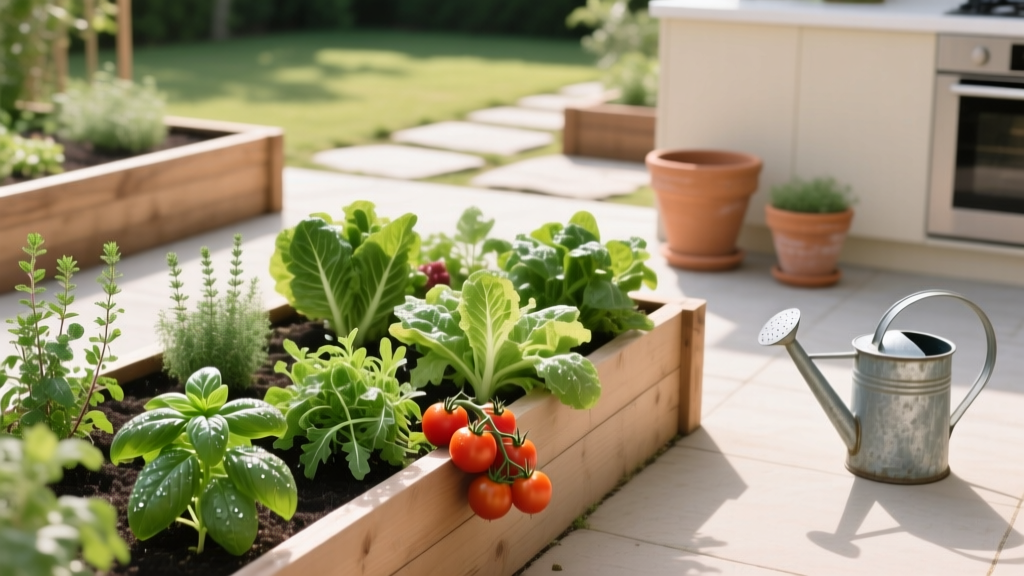
Kitchen Garden Planning for Fresh Ingredients
The evening you decide to cook something simple—pasta, olive oil, a squeeze of lemon—your recipe asks for basil. You check the fridge: nothing. The store is 12 minutes away, parking is a hassle, and you’re already in socks. This is the exact moment a kitchen garden earns its keep: a small, intentional layout that lets you step outside (or to a balcony) and pinch what you need while the water boils.
As a designer, I start kitchen gardens the same way I start patios and pathways: by observing how you move. A kitchen garden isn’t a field of vegetables; it’s a daily-use space. The goal is freshness on demand—herbs that don’t wilt in the crisper, greens that don’t slime in a bag, and a few reliable crops that make dinner feel like it came from a better version of your own home.
Design principles that make a kitchen garden actually usable
Place it where you’ll visit it—distance is destiny
If your edible beds are more than a quick walk from the kitchen door, you’ll harvest less. Aim for a path that’s 30–60 feet max from the door if you have a yard; for renters, choose the balcony or brightest window closest to the kitchen. This isn’t laziness—it’s ergonomics. The most successful kitchen gardens behave like an outdoor pantry.
Light is the next reality check. Most fruiting crops (tomatoes, peppers) want 6–8 hours of direct sun; leafy greens can often manage with 4–6 hours. The University of Minnesota Extension notes that vegetables generally need full sun for best results, commonly defined as at least 6 hours of direct sunlight (University of Minnesota Extension, 2020).
Right-size your beds for comfortable harvesting
Design your growing areas around reach, not ambition. A classic raised bed width is 4 feet, because you can reach the center from either side without stepping on soil. If you’re placing a bed against a fence, keep it to 2 feet wide. Bed length can be flexible; 8 feet is a sweet spot that fits many yards and keeps the project approachable.
For paths, treat them like you would interior hallways. If you’ll use a wheelbarrow or rolling cart, make paths 30–36 inches wide. If it’s just foot traffic and hand harvesting, 24 inches can work—especially in tight side yards.
Design for succession: keep “dinner ingredients” coming all season
Kitchen gardens are most satisfying when they’re never empty. Build your layout around succession planting: spring greens, summer fruiting crops, fall greens again. The layout should include at least one “quick-turn” zone (salad greens, radishes, cilantro) and one “anchor” zone (tomatoes, peppers, perennial herbs).
“Design is not just what it looks like and feels like. Design is how it works.” — Steve Jobs (quoted widely; principle applies directly to edible garden usability)
In practical terms, “how it works” means you can replant without pulling the whole garden apart. I like to reserve a 2 ft x 4 ft strip specifically for fast crops you re-sow every 2–3 weeks during peak season.
Water access and soil: plan them as infrastructure
Water is your kitchen garden’s utility line. If you’re dragging a hose across the lawn, your watering will become inconsistent. Ideally, beds sit within 25 feet of a spigot. If that’s not possible, plan for a rain barrel near a downspout (where legal) or use a lightweight hose reel.
Soil is not a place to economize blindly. A productive raised bed often needs 10–12 inches of quality mix. For an 4 ft x 8 ft x 12 in bed, you’ll need about 32 cubic feet of soil (roughly 1.2 cubic yards). Depending on your region, bulk garden soil/compost blends commonly run $35–$70 per cubic yard, plus delivery if needed. Containers typically cost more per volume but can be built gradually.
Layout strategies you can copy (and adjust to your space)
The “outside-the-kitchen” micro plan (best for small yards)
If you have even a sliver of ground near the back door, think in modules: one raised bed for anchor crops, one narrow bed for herbs, and one container cluster for flexible seasonal plants.
Suggested layout (footprint: about 10 ft x 12 ft):
- One 4 ft x 8 ft raised bed (tomatoes/peppers + basil + marigolds)
- One 2 ft x 8 ft bed against a wall or fence (herbs + scallions)
- Three 10–15 gallon containers (mint, rosemary, seasonal greens)
- One 30–36 in path for access
This layout gives you a clear “grab-and-go” herb edge and a main bed you can rotate year to year.
The balcony pantry garden (best for renters)
Balconies succeed when you treat them like vertical kitchens: tall at the back, short at the front, nothing wasted. Prioritize plants you actually use weekly—basil, parsley, chives, salad greens, cherry tomatoes—then fit the containers to the weight limits and sun exposure you have.
Suggested layout (footprint: 2 ft x 6 ft railing zone + floor space):
- Two railing planters, each 24 inches long (cut-and-come-again lettuce, spinach)
- One 5-gallon pot with a compact tomato
- One 3–5 gallon pot for basil (or shiso in hot climates)
- One narrow vertical trellis (cucumbers or pole beans if you have 6+ hours sun)
Budget tip: food-grade buckets can be DIY planters for $5–$8 each, plus drainage holes and a saucer. If you do this indoors or on balconies, protect surfaces—water stains can become landlord negotiations you don’t want.
The side-yard strip (best for “awkward” spaces)
Side yards are often dismissed as too narrow, too shady, or too annoying to mow. That’s exactly why they’re ideal for a linear kitchen garden: you don’t need lawn, you need access and light.
Suggested layout (footprint: 3 ft x 20 ft):
- Two beds, each 2 ft x 8 ft, with a 24 in stepping path between
- Wall-mounted or fence-mounted herb planters at hand height
- Shade-tolerant greens (if sun is only 4–5 hours)
This is also where drip irrigation shines. A basic drip kit for small gardens often lands around $30–$60 depending on brand and how many emitters you need.
Step-by-step: setting up your kitchen garden layout
- Map sun for 2 days. Check your garden area at 9 a.m., noon, and 3 p.m. Note where you get 4 hours, 6 hours, and 8 hours of sun.
- Choose your “daily harvest” zone. Put herbs and salad greens closest to the door—ideally within 10–15 steps.
- Lay out beds with string. Mark a 4 ft bed width if you can access both sides; 2 ft if one-sided. Mark paths at 30–36 in if you’ll use a cart.
- Decide containers vs. beds. Use beds for crops that need steady moisture (greens, beans). Use containers for aggressive herbs (mint) and crops you want to move (basil in heat waves).
- Build soil volume intentionally. For raised beds, aim for 10–12 in depth. Blend compost plus a quality topsoil. Avoid filling with pure compost—it can compact and hold too much moisture.
- Install water before planting. Run drip lines or soaker hoses now; you’ll avoid stepping around delicate seedlings later.
- Plant in layers. Tall (trellised tomatoes/beans) on the north side, medium (peppers), low (basil, lettuce) on the south edge to prevent shading.
- Label and calendar. Put a small weatherproof tag on each area and set reminders for re-sowing greens every 2–3 weeks.
Plant selection: varieties that earn their square footage
Kitchen gardens thrive on plants that are either expensive at the store (fresh herbs), quick to harvest (greens), or dramatically better when picked minutes before eating (tomatoes). Below are reliable performers with specific traits that help them fit real homes and real schedules.
Herbs: the highest flavor per square foot
- Basil ‘Genovese’: Classic pesto basil with big leaves; grows fast in warm weather. Plant 10–12 inches apart. Great for repeated pinching to keep it bushy.
- Parsley ‘Giant of Italy’: Flat-leaf type with strong flavor; tolerates cooler temps. Space 8–10 inches apart. Holds well in the garden without bolting as quickly as cilantro.
- Chives: Perennial in many climates; comes back each year and takes partial sun. Clump spacing 8 inches. The flowers are edible and pollinator-friendly.
- Mint (in a container only): Productive and wonderful, but it runs. Use a 10–12 inch pot so it can’t take over beds.
- Rosemary ‘Arp’ (cooler climates) or ‘Tuscan Blue’ (milder climates): Excellent for containers; drought-tolerant once established. Give it a 12–18 inch personal space.
Greens: fast, forgiving, and perfect for succession
- Lettuce ‘Salanova’: Uniform baby leaves and great regrowth after cutting; ideal for “cut-and-come-again.” Space 6–8 inches.
- Spinach ‘Bloomsdale Long Standing’: Handles cool spring and fall; slower to bolt than many. Sow 1/2 inch deep, thin to 4–6 inches.
- Kale ‘Lacinato’ (dinosaur kale): Productive, sturdy leaves; tolerates cool weather and light frosts. Space 12–18 inches.
- Arugula ‘Astro’: Quick harvest (often 25–35 days baby leaves); peppery flavor. Sow in short rows every 2 weeks for continuity.
Fruiting crops: pick the compact, high-performing types
- Tomato ‘Sungold’ (cherry): Exceptional flavor, heavy producer, perfect for snacking. Needs a cage/trellis and consistent water. Plant 18–24 inches apart in beds; one plant per 10–15 gallon pot.
- Tomato ‘Celebrity’ (slicer): Dependable and widely adaptable; good disease tolerance in many regions. Give it 24 inches spacing and sturdy support.
- Pepper ‘California Wonder’: Reliable bell pepper; does well in beds or large containers. Space 18 inches apart; use stakes if loaded with fruit.
- Cucumber ‘Patio Snacker’ or ‘Bush Champion’: Compact habit for small spaces; still benefits from a small trellis. Space 12 inches with vertical support.
Food safety note: if you’re gardening in older urban areas, consider a soil test—especially in-ground beds near old structures. The U.S. EPA highlights that lead can be a concern in urban soils and recommends steps to reduce exposure (U.S. Environmental Protection Agency, 2023).
A quick comparison: raised beds vs. containers vs. in-ground rows
| Format | Best for | Typical cost (starter) | Watering needs | Design notes |
|---|---|---|---|---|
| Raised bed (4 ft x 8 ft x 12 in) | High yields, clean layout, easy harvest | $150–$400 (lumber/kit + soil) | Moderate; consistent with mulch | Keep width at 4 ft for reach; add 30–36 in paths |
| Containers (5–15 gallon) | Renters, patios, herbs, tomatoes | $15–$60 per pot (or $5–$8 DIY bucket) | High; can be daily in summer | Use saucers; group pots to simplify watering |
| In-ground rows | Large yards, lowest upfront cost | $20–$80 (soil amendments + edging) | Lower once established | Needs weed control plan; avoid soil compaction with defined paths |
Three real-world scenarios (and how I’d design each)
Scenario 1: A renter with a 6-hour-sun balcony and strict rules
You can’t drill into walls, and you need everything movable. We build a “pod” system: a cluster of containers that can shift with the season. Start with 6 containers: two 24-inch railing planters for greens, one 5-gallon tomato pot, one basil pot, one parsley/chive combo pot, and one mint pot kept isolated. Budget realistically: $120–$250 depending on pot style, plus $40–$80 in potting mix.
The design trick is to keep the harvest plants at the front edge where you can pinch and cut without moving anything. Put the tomato at the back corner with a slim trellis tied to the container.
Scenario 2: A homeowner with a 10 ft x 12 ft patch near the kitchen door
This is the dream footprint for a compact, high-output kitchen garden. We place one 4 ft x 8 ft raised bed parallel to the house, a 30-inch mulch path, and a 2 ft x 8 ft herb bed along the foundation (keeping a small air gap for airflow and siding maintenance).
Planting plan: tomatoes on the north edge of the main bed (2 plants spaced 24 inches), peppers in the center (18 inches), basil and lettuce along the south edge for easy cutting. The herb bed carries parsley, chives, thyme, and a small rosemary in a pot sunk into the soil for visual cohesion but easy winter movement.
Approximate build cost: $250–$600 depending on bed material (cedar costs more than pine), soil delivery, and whether you add drip irrigation.
Scenario 3: A narrow side yard with only 4–5 hours of sun
In limited sun, we stop fighting for tomatoes and design around greens and herbs. Two 2 ft x 8 ft beds run lengthwise with stepping stones between them. The fence becomes a vertical herb rack: cilantro in spring, then switch to basil if summer heat is strong.
Crop choices: kale, arugula, spinach, parsley, chives, scallions. You’ll still get “fresh ingredient” satisfaction nightly, just with a shade-smart menu. Add one container tomato only if you can place it at the brightest end and it receives 6 hours in midsummer.
Budget planning and smart DIY alternatives
A kitchen garden can be elegant or scrappy; both work. What matters is stable soil, consistent water, and a layout you’ll use.
- Lower-cost bed option: Use untreated pine for a 4 ft x 8 ft bed and plan to replace boards after several years. Or build a “no-dig” bed by edging with bricks and layering cardboard + compost + topsoil.
- DIY container hack: Use food-grade buckets (5 gallons) with drainage holes; paint them or sleeve them in a woven basket for a cleaner look.
- Soil savings without sacrificing quality: Buy bulk soil for beds (cheaper per cubic foot), then use premium potting mix only for containers.
- Support structures: Concrete remesh panels can be a sturdy, budget trellis; zip-tie to stakes and you have a vertical plane for cucumbers or beans.
If you’re on a strict budget, start with one 4 ft x 4 ft bed or even just 3–4 containers. A kitchen garden that expands slowly stays tidy and successful; one that starts oversized often becomes weedy and discouraging.
Maintenance expectations: what it really takes week to week
Plan maintenance like a standing appointment, not a heroic weekend. A small kitchen garden typically asks for 45–90 minutes per week in the growing season, plus a bit more during planting and peak harvest.
- Weekly (spring/summer): Water check (especially containers), harvest herbs and greens, scout for pests, and re-sow one short row of greens every 2–3 weeks.
- Monthly: Add a light compost top-dress (about 1/2 inch), tighten trellis ties, and prune tomatoes for airflow.
- Heat waves: Expect containers to need water daily; beds may need deep watering 2–3 times per week depending on soil and mulch.
- Fall: Pull spent summer crops, plant spinach/arugula for cool weather, and mulch beds for winter protection.
A simple habit that changes everything: keep a small harvesting bowl by the door. When you step out to snip herbs, you’ll notice dry soil, aphids starting, or lettuce ready to cut. The garden stays “in your orbit,” which is the whole point of planning it like a designer.
When the layout is right, you won’t be gardening to impress anyone. You’ll be gardening because it’s easier than going to the store—and because dinner tastes sharper when the basil is still warm from the sun.
Sources: University of Minnesota Extension (2020) guidance on vegetable sunlight needs; U.S. Environmental Protection Agency (2023) recommendations regarding lead in soil and reducing exposure in urban gardening.