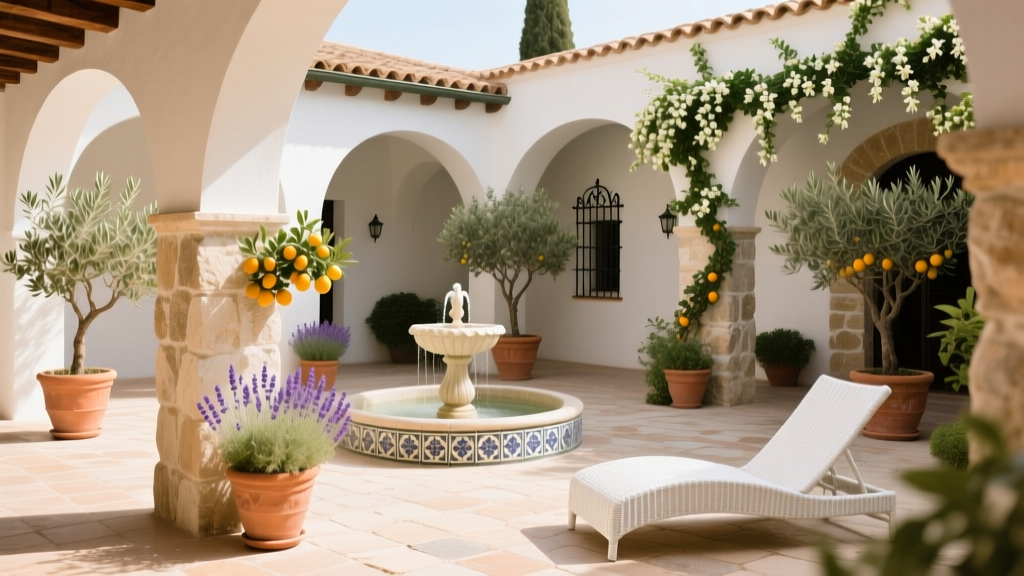
Courtyard Mediterranean Garden Style
The gate clicks shut behind you, and suddenly the noise of the street drops away. But the courtyard itself feels… flat. A rectangle of paving that throws heat back at the windows, a single potty shrub in the corner, and a view that doesn’t invite you to sit down. If this sounds familiar, you’re standing in the perfect place for a Mediterranean-style makeover: a garden designed for sun, scent, stone, shade, and long evenings outdoors.
As a landscape designer, I start Mediterranean courtyards the same way I start any good outdoor room—by solving comfort first. You want the space to feel cooler at 3 p.m., welcoming at 7 p.m., and still easy to maintain on a busy week. The Mediterranean palette (silver foliage, herbs, citrus in pots, gravel, terracotta, clipped structure) works brilliantly in courtyards because it’s visually rich without needing deep borders or a lawn.
Start with the “Outdoor Room” Plan
Mediterranean courtyards aren’t crammed with plants; they’re composed. Think of the layout like a small villa patio: a central living area, planting as perimeter texture, and one or two focal points that make the view feel intentional.
Choose a main axis and a focal point
Stand at the door you use most. What do you see first? In a courtyard, you usually have one dominant sightline. Place your focal point at the end of that view:
- A wall fountain centered on the far wall
- A single sculptural olive tree in a large pot
- A built-in bench framed by tall planters
Even in a tight courtyard (say, 3 m x 5 m), one strong focal point will make it feel designed instead of improvised.
Use the 60/30/10 balance
A practical rule for Mediterranean courtyards:
- 60% hardscape (paving/gravel) for usability and heat-friendly surfaces
- 30% planting (mostly pots and slim borders)
- 10% feature (water, fire bowl, sculpture, or statement tree)
This ratio keeps the space functional while still lush enough to feel like a garden.
Layout Strategies That Make Small Courtyards Feel Larger
1) Edge planting: keep the middle open
In courtyards, plants belong at the edges and corners. Aim for borders that are 30–45 cm deep if you can, or do the same effect with pots. Keeping the center clear makes the space feel bigger and allows airflow—important for hot, enclosed spaces.
2) Create shade without losing the sun-loving look
Mediterranean style loves sun, but people don’t. Plan shade early:
- A retractable awning or sail over a seating zone (budget-friendly)
- A pergola (more architectural, best for owners)
- A single small tree in a pot (renter-friendly)
For comfort, target at least 30–40% shade coverage over your seating area during peak hours. Most courtyards get 4–8 hours of direct sun depending on wall height and orientation—track it for a day before you commit to plant choices.
3) Borrowed landscape: soften walls with vertical elements
Courtyard walls can feel like a box. Use vertical trellis panels or wire systems for climbers and espalier. This adds greenery without stealing floor space.
“Green infrastructure such as trees, green walls, and vegetated surfaces can lower urban temperatures through shading and evapotranspiration.” — U.S. Environmental Protection Agency, Using Trees and Vegetation to Reduce Heat Islands (updated 2023)
In a courtyard, that cooling effect is noticeable because hard surfaces and walls trap heat. Even a few square meters of leafy coverage changes how long you can comfortably sit outside.
Hardscape Choices: The Mediterranean Materials That Work in Courtyards
Gravel vs. paving: pick based on drainage and furniture
If you like the crunch-and-glow of Mediterranean gravel, it can work beautifully—especially in renters’ courtyards where you can lay it over a geotextile membrane. But if you need steady footing for dining chairs, use paving under the table and gravel elsewhere.
| Surface | Best for | Typical cost (installed) | DIY friendliness | Mediterranean feel |
|---|---|---|---|---|
| Pea gravel (10–14 mm) | Informal lounging areas, paths | $6–$12 per sq ft | High (membrane + edging) | Excellent |
| Porcelain pavers (stone-look) | Dining zones, narrow courtyards | $15–$30 per sq ft | Medium (needs level base) | Very good |
| Natural stone (limestone/travertine) | Premium courtyards, high-end look | $25–$45 per sq ft | Low–Medium | Classic |
| Decomposed granite (DG) | Paths and small seating pads | $8–$18 per sq ft | Medium (compaction is key) | Excellent |
Practical note: In enclosed courtyards, drainage is non-negotiable. If water puddles near the house, prioritize permeable joints, gravel bands, or a subtle slope (often 1–2% away from buildings) and confirm where runoff is allowed to go.
Walls, pots, and color temperature
Mediterranean style leans on warm neutrals: limestone, sand, terracotta, and sun-bleached timber. If your walls are stark white or dark gray, you can warm the space with:
- Terracotta pots (mix sizes; avoid all-matching sets)
- Buff or beige gravel
- Outdoor cushions in muted clay, olive, and indigo
Planting Design: Structure First, Flowers Second
Good Mediterranean planting is built like a menu: a few reliable staples, plenty of herbs, and seasonal highlights. In courtyards, we also choose plants that tolerate reflected heat and occasional missed watering.
Core structural plants (the “bones”)
These plants give year-round form and that instantly Mediterranean silhouette:
- Olea europaea (olive) — choose a multi-stem standard in a 50–70 cm diameter pot. Silver foliage reflects light and reads “Mediterranean” in one glance.
- Laurus nobilis (bay) — ideal for clipping into a lollipop or cone. A pair flanking a doorway is classic. Space pots 1.2–1.5 m apart for symmetry without crowding.
- Cupressus sempervirens ‘Totem’ or ‘Stricta’ (Italian cypress forms) — where climate allows, use as vertical punctuation. In colder regions, mimic the look with narrow evergreen conifers suited to your area.
Signature fragrant plants (the courtyard perfume)
Courtyards trap scent, so you get more payoff from fragrance than in open gardens. Plant these near seating and doorways:
- Lavandula angustifolia ‘Hidcote’ or ‘Munstead’ — compact, reliable, and drought-tolerant once established. Space 35–45 cm apart for a low hedge effect.
- Rosmarinus officinalis (now often sold as Salvia rosmarinus) ‘Tuscan Blue’ — upright form, great in pots; place where it can spill scent when brushed.
- Jasminum officinale (summer jasmine) — climb it on wires along a warm wall; evening scent is the whole point of a Mediterranean courtyard.
Heat- and pot-tough perennials (for long season color)
- Salvia nemorosa ‘Caradonna’ — purple spires, strong structure, pollinator-friendly; looks crisp against gravel.
- Gaura lindheimeri ‘Whirling Butterflies’ — airy movement; ideal in tight spaces where you want softness without bulk.
- Stachys byzantina (lamb’s ear) — silver, tactile foliage that echoes olive leaves; thrives in sun and dryness.
- Pelargonium (scented geraniums) — unbeatable in pots for scent and summer flowers, especially in renter setups.
Climbers for walls and privacy
Climbers let you add green volume without losing floor area:
- Trachelospermum jasminoides (star jasmine) — glossy evergreen leaves, white flowers, handles heat; give it wires and patience.
- Vitis vinifera (grapevine) — if you have strong sun (6+ hours) and a sturdy pergola, it creates authentic shade and dappled light.
- Bougainvillea — stunning in warm climates; in cooler zones, treat as a summer container plant and overwinter bright and frost-free.
Edibles that fit the theme
The Mediterranean courtyard is meant to be used, not just admired:
- Citrus (e.g., Citrus × microcarpa calamondin, Citrus limon ‘Meyer’) — best in containers you can protect in winter; feed regularly during growth.
- Thymus vulgaris (thyme) — edge planting that doubles as a kitchen herb; thrives in gritty soil.
- Origanum vulgare (oregano) — tough, aromatic, and happy in pots.
For drought planning, it helps to remember that Mediterranean plants generally prefer free-draining soil and deep, infrequent watering once established. The Royal Horticultural Society notes that drought-tolerant gardening focuses on improving soil structure and choosing plants adapted to dry conditions (RHS, 2022).
Three Courtyard Scenarios (with Layouts You Can Copy)
Scenario 1: The narrow rental courtyard (2 m x 6 m)
This is the classic “corridor patio” with tall fences and mixed sun. The strategy is to keep a clean walking line and build the garden in containers.
Layout: Place a bistro set at one end (table diameter 60 cm), then run a row of pots down the sunny side. Add one vertical trellis panel on the shadiest wall to soften it.
Planting: Star jasmine on a trellis (large pot), two lavender pots, one bay tree (cone shape), and trailing thyme in a window box. Add pelargoniums for summer color.
Budget: You can do a strong version of this for $250–$700 depending on pot size and whether you buy mature trees. DIY tip: use reclaimed terracotta or breathable fabric pots to cut costs.
Scenario 2: The square owner courtyard (5 m x 5 m) with full sun
Full sun is a gift—if you design shade.
Layout: Center a small tree in a statement pot (olive), then create an L-shaped built-in bench against two walls. Pave the seating zone and use gravel bands as planting pockets at the edges (40 cm deep).
Planting: Lavender hedge along one edge (spacing 40 cm), salvia and gaura mixed behind it, and a grapevine trained over a pergola if you want a true Mediterranean canopy. Add a small wall fountain on the far wall to draw the eye.
Cost reality: A simple wall fountain kit and installation can run $300–$1,200 depending on plumbing and materials. If you can’t plumb, use a recirculating solar feature bowl as a cheaper alternative.
Scenario 3: The shaded courtyard (3.5 m x 4 m) with 3–4 hours of sun
Not every courtyard is blazing hot. You can still achieve Mediterranean character by leaning into foliage texture, pots, and light-colored surfaces.
Layout: Use lighter paving or gravel to brighten the space. Place a mirror discreetly on the darkest wall (weatherproof frame) to bounce light. Keep one open seating square of about 2 m x 2 m so the courtyard doesn’t feel crowded.
Planting: Bay does well in part sun; choose it over citrus. Use star jasmine (tolerates part shade better than many climbers), plus pelargoniums in the brightest spots. For texture, add lamb’s ear where it gets sun and a variegated rosemary if available locally and hardy in your climate.
DIY upgrade: Paint or limewash a dark fence in a warm off-white. It’s one of the cheapest ways to make a courtyard feel more Mediterranean without changing a single plant.
Step-by-Step Setup: A Practical Build Order
This order keeps the project tidy and prevents that common “I bought plants first and now nothing fits” problem.
- Measure and sketch the courtyard. Mark doors, drains, hose taps, and the sun path. Note where you get 6+ hours vs. 3–4 hours of sun.
- Choose your seating footprint. For comfortable dining, aim for at least 2.4 m x 2.4 m to fit a small table and chairs with clearance.
- Pick one focal feature (olive pot, fountain, or bench). Decide where it goes on the main sightline.
- Lock in hardscape: paving/gravel zones, edging, and drainage. If you’re DIYing gravel, plan for about 5 cm depth over a membrane.
- Place big pots first. Start with 2–3 large containers (the “bones”), then fill in with medium and small pots.
- Install vertical supports: trellis, wires, or a pergola before planting climbers.
- Plant and mulch. Use a gritty potting mix for Mediterranean plants, and top dress pots with gravel to reduce evaporation and keep the look cohesive.
- Set up irrigation options. At minimum, use drip lines for pots or self-watering reservoirs. Even drought-tolerant plants need consistent watering in containers.
Budget Planning and Smart DIY Swaps
A Mediterranean courtyard can look expensive because of stone and mature trees, but you can stage it in layers.
Where to spend
- One statement pot (large terracotta or frost-proof ceramic). A 60 cm pot makes everything around it look more intentional.
- Evergreen structure (olive or bay). A more mature tree gives instant character.
- Comfort (shade and seating). If you don’t sit there, you won’t use it.
Where to save
- Use gravel and edging instead of full paving. Gravel is often cheaper and more DIY-friendly.
- Buy smaller plants (lavender, salvia, thyme) and plant at proper spacing; they fill in quickly in sun.
- DIY limewash or paint to warm up walls and fences.
As a rough guide for a 15 sq m courtyard, a budget refresh (pots, plants, gravel, bistro set) can land around $600–$1,500. A mid-range renovation (paving, pergola, built-in bench, irrigation) often runs $3,000–$8,000 depending on materials and labor in your area.
Maintenance Expectations: Keep It Beautiful Without Living Out There
Mediterranean-style planting is forgiving, but courtyards concentrate heat and dry out pots quickly. Plan on 30–60 minutes per week in the growing season for a tidy, designed look.
Weekly (spring through early fall)
- Check containers for moisture; in hot spells, pots may need water 2–4 times per week depending on sun and wind.
- Deadhead pelargoniums and tidy spent salvia spikes to keep flowers coming.
- Quick sweep of gravel/paving to keep the space crisp.
Monthly
- Feed container citrus and other heavy feeders during active growth (follow label rates).
- Lightly clip bay and shape lavender edges if they’re sprawling.
Seasonal tasks
- Late winter/early spring: prune lavender once risk of hard frost passes; don’t cut into old woody stems.
- Spring: refresh gravel top-dressing in pots; check irrigation/drip emitters.
- Summer: monitor for spider mites on drought-stressed plants, especially in hot, enclosed courtyards.
- Autumn: clean fallen leaves from drains; bring tender citrus/bougainvillea into protection if your winters freeze.
If you’re aiming for lower input, choose fewer flowering perennials and more evergreen structure (olive/bay + rosemary + thyme) and let the architecture do the work.
Small Details That Make It Feel Like the Mediterranean
The final 10% is what turns a courtyard from “nice patio” into “Mediterranean escape.” Use these designer moves:
- Repeat materials: gravel top-dressing in pots that matches the gravel underfoot.
- Limit the pot palette: terracotta + one accent finish (aged zinc or cream ceramic) looks curated.
- Night lighting: one uplight on an olive tree and warm wall lights at 2700K color temperature make the courtyard usable after dark.
- A simple water sound: even a small recirculating bowl masks street noise in tight spaces.
Courtyard Mediterranean style is less about copying a postcard and more about capturing the way those gardens live: open floor space, shade where you need it, plants that give scent when you brush past, and a few strong shapes that look good in every season. Once the layout is right, the rest is just editing—one pot, one plant, one texture at a time.
Sources: U.S. Environmental Protection Agency (2023), Using Trees and Vegetation to Reduce Heat Islands. Royal Horticultural Society (RHS) (2022), drought-tolerant gardening guidance and plant selection principles.