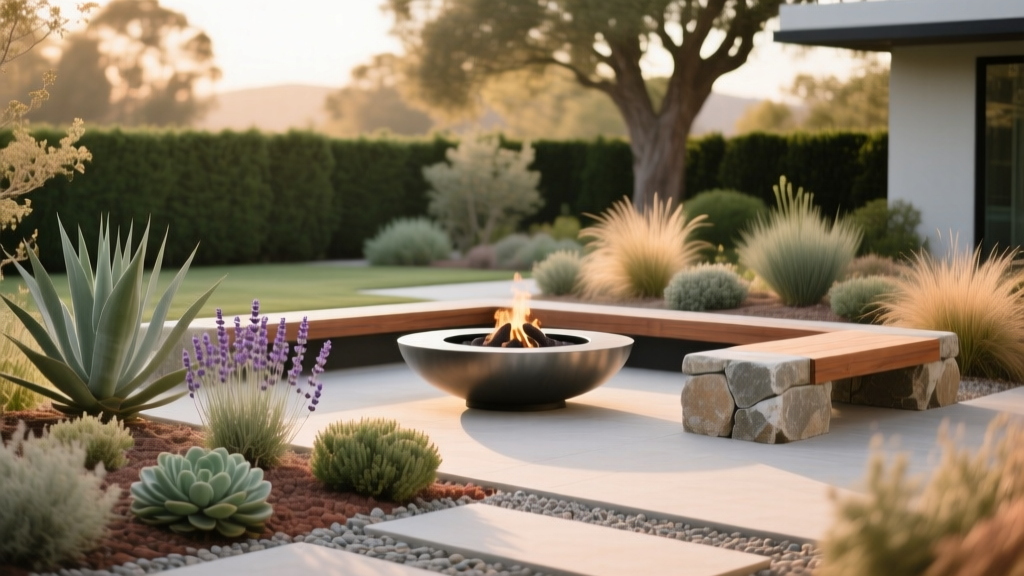
Fire Pit Area Landscaping with Hardy Plants
The first time you light a fire pit in a new space, you notice everything the flames reveal: the lawn feels uneven underfoot, the wind funnels smoke straight into your seating, and the plants closest to the heat look… nervous. You can almost hear them crisping. If your fire pit area feels like an awkward “circle of chairs on dirt,” you’re not alone. The good news is that fire pit landscaping isn’t about fussy flowers—it’s about smart layout, heat-tolerant buffers, and hardy plants that can take a little neglect without turning your gathering space into a maintenance chore.
Let’s walk through a designer-style plan that works for homeowners and renters alike, with practical dimensions, plant picks that won’t faint in summer, and DIY options that keep your budget intact.
Design principles that make a fire pit area feel intentional
Start with safety distances (then design outward)
Before you pick a single plant, set your “no-regrets” perimeter. A common, workable rule in residential design is a minimum 10 ft (3 m) clearance from structures and anything flammable for an open flame feature (always check your local code and manufacturer instructions). For planting, I treat the zone closest to the fire as a hardscape buffer.
Use this simple zoning approach:
- Zone 1 (0–3 ft from flame edge): nonflammable surface only—gravel, decomposed granite, pavers, or stone.
- Zone 2 (3–8 ft): low, resilient plants with some heat tolerance; keep foliage away from direct flame and avoid resinous evergreens.
- Zone 3 (8–15+ ft): taller screening plants, ornamental grasses, and shrubs that shape the “room.”
If you’re using a propane fire table with controlled flame, you can sometimes tighten the planting distance slightly, but I still like 3 ft as a clean edge for circulation, stray embers, and chair movement.
Build a “conversation circle” with real human dimensions
A fire pit area succeeds or fails based on legroom and pathways. Here are the dimensions I use most often:
- Fire pit diameter: 30–42 in is comfortable for 4–6 people.
- Distance from fire edge to chair front: 30–36 in (enough warmth without roasting knees).
- Clear walking path behind chairs: 36 in minimum; 42–48 in feels generous.
- Overall pad size for 4 chairs: plan on roughly 12 ft x 12 ft as a starting point.
That pad can be gravel or pavers—what matters is that it’s stable, drains well, and doesn’t turn into mud under foot traffic.
Control smoke and wind with placement and soft screening
Smoke management is part design, part reality. Position your fire pit where prevailing winds won’t push smoke into the house or directly at seating. Even a 3–4 ft tall planting screen can help shift airflow—especially if you stagger plants (not a solid wall) so wind can filter through instead of creating a turbulence pocket.
“People are drawn to fire, but comfort comes from the space around it—clear circulation, sheltered edges, and materials that can take heat.” — James van Sweden (as quoted in discussions of naturalistic landscape design principles; see also Lady Bird Johnson Wildflower Center guidance on designing for place, 2019)
For a more research-backed note on defensible space and reducing ignition risks, the National Fire Protection Association emphasizes reducing combustible materials near heat sources and structures (NFPA, 2023).
Choose hardscape that supports hardy plants (drainage matters)
Hardy plants still hate soggy roots. Build your fire pit base like a mini patio:
- Excavate: 4–6 in for gravel patios; 6–8 in for pavers depending on soil.
- Base: 3–4 in compacted crushed stone.
- Top: 1–2 in decomposed granite, pea gravel, or bedding sand + pavers.
Plan a subtle slope of about 1/4 in per foot away from the pit so rain doesn’t pool where people sit.
Layout strategies that work in real yards (and rentals)
The “ring + rays” layout: clean and expandable
This layout starts with a round or octagonal pad (the ring), then adds simple paths (the rays) to connect doors, gates, or a veggie bed. It’s excellent when you want the fire pit to feel like the hub.
Best for: average suburban yards, families, frequent hosting.
How it looks: stone or gravel circle (10–14 ft diameter), with 2–3 straight paths in compacted gravel leading to key destinations.
The “corner hearth” layout: cozy, space-saving
If your yard is small, tuck the fire pit into a corner with an L-shaped seat wall or two chairs and a bench. The planting does heavy lifting here—softening fences, absorbing sound, and creating privacy.
Best for: townhomes, tight patios, renters (with container planting).
Key dimension: a 9 ft x 11 ft pad can still work if you use a 30-in fire bowl and a bench.
The “viewfinder” layout: frame something worth staring at
Sometimes the fire isn’t the only focal point. If you have a nice tree, a distant view, or a water feature, align seating so people face both the flame and the view. Use plants like grasses and upright shrubs to create a soft frame.
Best for: sloped yards, scenic lots, or anyone who wants a more “designed” feel without extra ornament.
Step-by-step setup (a practical build sequence)
- Call for utility locating (in the U.S., 811) before digging.
- Mark your circle: stake the center, tie a string, and spray paint a 12 ft diameter ring (adjust to your space).
- Excavate to 5–7 in depth for a gravel patio or deeper for pavers.
- Compact the base in lifts (2–3 in at a time). A rented plate compactor typically costs about $70–$100/day.
- Add edging (steel, aluminum, or paver border) to keep gravel from migrating.
- Install surface: decomposed granite (DG) at 1–2 in or pavers on bedding sand.
- Place the fire pit and confirm chair spacing: aim for 30–36 in from flame edge.
- Set irrigation strategy: drip lines in planting beds, or a simple hose-end drip kit for containers.
- Plant Zone 2 and Zone 3 (hardscape first, then plants so you don’t trample new roots).
- Mulch wisely: use gravel mulch near the pit; keep wood mulch farther out.
DIY note: if you’re renting, you can skip excavation entirely and build a “floating” gravel pad with heavy-duty landscape fabric and a low-profile edging system, then place container plants around it.
Hardy plant selection: heat, drought, and foot-traffic reality
A fire pit area is tough on plants: reflected heat, drier soil, occasional ash, and people stepping off the edge to adjust a chair. I focus on plants that handle 6–8 hours of sun, tolerate drought once established, and don’t turn into a crisp pile if you miss a week of watering.
Design rule: keep plants low and non-resinous near flame
Avoid highly resinous plants right next to the pit (many conifers, some aromatic shrubs) and anything that drops a lot of dry litter into the fire zone. Save the fragrant stuff for Zone 3 where it won’t lean into heat.
My go-to hardy plants (with spacing and “why it works”)
1) Lavender (Lavandula angustifolia ‘Hidcote’ or ‘Munstead’)
Why: drought-tolerant, tidy mounds, pollinator-friendly, handles reflected heat well in full sun.
Spacing: 18–24 in apart.
Notes: best with sharp drainage; keep it out of soggy soil.
2) Catmint (Nepeta x faassenii ‘Walker’s Low’)
Why: tough, long bloom, softens hard edges, bounces back after a haircut.
Spacing: 24–30 in apart.
Bonus: handles casual foot brushing better than many perennials.
3) Blue fescue (Festuca glauca ‘Elijah Blue’)
Why: compact grass that reads as “designed” year-round; thrives in lean soil.
Spacing: 10–12 in apart for a tight drift.
4) Feather reed grass (Calamagrostis x acutiflora ‘Karl Foerster’)
Why: upright screening without bulk, winter interest, reliable in many climates.
Spacing: 24–30 in apart.
Placement: Zone 3—great for framing and privacy.
5) Sedum/Stonecrop (Hylotelephium ‘Autumn Joy’)
Why: drought-tolerant, sturdy stems, late-season color when gatherings extend into fall.
Spacing: 18–24 in apart.
6) Salvia (Salvia nemorosa ‘Caradonna’ or ‘May Night’)
Why: upright purple spikes, heat-tough, and doesn’t flop if grown in sun.
Spacing: 18 in apart.
7) Yarrow (Achillea millefolium ‘Moonshine’)
Why: thrives in heat, airy texture, long bloom, great in gravel-mulched beds.
Spacing: 18–24 in apart.
8) Rosemary (Salvia rosmarinus ‘Arp’ for colder climates)
Why: evergreen structure in mild winters, edible, drought-tough.
Spacing: 24–36 in depending on variety.
Placement: Zone 3 rather than right next to flame—aromatic oils + heat are not best friends.
9) Red yucca (Hesperaloe parviflora)
Why: architectural, exceptionally heat/drought tolerant, hummingbird magnet.
Spacing: 3–4 ft apart.
Best for: hot, sunny sites.
10) Switchgrass (Panicum virgatum ‘Northwind’)
Why: strong vertical form, excellent movement, hardy and adaptable.
Spacing: 24–36 in apart.
Plant performance depends on climate and soil, so match selections to your hardiness zone and drainage. For region-specific guidance on native and adapted plants, the Lady Bird Johnson Wildflower Center emphasizes selecting plants suited to local conditions to reduce inputs (Wildflower Center, 2019).
Quick comparison: best hardy plants by fire pit role
| Plant | Best Zone (1/2/3) | Sun Needs | Spacing | Why It’s Fire-Pit Friendly |
|---|---|---|---|---|
| Nepeta ‘Walker’s Low’ | 2 | 6+ hours | 24–30 in | Heat tolerant, soft edge, rebounds after trimming |
| Lavender ‘Hidcote’ | 2–3 | 6–8 hours | 18–24 in | Drought tolerant, crisp form, thrives in well-drained beds |
| Festuca ‘Elijah Blue’ | 2 | 6+ hours | 10–12 in | Neat clumps, tolerates lean soil and reflected heat |
| Calamagrostis ‘Karl Foerster’ | 3 | 5–8 hours | 24–30 in | Creates privacy and structure without blocking airflow |
| Hesperaloe parviflora | 3 | 6–10 hours | 3–4 ft | Extreme heat tolerance; architectural, low-litter |
Three real-world scenarios (and how I’d design each)
Scenario 1: Small rental patio (8 ft x 12 ft) with no digging allowed
You want a fire feature but can’t alter the ground. Here’s a renter-friendly approach:
Layout: a 30-in propane fire table centered on an outdoor rug; two chairs + a small bench to save space. Keep a 36-in clear path to the door.
Planting: containers only. Use 3–5 pots (12–18 in diameter) clustered to create a “green corner” away from flame direction. Best hardy container picks: lavender (if sunny), compact rosemary, blue fescue, and sedum. Top pots with gravel for a clean, fire-aware finish.
DIY cost snapshot: fire table $200–$600, gravel-top planters $35–$80 each, and a bagged potting mix budget around $40–$60.
Scenario 2: Suburban yard hangout (12 ft x 12 ft pad) with kids and a dog
This is the “high-traffic” build—plants must survive shortcuts and soccer balls.
Layout: a 12 ft diameter compacted gravel circle with a steel edge. Add a 42-in wide path to the gate for easy carrying of wood or snacks.
Planting strategy: keep Zone 2 low and tough: catmint, yarrow, sedum, and fescue in drifts. Put taller grasses (Karl Foerster, switchgrass) in Zone 3 as a soft boundary. Avoid thorny plants and anything that attracts lots of bees right where kids run—place pollinator favorites slightly farther out.
Practical detail: set plants back so the mature edge sits at least 18 in from the gravel to reduce trampling. In heavy traffic yards, I’d rather widen hardscape by 12–18 in than constantly replace crushed plants.
Scenario 3: Windy hillside or exposed yard where smoke is a problem
If you’ve ever played “musical chairs” to dodge smoke, you need a wind-aware layout more than you need fancy plants.
Layout: place the pit where the land offers even mild shelter—near a retaining wall, dense hedge line, or the leeward side of the house (while maintaining clearance). Build a 14 ft wide pad so you can rotate seating.
Planting strategy: use upright grasses and shrubs in Zone 3 to filter wind without creating a solid barrier. Stagger clumps of Karl Foerster and switchgrass. If your climate allows, a line of tough evergreen structure farther away (not near embers) can help, but keep anything highly flammable at a safe distance and maintain it well.
Material tweak: choose heavier gravel (like 3/8 in) over lightweight mulch so it doesn’t blow into the pit.
Budget planning and smart DIY swaps
Fire pit landscaping can be done in tiers. Here’s how costs tend to shake out in real projects:
- DIY gravel patio (12 ft diameter): often $300–$900 depending on gravel type, edging, and whether you rent a compactor.
- Paver patio (similar size): commonly $900–$2,500+ DIY depending on paver choice and base depth.
- Plants: a simple, hardy planting plan with 18–30 perennials/grasses can run $150–$600 depending on pot size (4-inch pots vs 1-gallon).
DIY alternatives that still look designed:
- Use “drifts” of fewer plant types (3–5 varieties repeated) instead of buying one of everything.
- Choose smaller plants and be patient; spacing correctly saves money long-term because you’re not overcrowding.
- Gravel mulch instead of bark near the pit: it’s cleaner, longer-lasting, and less likely to drift into flames.
- Solar path lights instead of wired lighting—place them 12–18 in into beds so they’re not kicked over.
One more safety-minded note: NFPA materials on home fire safety emphasize managing combustible materials and maintaining safe clearances (NFPA, 2023). Treat that as part of your budget—stone and gravel are not just aesthetic, they’re protective.
Maintenance expectations (so the space stays inviting)
A well-designed fire pit landscape should not become another weekend-consuming project. Here’s what I tell clients to expect:
Weekly (20–40 minutes total in growing season):
- Quick tidy: pick up fallen twigs/leaves that could blow into the pit.
- Deadhead or shear catmint/salvia lightly for repeat bloom (optional but worthwhile).
- Check drip lines or container moisture, especially in hot spells.
Monthly (30–60 minutes):
- Edge the gravel ring and rake it back into place.
- Inspect plant spacing—trim anything encroaching into walk paths.
- Top up gravel in low spots (people naturally scuff out “chair wells”).
Seasonal tasks:
- Spring: cut back ornamental grasses before new growth; prune lavender lightly (avoid cutting into old wood).
- Summer: deep water new plantings; once established, many of these plants prefer less frequent, deeper watering.
- Fall: leave some seed heads (sedum, grasses) for winter structure; clear excess dry debris near the pit.
- Winter: check for frost heave around edging; keep pathways clear so you’ll actually use the space.
Plan on more attention the first 6–8 weeks after planting (establishment watering), then less as roots settle in.
Putting it together: a sample planting layout you can copy
If you want a ready-to-use blueprint, here’s a simple plan sized for a 12 ft diameter gravel fire pit pad with a surrounding planting bed that’s 4 ft deep on two sides (like a soft “L” around the circle):
- Zone 2 edge (closest to gravel): 7–9 catmint plants spaced 24–30 in apart, woven with 9–12 blue fescue spaced 10–12 in apart.
- Color + structure pockets: 5 salvia spaced 18 in, 5 sedum spaced 18–24 in.
- Zone 3 backdrop: 3 Karl Foerster grasses spaced 24–30 in for a vertical screen.
That palette stays attractive without constant babysitting, and it won’t mind the heat bounce from stone—especially if your site gets 6+ hours of sun.
When you light the first fire after installing the layout, the difference is immediate: chairs sit level, smoke has somewhere to go, and the space feels like an outdoor room rather than a temporary setup. The hardy plants do what they’re supposed to do—soften edges, catch light, and quietly handle the tough conditions—so you can focus on the part that matters: pulling people outside and keeping them there long after sunset.
Sources: National Fire Protection Association (NFPA), home fire safety and defensible space guidance, 2023. Lady Bird Johnson Wildflower Center, plant selection and sustainable landscaping principles, 2019.