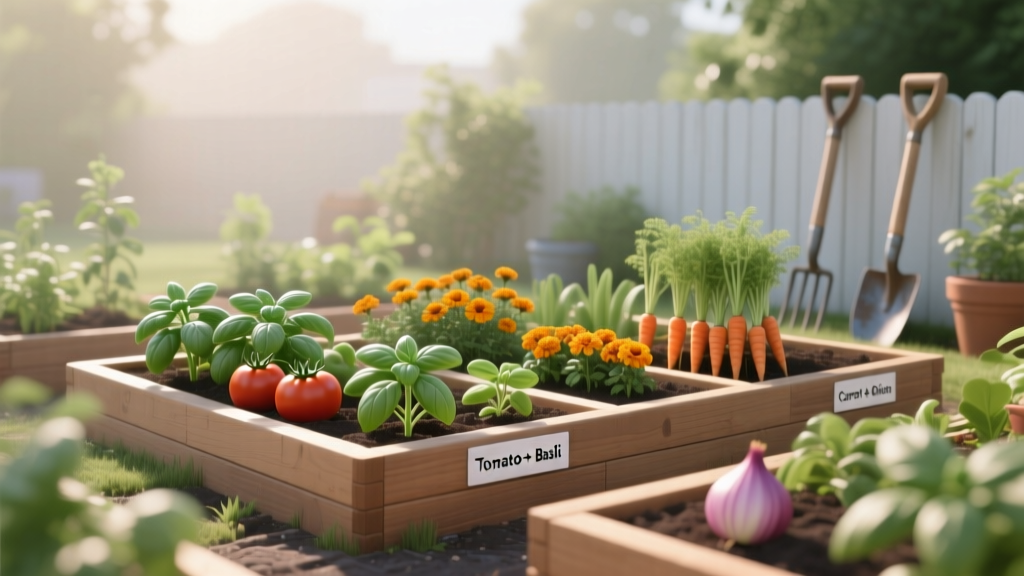
Community Plot Companion Planting Plan
It’s 6:30 p.m. on a Tuesday, and the community garden is half sun, half shadow. Someone’s watering tomatoes with a cracked hose. A neighbor is harvesting zucchini the size of a forearm. And in your plot—small, precious, and public—you’re staring at a patchwork of seedlings and wondering how to fit dinner, flowers, pollinators, and a little dignity into a rectangle of soil that everyone walks past.
Community plots reward smart layout more than brute effort. The trick is to design the bed so plants help each other: shading, attracting beneficial insects, confusing pests, and using nutrients at different depths. Companion planting isn’t magic, but it is practical ecology—especially when your space is limited and your harvest needs to be reliable.
Start With the Plot You Actually Have (and the Rules You Can’t Ignore)
Most community garden plots cluster around a few common sizes. This plan assumes a standard 10 ft × 20 ft (200 sq ft) plot, but every strategy below scales down to a 4 ft × 8 ft raised bed or up to a 20 ft × 20 ft family plot.
Before you buy a single plant, check these three realities:
- Sunlight: Aim for crops that thrive in 6–8 hours of direct sun. If you only get 4–5 hours, prioritize greens, herbs, peas, and bush beans.
- Water access: If the hose bib is shared and chaos-prone, design fewer, deeper watering zones with mulch.
- Height rules: Many community gardens restrict structures over 6 ft. Keep trellises tidy and placed so you don’t shade neighbors.
Design Principles That Make Companion Planting Work
1) Put the Tall Stuff North (So You Keep Your Sun)
In the Northern Hemisphere, place trellises and tall crops (tomatoes, cucumbers, pole beans, sunflowers) along the north edge of your plot. This prevents the classic community-garden mistake: a tomato jungle shading everything else by mid-July.
Design note: Even a 6 ft trellis can cast a long shadow in spring and fall. Keep your shade-tolerant crops (lettuce, cilantro) closer to that north strip and reserve the southern half for heat-lovers.
2) Plant in “Guilds,” Not Rows
A guild is a small neighborhood of plants that share space well. Instead of long rows that invite pests like a buffet line, design repeated clusters that mix families and scents.
“Diversifying plantings at the field scale can increase natural enemy abundance and pest control.” — Letourneau et al., Proceedings of the National Academy of Sciences (2011)
In a community plot, this isn’t academic—it’s fewer aphid explosions and less “what ate my kale overnight?” drama.
3) Keep Paths Narrow but Real
If you can’t reach the center without stepping on soil, you’ll compact it—then water will run off and roots will sulk. Build in access on purpose.
For a 10 ft × 20 ft plot, use 18-inch paths (mulched) between growing zones. That’s wide enough for a bucket and knees, narrow enough to protect growing area.
4) Rotate by Plant Family, Even in Small Spaces
Rotation is your quiet insurance policy against soil-borne disease. Track crops by family: nightshades (tomatoes/peppers), brassicas (kale/broccoli), legumes (beans/peas), cucurbits (cucumbers/squash). Rotate these zones year to year within your plot.
The USDA emphasizes rotation and sanitation as core integrated pest management tactics for home gardens (USDA, 2020). Keep a simple sketch in your phone notes so next spring you know what went where.
A Practical Layout: The “Four-Zone Community Plot” (10 ft × 20 ft)
This is the layout I use when designing small edible spaces for maximum yield and minimal conflict. It balances vertical growing, easy harvest, and companion relationships.
Zone Dimensions
- North Trellis Strip: 2 ft × 20 ft (40 sq ft)
- Central Production Beds (two): 3 ft × 16 ft each (96 sq ft total)
- South Border (pollinator + herbs): 2 ft × 20 ft (40 sq ft)
- Paths: Two paths, each 18 inches wide running lengthwise (about 24 sq ft total)
That gives you structure without wasting space. If your plot is smaller, compress the central beds and keep the north trellis and south border concept intact.
Step-by-Step Setup (A Realistic Weekend Plan)
- Day 1 (60–90 minutes): Measure and mark your plot with string. Confirm north/south orientation. Flag where paths will go.
- Day 1 (90 minutes): Lay down cardboard on paths (remove tape), then add 2–3 inches of wood chips. This saves weeding time immediately.
- Day 1 (60 minutes): Install a trellis on the north edge: T-posts or EMT conduit with netting. Keep it under 6 ft if required.
- Day 2 (60–120 minutes): Top-dress beds with compost: plan on 1–2 inches over 200 sq ft (roughly 0.6–1.2 cubic yards).
- Day 2 (60 minutes): Plant by guilds (details below), then mulch open soil with 2 inches of straw or leaf mulch, keeping mulch back from stems.
- After planting (15 minutes): Label zones with a weatherproof marker so rotation is easy next year.
Plant Selection: Specific Varieties That Earn Their Space
Community plots need plants that are productive, resilient, and not too precious. These varieties are widely available, perform well in mixed plantings, and make companion planning easier.
North Trellis Strip: Vertical Crops + Beneficial Flowers
Cucumbers + Dill + Nasturtiums is a classic combination: cucumber climbs, dill attracts hoverflies and parasitic wasps, and nasturtiums act as a trap crop for aphids while bringing color to a very functional edge.
- Cucumber: ‘Diva’ (parthenocarpic, reliable in inconsistent pollinator weather). Space 12 inches apart along the trellis.
- Dill: ‘Bouquet’ (vigorous, great for beneficial insects). Sow a clump every 18 inches.
- Nasturtium: ‘Jewel Mix’ (edible flowers, aphid magnet). Plant at trellis ends and corners, 12–18 inches apart.
Alternative if cucumbers fail in your garden’s disease pressure: swap in pole beans like ‘Blue Lake’ and keep the dill.
Central Bed A: Tomatoes as the Anchor (With Smart Neighbors)
Tomatoes pull focus—and pathogens—so give them airflow, mulch, and companions that don’t compete heavily.
- Tomato: ‘Sungold’ (cherry, high yield) + ‘Celebrity’ (slicer, dependable). Plant 24–30 inches apart, stake or string-trellis.
- Basil: ‘Genovese’ tucked near tomatoes, 10–12 inches apart for frequent harvest.
- Green onions: ‘Evergreen Hardy White’ as an edging to save space; plant 2–3 inches apart.
- Marigold: ‘Gem’ marigolds (compact) at bed corners, 10 inches apart to add nectar and visual structure.
Spacing matters more than wishful thinking. Give tomatoes air; tight spacing is how blight becomes a plot-wide conversation.
Central Bed B: Brassicas + Aromatics (A Pest-Confusing Mix)
Brassicas can be glorious or heartbreaking. The difference is usually pest pressure (cabbage moths) and soil moisture. Mix in strong-scented herbs and flowers, and use a seasonal cover if needed.
- Kale: ‘Lacinato’ (tough, productive). Space 12–18 inches.
- Broccoli: ‘Arcadia’ (cool-season performer). Space 18 inches.
- Cilantro: ‘Santo’ (slow-bolt) tucked between young brassicas in spring, 6 inches apart.
- Sweet alyssum: ‘Snow Crystals’ as a low edging to feed beneficial insects; plant 6–8 inches apart.
If your garden allows it, keep a roll of insect netting. A 10 ft × 20 ft lightweight cover can be shared with a neighbor and used during peak moth season.
South Border: Pollinator Strip + Cut-and-Come-Again Herbs
This strip is your design “frame”—it makes the plot look intentional while doing real work: feeding pollinators and providing quick harvests on busy days.
- Calendula: ‘Resina’ (edible petals, hardy). Space 10–12 inches.
- Thyme: ‘English thyme’ (perennial in many areas, drought tolerant). Space 12 inches.
- Oregano: ‘Greek’ (strong flavor, drought tolerant). Space 12–18 inches.
- Lettuce: ‘Salad Bowl’ as a spring/fall filler. Space 8 inches, succession sow every 2–3 weeks.
Perennial herbs can be controversial in community plots (some gardens want everything removed annually). If that’s your rule, grow thyme and oregano in 1–2 gallon pots sunk into the soil so you can lift them out at season’s end.
Companion Planting Comparisons (What Works Best in Shared Spaces)
| Goal | Pairing | Why It Helps | Spacing/Notes |
|---|---|---|---|
| Reduce tomato stress + increase harvest frequency | Tomato + basil + green onions | Basil uses understory space; onions create a narrow edging and may confuse pests | Tomato 24–30 in; basil 10–12 in; onions 2–3 in |
| Support beneficial insects near vulnerable crops | Brassicas + sweet alyssum | Alyssum provides nectar for parasitoids and hoverflies | Alyssum 6–8 in along bed edges |
| Maximize vertical yield in small footprint | Cucumber + dill + nasturtium | Dill attracts beneficials; nasturtium can act as trap crop and adds edible flowers | Cucumber 12 in on trellis; dill 18 in; nasturtium 12–18 in |
| Keep soil covered and productive early/late | Broccoli + cilantro (spring) / lettuce (fall) | Fast crops fill gaps before brassicas size up; less bare soil = fewer weeds | Cilantro 6 in; lettuce 8 in; thin for airflow |
Three Real-World Scenarios (and How to Adapt the Plan)
Scenario 1: The Renter With a 4 ft × 8 ft Bed and No Storage
You’re carrying tools in a tote bag and you can’t leave a trellis up year-round. Use a simplified two-zone version:
Layout: One 4 ft wide bed with a 4 ft trellis on the north short end, and a tight pollinator strip along the south edge.
- North trellis: 2 cucumbers (‘Diva’) at 12 inches apart.
- Center: 2 tomatoes (‘Celebrity’) at 30 inches apart (or 1 tomato + 4 peppers if you prefer).
- Edges: basil + green onions + alyssum.
DIY alternative: Use a removable trellis made from a $12 roll of jute twine and two borrowed stakes. You can take it down at season’s end with no drama.
Scenario 2: The Shared Family Plot (Two Adults, Two Kids, Limited Time)
Your design priority is “forgiving.” Choose crops that tolerate missed watering and still feed everyone.
- Swap cucumbers for pole beans (‘Blue Lake’)—they handle heat swings and keep producing.
- Use cherry tomatoes (‘Sungold’) because kids will actually snack on them, reducing wasted harvest.
- Replace broccoli with collards (‘Georgia Southern’) for fewer pest issues and longer harvest.
Maintenance expectation: Plan on 60–90 minutes per week total: 20 minutes watering, 20 minutes harvesting, 20–50 minutes weeding/training vines. Miss a week and you’ll spend double the next visit.
Scenario 3: The Plot Next to the “Tomato Person” (Disease Pressure Is Real)
If your neighbor grows 20 tomatoes and never prunes, design defensively. Disease spores move by splash and wind.
- Keep your tomatoes on the farthest side and prioritize airflow: 30 inches spacing, aggressive suckering, and mulch.
- Choose more resistant types when possible (ask your local nursery for blight-tolerant options suited to your region).
- Use the neighbor-facing edge for non-nightshades: herbs, flowers, beans, and onions.
Sanitation tip: Don’t compost diseased tomato leaves on-site unless the garden has a hot compost system. Bag and remove.
Budget Planning (with Real Numbers You Can Use)
Community gardening can be surprisingly affordable—or surprisingly not—depending on how you build your system. Here’s a realistic starter budget for a 10 ft × 20 ft plot.
- Compost: 1 cubic yard delivered often runs $40–$80 (varies by region). If you buy bagged compost, expect $5–$8 per 1.5–2 cu ft bag.
- Mulch (straw): $8–$15 per bale; 1 bale typically covers a plot this size lightly.
- Trellis materials: Two T-posts + netting: roughly $25–$45. DIY option: salvaged conduit + twine.
- Seedlings: Tomatoes and herbs: $3–$6 each; plan $30–$60 if you buy most starts.
- Seeds: Many packets cost $2–$5 and can cover multiple successions (lettuce, dill, cilantro, alyssum).
Cost-saving strategy: Buy seedlings only for long-season crops (tomatoes, peppers). Direct-sow the rest. And split seed packets with a neighbor—community plots are built for cooperative economics.
Maintenance Expectations (So the Plot Stays Friendly, Not Feral)
Companion planting reduces some pest problems, but it doesn’t replace weekly attention. The goal is a routine that fits real life.
Weekly (45–90 minutes)
- Watering: Deep soak 1–2 times depending on heat and rainfall. Mulch can cut watering frequency dramatically.
- Training: Spend 10 minutes guiding cucumbers/beans onto the trellis so they don’t sprawl into paths.
- Harvesting: Pick frequently—especially cucumbers and beans—to keep production steady.
- Quick pest scan: Flip brassica leaves for eggs/larvae; pinch off early before it becomes a project.
Monthly (30–60 minutes)
- Re-mulch thin spots: Keep soil covered to suppress weeds and stabilize moisture.
- Succession sowing: Add lettuce/cilantro every 2–3 weeks in spring and again in late summer for fall.
- Feed heavy feeders: Side-dress tomatoes with compost or an organic fertilizer when flowering begins.
Seasonal Tasks
- Spring: Install trellis early; plant cool-season greens first; protect brassicas if moths arrive.
- Mid-summer: Prune tomatoes for airflow; keep paths clear; replant fast crops in gaps.
- Fall: Remove spent vines; plant a quick cover crop if allowed (e.g., oats/peas) or mulch heavily.
Smart Companion “Do Nots” in Community Plots
A few pairings create avoidable headaches in tight quarters:
- Mint in the ground: It will spread into neighboring plots. Grow it in a pot only.
- Sprawling squash without a plan: One pumpkin vine can annex 50+ sq ft. If you want squash, choose compact types or train vertically with strong support.
- Overcrowded tomatoes: The cost of one extra tomato plant is often two lost to disease. Space them properly and let the sun in.
Two Credible Touchstones (So You’re Not Relying on Garden Folklore Alone)
Companion planting advice ranges from proven ecology to charming myth. Two sources that ground this plan:
- Letourneau, D.K. et al. found that increasing crop diversity can improve natural enemy abundance and pest suppression in agricultural systems (Letourneau et al., 2011).
- The USDA highlights crop rotation, sanitation, and integrated approaches as core tools for pest management in gardens and farms (USDA, 2020).
In practice: diversify, rotate, keep plants healthy, and respond early. Your plot doesn’t need to be perfect—it needs to be consistently cared for.
The best community plots look like they were designed, not just planted. When your trellis line is tidy, your paths are mulched, and your herbs and flowers frame the edges, neighbors treat your space with respect. More importantly, your plants cooperate: vines climb, greens fill gaps, beneficial insects hover, and you harvest something nearly every visit. That’s the real win—an edible layout that works with your schedule, your sunlight, and the shared reality of gardening alongside other people.