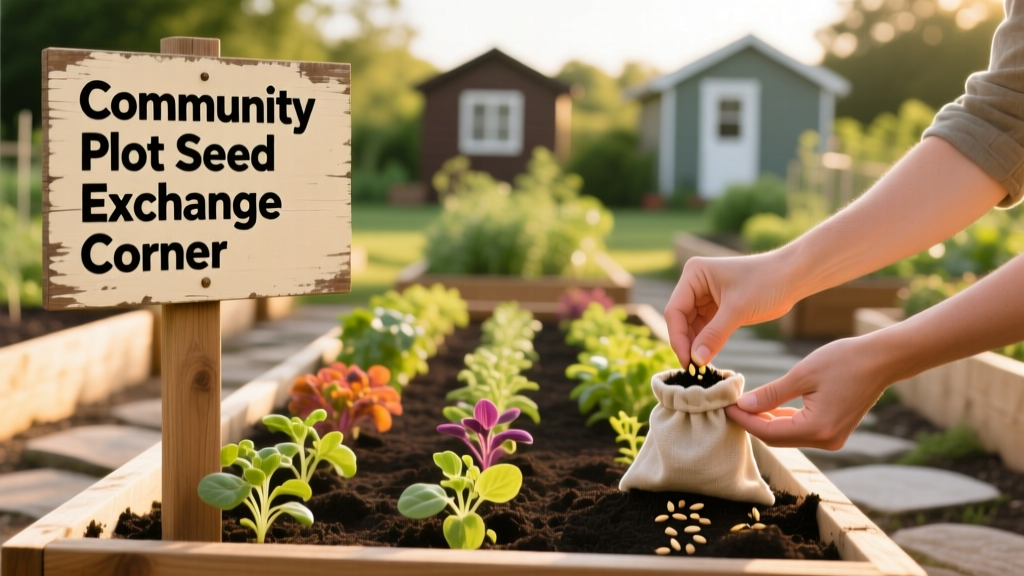
Community Plot Seed Exchange Corner
You arrive at the community garden with a pocket full of seed packets and a head full of good intentions. Ten minutes later, you’re juggling half-used envelopes, trying to remember what “purple pod” meant, and wondering why the shed bulletin board is the unofficial seed swap—wind-blown, damp, and impossible to browse without losing something. The garden has plenty of beds, but the seeds—the real beginning of every plot—don’t have a home.
A seed exchange corner fixes that, and it does more than tidy up. When it’s designed like a small, intentional “room” inside the garden, it becomes a place where neighbors trade locally adapted varieties, label what actually worked, and plan succession sowing right on the spot. Think of it as a mini potting studio, library, and meeting node that can fit into a 6' x 8' wedge of unused space beside the gate.
Design principles: make it easy to use, hard to mess up
Put it where hands already pause
Seed swapping works when it’s on the natural walking line: near the main entrance, tool shed, water spigot, or compost bays—where people already stop. If the corner is tucked behind tall sunflowers, it becomes a storage problem instead of a community ritual.
Layout target: Reserve a footprint of 6' x 8' (48 sq ft) for a basic setup, or 8' x 10' if you want a bench plus a small potting surface. Keep a 36" clear path for accessibility (a common minimum used in many public space guidelines and practical for wheelbarrows).
Design for weather, pests, and “grab-and-go” behavior
Seeds are sensitive to heat and humidity. Your design should assume rain blows sideways, the sun bakes south-facing walls, and someone will open a box with damp hands. Create layers of protection:
- Overhead cover: a small roof, awning, or repurposed cabinet placed under an existing pavilion eave.
- Sealed containers: gasketed bins or jars for the “library” stock, with paper envelopes only inside sealed storage.
- Clear labeling: big, durable signage so the system doesn’t rely on memory.
For practical seed storage, the U.S. National Center for Home Food Preservation notes that cool, dry conditions help maintain quality, and that moisture is a major factor in deterioration (NCHFP, 2020). Even without a climate-controlled room, you can design a corner that stays drier and cooler than a bulletin board in the open.
Keep the system “one-handed”
Most gardeners arrive carrying a hose nozzle, harvest basket, or a toddler’s hand. Your exchange should be operable with one hand: flip-top bins, a clipboard on a tether, and a flat surface at 34–36" high (comfortable counter height) so people can write while standing.
“Good design reduces the need for rules—if the layout makes the right action the easiest action, people will naturally keep it working.” — a principle echoed in user-centered public space design research; see Project for Public Spaces on designing for use patterns (PPS, 2018).
Layout strategies: three proven footprints
Strategy A: The “Gate Nook” (best for small gardens)
Footprint: 6' x 8'. Place a narrow cabinet against a fence, add a small roof panel, and a standing-height writing shelf.
Key dimensions:
- Cabinet: 24" deep x 36–48" wide
- Writing shelf: 10–12" deep at 36" high
- Clear path: 36" minimum
Why it works: Minimal materials, fast to install, and it’s visible enough that people remember to check it.
Strategy B: The “Potting + Exchange Porch” (best for active communities)
Footprint: 8' x 10' with a bench. This layout adds value because people can open seed envelopes, split quantities, and label on-site instead of “doing it later.”
- Bench: 48–60" long
- Potting counter: 18–24" deep
- Roof/awning: at least 30" projection
Why it works: It turns swapping into a social moment. The bench also helps older gardeners and anyone who needs a seated option.
Strategy C: The “Mobile Cart Corner” (best for renters or temporary sites)
Footprint: as little as 3' x 5' plus path clearance. Use a rolling waterproof deck box or locking tool cart that can be moved under shelter when storms roll in.
Why it works: Ideal when you can’t attach anything to fences, or the garden is on a seasonal lease.
Core components (and what they cost)
Here’s a realistic shopping list with DIY alternatives. Costs vary regionally, but these ranges are dependable for planning:
- Weatherproof deck box (50–80 gal): $60–$180 (big enough for labeled bins)
- Gasketed plastic bins (6–12 qt), set of 6: $18–$35
- Seed envelopes (pack of 200): $10–$18
- Silica gel desiccant packs (50-pack): $10–$15 (helps buffer humidity)
- Exterior plywood + roofing panel for a small awning: $35–$90
- Clipboards + waterproof pens: $12–$25
DIY swap: An old kitchen wall cabinet (often free from remodel giveaways) becomes a seed “library” if you add a simple latch and mount it under an existing roofline. Paint it with leftover exterior paint and add adhesive weather stripping (usually $6–$12).
Step-by-step setup (a weekend build)
- Choose the exact spot within 20–40 ft of the entrance or water source, with at least 4 hours of shade or dappled light (morning sun is fine; harsh afternoon sun overheats containers).
- Mark a 6' x 8' rectangle with stakes and string. Confirm you still have a 36" clear path for wheelbarrows.
- Install a firm surface so people can stand and write comfortably:
- Budget: compacted gravel, 2" deep, edged with scrap lumber.
- Upgrade: pavers set on sand for a level pad.
- Add the weather barrier (awnings or roof panel). Aim for a 30" overhang to reduce wind-driven rain.
- Place the storage (deck box or cabinet) with bins inside. Label bins by crop family: “Tomatoes,” “Beans,” “Greens,” “Flowers,” “Herbs,” “Cover Crops.”
- Install a writing shelf at 34–36" high. A simple 1x10 board on brackets works.
- Create the rules signage in plain language: date, variety, source, year, and any notes (“saved seed,” “isolated,” “pollinator-friendly,” etc.).
- Add a simple log (clipboard) for what came in/out. It’s the quiet backbone of a thriving seed corner.
Plant selection that makes a seed exchange thrive
A seed exchange corner isn’t just storage—it’s a cue to grow plants that are easy to save seed from, regionally useful, and genuinely worth sharing. Choose varieties that produce reliably in community beds and don’t require specialized isolation distances to be worthwhile at small scale.
Easy, high-success seed savers (beginner-friendly)
- Beans (Phaseolus vulgaris):
- ‘Provider’ bush bean — dependable yields, quick maturity (~50–55 days), seeds dry easily on the plant.
- ‘Dragon Tongue’ — beautiful pods that get people talking; seeds mature well for saving.
- Lettuce (Lactuca sativa):
- ‘Black Seeded Simpson’ — tolerant, fast, and bolts to seed predictably for saving.
- ‘Rouge d’Hiver’ — excellent fall performance; seed heads are easy to collect in paper bags.
- Tomatoes (Solanum lycopersicum):
- ‘Sun Gold’ (hybrid) is delicious but not true-to-type from saved seed; label it clearly as hybrid if shared.
- ‘Brandywine’ (heirloom) — beloved flavor; saved seed generally stays true if isolated reasonably.
- ‘San Marzano’ type — great for sauce; seed saving is straightforward with fermentation and drying.
- Calendula (Calendula officinalis): easy seed collection, long bloom, and seeds are big—perfect for kid gardeners.
Spacing notes for shareable success: If your community beds are tight, pick compact and productive varieties. Tomatoes at 24" apart (staked) and bush beans at 4–6" apart in rows 18" apart are practical baselines for many home and community plots.
Corner-adjacent “seed support” plantings
Plant a small border around the exchange corner that supports pollinators, offers a teaching moment, and makes the corner feel intentional rather than leftover space.
- Borage — nectar-rich, self-sows lightly, and visually signals “this is a garden hub.”
- Sweet alyssum — low edging, attracts beneficial insects, easy to trim.
- Dwarf nasturtiums — edible flowers, fast growth, and seeds are fun to collect and share.
Keep these border plants in a strip no wider than 12–18" so they don’t crowd traffic. Aim for 6+ hours of sun for the border if possible; if the corner is shaded, choose shade-tolerant edging like violas or mint in pots (contained, always).
A comparison table: three exchange corner builds
| Build option | Footprint | Best for | Approx. cost | DIY difficulty |
|---|---|---|---|---|
| Gate Nook (cabinet + shelf) | 6' x 8' | Small gardens, quick visibility | $80–$250 | Low–Medium |
| Porch (bench + potting counter + awning) | 8' x 10' | Busy gardens, frequent swaps | $200–$650 | Medium |
| Mobile Cart (locking deck box on pavers) | 3' x 5' | Renters, temporary/community pop-ups | $70–$220 | Low |
Sunlight, microclimate, and keeping seed viable
Unlike a herb spiral, this is one garden feature where less sun is often better. Your goal is a stable, cool corner. If the only available space gets intense afternoon sun, add a shade panel (even a simple lattice with a vine in a pot) to cut heat buildup.
The USDA’s Home and Garden Bulletin on seed storage emphasizes that seed longevity improves in cool, dry conditions (USDA, 2014). You don’t need perfection—just avoid leaving seeds in hot, humid air. A sealed bin plus a desiccant pack and shade can make a noticeable difference over a season.
Three real-world scenarios (and how the design shifts)
Scenario 1: The tiny courtyard community garden (space is the constraint)
A 12-plot courtyard garden has one narrow gate and a fence line that bakes in summer. The best move is a mobile cart parked under the only shaded pergola post. The “exchange” becomes a rolling deck box with internal bins, plus a 24"-wide folding shelf attached to the pergola post with removable straps (no drilling into shared structures).
Result: Zero permanent construction, and the cart can be wheeled into the shed before storms. This setup also works for renters managing a shared backyard space.
Scenario 2: The suburban neighborhood garden (people are the constraint)
This garden has room—plenty of it—but participation is uneven. Seeds sit untouched unless there’s an event. Here, the design trick is to make the exchange corner feel like the “front porch” of the garden: 8' x 10', a real bench, and a simple seasonal display (“What to sow this week”).
Add-on: A laminated succession sowing chart and a “Take 3 / Leave 3” prompt. Put a small chalkboard at eye level. Suddenly, the corner isn’t storage; it’s programming.
Scenario 3: The windy, exposed lot garden (weather is the constraint)
In open lots, wind-driven rain is what ruins seed corners. The solution is orientation and sealing: place the cabinet on the leeward side of a shed or fence return, add a 30" roof overhang, and store seeds inside gasketed bins. Gravel underfoot drains quickly, and a simple side panel (even clear corrugated roofing) blocks sideways rain without making the corner dark.
Result: The exchange stays usable after storms, and labels don’t turn to paper mush.
Smart labeling: the small detail that makes the system work
Every shared packet should answer four questions in five seconds: what it is, when it was packed, where it grew, and any special notes. Print or stamp a simple template on envelopes:
- Crop + variety
- Year packed (example: 2026)
- Source: purchased / saved seed
- Notes: flavor, disease resistance, days to maturity, and “hybrid” if applicable
If you want a system that’s friendly but not fussy, add a color dot sticker:
- Green dot: easy to save
- Yellow dot: may cross-pollinate
- Blue dot: donated from a store-bought packet
Maintenance expectations (so it doesn’t become a clutter corner)
A seed exchange corner needs light, steady stewardship—not heroic effort. Plan on 15–25 minutes per week during peak season to straighten bins, remove damp packets, and restock envelopes. In the off-season, it drops to 10 minutes every two weeks.
Seasonal task list
- Early spring (1 hour): wipe surfaces, replace desiccant packs, refresh signage, and stock 50–100 empty envelopes.
- Mid-summer (30 minutes): cull sun-faded labels, check for ants, and add a shade cloth panel if interior temps feel hot.
- Fall (1–2 hours): host a “clean-out swap,” compost unidentifiable packets, and inventory what’s left.
- Winter (30 minutes): move the seed stock to the driest, coolest available storage (shed cabinet off the floor), or have a volunteer store the library indoors if your community rules allow.
Budget planning and DIY alternatives that still look designed
If you’re building this for a community plot, you’re probably balancing ideals with a line-item reality. Here are three budget tiers that still feel cohesive:
- Under $100: free wall cabinet + weather stripping + a small scrap-wood shelf + donated jars. Use a simple sloped lid made from leftover corrugated roofing.
- $150–$300: deck box + gasketed bins + printed signage + gravel pad. This is the sweet spot for durability per dollar.
- $300–$650: add a bench, a real awning, and a counter. This turns the corner into a year-round social node.
Design tip: unify mismatched donated items with one paint color (matte exterior paint hides wear) and consistent labels. The difference between “junk corner” and “garden feature” is often just repetition and clarity.
Small-space renters: how to build the same idea on a balcony or shared yard
If you don’t have a community garden but want the seed exchange energy in a rental setting, make a micro version: a lidded storage tote under a bench plus a binder of seed envelopes. Set it near the shared grill area or mailboxes with permission. Keep the footprint to 2' x 3', and include only seasonally relevant seeds so it doesn’t become an archive.
For shared yards, use a weatherproof cooler (cleaned well) as a surprisingly effective short-term seed storage box—insulated, lidded, and easy to move.
Make the corner earn its space: pair it with a “try-it” demo strip
Want your exchange to feel alive? Give it a companion planting strip: a 2' x 6' demo bed right beside the corner where you grow two or three “exchange stars” each season. Label them clearly: “These seeds are in the exchange box.”
Try this rotation:
- Spring: ‘Black Seeded Simpson’ lettuce + calendula
- Summer: ‘Provider’ beans + dwarf nasturtium
- Fall: dill (for seed heads) + a quick mustard green
People are more likely to take (and return) seeds when they can see the plant, taste the harvest, and trust that it performs in your soil.
By the time you leave the garden, the seed packets are no longer loose in your pocket. They’re filed, dated, and waiting for the next gardener—someone who will grow your ‘Dragon Tongue’ beans in a different bed and bring back a story with the saved seed. That’s what the exchange corner is really doing: turning spare square footage into continuity.
Citations: Project for Public Spaces (PPS), 2018. U.S. National Center for Home Food Preservation (NCHFP), 2020. USDA Home and Garden Bulletin on seed storage, 2014.