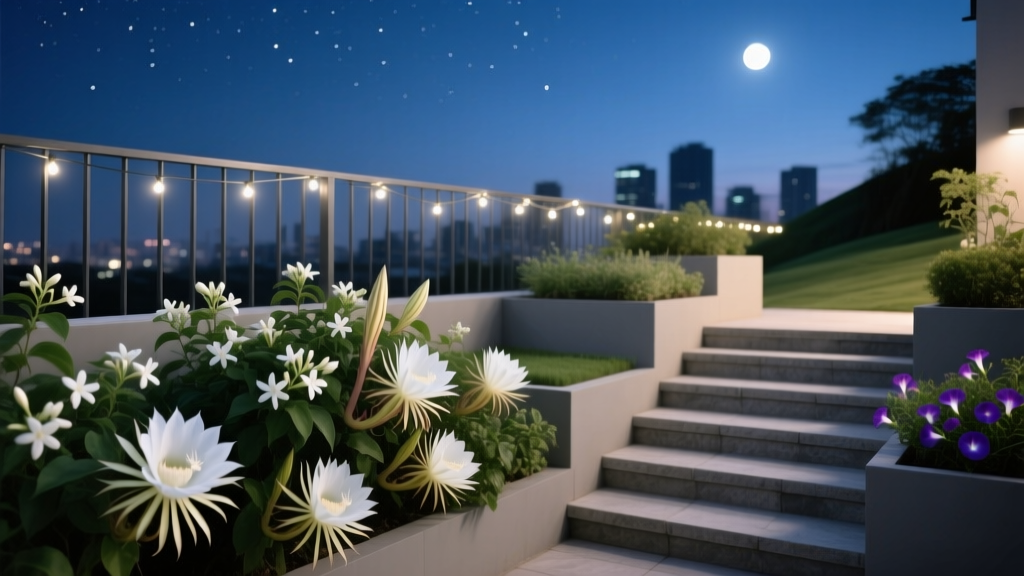
Terrace Fragrant Night Garden Plants
The terrace looks perfect at 2 p.m.—clean pots, a café table, maybe a bit of rosemary. Then evening arrives and the space goes flat. Heat lingers in the paving, the view turns dark, and the “garden” feels like décor instead of atmosphere. If you’ve ever stepped outside after dinner hoping for that soft, perfumed air—and gotten nothing but warm concrete—this is the project: a night-scented terrace garden that earns its keep from 7 p.m. to midnight.
I’m going to walk you through a practical layout that works for homeowners and renters, using plants that release fragrance in the evening, reflect light, and handle container life. We’ll design for real constraints—wind, neighbor windows, weight limits, and that awkward triangle of space behind the AC unit—because terrace gardens succeed or fail on details.
Design Principles for a Night-Fragrant Terrace
Start with the “scent path,” not the plant list
Night fragrance is directional and time-sensitive. Most night-scented plants peak from dusk through early night, and scent travels best when air is still. Your goal is to place fragrance where you actually sit and where air naturally moves. On many terraces, wind slides along the building façade and spills around corners—so the most effective spot for fragrance is often upwind of seating, 3–6 ft (0.9–1.8 m) away.
Design rule of thumb: place your top two fragrance plants within 5 ft (1.5 m) of your primary seat, at nose height (about 3–5 ft / 0.9–1.5 m tall). Low fragrance plants can be closer to the floor, but the “headline” scent needs lift.
Layer by height to trap and hold aroma
Fragrance dissipates quickly on exposed terraces. Use a simple three-layer structure to slow airflow and hold scent around the seating zone:
- Screen layer (4–7 ft / 1.2–2.1 m): tall containers with jasmine, tall grasses, or a trellis to soften wind.
- Body layer (2–4 ft / 0.6–1.2 m): mounding shrubs and floriferous plants like angel’s trumpet alternatives (safer picks listed later) or fragrant pelargoniums.
- Edge layer (6–16 in / 15–40 cm): spillers and low plants near the terrace edge and table base—think night-scented nicotiana, alyssum, or scented geraniums.
Use pale surfaces and “moon colors” for visibility
A night garden isn’t just scent; it’s legibility. White and pale flowers read clearly in low light, and silvery foliage acts like a lantern. The Royal Horticultural Society notes that white flowers and pale foliage show up best after dusk, helping night gardens feel brighter without harsh lighting (RHS, 2023).
Plan for sun hours, because scent needs energy
Most heavy evening bloomers want real sun. For a terrace, target:
- 6+ hours of sun: jasmine (in many climates), nicotiana, heliotrope, roses, many herbs.
- 3–5 hours (bright shade): some pelargoniums, certain lilies, foliage “reflectors” like dusty miller.
If you only get 2–3 hours, you can still build a night garden—just lean on foliage, lighting, and fragrant leaves (mint-family plants) rather than relying on big bloom cycles.
Layout Strategies That Fit Real Terraces
The 6-by-10 ft “scent lounge” layout
If you have roughly 6 ft x 10 ft (1.8 m x 3 m), treat it like an outdoor room. Here’s a layout that works even for renters because it’s mostly containers:
- Back wall: 1 trellis planter, 36 in (91 cm) wide, with jasmine or a fragrant climber.
- Side corner: 1 tall pot (18–20 in / 46–51 cm diameter) with a structural plant + underplanting.
- Seating zone: keep a 30 in (76 cm) clear walkway—tight but comfortable.
- Front edge: 2 window boxes or railing planters for spillers and low night fragrance.
Spacing note: in mixed containers, give medium plants 8–12 in (20–30 cm) between centers; vigorous plants like nicotiana get 12–18 in (30–46 cm) depending on variety.
Balcony railings: the scent “shelf”
Rail planters are underused scent delivery. Set the most fragrant plants on the railing that sits upwind of your chairs. Your body heat and movement will “stir” fragrance up from the plants, especially from evening bloomers that open around dusk.
Weight matters. Many railing planters hold 10–20 lb (4.5–9 kg) when wet; check your hardware rating and lease rules. A DIY alternative is a lightweight coco-lined basket with a drip tray and a compact plant palette (nicotiana + alyssum + silver foliage).
Lighting that doesn’t kill the mood
Use warm, low lighting so your eyes adjust and the pale flowers glow. A simple plan:
- 1 string of 2700K warm LEDs along the wall or pergola edge.
- 2 small solar/LED lanterns at floor level to wash silvery foliage.
- Avoid bright overhead floodlights that flatten texture and reduce perceived fragrance.
“Good lighting in a garden is about restraint—aim for pools of light and shadow, not uniform brightness.” —Nigel Dunnett, planting designer and professor, quoted in garden lighting discussions emphasizing layered illumination (Dunnett, 2016).
Step-by-Step: Building a Terrace Night Garden (DIY Friendly)
- Map sun and wind for one day. Note sun hours (e.g., 6 hours on the south edge, 3 hours near the wall). Stand outside at 8–10 p.m. to feel wind direction.
- Choose your seating first. Reserve a clear rectangle at least 30 in (76 cm) wide for circulation and 24 in (61 cm) behind chairs to scoot back.
- Place the “scent anchors.” Put 2 highly fragrant plants within 3–5 ft (0.9–1.5 m) of the seat, ideally upwind.
- Add a wind-softening screen. Use a trellis planter (36 in / 91 cm wide) or two tall pots to create a calm pocket.
- Fill the mid layer. Add 2–4 medium containers (12–16 in / 30–40 cm) with evening bloomers and reflective foliage.
- Finish with edge fragrance. Rail planters or low bowls for spillers and fragrant leaves.
- Install simple irrigation. A $25–$45 drip kit can be a sanity-saver if you travel; otherwise, group plants by water needs.
Plant Selection: Fragrant Night Garden Stars (Container-Smart)
The best night-scented terrace plants share three traits: they perfume reliably, tolerate containers, and look good in low light. Here are specific varieties and why they work.
Primary scent anchors (choose 2)
- Night-scented tobacco (Nicotiana alata ‘Fragrant Cloud’ or similar): A classic evening perfume that intensifies at dusk. Great in 12–16 in (30–40 cm) pots, spacing 12–18 in (30–46 cm). Deadhead lightly for extended bloom.
- Star jasmine (Trachelospermum jasminoides): Waxy white flowers and strong fragrance in warm seasons. Works in a 16–20 in (40–51 cm) pot with a trellis; prune after flowering. (Note: despite the name, it’s not a true jasmine.)
- Arabian jasmine (Jasminum sambac ‘Maid of Orleans’): Intensely fragrant, often grown in pots; bring indoors if your winters drop below about 40°F/4°C. Place near seating so you catch the perfume.
- Heliotrope (Heliotropium arborescens ‘Marine’): Vanilla-cherry scent that reads well in evening air. Likes sun and consistent moisture; use a 12–14 in (30–36 cm) pot.
Evening bloomers and “supporting actors”
- Evening stock (Matthiola longipetala): Small, airy flowers with a surprisingly strong night scent; great for railing planters. Treat as a cool-season annual in many climates.
- Tuberose (Polianthes tuberosa, often sold as Agave amica): Powerful fragrance; grow bulbs in a deep pot (at least 12 in / 30 cm) and give full sun. In cold regions, lift and store bulbs.
- Moonflower (Ipomoea alba): Dramatic white blooms that open at night; needs a trellis and warmth. Best for larger terraces due to vigor.
- Sweet alyssum (Lobularia maritima ‘Snow Princess’): Honey scent and white “foam” that brightens edges; easy filler for bowls and rail planters.
Fragrant foliage for nights when blooms pause
- Scented geranium (Pelargonium ‘Attar of Roses’): Leaves release fragrance when brushed—perfect near a walkway. Handles containers well and tolerates some drought.
- Lemon balm (Melissa officinalis): Citrusy leaves; best in a pot (it spreads). Snip for tea; place where you’ll touch it.
- Herbs with nighttime payoff: thyme, mint (in pots), and basil varieties can read as “kitchen fresh” after dusk.
Reflective foliage to make it feel brighter
- Dusty miller (Senecio cineraria): Silver leaves that glow under soft light; drought tolerant once established.
- Lamb’s ear (Stachys byzantina): Soft, pale foliage; best in wider pots with good drainage.
Pollinator note: many night-fragrant flowers are moth-pollinated. The Xerces Society highlights that night-blooming, pale flowers can support nocturnal pollinators like moths, which are important in food webs (Xerces Society, 2020).
Comparison Table: Top Night-Fragrant Container Choices
| Plant | Fragrance Timing | Sun Needs | Container Size | Notes for Terraces |
|---|---|---|---|---|
| Nicotiana ‘Fragrant Cloud’ | Dusk to night | 6+ hours | 12–16 in pot | Fast results; can be grown from seed cheaply |
| Trachelospermum jasminoides | Evening (in bloom) | 4–8 hours | 16–20 in pot + trellis | Evergreen in mild climates; excellent screen |
| Jasminum sambac | Evening to night | 5–8 hours | 12–16 in pot | Bring indoors in cold winters; place near seating |
| Heliotrope ‘Marine’ | Late day to evening | 6+ hours | 12–14 in pot | Steady moisture; great near a chair arm |
| Evening stock | Night (strongest) | 4–6 hours | Window box/rail planter | Best for cool seasons; reseeds in some areas |
Three Real-World Terrace Scenarios (and How to Solve Them)
Scenario 1: The renter’s 5-by-8 ft balcony with strict rules
You can’t drill, you can’t add heavy planters, and management hates water runoff. Here’s a tight plan that still delivers scent:
Layout: One 30 in (76 cm) wide bistro set centered; two 24 in (61 cm) tall lightweight resin planters in the back corners; two railing planters on the windward side.
Planting recipe:
- Back corner planter #1: Jasminum sambac (or a compact star jasmine if winters are mild) + dusty miller.
- Back corner planter #2: Heliotrope ‘Marine’ + sweet alyssum spill.
- Railing planters: Evening stock + trailing white bacopa or alyssum.
- One small pot by the doorway: Pelargonium ‘Attar of Roses’ for touch fragrance.
Cost snapshot: Expect about $120–$250 for 4–6 plants + potting mix if you already own containers; add $60–$140 if you need to buy lightweight pots and railing hardware. Use saucers or a slim balcony tray to prevent staining.
Scenario 2: The exposed rooftop terrace (windy, full sun, big temperature swings)
Rooftops burn by day and gust at night. The trick is to create a sheltered “scent pocket” using a screen and heavier pots that won’t tip.
Layout: A 36 in (91 cm) wide trellis planter placed perpendicular to prevailing wind, forming an L-shape with a tall pot. Keep the seating 3–4 ft (0.9–1.2 m) inside this pocket.
Planting recipe:
- Trellis planter: Trachelospermum jasminoides trained horizontally and vertically to slow wind.
- Tall pot (20 in / 51 cm diameter): Bay laurel (structure) underplanted with nicotiana for night scent.
- Edge pots: lamb’s ear + alyssum for glow and spill.
Practical numbers: Use heavier containers (at least 18 in diameter) and aim for a total planted pot weight of 40–70 lb (18–32 kg) in the windiest positions—often achievable with thicker pots and saturated mix. If weight is a concern, add wind screens instead of heavier pots.
Scenario 3: The shaded urban terrace with bright neighbor windows
You get only 3–4 hours of direct sun, and you don’t want a spotlight garden that competes with surrounding buildings. In this case, your night garden is a mix of scent-by-touch, pale foliage, and a few bloomers that tolerate bright shade.
Layout: Pull seating closer to the wall to reduce glare exposure. Place reflective foliage in containers opposite neighbor windows so your eye reads softness rather than shine.
Planting recipe:
- Two medium pots: scented geranium + dusty miller.
- Railing planter (brightest spot): evening stock in spring/fall; switch to nicotiana in summer if sun increases.
- One “interaction pot” beside the chair: lemon balm or mint (in a pot) so scent happens when you brush it.
DIY trick: If neighbor glare is the issue, add a simple reed/bamboo screen panel and let a fragrant climber (star jasmine in mild climates) soften it over time—no drilling required if you use freestanding supports and zip ties.
Budget Planning and DIY Alternatives
A fragrant night terrace can be built in layers as budget allows. Here’s a realistic range:
- Starter build ($80–$160): 3–5 small plants (including nicotiana from seed), 1–2 bags of potting mix, and repurposed containers.
- Mid-range build ($200–$450): Add a trellis planter, 2–3 quality containers, and warm LED lighting (2700K).
- Premium build ($500–$900+): Larger specimens (jasmine in a 5–7 gallon pot), matched containers, drip irrigation, and a screen system.
DIY alternatives that work:
- Use a $15 concrete mixing tub as a hidden planter inside a decorative sleeve.
- Make a trellis from cedar lattice and two upright posts in a large pot—stable, removable, and renter-friendly.
- Grow nicotiana from seed for pennies per plant instead of buying multiples in nursery pots.
Maintenance Expectations (So the Scent Keeps Coming)
Plan on 30–60 minutes per week in peak season for a small-to-medium terrace, mostly watering and grooming. If you’re in full sun with lots of containers, watering can be the main job—often 3–5 times per week in hot weather, sometimes daily during heat waves.
Weekly routine
- Water check: Stick a finger 2 in (5 cm) into soil. If dry, water deeply until it drains.
- Deadhead and pinch: Remove spent blooms on nicotiana and heliotrope to keep flowering steady.
- Fragrance management: Lightly brush or prune scented geranium and lemon balm to release oils (and encourage fresh growth).
Seasonal tasks
- Spring (setup): Refresh the top 2–3 in (5–8 cm) of potting mix; add slow-release fertilizer.
- Mid-summer: Prune jasmine after flowering; cut back leggy annuals by 1/3 to trigger a flush.
- Fall: Swap in evening stock for cool-season scent; reduce watering as temperatures drop.
- Winter (if cold): Bring Jasminum sambac and tender scented geraniums indoors to a bright window; water sparingly.
If you want lower maintenance, reduce the plant count and choose one main fragrant anchor plus two “background” plants. Fewer pots means fewer dry-outs, and the scent can actually feel stronger because it’s concentrated near your seating.
The best night gardens don’t ask you to rearrange your life—they simply reward the hours you’re already home. When the day cools and the city settles, you’ll step out with a drink, brush past a scented geranium, and catch that first wave of jasmine or nicotiana drifting into the chair zone. That’s the moment your terrace stops being extra space and starts being a nightly ritual.
Citations: Royal Horticultural Society (RHS), guidance on white/pale planting for evening gardens, 2023. Xerces Society, resources on moths and night-pollinated flowers, 2020. Nigel Dunnett, lighting/planting design commentary widely published and discussed in design education contexts, 2016.