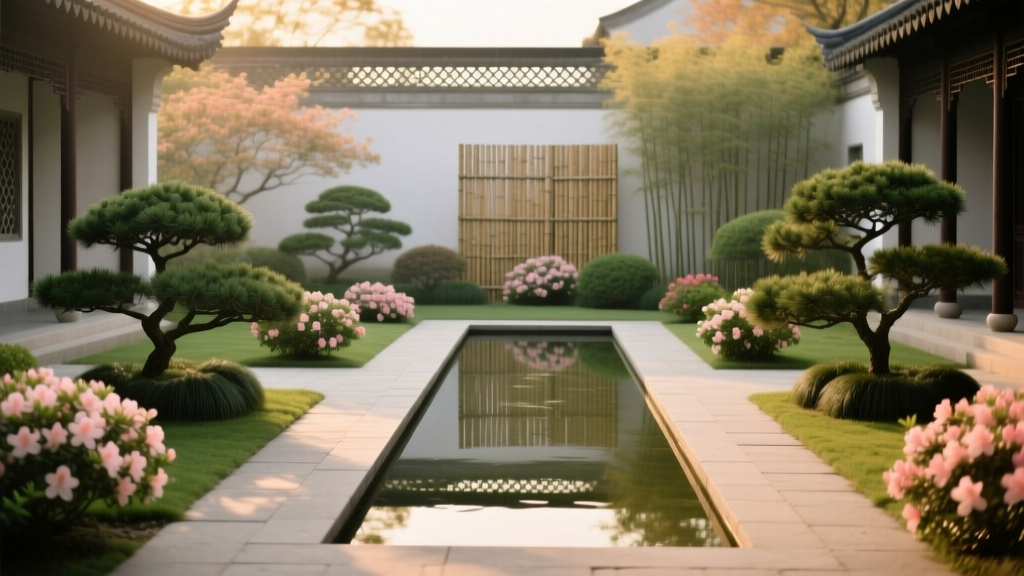
Courtyard Classical symmetry Garden
The courtyard is only 12 feet wide, the neighbor’s upstairs window looks straight down, and the existing paving feels like a forgotten service area—bins, hose, a lonely pot of mint, and a gate that never quite closes. You want it to feel finished, calm, and intentional, but also livable: a place for morning coffee, a bit of fragrance at night, and an easy route to the back door. This is exactly where classical symmetry earns its keep. It takes a messy, visually exposed space and gives it structure—so even a small courtyard reads as a “garden room,” not a leftover gap.
Let’s walk through a practical, designer-style approach to creating a courtyard with classical symmetry: a clear axis, balanced planting, repeatable shapes, and a few well-chosen focal points that look good in every season.
Start with the axis: the line that makes everything feel intentional
Classical symmetry doesn’t mean stiff or fussy. It means the space has a visual “spine.” In courtyards, that spine is usually the main sightline from the most-used doorway or the window you look out of most often.
Pick the primary view and build around it
Stand at your kitchen threshold (or main patio door) and look straight ahead. Wherever your eye naturally lands is your focal point location—often the far wall, a gate, or the center of the courtyard. In a tight courtyard, the focal point should be compact but strong: an urn, a small tree in a pot, a wall fountain, or a simple bench with a pot on either side.
For a rectangular courtyard measuring 12 ft x 18 ft (a common footprint behind townhomes), place the focal point on the centerline of the 18 ft length. Then mirror what happens on the left and right: same bed widths, matching pots, paired lights, repeated plant shapes.
Use classical proportions to avoid “pinched” paths
For comfortable circulation, aim for a clear walking path of 36 inches minimum; 42 inches feels luxurious in a courtyard. If you’re squeezing a dining set in, you’ll want 48 inches behind chairs if that’s your main walkway. These numbers are what keep the garden practical—symmetry is the icing, not the cake.
As a simple layout rule: if your courtyard is 12 ft wide, a central path of 3.5 ft with two side borders of 3.5–4 ft each creates a balanced, generous look.
Layout strategies that read “classical” without requiring a palace
Strategy 1: The central “carpet” with mirrored borders
This is the workhorse layout for small courtyards: a central rectangle (paving, gravel, or lawn substitute) framed by two identical planting beds. It’s symmetrical, flexible, and easy to scale.
- Central area: 6–7 ft wide (paving or gravel) so two people can pass comfortably.
- Side borders: 30–48 inches wide for layered planting (low edging + mid shrubs + one vertical accent repeated).
- Focal point: centered on the far end: a 24–30 inch diameter urn, or a slim bench (48–60 inches wide).
Strategy 2: The parterre-inspired courtyard (for renters or small budgets)
If you can’t dig or don’t want to commit to permanent beds, you can “draw” a parterre-like pattern with containers. Use pairs of identical pots and repeat them in a mirrored arrangement. Even inexpensive materials look elevated when they’re repeated with discipline.
Try 8 identical pots (12–14 inch diameter) arranged as two mirrored groups of four. Keep plant choices consistent: the same clipped herb or small evergreen in each pot, plus seasonal accents that swap out.
Strategy 3: The cross-axis (when you want seating to feel ceremonial)
In slightly larger courtyards—say 16 ft x 24 ft—you can introduce a cross-axis: a main path to a focal point plus a perpendicular line that frames a seating area. This is a classic trick in European courtyards: the garden feels like it has “rooms,” even when it’s just one rectangle.
Place a small bistro set at the intersection of the axes. The symmetry will make the seating feel placed, not parked.
Hardscape choices: the quiet geometry that holds the design together
Surfaces that suit symmetry (and real life)
Classical symmetry likes calm materials: stone, brick, gravel, and simple pavers. Your goal is a background that doesn’t fight the planting.
| Surface | Best for | Approx. installed cost (USD/sq ft) | DIY difficulty | Notes for courtyards |
|---|---|---|---|---|
| Decomposed granite (DG) | Soft, classic look; good drainage | $6–$12 | Medium | Add edging to keep lines crisp; choose stabilizer for less tracking. |
| Clay brick (on sand) | Traditional formality | $12–$25 | High | Herringbone reads “classical” fast; needs good base prep. |
| Concrete pavers | Budget-friendly structure | $8–$18 | Medium | Pick large-format (e.g., 24" x 24") for calm geometry. |
| Porcelain pavers | Clean, modern-classical blend | $15–$35 | High | Excellent stain resistance; can feel slippery if glossy. |
For drainage and plant health, keep a gentle slope away from the house: about 1–2% grade (roughly 1/8 to 1/4 inch per foot). In a 18 ft run, that’s around 2.25–4.5 inches of total drop—enough to move water without feeling tilted.
Edges are your secret weapon
Symmetry falls apart when borders look fuzzy. Install a hard edge—steel edging, brick soldier course, or stone. A simple 4-inch steel edge (often $2–$4 per linear foot) gives you the crisp “drawn line” that makes classical layouts feel professional.
Planting design: repeatable shapes, controlled exuberance
In a classical symmetrical courtyard, plants do two jobs: they soften the hardscape and reinforce the geometry. Think of planting in layers—low edging, mid-level mass, and a vertical accent—repeated on both sides.
“Repetition and simplicity are the keys to creating a sense of order in a garden—especially in smaller spaces where every element carries visual weight.” — Rosemary Alexander, garden designer and founder of The English Gardening School (as quoted in her teaching materials and interviews, 2010s)
Sunlight hours: match the palette to the reality
Before buying anything, take one day to observe sun. Courtyards often get “shafted sun”—bright for a short window, shaded the rest. Record direct sun hours:
- Full sun: 6+ hours
- Part sun/part shade: 3–6 hours
- Shade: under 3 hours
This matters for classics like lavender and roses (sun lovers) versus boxwood alternatives and shade-tolerant evergreens.
Specific plant selections (with varieties) that suit a symmetrical courtyard
Evergreen structure (the “bones”)
1) Boxwood alternatives (for disease-prone regions)
Boxwood can be iconic in classical gardens, but boxwood blight and leafminer can be serious in some areas. If you love the clipped look, consider these dependable substitutes:
- Ilex crenata ‘Sky Pencil’ (Japanese holly): narrow vertical accent, great in pairs by a doorway or focal point. Space 24–30 inches apart if planting a slim “gatepost” effect.
- Ilex crenata ‘Green Luster’: small-leaved, boxwood-like mound; clips neatly for low hedging. Plant 18 inches on center for a tight edging line.
- Lonicera nitida (box honeysuckle): very clip-friendly, fast, and forgiving. Works well for low parterre lines in mild climates.
2) True boxwood (where it performs well)
If boxwood is reliable in your area, choose cultivars bred for resilience:
- Buxus microphylla ‘Winter Gem’: compact, good for low hedges.
- Buxus ‘Green Velvet’: dense, rounded, strong winter color in many regions.
For a classic low hedge, keep height at 12–18 inches and clip 1–2 times per year. That scale feels formal without swallowing the courtyard.
Flowering structure (seasonal elegance without chaos)
- Rosa ‘The Fairy’ (polyantha rose): repeat blooms, tidy habit, good for mirrored beds. Give it 4–6 hours sun minimum; space about 24–30 inches apart.
- Hydrangea paniculata ‘Bobo’: compact (about 2.5–3 ft), big impact in part sun. Great as matching pairs on either side of a path.
- Lavandula angustifolia ‘Hidcote’: crisp mounding form, fragrance, classical color. Needs 6+ hours sun and sharp drainage; space 18–24 inches.
Fragrance and evening payoff (courtyards shine at night)
- Sarcococca confusa (sweet box): shade-tolerant evergreen with powerful winter fragrance; perfect near doors. Space 3 ft apart.
- Trachelospermum jasminoides (star jasmine): glossy evergreen climber for warm climates; train it symmetrically on trellis panels. Plant 18–24 inches from the wall with support wires.
- Nepeta ‘Walker’s Low’: long bloom, softens edges without looking messy; space 18–24 inches and shear once midsummer for rebloom.
Courtyard trees for a focal point (scaled and well-behaved)
- Laurus nobilis (bay laurel) in a pot: classic, edible, and clips into a lollipop standard. Choose a 20–24 inch diameter pot for stability.
- Olea europaea (olive) in a pot: strong Mediterranean character; thrives in sun and good drainage.
- Acer palmatum ‘Bloodgood’ (Japanese maple): for part shade courtyards; graceful structure without overwhelming the space (choose a compact form if your courtyard is under 200 sq ft).
Three real-world scenarios (and how symmetry adapts)
Scenario A: The rental courtyard (no digging, no permanence)
Space: 10 ft x 14 ft, part shade (3–4 hours direct sun).
Goal: privacy and polish without altering the property.
Design move: Create symmetry with containers and a central “runner” of gravel on top of landscape fabric (removable). Use two tall planters (18–22 inches wide) flanking the far wall, each with a ‘Sky Pencil’ holly or bay laurel. Add 6 smaller matching pots (12 inches) arranged symmetrically with clipped herbs.
Budget: $450–$900 depending on pot material. DIY tip: use lightweight resin urns instead of terracotta to reduce cost and weight.
Scenario B: The narrow townhouse courtyard (the “corridor problem”)
Space: 8 ft x 22 ft, full sun in the middle (6 hours), shade near the house.
Goal: stop it feeling like a passageway and make a place to sit.
Design move: Keep a 36-inch central path, then create two identical 18–24 inch beds on each side. At the midpoint, widen the path into a 5 ft x 5 ft “pause square” for a bistro table. The symmetry comes from repeating the same plant blocks on both sides: edging (lavender or dwarf boxwood), mid-layer (roses or nepeta), and vertical accent (pair of trained jasmine on trellis panels near the seating square).
Cost marker: A simple steel-edged DG path for this footprint (about 175 sq ft) often lands around $1,050–$2,100 installed, or less if you DIY the base prep and edging.
Scenario C: The shaded urban courtyard (bright walls, low light)
Space: 12 ft x 12 ft, shade (1–2 hours sun).
Goal: lush, calm, and not “sad” despite low light.
Design move: Use symmetry with foliage and texture instead of sun-loving blooms. Create a centered focal pot (24-inch diameter) with a Japanese maple (compact variety), then mirror two rectangular planters left/right with Sarcococca and ferns. Paint the back wall a soft warm white to bounce light and make greens glow.
Practical note: In low light, reduce the number of different plant types. Repeating 3–4 species reads intentional and serene.
Step-by-step setup: a designer’s sequence that avoids expensive rework
- Measure and draw: Sketch the courtyard to scale on graph paper. Mark doors, drains, taps, and existing levels. Add the centerline (your axis).
- Set clearances: Lock in circulation first—36 inches minimum for main paths, 24 inches minimum for secondary access.
- Place the focal point: Choose one: urn, bench, wall fountain, or specimen pot. Center it on the axis.
- Mirror the beds/containers: Decide bed widths (e.g., 36 inches each side). Confirm symmetry by measuring from the centerline, not from walls (old walls are rarely square).
- Install edging and hardscape: Establish crisp lines first; symmetry depends on them. Maintain a 1–2% slope away from buildings.
- Soil prep: In beds, add 2–3 inches of compost and incorporate gently. In pots, use quality container mix and ensure drainage holes are open.
- Plant from largest to smallest: Place trees/vertical accents, then shrubs, then perennials/groundcovers. Step back often and check balance.
- Mulch and finish: Add 2 inches of mulch in beds (keep away from stems). Top-dress pots with fine gravel for a clean, classical look.
- Light it: Add two matching wall lights or spike lights to reinforce symmetry and make the courtyard usable at night.
Budget planning and DIY alternatives (where to spend, where to save)
A symmetrical courtyard looks high-end, but it doesn’t require high-end everything. Put money into what you touch and what defines lines: paving base prep, edging, and a focal point.
- Spend: edging, path base materials, one statement focal element (a good urn, a bench, or a quality specimen plant).
- Save: choose smaller plants and let them grow; use gravel/DG instead of full paving; buy pots in one consistent budget material.
Concrete numbers that help you plan:
- Path width: 36–42 inches for comfort.
- Low hedge spacing: 18 inches on center for tight structure.
- Mulch depth: 2 inches in beds to reduce evaporation and weeds.
- Typical courtyard light: many urban courtyards get 3–6 hours direct sun; plan plant choices around your measured number.
- Starter budget ranges: $450–$900 for a renter-friendly container symmetry; $1,500–$4,000 for a modest hardscape refresh with DG/pavers and new planting (varies widely by region and labor).
Maintenance expectations: what it really takes to keep symmetry crisp
Symmetry looks best when it’s maintained lightly but consistently. The good news: structured planting is often easier to manage than a mixed cottage border.
Weekly time
Plan for 30–60 minutes per week in peak season (spring through early fall): quick deadheading, checking irrigation, a light tidy, and a glance for pests.
Seasonal tasks
- Spring (1–2 hours total): feed container plants, refresh mulch, prune winter damage, check drip lines.
- Early summer (30–60 minutes): first clip of hedges (boxwood/holly/lonicera), shear nepeta after bloom for rebloom.
- Late summer (30 minutes): second light clip if needed to keep lines sharp; don’t over-shear in very hot weather.
- Autumn (1–2 hours): leaf cleanup (especially around drains), cut back perennials, protect tender pots if you freeze.
- Winter (30 minutes): check pots after storms, tidy evergreen shape, enjoy the structure doing its job.
Details that quietly elevate a classical courtyard
1) Paired lighting: Two identical fixtures flanking a door or focal wall reinforce symmetry instantly. Warm color temperature (around 2700K) flatters foliage and brick.
2) Matched hardware: Repeat finishes—black iron, aged brass, or simple stainless. A symmetrical garden is sensitive to visual “noise.”
3) Restraint with color: Choose a tight palette: whites + lavender + green, or blush + deep green, or all-green with texture. The structure does the heavy lifting.
Notes backed by research and industry sources
Water use and irrigation efficiency matter in courtyards, where reflected heat can dry pots quickly. Drip irrigation and targeted watering reduce waste; the U.S. Environmental Protection Agency notes that landscape irrigation can account for a significant share of residential water use and that more efficient watering practices reduce water loss (U.S. EPA, 2023).
For soil health, incorporating compost improves soil structure and water-holding capacity—especially valuable in small beds that can dry out near walls and paving. The Royal Horticultural Society highlights organic matter (like compost) as a core tool for improving soils over time (RHS, 2022).
Citations:
U.S. Environmental Protection Agency (EPA). (2023). WaterSense: Outdoor Water Use in the United States and related WaterSense guidance.
Royal Horticultural Society (RHS). (2022). Improving soil / soil organic matter guidance pages.
Bringing it to life: a sample planting plan for a 12 ft x 18 ft courtyard
If you want a clear starting point, here’s a simple, symmetrical layout that performs in many temperate climates with 4–6 hours of sun:
- Center: 7 ft wide DG or paver “carpet,” 18 ft long.
- Two side beds: each 30 inches wide, running the length.
- Focal point: one 24–30 inch urn at the far end with bay laurel.
- Vertical accents: two Ilex crenata ‘Sky Pencil’ (one in each bed near the focal end) or in pots for sharper punctuation.
- Mid layer: Hydrangea paniculata ‘Bobo’ (2 per side, evenly spaced), or Rosa ‘The Fairy’ for sunnier sites.
- Edging line: Lavandula ‘Hidcote’ (sun) or Lonicera nitida (part shade) in a repeated row.
Space plants so they can meet but not crowd: hedging at 18 inches on center, shrubs at 30–36 inches depending on mature size. In courtyards, air circulation matters—tight plantings can invite mildew if walls block breezes.
When you’re done, the courtyard should feel like it has always had this plan: a centered view, matched borders, and a focal point that stops the eye gently. The symmetry does more than look pretty—it makes a small outdoor space feel stable, private, and complete, which is exactly what a courtyard is supposed to offer when you step outside with a cup of coffee and finally see a garden, not a gap.