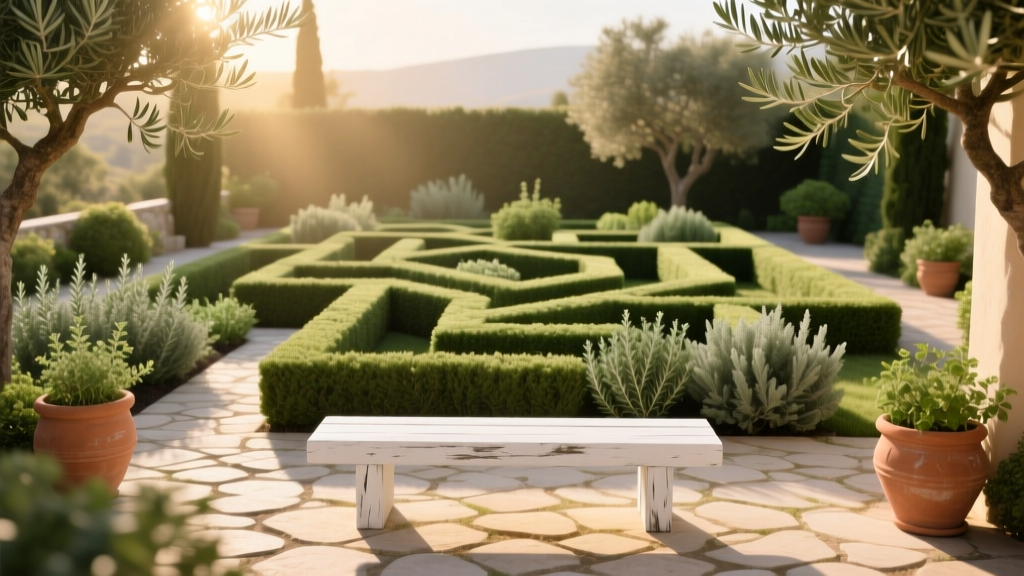
Patio Mediterranean Herb Maze
You step outside with a mug of coffee and a short list: pick rosemary for potatoes, clip mint for tea, and grab thyme for tonight’s pasta. Two minutes later, you’re staring at a jumble of pots—some leggy, some scorched, some drowned—tucked into whatever space was left on the patio. The herbs are alive, technically, but they don’t feel like a garden. What if that same patio became a tiny, walkable maze—fragrant, structured, and productive—where every turn offers a different scent and a handful of ingredients?
This design is a Mediterranean herb maze scaled for patios, balconies, and rental courtyards. It uses repeatable modules, tight plant spacing, and materials you can move when the lease is up. Think of it as a landscape designer’s trick: create the feeling of “garden rooms” in just a few square meters by using low hedges of herbs instead of boxwood.
Design principles: make it feel like a maze, keep it practical
Start with a footprint you can actually walk
A patio maze fails if it’s too cramped to harvest. The sweet spot for a home patio is a compact grid that still allows a single person to step in, turn, and clip herbs without brushing every plant.
Baseline dimensions (works for many patios):
- Overall maze size: 8 ft x 10 ft (80 sq ft) or 2.4 m x 3.0 m
- Path width: 16–18 inches (40–45 cm) minimum for comfortable foot traffic
- Bed/hedge width: 10–12 inches (25–30 cm) per planted strip
- Center “pause point”: 18–24 inches (45–60 cm) diameter for a pot feature or small stool
If you have less space, scale down to a 6 ft x 6 ft layout with a single loop path and one central feature pot. If you have more, scale up by repeating the module—don’t widen paths too much or you lose the maze feeling.
Use a simple geometry: the “one-loop + dead-ends” trick
For patios, I like a “one-loop maze” because it feels playful but never frustrating. You get one continuous circuit path with a few short dead-ends for discovery (and extra herb pockets). The geometry is easy to build with modular planters or edging, and you can reconfigure it later.
Layout strategy: design a loop that always brings you back to the entry, then add 2–4 dead-end herb bays. Dead-ends are great places for strong-scented plants like mint (in pots), lemon thyme, or curry plant—little aromatic surprises.
Sunlight and microclimates: read the patio like a tiny hillside
Mediterranean herbs want strong light and sharp drainage. Most do best with 6–8+ hours of direct sun daily; some will cope with 4–6 hours but grow looser and less aromatic. If your patio is partly shaded by buildings, treat it like microclimates:
- Hottest edge (near reflective walls): rosemary, thyme, oregano
- Moderate light pockets: chives, parsley (not Mediterranean, but useful), mint (in containment)
- Windy corners: low-growing thyme and oregano (less snap risk)
Also plan for heat: paved patios can run hotter than adjacent soil. Mediterranean herbs tolerate heat, but containers dry fast—so the design must support efficient watering.
Choose the right “walls”: living hedges that stay low
A patio maze needs herb “walls” you can see over. Aim for a finished hedge height of 8–14 inches (20–35 cm). That keeps it navigable and makes harvesting easy.
Good hedge-formers: compact thymes, oregano, dwarf rosemary (in warm climates), lavender (where hardy), and compact santolina. Save sprawling rosemary and vigorous mint for feature containers, not the maze walls.
“The first rule of a successful planting design is to put the right plant in the right place.” —Beth Chatto, quoted widely in garden design literature; her principle remains a standard in drought-wise design.
Layout strategies for real patios (and rentals)
Option A: Modular planter maze (best for renters)
This is the most flexible approach: build the maze walls from identical planters arranged into a loop. You can move it, tweak it, or take it with you.
Recommended modules: 24-inch (60 cm) long rectangular planters, 8–10 inches (20–25 cm) deep. Arrange them like bricks to create corridors.
Estimated cost (typical ranges):
- 10–14 rectangular planters at $12–$25 each = $120–$350
- High-quality potting mix: 8–12 bags (1.5–2 cu ft) at $8–$14 each = $64–$168
- Plants (4-inch pots): 30–45 herbs at $4–$7 each = $120–$315
- Drip kit (optional but helpful): $35–$80
Option B: Raised-bed “maze panels” (best for homeowners)
If your patio is adjacent to a yard strip or you can place beds on compacted gravel, build shallow raised panels (like low labyrinth walls). Keep bed height modest—6–10 inches—so the maze stays visually open.
Use rot-resistant lumber or composite boards and line the base with hardware cloth if rodents are a concern. For drainage, set beds on 1–2 inches of gravel or paver sand.
Option C: Painted path + clustered pots (best for tiny balconies)
If your “patio” is a balcony barely wide enough for a chair, you can still get the maze vibe. Paint or stencil a simple looping path on deck tiles, then place low herb pots along the edges to imply walls. It’s more optical illusion than labyrinth, but it’s surprisingly effective.
Use 10–12 inch diameter pots for the “walls” and a single taller pot (like bay laurel) as the focal point.
Step-by-step setup instructions (designer workflow)
- Measure the usable rectangle. Don’t guess—measure in feet/inches or cm. Mark the footprint with painter’s tape. Aim for at least 6 ft x 6 ft of clear area for a walkable maze.
- Mark the path first. Tape out 16–18 inch corridors. If you can’t turn comfortably, widen the tightest corner before you add planters.
- Place planters/edging as “walls.” Arrange them to form one continuous loop plus 2–4 short dead-ends. Keep a 18–24 inch circle in the center for a feature pot.
- Confirm sun exposure. Note how many hours the footprint gets. If it’s under 6 hours, prioritize thyme, chives, parsley, and mint-in-pots; keep rosemary/lavender for the brightest zone.
- Fill with a fast-draining mix. Use potting mix amended with 20–30% pumice/perlite for Mediterranean herbs. Avoid heavy compost-only blends that stay wet.
- Plant in repeating patterns. Repeat the same 3–5 herbs around the maze to create visual rhythm. Keep the most vigorous plants in contained spots.
- Mulch with gravel. A 1/2–1 inch layer of pea gravel reduces splashing, keeps stems dry, and nods to Mediterranean gardens.
- Install watering. For planters, a simple drip line with 1 GPH emitters prevents the “one pot thriving, one pot dying” problem.
- Pinch and shape weekly for the first month. You’re training living walls. Light trimming now prevents woody gaps later.
Plant selection: varieties that behave well in a maze
The trick is choosing herbs that stay compact, tolerate pruning, and don’t collapse into the path. Many Mediterranean plants are naturally shrubby—great for structure—while others are better as accents.
Core “hedge” herbs (the maze walls)
Thyme (Thymus vulgaris) is a designer’s dream for low hedging: tight foliage, drought-tolerant, and responsive to clipping. Plant it close and it knits together.
- English thyme ‘Compactus’: stays dense; great for 8–10 inch hedges
- Lemon thyme ‘Doone Valley’: bright scent; use as accent segments (not the whole maze)
- Spacing: 8–10 inches (20–25 cm) on center for quick fill
Oregano (Origanum vulgare) makes a softer wall—slightly looser than thyme but fragrant and productive.
- Greek oregano (often sold as Origanum vulgare subsp. hirtum): stronger flavor; tolerates heat
- Spacing: 10–12 inches (25–30 cm)
Lavender (Lavandula angustifolia) can form a gorgeous low border if your climate supports it and your patio is sunny. Choose compact cultivars.
- ‘Hidcote’: compact, deep purple; strong structure
- ‘Munstead’: reliable, slightly softer habit
- Spacing: 12–16 inches (30–40 cm), but use it in segments so it doesn’t overwhelm
Santolina (Santolina chamaecyparissus) (cotton lavender) is not a culinary herb, but it’s a Mediterranean classic for clipped edging—silvery, drought-tough, and tidy.
Accent herbs (pockets, dead-ends, and the center)
- Rosemary ‘Arp’ (upright, cold-hardy selection): use as a corner “marker” in larger planters; clip lightly rather than hard-shearing.
- Rosemary ‘Prostratus’ (trailing): use on the outer edge so it can spill outward, not into the path.
- Bay laurel (Laurus nobilis): a perfect center-feature plant in a pot; it reads like a tiny Mediterranean tree.
- Sage ‘Berggarten’ (Salvia officinalis): broad leaves, sturdy form; place where you can brush it for scent.
- Marjoram (Origanum majorana): softer, sweet fragrance; great near seating.
Use mint strategically (and always contained)
Mint is irresistible in a maze—one brush and the whole path smells like tea—but it can dominate. Keep mint in its own pot sunk into a larger container or placed as a dead-end “reward.”
Good choice: spearmint (Mentha spicata) for culinary versatility.
Comparison table: best herbs for maze “walls” vs accents
| Plant | Role in maze | Sun needs | Typical spacing | Notes for patios |
|---|---|---|---|---|
| English thyme ‘Compactus’ | Primary wall/hedge | 6–8+ hours | 8–10 in | Stays tight; handles clipping; great fragrance when brushed |
| Greek oregano | Secondary wall | 6–8+ hours | 10–12 in | More vigorous; harvest often to keep edges crisp |
| Lavender ‘Hidcote’ | Structural accents | 6–8+ hours | 12–16 in | Needs sharp drainage; don’t overwater in containers |
| Rosemary ‘Arp’ | Corner markers / focal points | 6–8+ hours | 18–24 in (in its own pot) | Can get woody; clip lightly and regularly |
| Spearmint | Dead-end “surprise” pot | 4–6+ hours | One plant per 10–12 in pot | Contain it; keep evenly moist compared to Mediterranean herbs |
Real-world scenarios: three patios, three solutions
Scenario 1: A rental patio (8 ft x 10 ft) with strict “no digging” rules
You can still build a maze that feels permanent. Use 12 rectangular planters (24 inches long) to form a loop with two dead-ends. Place a 14-inch round pot in the center with bay laurel, and surround it with a ring of gravel mulch to prevent splashing on the leaves.
Planting scheme: alternate thyme ‘Compactus’ and Greek oregano for the walls, with lemon thyme at the dead-ends for a scent shift. Add one pot of spearmint at the entry as a “welcome” fragrance—contained and easy to water more often.
Maintenance reality: plan 20–30 minutes per week for clipping and checking moisture. A cheap moisture meter can help prevent overwatering—Mediterranean herbs resent constantly wet feet.
Scenario 2: A sunny condo balcony (3 ft x 10 ft) where every inch matters
On a narrow balcony, don’t fight for a walk-in maze; create a “finger maze” you interact with from one standing line. Lay down interlocking deck tiles and paint a looping path motif. Then line both edges with 10–12 inch pots of thyme, oregano, and compact lavender, leaving a 16-inch standing strip down the middle.
Here the “maze” is visual and sensory. Your hands do the wandering—snip thyme here, brush lavender there—while you stay in place. Put rosemary ‘Prostratus’ at the sunniest end so it spills outward and doesn’t steal your walking line.
Scenario 3: A family patio that needs herbs, but also needs to be kid-proof
If kids or pets use the patio, the maze walls should be tougher. Choose herbs with sturdier stems and forgiving growth: oregano, thyme, and sage. Skip brittle lavender in the highest-traffic corners and place it in protected pockets instead.
Make the center feature functional: a 16-inch wide stool or a low, heavy pot (to avoid tipping). Keep paths at the wider end: 18 inches. If you’re using gravel mulch, choose rounded pea gravel rather than sharp crushed stone.
Data-driven guidance: drainage, watering, and plant health
Most Mediterranean herbs prefer soils that drain well and are not over-fertilized. Overfeeding can reduce essential oil concentration (less flavor) and make growth floppy.
For edible plants, keep basic food safety in mind. If your patio is near dusty roads, rinse harvests well.
Citations (for practical reference):
- Royal Horticultural Society (RHS) notes that lavender needs full sun and well-drained soil; poor drainage is a common cause of failure (RHS, 2024).
- University of California Agriculture and Natural Resources provides guidance on rosemary culture, including preference for well-drained soil and full sun for best growth (UC ANR, 2020).
Budget planning and DIY alternatives
You can build this maze on a wide range of budgets. The biggest cost lever is the container choice.
Low-budget build (approx. $150–$300)
- Use recycled nursery pots hidden inside inexpensive wooden crates (lined with plastic, drainage holes added).
- Buy smaller herbs (2–3 inch starts) at $2–$4 each and plant closer; they’ll fill in over the season.
- Use pine bark fines and perlite to lighten cheaper potting mix.
Mid-range build (approx. $350–$700)
- Uniform planters for clean lines and easy rearranging.
- Gravel mulch for a Mediterranean look and healthier stems.
- Add a basic drip system to reduce summer failures.
Higher-end build (approx. $700–$1,200+)
- Terracotta or fiberstone planters, matching set.
- Specimen bay laurel or a larger rosemary standard in the center pot.
- Pressure-compensating drip lines and a timer for consistent moisture.
Maintenance expectations: what it takes to keep the maze crisp
The maze looks its best when you treat it like a clipped herb parterre—soft structure, regularly edited.
Weekly (about 20–40 minutes):
- Clip fast growers (oregano, marjoram) to keep edges off the path.
- Check moisture: Mediterranean herbs want to dry slightly between waterings; mint wants more consistent moisture.
- Harvest intentionally: cut stems above a node to encourage branching.
Monthly (about 30–60 minutes):
- Rebalance: rotate planters if one side is shading another.
- Lightly top-dress with gravel where soil is exposed.
- Inspect for spider mites (common in hot, dry patios) and rinse foliage if needed.
Seasonal tasks:
- Spring: pinch tips to promote density; refresh potting mix in the top 1–2 inches.
- Summer: water early; consider shade cloth if heat is extreme and pots dry twice daily.
- Fall: reduce watering; take cuttings of rosemary and lavender to overwrite losses.
- Winter: protect tender rosemary or bay laurel if freezes occur—move pots against a wall or wrap containers to reduce root chill.
Small design moves that make it feel intentional
Repeat, don’t collect. A maze reads as design when you repeat the same few plants in a rhythm. Limit yourself to 5–7 primary species and use the rest as accents.
Use a focal point that earns its keep. In the center, a bay laurel is both sculptural and useful. If bay isn’t hardy for you, try a pot of upright rosemary or a small olive tree (non-fruiting ornamental selections are often easier on patios).
Keep the edges clean. The maze feeling disappears when plants sprawl into the path. If you only do one thing consistently, do this: clip the path lines every week in growing season.
When you’re done, walk the loop slowly once. Brush your hand across thyme, then oregano, then lavender. That’s the moment the patio stops being a storage zone for pots and becomes a small, fragrant place to wander—one that feeds you, too.