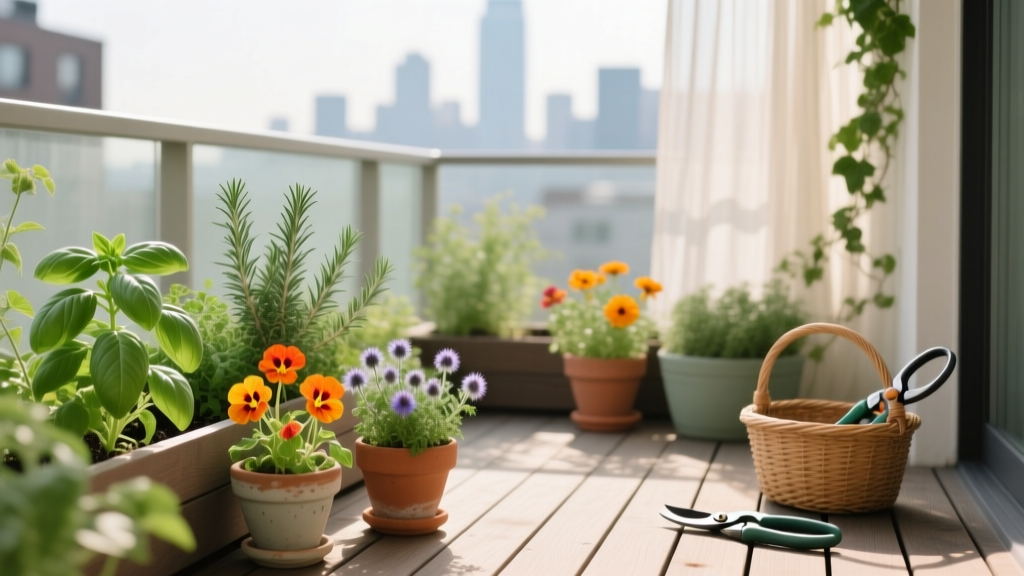
Deck Herb and Edible Flower Garden
The grilling’s almost done, you reach for basil, and realize your “kitchen herbs” are three steps away… inside… in the grocery bag you forgot to unpack. Meanwhile, the deck is right there—sunny, close to the kitchen, and begging to be useful instead of becoming a storage zone for a hose reel and two forgotten planters. A deck herb and edible flower garden fixes that problem fast: it turns a few square feet into fragrance, garnish, pollinator habitat, and the best kind of convenience—snip-and-serve.
I’m going to walk you through a deck layout like I would with a client: starting with how people move through the space, then choosing containers and plants that behave, then building a setup you can maintain without it becoming another chore. You’ll see three real-world layout scenarios (tiny rental balcony, family deck with traffic, and a windy high-rise), plus a plant palette with specific varieties that actually perform in containers.
Start With the Deck’s “Daily Path” (Not the Plant List)
Before you buy a single pot, watch how the deck is used for a day. Most deck gardens fail because pots get placed where feet and chair legs need to go—then everything gets bumped, scorched, or ignored. Your design goal is to keep a clear circulation lane while clustering plants where you’ll interact with them (near the kitchen door, by the grill, beside the outdoor dining spot).
Measure three things: footprint, sunlight, and wind
Grab a tape measure and note: (1) your usable footprint, (2) sun hours, and (3) wind exposure. For a typical project, I’ll sketch a deck rectangle and mark “no-go” zones for doors and furniture movement.
- Minimum clear walkway: 36 inches is comfortable for two people to pass; 30 inches works for a tighter deck lane.
- Sunlight target: 6–8 hours of direct sun grows the broadest herb selection; 4–6 hours supports many herbs plus leafy greens and flowers like violas.
- Wind reality check: On upper decks, wind can dry containers in a day. Plan for heavier pots, grouped containers, and a drip line or self-watering system.
One practical note: most culinary herbs (basil, thyme, oregano, rosemary) prefer full sun, while edible flowers range from sun-lovers (calendula, nasturtium) to flexible performers (violas). Aim to place the sunniest containers closest to the brightest edge of the deck, and reserve shadier corners for chives, mint (contained!), and violas.
Layout Strategies That Feel Designed (Even in Pots)
Think in “stations”: prep, dining, and scent
Instead of scattering pots, create two or three stations. A station is a cluster of 3–7 containers that reads as a single garden moment. This looks intentional and simplifies watering.
- Prep station: near the kitchen door—basil, parsley, chives, thyme, edible flowers for salads.
- Grill station: rosemary, oregano, sage (and a small pot of chile peppers if you like heat).
- Scent station: near seating—lavender, lemon thyme, pineapple sage, and violas for color.
Use vertical space to triple your planting area
Deck gardens shine when you go up. A 6-foot trellis panel can hold climbing nasturtium or compact peas, plus hooks for small pots. Just keep heavy items low and secure anything that could tip.
For renters: a freestanding ladder shelf (about 60–70 inches tall) adds tiers without drilling into railings.
Pick a container system and stick with it
Mixing random pots can look chaotic. Choose a simple system: two sizes in one material, repeated. For most decks, I like:
- One “anchor” size: 16–20 inch diameter pots for rosemary, sage, or mixed herb bowls.
- One “support” size: 10–12 inch pots for thyme, chives, violas, and rotating seasonal flowers.
- One rectangular planter: 24–36 inches long for cut-and-come-again herbs or edible flowers.
Concrete numbers to guide buying: a 20-inch pot typically holds about 8–12 gallons of mix; a 12-inch pot about 3–5 gallons. That volume matters on a deck because it determines how often you water and how stable the pot feels in wind.
A Practical Layout Blueprint (With Dimensions)
Here’s a layout that works on many standard decks without swallowing the whole space. Picture a 10 ft x 12 ft deck with a door on one short side and a grill on the long side.
- Keep a 36-inch walkway from the door to seating.
- Build a 24-inch-deep planting strip along the sunniest rail: this can be three 24-inch rectangular planters or a row of 12–16 inch pots.
- Add one corner “tower”: a ladder shelf or a 48-inch trellis with two anchor pots at the base.
- Reserve one 18–20 inch pot as a seasonal switch-out (spring violas, summer basil, fall calendula).
If your deck gets 6+ hours of sun, put basil and nasturtiums in the rail strip. If it’s closer to 4 hours, move basil to the brightest corner and lean into chives, parsley, mint (in its own pot), and violas.
Plant Selection: Herbs and Edible Flowers That Behave in Containers
The key to container success is selecting plants with compatible water needs and growth habits. Basil wants regular moisture; rosemary hates wet feet. So we design with “dry pot” and “moist pot” groupings.
Reliable culinary herbs (with specific varieties)
- Genovese basil (Ocimum basilicum) — fast, classic flavor, great for repeated pinching. Space 8–10 inches apart in planters.
- ‘Greek’ basil — compact and tidy for small pots; less floppy than large-leaf types.
- Flat-leaf parsley ‘Italian Giant’ — productive and sturdy in partial sun; harvest outer stems weekly.
- Chives (Allium schoenoprasum) — tolerant of 4–6 hours sun, perennial in many climates, edible purple blooms.
- Thyme ‘English’ (Thymus vulgaris) — drought-tolerant; perfect for a “dry pot” with oregano.
- Oregano ‘Greek’ — tough, fragrant, and forgiving; pinch often to prevent legginess.
- Rosemary ‘Arp’ — one of the more cold-tolerant options; best in a 16–20 inch pot with excellent drainage.
- Sage ‘Berggarten’ — broad leaves, compact habit, beautiful in a pot; keep on the drier side.
Edible flowers that earn their space
- Nasturtium ‘Alaska’ — edible leaves and flowers, great for trailing over rail planters; prefers sun and not-too-rich soil.
- Calendula ‘Pacific Beauty’ — sunny orange/yellow petals for salads; handles cooler shoulder seasons well.
- Viola ‘Johnny-Jump-Up’ — compact, charming, and one of the best edible flowers for partial sun; ideal for the front edge of mixed planters.
- Borage (Borago officinalis) — star-blue flowers loved by pollinators; choose one larger pot because it gets sizable.
- Chive blossoms — already on your herb list; you get edible flowers with no extra container.
Safety note: only eat flowers you’ve grown without systemic pesticides, and always confirm the specific species is edible. University Extension programs routinely remind gardeners to avoid consuming ornamental flowers from unknown sources. For example, North Carolina State Extension discusses edible flowers and emphasizes correct identification and pesticide-free growing (NCSU Extension, 2020).
Pair plants by water needs (a designer’s shortcut)
| Container “Zone” | Best Plants | Watering Style | Why It Works on a Deck |
|---|---|---|---|
| Moist Pot (regular water) | Genovese basil, parsley, chives, violas | Water when top 1 inch is dry | High-yield herbs near the kitchen stay tender and productive |
| Dry Pot (sharp drainage) | Rosemary ‘Arp’, thyme, oregano, sage ‘Berggarten’ | Water deeply, then let dry more between | Mediterranean herbs stay flavorful and don’t rot in wet mix |
| Flower-Spiller Pot | Nasturtium ‘Alaska’, calendula, trailing thyme | Moderate; avoid over-fertilizing | Softens hard deck lines and adds color at eye level |
Soil, Drainage, and Containers: The Unsexy Parts That Make It Work
Deck gardens are containers first, plants second. If your drainage and soil structure are wrong, you’ll fight constant wilt, fungus gnats, or root rot.
“Container plants depend entirely on you for water and nutrients—there’s no reserve in the surrounding soil.” — Royal Horticultural Society guidance on container growing (RHS, 2023)
Use a quality potting mix (not garden soil). Plan on roughly 1.5–2 cubic feet of potting mix to fill three 12-inch pots plus one 24-inch rectangular planter (exact amounts vary by pot shape). Add a slow-release organic fertilizer per label directions, or top-dress with compost mid-season.
Drainage detail that matters: choose pots with holes, and lift them slightly with pot feet or risers so water doesn’t stain the deck and roots don’t sit in puddles. If you’re worried about drips, place saucers under pots—but empty them after watering to prevent mosquitoes and soggy soil.
Step-by-Step Setup (One Weekend, No Guesswork)
- Map your zones: mark a 36-inch clear path and identify the sunniest edge for the main planting strip.
- Select containers: aim for at least 2 anchor pots (16–20 inch), 4–6 medium pots (10–12 inch), and 1–2 rectangular planters (24–36 inch).
- Stage the layout dry: place empty pots where they’ll live and test door swing, chair movement, and grill clearance.
- Fill with potting mix: pre-moisten the mix so it hydrates evenly; add fertilizer if you use slow-release.
- Plant by water needs: build a “moist cluster” and a “dry cluster” so you don’t accidentally overwater rosemary.
- Mulch lightly: a 1-inch layer of fine bark or straw reduces evaporation (avoid thick layers that stay soggy).
- Water deeply: water until it runs out the bottom; then recheck after 30 minutes and top up if needed.
- Add labels and a snip tool: keep herb scissors or pruners in a small deck bin so harvesting becomes automatic.
Budget Planning and DIY Alternatives
A realistic starter budget depends on container choices. Here are workable numbers for a well-stocked deck herb and edible flower garden:
- Potting mix: $12–$20 per 2-cu-ft bag; expect 2–4 bags ($24–$80) depending on container count.
- Containers: $15–$35 each for 12–16 inch resin/ceramic; 6 pots can run $90–$210. DIY: food-safe 5-gallon buckets ($5–$8 each) drilled for drainage.
- Plants: $4–$7 per 4-inch herb start; 10 plants = $40–$70. DIY: seeds for calendula/nasturtium often $3–$5 per packet.
- Watering upgrade: A simple drip kit can be $25–$60; DIY: self-watering inserts or olla-style watering spikes.
- Trellis/lift: $20–$45 for a freestanding trellis or ladder shelf; DIY: a recycled pallet leaned and secured (sand well, avoid treated wood near edibles).
If you want the best look for the least money, spend on fewer nicer containers and fill gaps with smaller DIY pots tucked behind. A repeating set of 6–8 matching pots reads more “designed” than 12 mismatched bargains.
Three Real-World Deck Scenarios (With Solutions)
Scenario 1: Tiny rental balcony (6 ft x 8 ft) with strict rules
In small rentals, you’re designing around two constraints: no drilling and limited floor space. Here’s the layout I use most often:
- One 30-inch rectangular planter along the rail (or on the floor against it) with basil spaced 8 inches apart and violas along the front edge.
- Two 12-inch pots by the door: parsley and chives (they handle a bit less sun).
- One vertical ladder shelf in the corner for 3–4 small pots (thyme, oregano, ‘Greek’ basil, calendula).
Maintenance expectation: 15–25 minutes per week plus watering. With smaller soil volumes, you may water every day during heat waves.
Scenario 2: Family deck (10 ft x 12 ft) with traffic, toys, and a grill
This is where circulation design matters. Keep the planting strip on one side and cluster pots in corners so the center stays open.
- Rail strip: three 24-inch planters—one “moist” (basil/parsley), one “flowers” (nasturtium/calendula), one “greens” (more herbs or salad mix).
- Grill-side anchor pot: rosemary ‘Arp’ in a 20-inch pot; it handles heat reflection and smells fantastic when brushed.
- Seating-side scent pot: lavender (if you have sun) or lemon thyme and violas.
Tip from experience: set pots back 6–10 inches from the deck edge of the main walkway so kids and guests don’t clip them with hips and elbows.
Scenario 3: Windy high-rise deck with blazing afternoon sun
High-rise gardening is microclimate gardening. Wind plus sun equals fast dehydration, and lightweight pots can topple. Here’s what works:
- Choose heavier containers (or add weight in the bottom with gravel in a sealed inner liner so drainage isn’t blocked).
- Go bigger on soil volume: favor 16–20 inch pots over 10-inch; they dry out slower.
- Pick tougher plants: thyme, oregano, sage, rosemary, calendula, nasturtium. Basil can work if it’s in a self-watering container.
- Add a drip line if possible: even a basic kit reduces daily stress and keeps growth steady.
For wind protection without construction, use a row of taller, sturdy pots as a “living windbreak,” then tuck smaller pots behind them.
Harvesting and Maintenance: What It Really Takes
A deck herb garden should be a pleasure, not a second job. Plan for 20–40 minutes per week in peak season, plus watering. Watering time depends on heat and container size; in midsummer, some decks need a quick daily check.
Weekly rhythm (simple and effective)
- Pinch basil weekly to keep it bushy (remove the top set above a pair of leaves).
- Snip herbs often: harvesting is pruning; it prevents legginess.
- Deadhead flowers (calendula, violas) to keep blooms coming.
- Check soil moisture with a finger test to the first knuckle (about 1 inch).
Seasonal tasks (so things don’t collapse in August)
- Spring: refresh the top 2 inches of potting mix; plant violas and calendula early if nights are cool.
- Early summer: fertilize lightly (especially basil and parsley) and set up a consistent watering method.
- Midsummer: watch for aphids on nasturtiums and parsley; rinse with a strong water spray.
- Fall: replace heat-loving basil with cool-season violas; harvest rosemary/sage lightly and reduce watering as growth slows.
- Winter (cold climates): move rosemary to a protected spot if possible; many gardeners overwinter it indoors near a bright window.
Edible flowers and herbs also support beneficial insects. Many studies and extension resources emphasize that flowers integrated into edible gardens can increase pollinator visitation and garden resilience. For a practical, research-based overview of pollinator-supportive planting, see Xerces Society resources on pollinator conservation and habitat planning (Xerces Society, 2022).
Troubleshooting the Most Common Deck-Garden Problems
Basil keeps wilting. Usually underwatering or a too-small pot. Move basil to a 12–16 inch container, mulch lightly, and keep it in the “moist pot” group.
Rosemary looks unhappy (yellowing, dropping leaves). Usually overwatering or poor drainage. Ensure the pot drains freely and let the soil dry more between waterings. Avoid pairing rosemary in the same planter as basil.
Flowers bloom once then stop. Deadhead regularly and avoid high-nitrogen fertilizer. Calendula and violas perform best with steady moisture and periodic trimming.
Everything looks cramped by July. That’s normal. Design for a “July haircut”: cut back oregano and thyme by about one-third, and replant a tired basil with a fresh start if needed. Container gardens are allowed to be edited midseason—professional displays are.
When your deck garden is laid out in stations, you’ll feel the difference immediately: you step outside, your hand naturally reaches for the plant you need, and the whole space smells alive. Keep the walkway clear, keep water needs grouped, and let edible flowers spill over edges like they were always meant to live there—right where dinner happens.