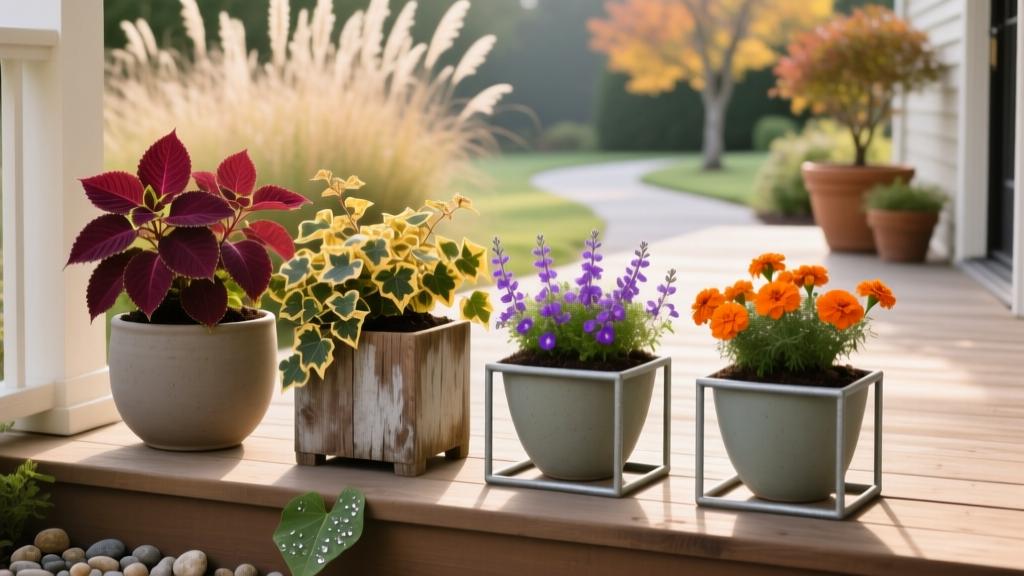
Porch Seasonal Container Recipes
The porch looks fine from the street—until you step onto it. One pot is half-full of tired petunias, another is a mystery shrub you keep watering out of guilt, and the welcome mat is the most vibrant thing in the whole scene. The tricky part isn’t that you “don’t have a garden.” It’s that your porch is a tiny stage with harsh light, drying winds, and a narrow footprint. The fix is not more pots. It’s a plan—and a set of repeatable seasonal container recipes you can swap in like outfits.
Think of this as a designer’s walk-through: we’ll set your porch up with a simple layout, choose containers that fit the circulation space, then plug in plant combinations by season. You’ll get specific varieties, spacing, sunlight targets, and realistic maintenance expectations—plus budget options that don’t look budget.
Start with the porch “floor plan”: circulation first, plants second
Before you buy a single plant, measure. A porch that feels cramped usually has a bottleneck near the door swing or steps. Containers should frame movement, not fight it.
Key dimensions that keep a porch comfortable
Use these practical numbers as guardrails:
- Keep at least 36 inches of clear walking path from steps to door (comfortable for two people passing, or carrying groceries).
- Leave 12–18 inches of clearance beside the doormat so you’re not brushing foliage every time you enter.
- Anchor pots near corners or posts; avoid placing large containers where the door opens (typical door swing needs 30–36 inches of arc clearance).
- For most seasonal mixes, a container with a 12–16 inch diameter is the sweet spot: big enough to hold moisture, small enough to move.
Sunlight reality check (and why it changes your recipe)
Most porch failures are light mismatches. Track sunlight for one day (or use your phone’s compass and observe) and categorize:
- Full sun: 6+ hours direct sun (hot, dries fast; choose heat-tough bloomers and larger pots).
- Part sun/part shade: 3–6 hours (best range for most mixed containers).
- Shade: under 3 hours (lean into foliage, texture, and shade flowers).
If you only remember one principle: match plant vigor to container volume and light. A sun-baked 10-inch pot is a stress test; a shady 16-inch pot is forgiving.
A repeatable layout strategy: the “Frame + Welcome” plan
This is the layout I use for small porches because it reads intentional from the curb and stays functional up close.
1) Frame the entry with a matched pair
Use two similar containers at the top of the steps or flanking the door—14–18 inch diameter is ideal. Matched doesn’t mean identical plants; it means similar height and visual weight.
2) Add one “welcome” pot near seating or railing
Place a single statement pot (16–20 inches) where it’s enjoyed at eye level—near a chair, by the porch post, or at the corner of the railing. This is where you can be bold with color or fragrance.
3) Use one small “bridge” pot only if needed
If the porch feels lopsided, add a smaller container (10–12 inches) to visually connect the pair and the statement pot. Stop at three to five containers total for most porches; more can look cluttered unless the porch is wide.
“A well-designed container relies on a clear structure—thriller, filler, and spiller—to create balance and readability.” — University of Illinois Extension, Container Gardening guidance (2020)
This classic framework isn’t a cliché—it’s a shortcut to proportion. We’ll use it in every seasonal recipe so swapping plants doesn’t require rethinking the whole porch.
Container “hardware”: soil volume, drainage, and wind-proofing
Plants are the decoration; containers are the infrastructure. Get the infrastructure right once, and seasonal change-outs become easy.
Drainage and soil mix that actually holds up
Choose pots with drainage holes. For soil, use a high-quality potting mix (not garden soil). The cost is worth it: a typical 2 cubic foot bag of potting mix often runs $12–$20, and it’s the difference between thriving roots and compacted sludge.
According to the Royal Horticultural Society, container plants need consistent watering and free drainage because pots dry out faster than ground beds (RHS, 2023). That’s why soil texture matters as much as plant choice.
Wind and tip-over prevention
Porches can be wind tunnels. Use these tactics:
- Pick heavier containers for tall “thrillers” (ceramic, concrete, or thick resin).
- Add weight: place a 2–4 inch layer of gravel at the bottom only if the container is very top-heavy (note: don’t do this to “improve drainage” universally; it reduces soil volume).
- For railings, use rail planters with secure brackets rated for 25–30 lbs.
Seasonal container recipes (swap-in designs that stay proportional)
Each recipe below is written like a planting plan: container size, light needs, specific varieties, and spacing so the pot fills in quickly without turning into a thicket.
Spring recipe: “Cool Welcome” (part sun to sun, 12–16 inch pot)
Best for: early spring when nights are still chilly and you want instant cheer.
- Thriller: Pansy (Viola × wittrockiana) ‘Delta Premium Yellow’ — cold-tolerant, bright face color, reliable bloom.
- Filler: Ranunculus ‘Tecolote Mix’ — lush, rose-like blooms that read “designed,” not accidental.
- Spiller: Alyssum (Lobularia maritima) ‘Snow Princess’ — honey fragrance, quick trailing edge.
Spacing: In a 14-inch pot, plant 1 ranunculus in the center, 3 pansies around it, and 2 alyssum near the rim. Expect full coverage in 4–6 weeks in mild weather.
Why it works: Pansies and alyssum handle cool snaps; ranunculus provides that boutique-florist focal point without needing a large shrub.
Summer recipe: “Heat-Proof Color” (full sun, 16–20 inch pot)
Best for: sunny porches that cook by afternoon; low drama, high color.
- Thriller: Canna ‘Tropicanna’ (or ‘Pretoria’ for a softer stripe) — architectural leaves, strong silhouette.
- Filler: Lantana ‘Landmark Citrus’ — heat tolerant, pollinator magnet, doesn’t sulk in drought.
- Spiller: Calibrachoa ‘Superbells Cherry Red’ — nonstop small blooms, excellent edge softener.
Spacing: In a 18-inch pot, use 1 canna, 2 lantana, 3 calibrachoa. Water deeply; in full sun you may need watering 5–7 days per week during heat waves.
Why it works: These plants are built for reflected heat from siding and concrete. The canna gives height without needing a trellis.
Fall recipe: “Porch Harvest” (sun to part shade, 14–18 inch pot)
Best for: crisp evenings and porch lighting; reads festive without looking like a craft store.
- Thriller: Ornamental pepper Capsicum annuum ‘Black Pearl’ — dark foliage, jewel-like peppers.
- Filler: Garden mum Chrysanthemum ‘Ruby Mound’ — dense dome of bloom; choose a tight habit for containers.
- Spiller: Heuchera ‘Caramel’ (coral bells) — warm foliage that lasts beyond blooms; great in part shade.
Spacing: In a 16-inch pot, use 1 ornamental pepper, 1 mum, 2 heuchera. Add mini gourds as removable accents instead of crowding roots.
Why it works: You get texture and color even after the mum peaks. Heuchera carries the pot through temperature swings.
Winter recipe: “Evergreen Lantern” (any light, 16–20 inch pot)
Best for: porches that feel empty after frost; no watering required once frozen.
- Centerpiece: Dwarf Alberta spruce (Picea glauca ‘Conica’) or a bundled evergreen “insert” from a garden center.
- Cut greens: cedar, pine, or fir boughs + red twig dogwood stems for color.
- Accent: weatherproof LED micro-lights (warm white).
Dimensions: Aim for a winter arrangement height of 30–42 inches total (container + greens) so it reads from the sidewalk. Cost is typically $25–$60 per pot depending on greens and lights.
Why it works: Winter containers are about structure, not bloom. An evergreen core gives you a “living” look even in deep winter.
Plant selection: reliable varieties and what they solve
Here are porch-proof plants I reach for repeatedly, with the specific problem they address.
For full sun and reflected heat (6+ hours)
- Salvia ‘Mystic Spires Blue’: upright, tidy, pollinator-friendly; handles heat without constant deadheading.
- Portulaca ‘Mojave’ series: thrives in hot, dry spots; ideal for renters who can’t water midday.
- Sweet potato vine ‘Marguerite’ or ‘Blackie’: fast spiller; instantly softens hard porch lines.
For bright shade or morning sun (under 4–5 hours)
- Begonia ‘Whopper’ series: big impact in shade; performs in humidity and rain.
- Coleus ‘ColorBlaze’ series: color without flowers; great for porches that need boldness.
- Fuchsia ‘Gartenmeister Bonstedt’: hummingbird favorite; strong color in shade.
For windier porches
- Festuca glauca ‘Elijah Blue’: compact grass; doesn’t shred easily.
- Lavender ‘Hidcote’ (sun): sturdy, fragrant, drought-tolerant once established in a roomy pot.
Reference point for watering: The U.S. Environmental Protection Agency notes that outdoor water use can increase significantly in warmer months, and efficient watering practices matter (EPA WaterSense, 2024). Containers are where efficiency is easiest: water the root zone, not the porch floor.
Comparison table: seasonal recipes at a glance
| Season recipe | Best light | Container size | Primary look | Weekly maintenance | Estimated plant cost (per pot) |
|---|---|---|---|---|---|
| Spring “Cool Welcome” | Part sun to sun | 12–16 in | Cheerful blooms + fragrance | 30–45 min | $25–$45 |
| Summer “Heat-Proof Color” | Full sun (6+ hrs) | 16–20 in | Tropical height + nonstop color | 45–60 min | $35–$70 |
| Fall “Porch Harvest” | Sun to part shade | 14–18 in | Warm foliage + seasonal bloom | 30–45 min | $30–$60 |
| Winter “Evergreen Lantern” | Any | 16–20 in | Structure + twinkle | 10–15 min | $25–$60 |
Three real-world porch scenarios (and how I’d design each)
Let’s apply the recipes to realistic constraints, because porches are never “ideal conditions.”
Scenario 1: A renter’s shaded apartment porch (north-facing, 2–3 hours of light)
The problem: Flowers fizzle, and management doesn’t want dripping water over the railing.
The layout: Two 12-inch lightweight resin pots by the door + one 10-inch pot on a plant stand near seating. Add saucers to catch runoff.
Recipe tweak: Swap sun-lovers for shade performers: coleus ‘ColorBlaze Rediculous’ (thriller), begonia ‘Whopper Rose’ (filler), creeping jenny ‘Aurea’ (spiller). These look full with less sun.
Budget move: Buy smaller starts (4-inch pots) and space them tighter for faster fill. Expect $60–$90 total for three containers including soil if you reuse pots.
Scenario 2: A sunny front stoop with no hose access (south-facing, 7–8 hours)
The problem: Everything wilts by 3 p.m., and dragging a watering can daily gets old fast.
The layout: Two substantial 18-inch containers to hold moisture, placed symmetrically at the top step. Skip extra small pots—they dry out too quickly.
Recipe tweak: Use the Summer “Heat-Proof Color,” but swap canna for salvia ‘Mystic Spires Blue’ if you want less height and less tipping risk. Add a 2-gallon watering can and commit to deep watering every other day in peak heat.
DIY upgrade: Add a simple olla-style watering spike or a recycled wine-bottle drip setup for slow release. It won’t replace watering, but it smooths out missed days.
Scenario 3: A narrow porch with one chair and constant foot traffic (36-inch wide walkway)
The problem: Pots become shin-bangers, and you lose the porch’s function.
The layout: One matched pair becomes too tight. Instead, choose one tall statement pot (16-inch) in the far corner, plus a railing planter if allowed.
Recipe tweak: Use the Fall “Porch Harvest” in the corner pot for seasonal impact, and plant the railing planter with trailing ivy or calibrachoa for softness without stealing floor space.
Cost control: A single hero pot can look more expensive than three random small ones. Put money into one great container and reuse it seasonally.
Step-by-step: set up a porch container like a pro (and keep it swappable)
This is the workflow I use so seasonal change-outs take minutes, not hours.
- Measure your clear path and mark container footprints with painter’s tape for a day. Make sure doors open freely.
- Select container sizes based on light: use 16–20 inch pots for full sun, 12–16 inch for shade/part shade.
- Add pot feet or risers (even 1/2 inch lift helps drainage and prevents staining).
- Fill with potting mix to within 1–2 inches of the rim to leave a watering lip.
- Place the “thriller” first (center or slightly off-center), then add fillers, then spillers at the edge.
- Water deeply until it runs out the bottom; this settles soil and removes air pockets.
- Mulch lightly with fine bark or compost (1/2 inch layer) to slow evaporation in summer.
- Fertilize with a slow-release granule at planting time (follow label; many last 8–12 weeks), then supplement with a liquid feed every 2 weeks for heavy bloomers.
Maintenance expectations (real time, real tasks)
Plan for 30–60 minutes per week for three to five containers, depending on heat and plant selection.
Weekly checklist
- Water: Check daily in summer; water when the top 1 inch of mix is dry. Spring/fall often needs 2–4 waterings per week.
- Grooming: Deadhead calibrachoa and lantana lightly; pinch coleus tips for fullness.
- Pest scan: Look under leaves for aphids/spider mites—especially on hot, still porches.
Seasonal tasks that keep containers looking designed
- Spring to summer swap: When nights stay above 50°F (a common warm-season planting threshold), swap cool-season plants for heat-lovers.
- Mid-summer reset: If a pot gets leggy, trim back by 1/3 and fertilize. You’ll often get a fresh flush in two weeks.
- Fall refresh: Replace tired annuals with mums, peppers, and heuchera; keep the same container positions for instant order.
- Winter build: Remove spent plants, keep soil in the pot, and insert greens. If soil level dropped, top up by 2 inches so your arrangement sits high.
Budget planning and DIY alternatives (without sacrificing style)
A porch can look polished on a modest budget if you spend strategically.
Where to spend
- One or two quality containers (often $40–$120 each) that you reuse all year.
- Potting mix and fertilizer—the unglamorous essentials that prevent constant replacement plants.
Where to save
- Use “plug” plants (smaller sizes) for fillers and spillers; they catch up quickly in warm weather.
- Grow one reusable thriller (like dwarf Alberta spruce, rosemary, or a small grass) and change only the fillers/spillers each season.
- DIY risers and fillers: Flip a sturdy plastic pot upside down inside a large container to reduce soil volume for shallow-rooted seasonal displays (still leave enough depth for roots—aim for 8–10 inches of soil above the filler).
If you’re aiming for the most impact per dollar: buy fewer plants but in healthier sizes, and repeat them. Repetition is what makes a porch look intentional, not chaotic.
Once you’ve set your Frame + Welcome layout, seasonal change-outs become a pleasant ritual: spring brightness, summer punch, fall warmth, winter structure—same containers, same footprints, new mood. The porch stops being a place you rush through and becomes a small, reliable garden room that greets you every time you come home.
Sources: Royal Horticultural Society (RHS), “Container gardening” guidance, 2023. U.S. Environmental Protection Agency (EPA) WaterSense, outdoor water use and efficiency resources, 2024. University of Illinois Extension, container design principles (thriller/filler/spiller), 2020.