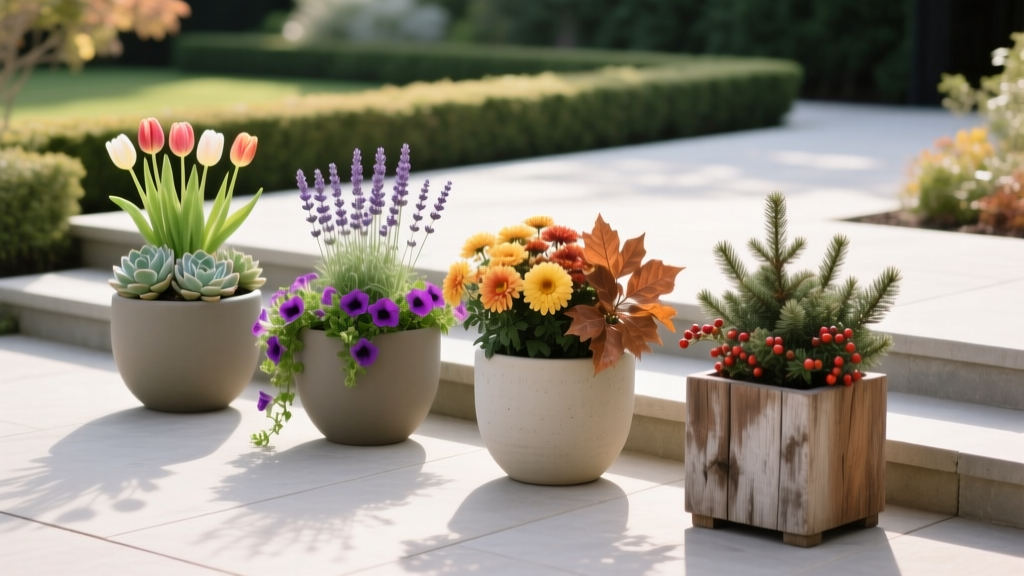
Terrace Four-Season Container Plan
The first cold snap always tells the truth about a terrace garden. One week you’re sipping coffee among basil and petunias; the next, a hard wind rattles empty pots and the view goes flat. If your outdoor space is a terrace—sunny, exposed, and precious in square footage—you don’t need more plants. You need a plan that holds its shape in January, blooms in April, doesn’t melt in August, and still looks intentional in November.
Let’s walk through a four-season container layout the way I’d design it on a site visit: we’ll anchor the edges, protect circulation space, stack heights for privacy and depth, and choose plants that earn their keep across multiple months. The goal is a terrace that feels furnished—like an outdoor room—rather than a collection of random pots.
Design principles that make containers feel like a real garden
Start with a “room” footprint: keep the walkway sacred
Most terraces fail because pots creep into the path. Before you buy a single plant, draw (or tape) your circulation lane. For comfortable movement and carrying a tray outdoors, aim for a clear walkway of 36 inches. If your terrace is tight, 30 inches can work, but anything less starts feeling like an obstacle course.
A practical layout I use often: keep the center open and build planting bands around the perimeter. This makes the space feel larger, improves safety, and gives you a consistent irrigation route.
Think in layers: anchor, midstory, spiller
Containers look lush when they copy natural plant structure:
- Anchor (structure): evergreen shrubs, dwarf conifers, architectural grasses—plants that look good when flowers are gone.
- Midstory (seasonal volume): perennials, compact shrubs, bold foliage plants.
- Spillers (edge softeners): trailing plants that hide pot rims and add movement.
This “layering” isn’t just aesthetics. It stabilizes the design through winter, when your annuals are long gone.
Use repetition to calm the view
On a terrace, the eye sees everything at once. Repetition creates calm. Choose 2–3 container styles max and repeat plant groupings. If you love variety, keep it inside the pots, not in the pots themselves.
Respect light and heat: terraces are microclimates
Terraces act like rooftop deserts: reflected heat, wind, and fast-drying soil. Track sunlight for one day. A simple guideline:
- Full sun: 6–8+ hours direct sun (best for lavender, rosemary, tomatoes, many grasses)
- Part sun/part shade: 3–6 hours (great for hydrangea in some climates, ferns in bright shade, heuchera)
- Shade: under 3 hours (think ferns, hellebores, ivy, some hostas)
Wind matters as much as sun. If you’re above the third floor or you get consistent gusts, prioritize heavier planters (or add weight in the bottom) and flexible plants like grasses rather than brittle-stemmed options.
“Right plant, right place is the most important rule of gardening.” —Royal Horticultural Society (RHS), 2020
Layout strategies for a four-season terrace plan
A simple grid that works: perimeter band + two “doorway” anchors
Picture a typical terrace that’s 12 ft x 8 ft (96 sq ft). Here’s a layout that stays functional:
- Perimeter planting band: 16–20 inches deep along the railing side and one long wall.
- Clear central zone: keep at least 36 inches open as the primary circulation lane.
- Two anchors at the “doorway”: one tall container on each side of the terrace door (or main entry point). This frames the space and instantly makes it feel designed.
Spacing rule: in a line, place medium-to-large containers about 24–30 inches apart center-to-center so plants can mature without forming a crowded hedge that blocks airflow.
Pick container sizes that match plant longevity
Four-season success depends heavily on soil volume. Bigger soil buffers temperature swings and reduces summer watering.
| Container size | Best for | Watering frequency (summer) | Overwintering success |
|---|---|---|---|
| 12–14 inch diameter | Annuals, herbs, bulbs (short-term) | Daily in heat waves | Low for shrubs |
| 16–18 inch diameter | Perennials, compact grasses | 3–5x/week | Moderate |
| 20–24 inch diameter (or 18–24 inch cube) | Dwarf shrubs, small conifers, mixed four-season pots | 2–4x/week | High (with insulation) |
| 30+ inch trough/planter box | Privacy screens, small trees, repeated plantings | 2–3x/week | High |
Budget note: a quality 20–24 inch frost-resistant pot often runs $60–$150 depending on material; a fiberglass trough can be $200–$400. DIY cedar planter boxes (lined) are often $70–$120 in materials for a 36 in x 16 in x 16 in box if you build it yourself.
Build in an irrigation “rhythm”
If you rely solely on hand-watering, design for it. Group thirstier plants together. Put drought-tolerant pots where they’re harder to reach. A basic drip system for 10–15 containers (timer + tubing + emitters) commonly costs $50–$120 and pays you back in healthier plants and fewer missed waterings.
Plant selection: four-season containers that actually earn their space
To keep a terrace looking alive all year, choose plants for structure first, bloom second. Then add seasonal swaps—bulbs in spring, heat lovers in summer, ornamental brassicas in fall—without rebuilding the whole design.
Evergreen anchors (structure all year)
- Buxus microphylla ‘Winter Gem’ (Boxwood): Compact, tolerant of clipping, dependable green structure. Works well in a 20–24 inch pot. Great for paired entry anchors.
- Ilex crenata ‘Sky Pencil’ (Japanese holly): Narrow and upright—excellent where you need height without width. Helps create privacy in tight footprints.
- Thuja occidentalis ‘Mr. Bowling Ball’: A globe form that reads as sculptural year-round and handles wind better than many broadleaf evergreens.
- Pinus mugo ‘Mops’ (Dwarf mugo pine): Tough, winter-hardy, and visually strong; pairs beautifully with spring bulbs and summer salvias.
Why these work: they don’t collapse after flowering, they look intentional in winter, and they tolerate occasional pruning to stay proportional to containers.
Winter interest that isn’t just “green blobs”
- Cornus sericea ‘Arctic Fire’ (Dwarf redtwig dogwood): Bright red stems in winter. Use in a larger pot or trough; prune stems in early spring for best color.
- Carex oshimensis ‘Evergold’: Evergreen-ish sedge in mild climates; luminous striped foliage that reads well from indoors.
- Helleborus x hybridus (Lenten rose): Flowers late winter into spring in many regions; leathery foliage holds well in containers with some shade.
Spring performers (small swaps, big impact)
- Narcissus ‘Thalia’: Elegant white blooms; perennializes in many climates and looks refined in modern pots.
- Tulipa ‘Spring Green’: Green-flamed petals that echo foliage and feel “designer” rather than busy.
- Muscari armeniacum: Reliable, fragrant, and a good underplanting around shrubs.
Plant bulbs closer than in-ground beds for drama: about 2–3 inches apart in containers, layered with potting mix between tiers (a simple “lasagna” method).
Summer backbone (heat-tough, not fussy)
- Salvia nemorosa ‘Caradonna’: Vertical purple spikes, pollinator magnet, and stays neat. Excellent in full sun with 6+ hours of light.
- Nepeta ‘Walker’s Low’ (Catmint): Soft haze of blue flowers, drought-tolerant, forgiving if you miss a watering.
- Pelargonium ‘Calliope Dark Red’ (Geranium): Big color without constant deadheading; holds up to wind better than many petunias.
- Lavandula angustifolia ‘Hidcote’: Fragrant, compact, and a visual bridge between modern and cottage styles.
Fall-to-winter transition (the pots that look good as the light changes)
- Brassica oleracea (Ornamental kale) ‘Redbor’: Rich purple-red foliage that intensifies with cold.
- Heuchera ‘Caramel’ or ‘Obsidian’: Colorful foliage that can carry through shoulder seasons; best in part sun.
- Pennisetum alopecuroides ‘Hameln’ (Dwarf fountain grass): Late-season plumes, beautiful in wind, and adds movement in fall.
For winter containers, add cut evergreen boughs and twig dogwood stems for instant structure. The National Garden Bureau notes that container gardening is highly adaptable for small spaces and seasonal refreshes (National Garden Bureau, 2022).
Three terrace scenarios (real-world layouts you can copy)
Scenario 1: The windy, sunny high-rise terrace (12 ft x 8 ft)
Problem: Pots dry fast, plants snap in wind, and the space feels exposed.
Layout move: Build a wind-tolerant “spine” along the railing using three rectangular planters, each about 36 inches long. Place them 6 inches off the railing for airflow and cleaning access.
Planting recipe:
- Anchors: 2x Ilex crenata ‘Sky Pencil’ (upright screen)
- Midstory: Pennisetum ‘Hameln’ + Salvia ‘Caradonna’ (movement + vertical bloom)
- Spillers: Dichondra ‘Silver Falls’ (wind-tolerant trailing silver)
Practical data: Expect summer watering 4–6 days/week without drip. With drip on a timer, most setups stabilize at 3–4 cycles/week during heat.
Scenario 2: The shaded rental terrace (10 ft x 6 ft) with restrictions
Problem: Low light (2–4 hours of sun), you can’t drill into walls, and you want a lush look without permanent construction.
Layout move: Use lightweight fiberglass or resin planters and create a “green corner” with one tall anchor plus layered shade plants. Keep furniture minimal: a bistro set needs about 30 inches clearance behind chairs.
Planting recipe:
- Anchor: Fatsia japonica (bold tropical look, handles bright shade)
- Midstory: Hellebores + Heuchera ‘Caramel’ for long-season foliage
- Spillers: Hedera helix (ivy) or creeping jenny (check invasiveness locally)
DIY alternative: Instead of a pricey tall planter, use a 18-inch pot inside a larger decorative basket-style cachepot (keep drainage safe with a saucer). It’s renter-friendly and easy to move.
Scenario 3: The family terrace that must stay functional (14 ft x 10 ft)
Problem: You need clear space for kids/pets and you don’t want a “don’t touch” garden.
Layout move: Push all containers to the perimeter and choose sturdy plants that tolerate bumps. Use two large corner pots (24 inches) to visually “hold” the layout so smaller pots don’t look scattered.
Planting recipe:
- Corner anchors: Pinus mugo ‘Mops’ (tough, forgiving)
- Midstory: Nepeta ‘Walker’s Low’ + compact daylilies (robust, repeatable)
- Seasonal color: Pelargoniums in summer; ornamental kale in fall
Safety note: Avoid top-heavy pots near railings if you have high winds or active kids. Wide-based planters are more stable than tall narrow ones.
Step-by-step setup: building the terrace plan in a weekend
- Measure and map. Note terrace dimensions and mark a 36-inch walkway. Identify sun hours (morning vs afternoon sun matters).
- Choose a container palette. Commit to 2–3 finishes (e.g., matte black + natural terracotta). Buy the largest anchors first: plan on at least 2 pots in the 20–24 inch range.
- Set anchors in place. Place tall/evergreen anchors at the entry and corners. Stand inside and check sightlines from your most-used indoor window.
- Add midstory containers. Fill gaps with medium pots (16–18 inch) and repeat plants for cohesion (e.g., three salvias spaced along one edge).
- Soil and drainage. Use a quality potting mix; don’t use garden soil. Keep drainage holes open. If weight is an issue, use lightweight fill (like empty nursery pots) in the bottom third—never gravel, which doesn’t improve drainage in containers.
- Plant and water in. Plant at the same depth as nursery pots. Water until it runs out the bottom. Add mulch (even 1 inch of fine bark) to slow evaporation.
- Install drip (optional but smart). A timer plus drip lines prevents the most common container failure: inconsistent moisture.
- Seasonal top-dressing. Reserve a small budget for swaps: bulbs in fall, annuals in late spring, kale/evergreen cuttings in autumn.
Budget planning (and where to spend vs save)
If you’re building a four-season container terrace, budget like a designer: invest in structure and soil volume; save on seasonal fillers.
- Smart splurge: 2–4 large frost-proof containers ($60–$150 each) + evergreen anchors. These are your “bones.”
- Save: Seasonal annuals and bulbs. A pack of 25 daffodil bulbs can be far cheaper than buying spring bloomers in pots.
- DIY option: Build one 36 x 16 x 16 inch cedar planter for a railing-side screen. Line it with heavy plastic (with drainage holes) to extend life.
Typical cost ranges for a starter four-season terrace (about 8–12 containers):
- Lean build: $250–$500 (more DIY planters, smaller sizes, fewer evergreens)
- Mid-range: $600–$1,200 (quality containers, drip kit, 3–5 woody anchors)
- High-finish: $1,500+ (large fiberglass planters, specimen shrubs, custom troughs)
For guidance on plant hardiness and matching plants to your climate, the USDA Plant Hardiness Zone Map is a practical reference (USDA, 2023). Use it to confirm whether your evergreen anchors can overwinter in containers in your zone.
Maintenance expectations: what it really takes to keep it sharp
A well-designed container terrace isn’t high-maintenance, but it is high-attention. Plan on 30–60 minutes per week during the growing season for watering checks, deadheading, and quick grooming. In peak summer heat, watering can become a 10-minute daily task if you don’t have drip.
Weekly rhythm (growing season)
- Check moisture in each container (finger test down 2 inches).
- Deadhead flowering plants like pelargoniums and salvias as needed.
- Spin pots a quarter turn every 1–2 weeks if plants lean toward light.
Seasonal tasks you can schedule
- Early spring: Cut back grasses; top-dress with compost; refresh mulch.
- Late spring: Swap in heat lovers once nights are consistently above 50°F.
- Mid-summer: Light trim of nepeta after first bloom for a second flush.
- Fall: Add ornamental kale; plant bulbs; reduce fertilizer.
- Winter: Group pots together for insulation, elevate slightly off cold surfaces if possible, and protect tender evergreens from drying winds with burlap if exposed.
A note on overwintering: woody plants in containers experience colder root temperatures than in-ground plants. In cold climates, choose plants rated at least one zone hardier than your local zone for best survival, or be prepared to provide protection (moving pots to a sheltered wall, wrapping containers, or using an unheated garage for the coldest stretches).
When the terrace is designed with structure first, the seasonal changes stop feeling like a teardown. You’ll swap a few plants, tuck in bulbs, refresh a top layer of soil, and the space keeps its identity. The result is a terrace that looks good from the street, from your sofa, and from the seat where you actually live your day-to-day life—January through December.