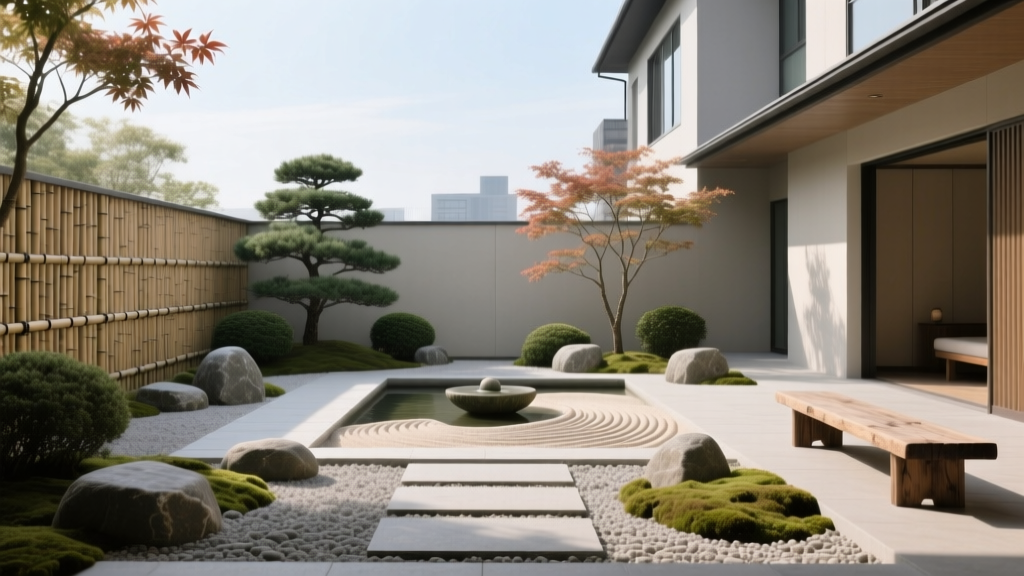
Courtyard Meditation Garden Layout
You step outside with a cup of tea, hoping for five quiet minutes—then the courtyard hits you like a bright, echoing box. Neighbors’ windows look in. The AC unit hums. The paving radiates yesterday’s heat. The space is technically “outdoors,” yet it doesn’t feel restorative. This is the moment a meditation courtyard earns its keep: not by being bigger, but by being arranged so your body relaxes as soon as you cross the threshold.
I’m going to walk you through a courtyard meditation garden layout the way I would on a site visit—starting with how to shape the experience (privacy, sound, and shade), then placing hardscape and plants with real dimensions, and ending with maintenance and budget-friendly swaps. The goal is a space you’ll actually use on a Tuesday, not just admire on a Saturday.
Start with the feeling: a clear “arrival,” a calm “center,” and a soft “edge”
Courtyards are usually small, hard-surfaced, and overlooked. That’s not a dealbreaker; it’s a design brief. A meditation layout works best when it has three zones:
- Arrival zone (transition): a small threshold that signals “slow down.”
- Center zone (practice): a stable seat or platform with breathing room.
- Edge zone (containment): planting or screens that make you feel held, not watched.
Even in a 10 ft x 12 ft courtyard, these zones can exist with smart scaling. If your courtyard is larger—say 14 ft x 18 ft—you can add a looping path for walking meditation without clutter.
Measure first, then design: the “minimum comfortable” dimensions
Before you buy a single pot, grab a tape measure and sketch the courtyard on paper. You’re looking for the minimum clearances that keep meditation comfortable:
- Seated practice pad: plan a 4 ft x 6 ft clear area for a cushion/bench plus a little space to adjust posture.
- Walking path (optional): a loop needs about 30–36 inches wide to feel uncramped.
- Planting depth along walls: even 12–18 inches of depth can support narrow evergreen screening in trough planters.
- Circulation: keep at least 36 inches between the meditation spot and any sharp corners or door swings.
Sun matters too. Most courtyards fall into one of three light patterns: 2–4 hours of direct sun (bright shade), 4–6 hours (part sun), or 6+ hours (full sun). If you don’t know, watch the space for one day and jot down when sunlight hits the floor.
Layout strategy: use asymmetry, not clutter, to quiet the mind
1) Place the seat first (and aim it away from distractions)
Your meditation seat is the “anchor.” Don’t tuck it into the tightest corner unless you love feeling boxed in. Instead, float it slightly off-center so your eyes land on something soft—planting, water, or textured wall—not a drainpipe.
Designer’s rule of thumb: align your gaze with a focal point about 6–10 feet away if possible. That distance is close enough to feel intimate, far enough to prevent visual strain.
2) Build a simple sightline: one focal element, one supporting layer
Courtyards get busy fast. Choose one focal element:
- a wall-mounted fountain,
- a single sculptural shrub in a pot,
- or a lantern-style light with warm color temperature.
Then add one supporting layer: a screen of plants or slats behind it to make it read clearly. This is where meditation gardens differ from entertaining patios—fewer “features,” more intention.
3) Treat the edges like acoustic insulation
Sound is half the battle in a courtyard. While plants won’t magically erase city noise, they do soften harsh reflections when paired with porous materials and moving water. A small fountain can mask intermittent noise by adding consistent sound. Research supports that natural soundscapes and water sounds can improve perceived restoration in urban environments (World Health Organization, 2018).
“Noise affects health and well-being… environmental noise is associated with annoyance, sleep disturbance, and cardiovascular outcomes.” — World Health Organization, Environmental Noise Guidelines for the European Region (2018)
Practical application: break up hard surfaces. If your courtyard is mostly concrete, add a 6 ft x 9 ft outdoor rug (washable polypropylene) under a small bench, or use pea gravel in a contained strip along one side for sound absorption and a softer visual field.
A reliable courtyard meditation layout (with real dimensions)
Here’s a layout that works in many urban courtyards, including rentals:
- Create a threshold: place two tall planters (16–20 inch diameter) near the door, spaced 30–36 inches apart to form a gentle “gate.”
- Set the meditation pad: a 4 ft x 6 ft deck tile platform (interlocking wood composite) or a smooth stone area. Keep 36 inches clear behind it for access.
- Add a focal wall: opposite the seat, mount a compact recirculating water feature about 48 inches high or place a tall ceramic pot with a single statement plant.
- Frame with screening: along the most exposed edge, line up trough planters 36–48 inches long, with plants spaced 12–18 inches apart depending on variety.
- Light for evening practice: use two warm LEDs at 2700K—one low uplight for a plant, one shielded path light to prevent glare.
Cost reality check (ballpark, DIY-friendly): composite deck tiles for a 4 ft x 6 ft area often run $120–$250, two tall planters $80–$200, and a compact recirculating fountain $150–$400. You can do the entire setup for $400 if you thrift planters and skip the fountain, or $1,200+ with premium pots and a higher-end water wall.
Planting that behaves: calm texture, predictable growth, and low litter
Meditation courtyards need plants that don’t constantly shed, spike, or flop into walkways. You want a limited palette: 3–5 plant “roles,” repeated.
Best plant roles for a meditation courtyard
- Evergreen screen: provides visual privacy year-round.
- Soft understory: calming texture at knee height.
- Fragrant accent (used sparingly): a cue for breath and presence.
- Seasonal highlight: one plant that marks time without chaos.
Specific varieties (and why they work)
1) Clumping bamboo (privacy without aggression)
Choose Bambusa multiplex ‘Alphonse Karr’ (warm climates) or Fargesia ‘Rufa’ (cooler climates). Clumping types behave better than running bamboo in containers. In troughs, space plants about 18–24 inches apart. Expect a dense screen in 12–24 months with regular watering.
2) Japanese forest grass for soft movement
Hakonechloa macra ‘Aureola’ thrives in bright shade and gives a gentle, fountain-like texture. Space 18 inches apart in a border or use one specimen in a 14–16 inch pot to keep the look uncluttered.
3) Lavender for sun courtyards (fragrance + pollinators)
In full sun (6+ hours), Lavandula ‘Hidcote’ stays compact and reads as a calming hedge. Space 12–18 inches apart. Keep it away from the meditation seat if fragrance triggers headaches—place it near the threshold so you pass it intentionally.
4) Star jasmine for a living wall (fragrance, evergreen, trainable)
Trachelospermum jasminoides trained on wires or a trellis gives privacy without eating floor space. Plant in a trough 18 inches deep if possible. It prefers part sun but tolerates bright shade once established.
5) Dwarf Japanese maple for a single “presence” plant
In part shade, Acer palmatum ‘Crimson Queen’ (weeping) or ‘Sango-kaku’ (coral bark) can be the one sculptural element—especially effective in a courtyard because the branching reads like living calligraphy. Use a pot at least 20–24 inches wide to buffer root temperature.
6) Herbs that behave in pots (touch and scent without mess)
Try Rosmarinus officinalis ‘Arp’ (upright rosemary) for structure, and Thymus vulgaris (thyme) as a low edging in shallow bowls. Both prefer sun and dry-ish soil.
For renters: stick to containers and trellises that strap to railings or stand free. You can achieve a fully planted look with 6–10 pots if you repeat two pot sizes and keep a restrained palette.
Comparison table: choose the right “privacy layer” for your courtyard
| Privacy Option | Best For | Typical Footprint | Cost Range (USD) | Maintenance |
|---|---|---|---|---|
| Clumping bamboo in trough planters | Fast evergreen screen in containers | Planter depth 18–24 in; width 12–18 in | $250–$900 (planters + plants) | Weekly watering in summer; yearly thinning |
| Wood slat screen + vines (star jasmine) | Privacy with minimal floor-space | Screen depth 2–6 in; planter 18 in deep | $150–$700 | Seasonal tying-in; light pruning |
| Sheer outdoor curtains on a tension rod/pergola | Rentals; quick visual softening | 2–4 in hardware; no soil needed | $40–$220 | Wash seasonally; replace sun-faded fabric |
| Tall evergreen shrubs in pots (boxwood, podocarpus) | Formal look; controlled shapes | Pot 18–24 in wide per plant | $200–$1,000+ | Monthly clipping in growing season |
Three real-world courtyard scenarios (and how I’d solve them)
Scenario 1: The rental courtyard (8 ft x 10 ft) with strict “no digging” rules
In a small rental, the win is a strong center and a soft edge—without permanent changes. I’d use:
- A 4 ft x 4 ft deck tile square as the meditation base (stable, removable).
- Two 18 inch wide planters with clumping bamboo or podocarpus to block the most direct sightline.
- A lightweight trellis panel leaned against the wall (not fastened) with star jasmine in a trough.
- A simple bowl fountain (recirculating) that can be emptied and stored.
Budget: you can keep this around $350–$700 by choosing resin planters and small plants you allow to grow in.
Scenario 2: The sun-baked townhouse courtyard (12 ft x 16 ft) with reflective walls
These courtyards can feel like ovens. The layout move is shade plus cooling texture:
- Hang a shade sail that covers about 40–60% of the courtyard area (angled for drainage).
- Use gravel strips and planted pots to break up paving heat.
- Plant lavender ‘Hidcote’ and rosemary ‘Arp’ for sun-proof structure, plus one small tree (olive in mild climates or a dwarf citrus in a pot).
For watering efficiency, add drip lines to containers. The U.S. Environmental Protection Agency notes that drip irrigation can reduce water use compared with conventional sprinklers by delivering water directly to the root zone (EPA, 2023).
Scenario 3: The shaded courtyard (14 ft x 18 ft) with damp corners and mossy paving
Shade can be deeply meditative if you lean into it—this is where texture and greens shine. I’d avoid plants that demand sun and instead use:
- Hakonechloa ‘Aureola’ for movement.
- Ferns like Dryopteris erythrosora (autumn fern) for structure.
- A dwarf Japanese maple as the focal presence.
In damp corners, improve airflow: pull pots 4–6 inches away from walls and use pot feet so water doesn’t pool under containers.
Step-by-step setup: build it like a designer, not like a shopper
- Map sightlines: stand at the door and mark the most stressful view (neighbor window, bins, utility meter). That becomes your first screening priority.
- Choose your meditation posture: cushion, bench, or chair. Measure your comfortable footprint and add 18 inches on all sides.
- Mark the center with painter’s tape: outline the seat area and a 36 inch circulation route. Live with it for 24 hours.
- Install the ground layer: deck tiles, gravel tray, or outdoor rug. This is what makes the space feel intentional even before plants arrive.
- Add privacy structure: screens/trellis first, then plants. Don’t rely on baby plants to do an adult job on day one.
- Place the focal element: fountain, pot, or sculpture directly in the primary line of sight from the seat.
- Plant in repetitions: pick one screen plant and one soft plant, repeat them. Keep flowering accents to 10–20% of the planting so it stays calm.
- Light last: walk the space at night with a flashlight to decide where light should skim textures (not blast faces).
Budget-smart choices and DIY alternatives (without looking cheap)
A meditation courtyard doesn’t need luxury materials, but it does need consistency. These swaps keep the design cohesive:
- Instead of poured concrete: use interlocking deck tiles for a crisp platform. They’re renter-friendly and replaceable.
- Instead of custom planters: use matching galvanized stock tanks or resin troughs. Paint them matte charcoal to unify the look.
- Instead of a built-in fountain: create a container water feature with a glazed pot, a small pump, and river stones. Expect $60–$180 depending on the vessel.
- Instead of expensive screens: use a freestanding clothesline-style frame with outdoor curtains; add two tall plants behind for depth.
If you’re spending, spend on what you touch and see up close: a comfortable bench, a beautiful pot, or a single specimen plant with presence. The mind relaxes when the “seat zone” feels cared for.
Maintenance expectations: what it takes to keep it serene
A calm courtyard is usually a 30–60 minutes per week garden once established, assuming container plants and a small water feature. Here’s the honest breakdown:
- Weekly (10–30 minutes): check moisture in pots; remove windblown leaves; quick wipe of the meditation platform; top up fountain water in warm weather.
- Monthly (20–45 minutes): light pruning to keep walkways clear; clean fountain pump intake; rotate pots for even growth.
- Seasonally (1–3 hours): refresh mulch in pots; replace tired annuals (if you use any); deep-clean hardscape; assess screening density and shift pots for better coverage.
Container soil typically needs refreshing every 12–24 months depending on plant density. For bamboo or large shrubs, top-dress (remove the top 2–3 inches and replace with fresh mix) rather than fully repotting unless roots are circling aggressively.
Small details that make the space feel meditative (and not just landscaped)
Limit your materials to three: for example, warm wood (deck tiles), matte ceramic (pots), and green planting. Too many finishes make the courtyard feel like a showroom.
Keep one “empty” rectangle: negative space is a design element. That clear 4 ft x 6 ft area is doing psychological work—letting your nervous system downshift.
Use scent as a marker, not a cloud: one pot of thyme near the seat that you can touch intentionally is often better than a whole border of heavy fragrance.
Make privacy diagonal: you rarely need a full wall of screening. Often you only need to block the angle from one window. Move a tall planter 18 inches left or right and you change everything.
When it’s right, the courtyard stops being an exposed utility zone and becomes a small outdoor room that asks less of you. The seat feels obvious. The focal point feels steady. The edges feel soft. And on the days you can only spare three minutes, the layout does what a good meditation teacher does: it gently reduces your options until calm is the easiest one to choose.
Sources: World Health Organization (2018), Environmental Noise Guidelines for the European Region. U.S. Environmental Protection Agency (2023), WaterSense guidance on irrigation efficiency and drip irrigation principles.