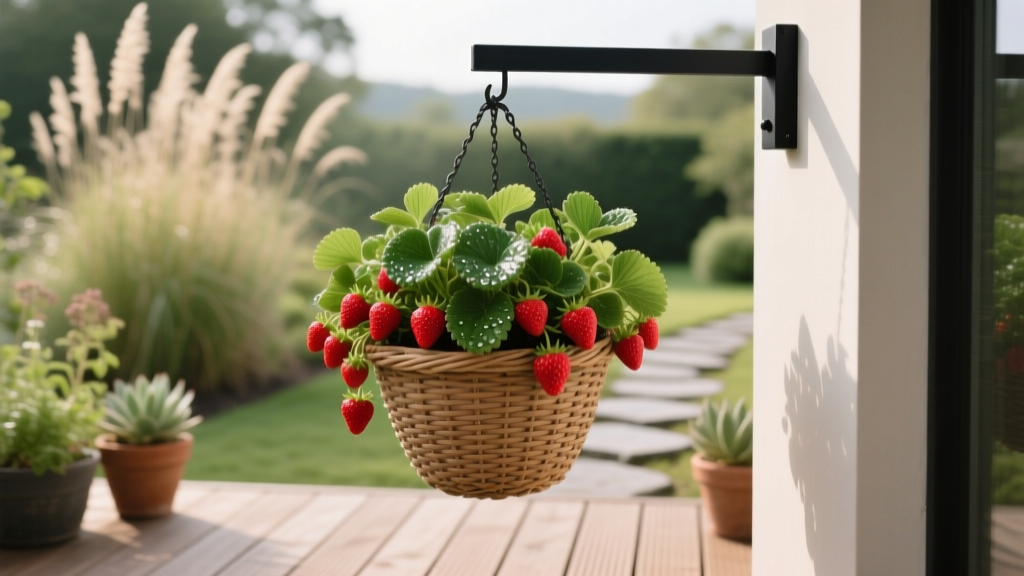
Deck Hanging Basket Strawberry Garden
The deck is perfect—until you notice the “perfect” view is mostly railing, hot boards underfoot, and a neighbor’s fence. You want something lush and edible, but you don’t want to give up your tiny bistro table, and you definitely don’t want a row of heavy pots to trip over every time someone carries out dinner. This is exactly where a hanging-basket strawberry garden shines: it lifts the planting up into the airspace you’re not using, softens the lines of the deck, and puts fruit within arm’s reach.
Think like a landscape designer: we’re going to treat your deck as a room with vertical walls (the railings and posts), a ceiling (the overhead pergola or eaves, if you have them), and a traffic pattern. The strawberries become your “living trim”—a ribbon of foliage and white flowers that happens to hand you dessert.
Start with the deck’s “use zones” (so the garden doesn’t get in your way)
Before you buy a single basket, stand on the deck and map how you actually move. Hanging gardens succeed when they respect circulation—especially on small decks where a 16-inch planter can feel like a boulder.
Layout rule #1: Keep a clear walkway
Aim for a minimum of 36 inches of clear walking space from your door to your seating area. If your deck is narrow (say 5 feet wide), this rule essentially means “hang, don’t place.” Use the railing line or overhead hooks so the floor stays open.
Layout rule #2: Put fruit where you’ll actually pick it
Strawberries are a “frequent harvest” crop. Place baskets along the spots you naturally pause—near the grill, at the stair landing, or beside the table—so picking becomes part of your routine. A basket that’s easy to reach produces more fruit because you’ll pinch runners, water on time, and harvest promptly.
Layout rule #3: Design for sunlight first, décor second
Strawberries are sun-lovers. Plan for 6–8 hours of direct sun for best yields. Many home decks have partial shade from eaves or trees, so choose the brightest side for the strawberries and reserve the shadier rail for herbs or shade-tolerant ornamentals.
Colorado State University Extension notes that strawberries “perform best in full sun,” and also emphasizes the importance of good drainage (CSU Extension, 2020). In hanging baskets, drainage is your insurance policy against root rot.
Design principles that make hanging baskets look intentional (not accidental)
Repeat a container style to create a “rail rhythm”
Pick one basket type and repeat it for cohesion. On a standard 10-foot deck railing, three matching baskets spaced evenly reads as a designed feature; three different baskets reads like a yard sale. If you want variety, vary the plants, not the hardware.
Use the “soft edge” trick: foliage at eye level, fruit below
Strawberries naturally trail. Hang baskets so foliage sits around eye level when you’re seated, and runners can cascade below the rail line. A practical target height: hang hooks so the basket rim is about 54–60 inches above the deck floor. That keeps fruit accessible without bumping heads or blocking views.
Think in layers: structure, spill, and sparkle
A designer’s container formula works beautifully here:
- Structure: the basket shape and the strawberry crown mass
- Spill: trailing runners and leaves
- Sparkle: white blossoms and red fruit
If you want additional color, tuck in one trailing companion per basket (like sweet alyssum), but keep strawberries as the star—overcrowding reduces airflow and increases disease risk.
Choosing baskets, liners, and soil (the build quality matters)
Basket size: don’t undershoot
For strawberries, a 12–14 inch hanging basket is the sweet spot for most decks—big enough to hold moisture, small enough to manage weight. A 14-inch basket typically holds about 3–4 gallons of potting mix, depending on shape. Avoid tiny 10-inch baskets unless you’re committed to daily watering in summer.
Weight check (especially for renters)
When saturated, a planted 14-inch basket can easily reach 20–30 lb. Use hardware rated for at least 40 lb per hook for a safety margin, especially on windy decks.
Soil blend: light, drainy, and consistent
Use a quality potting mix (not garden soil). To reduce watering stress, mix in coconut coir or use a potting mix labeled moisture-control—then add perlite for air space if the mix feels heavy. The goal: moisture that lasts, but roots that never sit in water.
The Royal Horticultural Society advises strawberries do best in fertile, well-drained conditions and are well-suited to containers and hanging baskets (RHS, 2023). Your container soil is the entire root world, so drainage is non-negotiable.
A comparison of strawberry types for hanging baskets
| Type | Best for | Typical fruiting pattern | Runner production | Hanging basket notes |
|---|---|---|---|---|
| June-bearing | Big harvests for freezing/jam | Heavy crop over ~2–3 weeks | High | Great if you want a short, dramatic harvest; runners can make baskets look wild fast. |
| Everbearing | Steady harvest with breaks | Two main flushes (early + late) | Moderate | Good balance of fruit and tidier growth; ideal for small decks. |
| Day-neutral | Continuous snacking | Fruits repeatedly in mild temps | Low to moderate | Often the best “designer” choice: consistent berries without excessive runners. |
Plant selection: specific strawberry varieties that perform in baskets
Hanging baskets are a special environment: wind, faster drying, and more temperature swing. The best varieties here are vigorous, disease-tolerant, and productive over a long window—so your deck stays pretty and edible.
Day-neutral favorites for long harvests
‘Albion’ is a go-to for container gardeners because it’s known for firm fruit and strong production through the season. The berries also hold up well if you’re picking in the evening and serving later.
‘Seascape’ is another container-friendly day-neutral with reliable yields and excellent flavor. In a basket, reliability is everything—one heat wave can stress finicky cultivars.
Everbearing options for a deck that’s used all summer
‘Quinault’ produces large berries and is a classic everbearing choice for home gardens. It’s generous enough that a couple of baskets can give you frequent handfuls.
‘Ozark Beauty’ is widely grown and dependable. It’s not the flashiest, but it’s a workhorse—perfect for a “set it up and enjoy it” deck plan.
One variety chosen for looks as much as taste
‘Tristan’ (ornamental edible) brings deeper pink blooms in some strains and a more ornamental habit—use it where the basket is the focal point near seating. It’s a design-forward choice that still feeds you.
How many plants per basket?
For a 12–14 inch basket, plant 3 strawberry plants spaced evenly. If you cram in 5–6 plants, you’ll get quick foliage but smaller berries and more disease pressure from reduced airflow. Three plants fill in beautifully by midsummer.
Step-by-step: build the deck hanging basket strawberry layout
This is the practical install sequence I use so the project feels calm—not like you’re wrestling potting mix while balancing on a chair.
- Count sun hours. Over one day, note where the deck gets direct sun. Aim to place strawberries where they receive 6–8 hours of sun.
- Mark basket spacing. On a 10-foot rail, place 3 baskets about 30–36 inches apart (center-to-center). This keeps foliage from merging into one damp mass.
- Install rated hooks/brackets. Use hardware rated at least 40 lb per basket. If you’re renting, use rail-hanging bracket hooks designed to clamp or hang over the railing without drilling.
- Prep drainage. Ensure each basket has drainage holes. If using a liner, poke extra holes. Add a thin layer of coarse bark or use a mesh insert to keep soil from washing out (don’t create a “drainage layer” that traps water—just prevent soil loss).
- Fill with potting mix. Fill to within 1 inch of the rim so watering doesn’t spill over constantly.
- Plant 3 strawberries per basket. Keep crowns at soil level—don’t bury them (they rot), don’t leave roots exposed (they dry).
- Water deeply. Water until it runs out the bottom. This settles soil around roots and ensures full saturation.
- Mulch the surface lightly. A thin layer of clean straw or fine bark helps slow evaporation and keeps berries cleaner when they rest on the surface.
- Add a drip option (optional but transformative). If you can, run a simple micro-drip line from a spigot to each basket with adjustable emitters. This turns summer maintenance from daily worry into a routine check.
Three real-world deck scenarios (and the layout that fits)
Scenario 1: The renter’s narrow apartment deck (no drilling allowed)
Space: a 4 ft x 8 ft deck with a metal railing and limited floor space. Goal: edible greenery without clutter.
Layout: two rail-hanging brackets on the sunniest side, each holding a 12-inch basket. Keep them near the corners so the center stays open for a chair.
Planting: day-neutral ‘Seascape’ (steady harvest, manageable runner habit). Plant 3 plants per basket.
DIY alternative: If rail hooks feel unstable, use a freestanding shepherd’s hook in a heavy umbrella base. It costs a bit more upfront but avoids railing stress and keeps the setup movable.
Scenario 2: The family deck with traffic and a grill
Space: a 12 ft x 14 ft deck with a main path from the kitchen to the grill. Goal: strawberries within reach but out of the way.
Layout: line 4 baskets along the “view rail” opposite the traffic path. Space them at 36 inches apart. Add one extra basket near the stair landing for quick picking on the way back inside.
Planting: ‘Albion’ for firm berries that don’t mush if kids pick enthusiastically. If you want a decorative pop, place one ‘Tristan’ basket near seating as the accent.
Practical note: Keep baskets at least 24 inches away from the grill zone to avoid heat blasts and grease buildup on leaves.
Scenario 3: The shaded townhouse deck (sun is limited)
Space: a deck that gets only 4–5 hours of direct sun because of buildings/trees. Goal: still harvest some berries and make the rail look alive.
Layout: concentrate strawberries only in the brightest microclimate—often the outer corner that catches afternoon sun. Use 2 larger 14-inch baskets instead of 4 small ones so roots stay cooler and moisture is steadier.
Planting: choose everbearing types like ‘Ozark Beauty’ or ‘Quinault’ and accept a lighter yield. In the shadier sections, use trailing herbs (mint in its own pot, or oregano) to continue the “soft edge” design without stressing strawberries.
Budget planning (with real numbers)
A hanging strawberry garden can be charming on a shoestring—or polished and permanent. Here’s a realistic cost outline for a 3-basket setup:
- Hanging baskets (3): $8–$20 each = $24–$60
- Strawberry plants (9): $4–$7 each = $36–$63
- Potting mix: 2 bags at $12–$18 = $24–$36
- Hooks/brackets (3): $10–$18 each = $30–$54
- Optional slow-release fertilizer: $8–$15
Estimated total: roughly $122–$228, depending on materials. If you already have baskets or can source plants as bare-root, costs drop quickly.
DIY swaps that still look designed
If you want the “designer” feel without premium pricing:
- Use one basket style. Consistency makes inexpensive materials look intentional.
- Choose smaller plant count, better care. Three healthy plants outperform five stressed plants.
- Make a simple watering aide. A $10 watering wand or a $15 moisture meter can prevent most container failures.
Care and maintenance expectations (so the baskets keep producing)
Hanging baskets reward small, regular attention. Plan for 30–60 minutes per week total for a 3–5 basket setup once established, plus more watering in heat.
Weekly routine (growing season)
- Watering: In mild weather, every 2–3 days; during heat spells, often daily. If temperatures run above 85°F, check moisture every day—baskets dry faster in wind and sun.
- Feeding: Use a slow-release fertilizer at planting, then supplement with a liquid feed every 2–3 weeks if growth slows. Avoid overfeeding nitrogen—it makes leaves, not berries.
- Grooming: Remove yellow leaves and pinch excess runners if baskets look crowded. This improves airflow and keeps the planting looking crisp.
- Harvesting: Pick ripe berries every 1–2 days in peak season. Frequent harvesting reduces pest pressure and keeps plants producing.
Seasonal tasks that matter
- Spring: Refresh the top 2 inches of potting mix, check hooks, and start feeding as growth resumes.
- Summer: Shade baskets temporarily during extreme heat (a simple shade cloth can prevent blossom drop), and stay consistent with watering.
- Fall: Reduce feeding, keep watering as temps cool, and decide whether to overwinter plants.
- Winter (cold climates): Strawberries in containers are more exposed to freeze-thaw cycles. If you’re in a region with hard freezes, move baskets to an unheated garage or tuck them against the house and insulate with burlap. Some gardeners treat basket strawberries as seasonal and replant in spring—often the simplest route for renters.
“In small spaces, vertical planting isn’t just a style choice—it’s a space-planning tool. It preserves circulation while still letting you build a lush edge.” — Susan Morrison, landscape architect (as quoted in discussions of small-space landscape planning; principle widely applied in residential design)
Troubleshooting the most common hanging-basket strawberry issues
Small berries: Usually low sun or inconsistent watering. Aim for 6–8 hours sun and keep moisture steady.
Lots of leaves, few flowers: Too much nitrogen or too much shade. Switch to a bloom-supporting feed and relocate to the brightest rail segment.
Plants drying out daily: Upgrade to a 14-inch basket, add mulch on top, or install drip irrigation. Windbreaks (a lattice panel) can help on exposed decks.
Mold or mushy fruit: Improve airflow by spacing baskets at least 30–36 inches, trim crowded foliage, and harvest frequently. Avoid overhead watering late in the day.
The best part of this project is that it’s flexible. Start with two baskets this season, learn how your deck’s sun and wind behave, then add one more basket next spring where the plants clearly want to thrive. When the railing line fills in and berries start dangling just below the foliage, the deck stops feeling like leftover outdoor space and starts feeling like a room with a living, edible border—one you can snack from while the grill heats up.
Sources: Colorado State University Extension, 2020; Royal Horticultural Society (RHS), 2023.