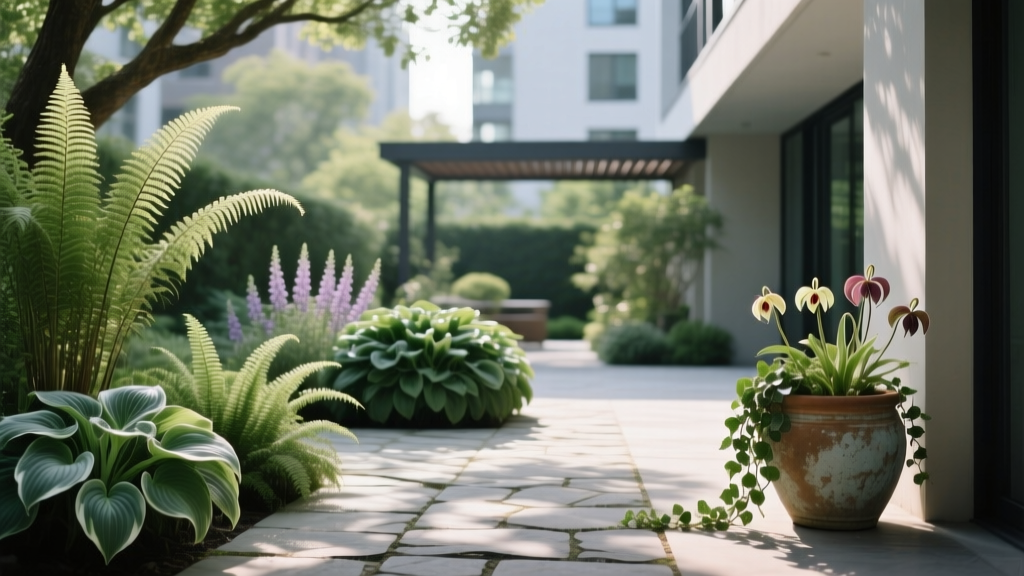
Courtyard Shade Garden Plant List
You step out with a cup of coffee and realize why the courtyard never quite feels “done.” The walls hold the cool air like a cellar. By late morning, the sun slices in for a short time, then disappears behind brick again. Pots dry unevenly. The corner by the downspout stays damp. And the one plant that looked great at the nursery is now sulking—leggy, pale, and refusing to bloom. Shade courtyards can feel tricky, but they’re also some of the most livable garden rooms once you design for the light you actually have, not the light you wish you had.
This is a designer’s approach to building a courtyard shade garden plant list and layout—one that works for homeowners and renters, for tight footprints, and for the weird microclimates created by walls, paving, and reflected heat.
Start With the Courtyard Reality Check: Light, Wind, and Water
Before choosing plants, get specific about conditions. In courtyards, “shade” can mean anything from bright open sky to deep, cave-like dimness. Most successful shade planting is less about “shade plants” and more about matching plants to how much light and what kind of moisture you can provide.
Measure sunlight hours (don’t guess)
On a clear day, check the courtyard at 9 a.m., noon, 3 p.m., and 6 p.m. Note where direct sun hits and for how long. In many courtyards, you’ll find one of these patterns:
- Bright shade: 0–2 hours of direct sun, but open sky overhead (good for hostas, heucheras, ferns).
- Part shade: 2–4 hours of direct sun (many “shade” plants bloom better here).
- Deep shade: Under 1 hour of direct sun plus heavy wall shadow (lean on foliage texture and evergreen structure).
Concrete number to aim for: if your courtyard gets 2–3 hours of direct sun, you can include more flowering perennials; under 1 hour, plan for a foliage-first design.
Know your soil situation: in-ground vs containers
Many courtyards are paved or built over compacted subgrade. If you’re planting in containers, assume you’ll water more and feed lightly. If you have planting beds, plan on improving soil structure—shade beds often sit under eaves, so they’re drier than you’d expect.
As the Royal Horticultural Society notes, improving soil with organic matter helps with moisture retention and structure in shade beds (RHS, 2023). That matters even more in courtyards where rainfall can be blocked by roof overhangs.
Layout Strategies That Make Shade Courtyards Feel Bigger
Shade gardens shine when they’re designed like interior spaces: you want clear circulation, a focal point, and layers that read well from the doorway.
Use the “3-layer” planting system (even in small footprints)
Think in three heights, and you’ll avoid the flat, cluttered look that happens when everything is mid-sized.
- Back/wall layer (36–72 in / 90–180 cm): tall shrubs, espalier, or clumping bamboo (where appropriate) to soften hard walls.
- Mid layer (12–30 in / 30–75 cm): hostas, heucheras, hellebores, Japanese forest grass.
- Front/edge layer (3–12 in / 8–30 cm): sedges, woodland groundcovers, bulbs for early season.
Spacing guideline: for most perennials in shade, plant on 12–18 inch centers (30–45 cm). For larger hostas, step up to 24–30 inches (60–75 cm) so they can mature without constant dividing.
Design for views from indoors (your most common “seat”)
Courtyards are seen from kitchen windows and sliding doors far more than they’re “toured.” Place your best foliage textures—glossy, variegated, or finely cut—where they’re visible from inside. I like a simple rule: put the highest-contrast plant within 6–10 feet of the main viewing door so it reads immediately.
Keep circulation generous—your courtyard isn’t a jungle
For comfort, set a clear walking route of at least 36 inches wide. If space is tight, a 30-inch path can work, but anything narrower starts to feel like squeezing past plants. In a 12 ft x 16 ft courtyard (192 sq ft), that circulation decision determines whether the space reads as a room or a storage area for pots.
Build a focal point that doesn’t require sun
In shade, flowers aren’t always reliable—so create a focal point that holds attention year-round: a water bowl, a pedestal planter, a mirror (protected and angled), or a sculptural container. Even a simple matte-black pot can read as intentional in low light.
“In low light, form and texture do the heavy lifting—broad leaves, fine fronds, and clean shapes are more dependable than blooms.” — A design principle echoed across shade planting guidance from major horticultural institutions, including the Royal Horticultural Society (RHS, 2023).
Step-by-Step Setup: A Practical Courtyard Shade Layout
This sequence keeps you from buying plants first and then trying to “make them fit.”
- Map the courtyard. Sketch the footprint and mark doors, drains, and any permanent utilities. Note wall height if it’s significant (e.g., 8–12 ft walls create deep shadow zones).
- Mark sun windows. Identify where you get 1 hour, 2–3 hours, or 4+ hours of direct sun.
- Choose seating first. Reserve a minimum 5 ft x 5 ft area for a bistro set or bench zone if you want the courtyard to be used daily.
- Define planting zones. Use two or three beds/planter groupings rather than scattered singles. Example: one long wall bed and one corner container cluster.
- Improve soil or potting mix. For beds, incorporate 2–3 inches of compost into the top layer. For containers, use a quality potting mix and top-dress with 1 inch compost annually.
- Install drip irrigation if possible. A simple kit often costs $35–$80 and saves shade plants from stress-drying under eaves.
- Plant big-to-small. Place shrubs and large perennials first, then fill with mid-layer plants, then groundcovers.
- Mulch. Apply 2 inches of fine bark mulch, keeping it off crowns of perennials.
Courtyard Shade Garden Plant List (With Specific Varieties)
The best shade courtyards don’t rely on one “hero” plant; they blend evergreen structure, bold leaves, and a few seasonal bloom moments. The plant list below focuses on reliable performers in bright shade to part shade, with notes where deep shade is acceptable.
Structural shrubs (the “walls within walls”)
Sarcococca confusa (sweet box): Evergreen, glossy, and fragrant in late winter—perfect near a doorway. It tolerates dry shade once established and stays tidy at roughly 4–6 ft.
Fatsia japonica: Large, architectural leaves that read well in low light. Great for the back layer and containers. Give it shelter from harsh wind; courtyards can funnel gusts.
Hydrangea macrophylla ‘Endless Summer’ (part shade): If you have 3–4 hours of sun, hydrangeas can work—especially morning sun. In deeper shade, expect more leaves than blooms.
Mid-layer perennials (where the design happens)
Hosta ‘June’ or ‘Halcyon’: These are consistent, elegant, and bright in shade. ‘Halcyon’ brings blue tones; ‘June’ adds variegation for visibility from indoors. Plant large hostas on 24–30 inch centers.
Heuchera ‘Caramel’ or ‘Obsidian’: Heucheras are color tools—amber, bronze, near-black—use them like paint. They prefer brighter shade and consistent moisture (especially in pots).
Helleborus ‘Ivory Prince’ (Lenten rose): One of the best courtyard plants—evergreen-ish foliage in many climates, late winter to early spring blooms, and it doesn’t mind shade. Space 18–24 inches.
Athyrium niponicum ‘Pictum’ (Japanese painted fern): Silvered fronds glow in dim courtyards. Best in moisture-retentive soil; avoid hot reflected sun.
Hakonechloa macra ‘Aureola’ (Japanese forest grass): Adds movement and a soft edge along paths. It brightens shade and looks expensive even in a small planting. Space 18 inches.
Groundcovers and edging (the finish work that makes it feel designed)
Carex oshimensis ‘Evergold’: A tidy, evergreen sedge for edging and containers. It handles bright shade and looks clean year-round.
Epimedium ‘Frohnleiten’ (barrenwort): Tough in dry shade once established, with spring flowers and good ground coverage. Great under shrubs.
Asarum europaeum (European wild ginger): Glossy, low groundcover for deep shade; slow but steady. Best where you can let it knit without disturbance.
Seasonal accents that earn their keep
Brunnera macrophylla ‘Jack Frost’: Heart-shaped silver leaves that brighten shade. Performs best with 2–3 hours of gentle sun or bright open shade.
Tiarella ‘Spring Symphony’ (foamflower): Soft flowers and excellent foliage texture; good for weaving between hostas and ferns.
Bulbs for shade: Snowdrops (Galanthus), species daffodils, and some alliums can work if you have a spring sun window before trees leaf out (or in courtyards, before adjacent plant growth shades them). Plant bulbs in groups of 7–15 for a natural look.
Comparison Table: Courtyard Shade Workhorses at a Glance
| Plant | Best Light | Typical Spacing | Evergreen? | Why It Works in Courtyards |
|---|---|---|---|---|
| Sarcococca confusa | Shade to part shade | 3–4 ft | Yes | Fragrant winter flowers; glossy leaves brighten dark walls |
| Fatsia japonica | Bright shade | 4–6 ft | Yes (mild climates) | Big architectural leaves; strong structure in low light |
| Hosta ‘Halcyon’ | Shade to part shade | 24–30 in | No | Reliable mound form; blue tone adds depth |
| Helleborus ‘Ivory Prince’ | Shade to part shade | 18–24 in | Semi-evergreen | Late-winter flowers; great near paths and doors |
| Hakonechloa ‘Aureola’ | Bright shade | 18 in | No | Softens edges; adds motion; reads well from indoors |
Three Real-World Courtyard Scenarios (And the Plant Lists That Fit)
Most courtyard shade gardens fall into a few repeatable patterns. Here are three you can steal directly, with adjustments for your exact light hours and container vs in-ground setup.
Scenario 1: The rental courtyard—paved, bright shade, container-only
Space: roughly 8 ft x 12 ft (96 sq ft), surrounded by fences, with 2 hours of morning sun.
Design goal: lush, privacy-friendly, and fully movable at move-out.
Layout move: place 3 large pots (16–20 inch diameter) along the back fence as a “green wall,” then 5–7 medium pots (10–14 inch) layered in front.
Plant picks:
- Back pots: Fatsia japonica (1), Sarcococca confusa (1), Hydrangea ‘Endless Summer’ (1, only if you truly get 3–4 sun hours)
- Mid pots: Hosta ‘June’, Heuchera ‘Caramel’, Brunnera ‘Jack Frost’
- Edge pots: Carex ‘Evergold’, Tiarella
DIY alternative: instead of buying many pots at once, use two 18-inch “anchor” containers and fill the rest with inexpensive nursery cans slipped into simple cachepots.
Scenario 2: The narrow townhouse courtyard—deep shade with a drain corner
Space: 6 ft x 20 ft (120 sq ft), tall walls, under 1 hour of direct sun, one persistently damp corner.
Design goal: calm, evergreen, minimal mess (because it’s a hallway-like space).
Layout move: keep a 30–36 inch clear path and plant a single long bed (or trough planters) on one side only to avoid crowding.
Plant picks:
- Structure: Sarcococca confusa repeated every 4–5 ft for rhythm
- Texture: Athyrium niponicum ‘Pictum’ and Asarum europaeum
- Damp corner: add a moisture-tolerant fern and consider a small 12–16 inch water bowl nearby to make the “wet spot” feel intentional
Practical note: deep shade is where you stop chasing flowers. You’re designing in greens, silvers, and glossy leaf surfaces.
Scenario 3: The family courtyard—part shade, seating-focused, light shifts seasonally
Space: 12 ft x 16 ft, receives 3–4 hours of sun in summer afternoons.
Design goal: comfortable seating with soft planting and a few bloom moments for joy.
Layout move: reserve a 6 ft x 8 ft patio zone for seating, then build two planting masses: one back border and one corner “feature cluster.”
Plant picks:
- Back border: Hydrangea ‘Endless Summer’ (2–3), underplanted with Helleborus and Hakonechloa
- Corner cluster: a tall pot with Fatsia japonica, surrounded by Hosta ‘Halcyon’ and Heuchera ‘Obsidian’ for contrast
- Edges: Carex ‘Evergold’ to keep the outline crisp
Bonus: If kids or pets use the courtyard, avoid fragile groundcovers in the main traffic zone and rely on sedges and grasses along edges.
Budget, Costs, and Smart DIY Swaps
A shade courtyard can be done on a tight budget if you prioritize structure first and let perennials fill in over time. Typical retail pricing varies regionally, but these are realistic planning numbers for many U.S. garden centers:
- 1-gallon perennials (hosta, heuchera, brunnera): $12–$20 each
- 2–3 gallon shrubs (sarcococca, fatsia): $35–$60 each
- Quality 16–20 inch container: $25–$80 each (DIY: reuse food-grade tubs with drainage holes and a decorative wrap)
- Compost: a 1.5 cu ft bag often runs $6–$10
- Drip kit: $35–$80
Example budget for a 96 sq ft rental courtyard (container-heavy): 3 anchor shrubs in large pots (about $180–$360 with containers), 10 perennials/groundcovers ($120–$200), potting mix and compost ($40–$80), optional drip kit ($35–$80). Total range: roughly $375–$720, with the ability to stage purchases across seasons.
DIY alternatives that still look designed:
- Use one “statement” pot and keep the rest simple and matching (uniformity reads intentional).
- Buy smaller sizes and be patient: a 4-inch starter heuchera is cheaper, and in one season it can bulk up surprisingly well in good soil.
- Divide hostas from friends or local plant swaps—hostas are famously shareable.
Maintenance Expectations (So Your Courtyard Doesn’t Become Another Chore)
Shade gardens are often marketed as “low maintenance,” but courtyards add container watering, leaf cleanup, and airflow issues. Plan on 30–60 minutes per week during the growing season, plus seasonal touch-ups.
Weekly rhythm (growing season)
- Watering: containers may need water 2–3 times per week in warm weather; in-ground beds often need deep watering weekly if under eaves.
- Quick grooming: remove yellowing leaves, especially on hostas and hellebores.
- Slug/snail check: courtyards can be slug-friendly—inspect hostas at dusk.
Seasonal tasks
- Late winter: cut back tired hellebore leaves before flowering for a clean display; refresh mulch at 2 inches.
- Spring: top-dress containers with 1 inch compost; divide crowded perennials every 3–5 years.
- Summer: watch for heat stress from reflected light off paving; move sensitive pots 12–24 inches away from hot walls if leaves scorch.
- Fall: clear leaves to prevent crown rot; consider adding a few bulbs for next spring.
For watering efficiency and plant health, it’s worth remembering the broader principle that organic matter improves soil water-holding capacity—a point reiterated by university extension resources, including Penn State Extension’s compost guidance (Penn State Extension, 2022).
Small Design Details That Make Shade Feel Intentional
In shade, small refinements matter more because you don’t have bright blooms distracting the eye.
Repeat two or three plants. Instead of collecting one of everything, repeat Hakonechloa and Carex to create calm, then add a few “accent” plants like heuchera for color punctuation.
Use light-colored hardscape touches. A pale gravel strip, a limestone stepping stone, or even a light bench helps bounce available light. You don’t need to redo the courtyard—sometimes adding a 24-inch square pale paver under a dark pot is enough to lift the whole corner.
Keep plant shapes readable. In deep shade, fine-textured plants can disappear. Pair bold leaves (fatsia, hosta) with fine fronds (ferns) so the contrast is visible from the house.
If you build your courtyard shade garden around measured light hours, clear circulation, and a layered plant list heavy on foliage texture, it stops being the “difficult spot” and starts acting like a cool outdoor room—quiet, green, and restorative. The best part is that shade plants, once settled, often get better every year, filling in and softening edges until the courtyard feels like it has always been that way.