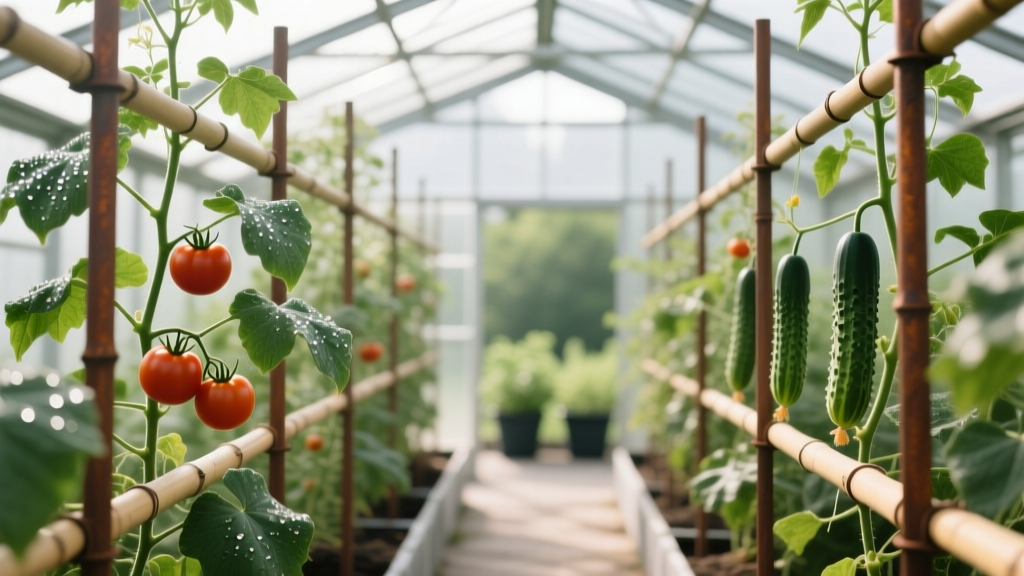
Greenhouse Vine Crop Trellis Design
The first time you notice it, it’s not dramatic—it’s annoying. Your cucumber vine is doing its best impression of a jungle gym, leaning into tomato cages, sliding across the walkway, and knitting itself to the irrigation line. You step inside your greenhouse to pick a few fruits and come out wearing a necklace of tendrils. The space is warm, bright, and full of potential… but without a trellis plan, vines will take every inch you didn’t mean to give them.
Let’s design this like a small, high-performing room: clear paths, vertical surfaces that work hard, and plant choices that match the structure you can actually build. I’ll walk you through trellis layouts that suit real homeowners and renters, including measured dimensions, spacing, costs, and a few “I’ve seen this go wrong” guardrails.
Design principles: treat vines like architecture, not accessories
A greenhouse trellis isn’t just support—it’s the backbone of your workflow. The goal is to lift foliage into light, keep fruit clean, and make watering and harvesting feel effortless. In a tight structure, trellis decisions also decide your airflow, disease pressure, and how often you’ll mutter, “How did it get up there?”
Principle 1: Keep a true service aisle
Before you hang a single string, decide where your body goes. A service aisle that’s 24–30 inches wide is a sweet spot for most home greenhouses: wide enough for a harvest basket and a careful turn, narrow enough to protect planting area. If you’re using a wheelbarrow or a rolling cart, aim for 36 inches.
Layout rule: vines should never cross the aisle. If you can’t resist training a runner across, that’s a sign your trellis belongs in a different orientation.
Principle 2: Put structure where the greenhouse is strongest
Most hobby greenhouses can support light trellis loads, but a fruiting vine can become surprisingly heavy. Put your main anchor points on framing members (not glazing bars) and distribute weight across a ridge beam or multiple rafters.
For renters or anyone avoiding drilling, think in terms of compression (tension poles) and weighted bases rather than screws.
Principle 3: Design for air exchange and leaf-dry time
Dense vine walls trap humidity. If your greenhouse already runs humid, your trellis should encourage vertical “curtains” rather than thick hedges. The U.S. National Institute of Food and Agriculture notes that many plant diseases require leaf wetness and humidity to develop and spread (USDA NIFA, 2023). Faster drying—through spacing, pruning, and airflow—reduces pressure from powdery mildew and blights.
Principle 4: Let the sun dictate height and orientation
Most fruiting vines perform best with 6–8 hours of direct sun (or strong greenhouse light exposure) and benefit from being trained up and away from shaded corners. If your greenhouse has a north wall that stays cooler, that’s often a good spot for greens or tools—not your most vigorous cucumbers.
If your structure is small, use a “high trellis, narrow footprint” strategy: a trellis height of 6–7 feet with a single row keeps foliage in bright upper air and leaves the lower zone open for watering and cleanup.
Three trellis layouts that work in real greenhouse footprints
Below are three layouts I use when designing for tight spaces. The right one depends less on plant dreams and more on how you enter, move, and vent your greenhouse.
Layout A: The single central ridge trellis (cleanest harvest flow)
This layout creates one “vine avenue” down the center, with beds on both sides and a walkway hugging one side (or split aisles if you’re wide enough).
Best for: 6' x 8' to 8' x 12' greenhouses growing cucumbers, indeterminate tomatoes, pole beans.
Core dimensions:
- Central trellis wire or pipe: mounted at 78–84 inches high
- Plant spacing: cucumbers at 12–18 inches, indeterminate tomatoes at 18–24 inches
- Bed depth (each side): 18–24 inches is plenty for trellised vines in amended soil
Design note: keep vines trained straight up and pruned to avoid creating a shaded tunnel. Your goal is a narrow vertical sheet of foliage, not a puffy hedge.
Layout B: The perimeter “green wall” trellis (best for renters and odd shapes)
Think of this as turning the greenhouse walls into productive surfaces. Vines rise along the perimeter, leaving the center open for pots, a small bench, or a movable cart.
Best for: renters, small lean-tos, and greenhouses with strong wall framing.
Core dimensions:
- Wall offset: keep foliage 4–6 inches off glazing to prevent scorching and condensation drip issues
- Walking loop: maintain at least 24 inches clearance inside the perimeter
- Netting panel widths: 24–36 inches per section (easy to remove and replace)
With perimeter training, you get a surprisingly comfortable interior. Your eyes and hands meet fruit at the edges, and the center stays breezy.
Layout C: The overhead grid + drop lines (maximum yield per square foot)
This is the “commercial greenhouse” move scaled down: a simple overhead grid (wire, EMT conduit, or wood slats) with drop strings for each plant. It’s neat, adjustable, and perfect for crops that want single-stem training.
Best for: indeterminate tomatoes, greenhouse cucumbers, melons trained vertically (in strong structures), and anyone who likes tidy systems.
Core dimensions:
- Grid spacing overhead: 12 inches between attachment points
- Drop line: heavy tomato twine or UV-stable cord, 7–9 feet long
- Clip spacing: every 8–12 inches as the vine climbs
“Trellising and training systems are fundamentally about managing light distribution and airflow in the canopy—two of the biggest drivers of fruit quality and disease outcomes.” — Cornell Cooperative Extension greenhouse vegetable guidance (Cornell CCE, 2020)
Materials and cost: from weekend DIY to semi-permanent builds
You don’t need fancy hardware, but you do need materials that tolerate heat, humidity, and constant tension. Here are practical ranges you can budget around (prices vary by region, but these are reasonable planning figures):
- EMT conduit (10 ft length): about $12–$20 each
- Stainless eye bolts / hooks: $1–$3 each
- UV-stable trellis netting (5' x 15'): $10–$25
- Tomato twine spool: $8–$18
- Plant clips (100 pack): $8–$15
If you’re aiming for a solid, long-lived system in a typical 8' x 10' greenhouse, a clean overhead grid plus drop lines often lands around $60–$180 depending on whether you already have fasteners and whether you choose conduit or wood.
DIY alternatives (especially renter-friendly)
If drilling into a frame is off-limits, use compression and weight:
- Tension shower curtain rods or telescoping poles as crossbars (good for light crops like peas or small cucumbers)
- Freestanding A-frames built from 1x2 lumber and joined with bolts (disassembles at move-out)
- Heavy planters as anchors: set two large containers (10–15 gallons) and span a crossbar between them
Pick the right trellis for the crop: a quick comparison
| Trellis System | Best Crops | Space Efficiency | DIY Difficulty | Notes |
|---|---|---|---|---|
| Drop-line strings (overhead grid) | Indeterminate tomatoes, greenhouse cucumbers | Very high | Moderate | Clean canopy control; easiest to prune and harvest |
| Trellis netting panel | Cucumbers, pole beans, peas, small melons | High | Easy | Fast setup; replace netting annually if it degrades |
| Cattle panel / wire panel arch | Beans, cucumbers, vigorous squash (with care) | Medium–High | Moderate | Very strong; can overwhelm small greenhouses if too wide |
| Freestanding A-frame | Cucumbers, peas, lighter vines | Medium | Easy–Moderate | Good for renters; keep aisle clearance in mind |
Plant selection: varieties that behave well on a greenhouse trellis
The best greenhouse vine varieties are the ones that match your trellis height, your pruning tolerance, and your pollination reality (especially if your greenhouse stays closed during bloom).
Greenhouse cucumbers (trellis superstars)
Why they work: naturally climb, love warmth, produce clean fruit when kept off soil, and respond well to single-stem training.
- 'Diva' (parthenocarpic/slice): sets fruit with limited pollination, great for enclosed spaces; steady producer on a string trellis.
- 'Socrates' (greenhouse type): bred for protected cultivation; performs well on drop lines with pruning.
- 'Marketmore 76' (reliable classic): not strictly greenhouse-bred, but vigorous; use if you vent often and can manage pollination access.
Spacing: 12–18 inches between plants on a trellis row. Plan on a mature vine height of 6–7 feet, then “lower and lean” (gently dropping the vine along the row) if you keep them long-season.
Indeterminate tomatoes (the vertical backbone crop)
Why they work: one plant can fill a tall trellis, and training improves airflow and fruit quality.
- 'Sungold': unmatched flavor; vigorous—pair with sturdy strings and consistent pruning.
- 'Trust' (greenhouse hybrid): bred for protected culture; strong truss set under greenhouse conditions.
- 'Brandywine': delicious but leafier and slower; choose only if you have excellent airflow and patience.
Spacing: 18–24 inches on a single-stem trellis. Give tomatoes the brightest zone in the greenhouse: aim for 8+ hours of good light exposure if possible.
Pole beans (fast vertical coverage, light trellis needs)
Why they work: climb quickly, tolerate moderate structure, and harvest is easy on netting.
- 'Kentucky Wonder': vigorous and classic; can shade neighbors if you don’t keep it narrow.
- 'Blue Lake Pole': productive, tidy pods; reliable for small trellises.
Spacing: 6–8 inches if you’re planting a dense bean wall, or 8–12 inches for better airflow.
Small-fruited melons (only if you love maintenance)
Why they can work: with strong trellises and slings, you can grow compact melons vertically.
- 'Minnesota Midget': smaller fruits that are easier to support.
- 'Sugar Baby' (watermelon): possible only with a very sturdy support plan and a warm greenhouse; expect extra training time.
Plan on fruit slings (old t-shirts, mesh bags) and do not exceed what your frame can bear. If you’re not sure, stick to cucumbers and tomatoes first.
Step-by-step: build a clean overhead trellis with drop lines
This is my go-to for a neat greenhouse. It scales up or down and makes pruning feel like a calm routine rather than a wrestling match.
- Measure your interior height at the ridge. If it’s under 7 feet, plan a top wire at 72–78 inches so you still have room to work and vent.
- Mark your planting row and aisle. Commit to a 24–30 inch service aisle with no plants encroaching.
- Install two anchor lines (wire or conduit) running parallel to the row, attached to structural members. If you’re using wire, tension it so it doesn’t sag more than 1 inch when pulled by hand.
- Add cross ties every 24–36 inches to prevent sway (zip ties on conduit, or short wire loops on a wire system).
- Hang drop lines above each plant site at 12–24 inch intervals depending on crop spacing.
- Plant and mulch. Keep the stem base clear; avoid piling compost against stems.
- Train weekly: clip or wrap vines around the string as they grow, adjusting every 3–7 days in peak season.
- Add support slings for heavy fruit (melons) and for tomato clusters if stems strain.
Three real-world scenarios (and the trellis that solves each one)
Scenario 1: A renter with a 6' x 8' lean-to greenhouse and zero drilling
You want food, not a construction project. Use a freestanding A-frame made from 1x2 lumber, joined with bolts so it breaks down at move-out. Place it lengthwise to preserve a 24-inch aisle along one side. Add trellis netting, and grow 'Diva' cucumbers at 14 inches apart plus a short row of 'Blue Lake Pole' beans at the far end.
Budget move: netting ($15), bolts/screws ($10), lumber ($25–$45). Total: roughly $50–$70. If you already have scrap wood, it’s even less.
Scenario 2: A homeowner with an 8' x 12' greenhouse and chronic powdery mildew
This greenhouse grows enthusiastically—and stays humid. The fix isn’t a new spray; it’s airflow and leaf-dry time. Install an overhead grid + drop lines and commit to single-stem training for cucumbers and tomatoes. Keep plants off the walls by 6 inches, prune lower leaves, and maintain a strict canopy width so air can move.
For cucumbers, pick 'Socrates' (protected-culture friendly). For tomatoes, choose 'Trust' or another greenhouse-bred indeterminate for steady truss set. Plan a weekly maintenance rhythm: 45–75 minutes per week for pruning, training, and removing old leaves. It’s less work than fighting disease once it explodes.
One more practical note: the CDC emphasizes that good ventilation reduces concentrations of airborne contaminants in indoor environments (CDC, 2021). While that guidance is for buildings, the same physical reality applies in greenhouses: moving air helps moisture disperse and surfaces dry faster.
Scenario 3: A busy household with kids and a narrow center walkway problem
If your greenhouse is a family passageway, the biggest “pest” is bump damage. Choose the perimeter green wall trellis so plants live at the edges and the center stays open. Use netting panels mounted on stand-offs so foliage remains 4–6 inches from glazing and doesn’t drip condensation onto leaves.
Plant 'Sungold' (one plant can be your summer treat machine) plus a cucumber variety like 'Diva' that doesn’t require heavy pollinator traffic. Place a small harvest hook and scissors near the door so picking doesn’t become a multi-step event.
Maintenance expectations: what it really takes to keep vines tidy
A good trellis reduces labor, but it doesn’t eliminate it. Expect to spend:
- 20–40 minutes per week for light crops (beans, peas) on netting
- 45–90 minutes per week for cucumbers and indeterminate tomatoes (training, pruning, clipping, checking ties)
Weekly tasks (in season): wrap or clip new growth; remove yellowing lower leaves; check tension points; scout for aphids and mites under leaves; keep fruit from resting against glazing (heat spots happen fast).
Seasonal tasks:
- Early spring: sanitize clips if reusing; tighten wires; replace UV-weakened netting; confirm anchors are on structural members.
- Mid-summer: “lower and lean” cucumbers/tomatoes if they hit the top; prune to keep canopy narrow; add extra ties where fruit load increases.
- Fall cleanout: remove vines before they lignify; compost disease-free material; wipe down trellis lines and hardware to reduce carryover pests.
Small design details that make the trellis feel effortless
Use a consistent tie system. If every plant has a different knot, you’ll waste time. Tomato clips or a simple wrap pattern around twine saves minutes every session.
Build in a “tool moment.” Add one hook at shoulder height for pruners and one for twine. That tiny convenience prevents the common mistake of tearing vines because you didn’t have a free hand.
Plan your irrigation with the trellis. Drip lines should run straight and accessible—never buried under a vine mat. If you’re installing a new line, budget $15–$40 for basic drip components and put the main header where you can reach it without stepping into beds.
Respect the top zone. The hottest air pools near the roof; fruit and flowers can abort if heat spikes. Train foliage so it doesn’t plaster the roofline, and keep vents unobstructed.
Simple upgrades if you want a more polished look
If you like your greenhouse to feel like a designed space (not a storage tent with plants), a few upgrades go a long way:
- Painted wood trellis frames (exterior-grade paint) for a crisp, garden-room feel
- Uniform netting panels rather than mismatched strings—especially along perimeter walls
- Dedicated “vine row” labels for pruning notes (date planted, variety, last feed)
The best greenhouse trellis design is the one you’ll happily maintain. Keep the aisle sacred, hang support where the structure is strongest, and match plant choices to your actual time and light. When everything has a place—vines included—you’ll walk in, harvest clean fruit at eye level, and walk out without wearing the garden.
Citations: USDA National Institute of Food and Agriculture (USDA NIFA), 2023; Cornell Cooperative Extension (Cornell CCE), 2020; Centers for Disease Control and Prevention (CDC), 2021.