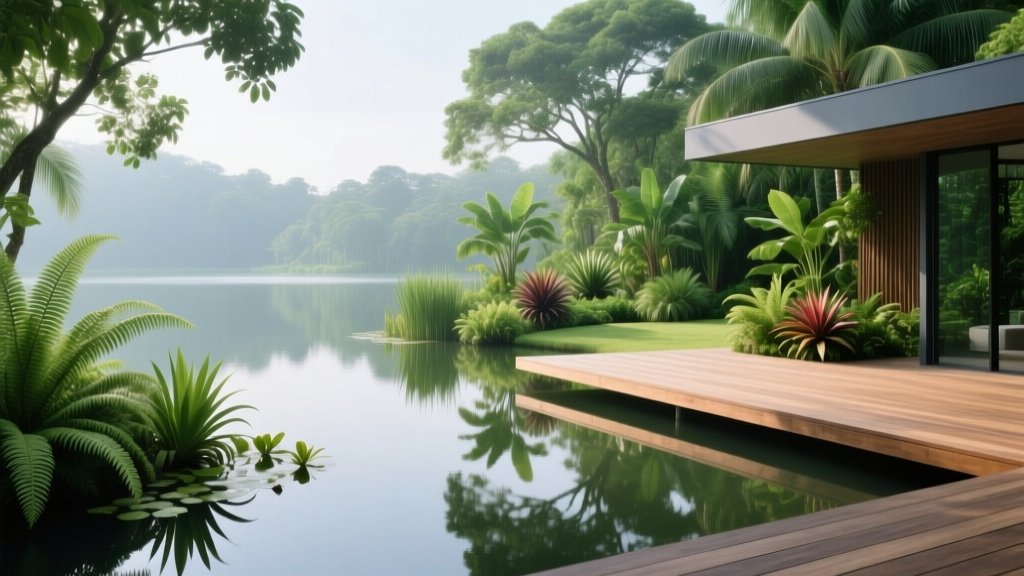
Lakeside Garden Design for Humid Climates
The air is heavy, your shoes sink a little at the shoreline, and the mosquitoes find you before you find your trowel. You want a garden that feels intentional—not a soggy strip of weeds that floods every time the lake level rises or a thunderstorm rolls through. In humid climates, lakeside spaces can be wildly generous (lush growth, long seasons) and brutally unforgiving (fungal pressure, rot, erosion). The good news: with a smart layout and plant palette, you can build a garden that looks composed on day one and still holds together after a July downpour.
Picture this common moment: you’ve planted a few “pretty” perennials near the water, and by August they’re flopped, mildewed, or washed out. The fix isn’t just swapping plants—it’s designing for moisture movement, wind, sun angles, and human habits. Let’s walk through a practical, designer-style plan you can scale to a cottage lot, a rental patio with shoreline access, or a full backyard that runs down to the lake.
Design principles that make humid lakeside gardens work
1) Start with water behavior, not plant shopping
In humid climates, the biggest mistake is treating the lakeside like a normal border. You’re dealing with three water sources: rainfall, groundwater, and occasional high water or wave splash. Before you sketch anything, watch your site during (or right after) a storm. Notice where runoff channels form and where puddles sit for more than 24 hours.
As a rule of thumb, many landscape designers treat any area that stays saturated beyond a day as “wet-foot tolerant only,” because roots need oxygen. If you can’t observe a storm, do a quick infiltration test: dig a hole about 12 inches deep, fill it with water, and see how long it takes to drain. Slow drainage suggests you’ll need plants adapted to wet soil and a layout that slows and spreads water rather than fights it.
2) Build in three shoreline zones (and respect them)
A dependable lakeside layout uses zones so your garden can flex with changing water levels. I like to divide it into:
- Zone A: Wet edge (0–10 feet from typical waterline) — occasional inundation/splash; choose deep-rooted natives and flexible stems.
- Zone B: Moist terrace (10–30 feet) — still humid and rich; best place for ornamental layers and seating edges.
- Zone C: Upland transition (30+ feet) — drier, more “normal garden”; great for paths, storage, and lower-maintenance plantings.
If you’re working with a smaller property, compress the distances—just keep the idea. Even a 20-foot deep strip can have a wet edge, a planted middle, and a clean path line.
3) Plan for airflow to reduce disease pressure
Humidity doesn’t just make you sweat; it feeds fungal issues like powdery mildew and leaf spot. Your layout can cut disease pressure significantly by improving airflow. Two practical tactics:
- Space plants to touch “later,” not at planting. If a shrub matures at 4 feet wide, plant it 4 feet from its neighbor—not 2.
- Create “breezeways.” Leave at least one open corridor 3–4 feet wide aligned with the prevailing breeze off the lake.
For guidance on recommended plant spacing and cultural practices that reduce disease, Cooperative Extension resources are consistently solid. For example, University of Minnesota Extension emphasizes spacing and airflow as key steps to reduce foliar diseases (University of Minnesota Extension, 2020).
4) Use a simple geometry: one path, two layers, and a view frame
Lakeside gardens can look messy fast because everything grows quickly. Keep the bones simple:
- One primary path (straight or gently arcing) at 36–48 inches wide.
- Two main plant layers: a low “shore stabilizer” layer (1–3 feet) and a taller “backdrop” layer (4–8 feet).
- A view frame: intentionally leave a “window” to the water—often 6–10 feet wide—so the lake feels like part of the design.
If you only do one designer move, do this: frame the view. It stops the garden from becoming a green wall and makes even a small space feel planned.
Layout strategies you can build (with dimensions and costs)
A) A shoreline buffer bed that stops erosion and looks ornamental
For many humid lakeside lots, erosion is the quiet problem. Deep-rooted plants and a stable edge reduce soil loss. The NOAA Coastal Services Center notes that vegetated buffers help reduce runoff and erosion while protecting water quality (NOAA, 2021).
Suggested buffer bed dimensions: If you have the room, aim for a planted buffer at least 10 feet deep along the shoreline. On a tight lot, even 6 feet helps—especially if you choose fibrous-rooted grasses and sedges.
Typical cost range:
- DIY with plugs and seed: about $1.50–$4 per plant plug; roughly $150–$500 for a 10' x 30' buffer depending on density and species.
- Nursery gallon pots: often $10–$18 each; the same area can jump to $600–$1,200.
B) A raised “moist terrace” bed for showy perennials without root rot
If your middle zone stays damp, give ornamentals a slight lift. You don’t need a formal retaining wall. A gentle berm 8–12 inches high (tapered at the edges) is often enough to keep crowns from sitting in water.
Soil recipe (by volume): 50% topsoil, 30% compost, 20% pine bark fines. In humid climates, that bark fraction matters—it adds air pockets and reduces compaction.
Budget note: Bulk compost/topsoil delivery varies widely, but a common retail range is $35–$60 per cubic yard. A 12' x 8' berm averaging 10 inches high uses about 2.5 cubic yards (often $90–$150 in material, plus delivery).
C) A clean path that stays walkable after storms
Paths fail at lakesides when they’re built like patio walkways—too flat, too tight, wrong base. Keep it simple and permeable.
- Width: 42 inches is a sweet spot for one person with a watering can or small cart.
- Base: 4 inches of compacted gravel (or decomposed granite if allowed), topped with 2 inches of fines.
- Pitch: Aim for a 2% slope (about 1/4 inch drop per foot) away from structures.
Cost snapshot: A DIY gravel path often lands around $2–$6 per square foot depending on edging and material availability. For a 42-inch x 30-foot path (about 105 sq ft), you’re typically looking at $210–$630 in materials, plus delivery if needed.
Step-by-step setup: a practical build order
This sequence keeps you from planting into chaos and then digging it up for hardscape later.
- Mark your high-water and soggy spots. Use small flags after a rain; note puddles that persist beyond 24 hours.
- Stake the view window. Choose a 6–10 foot wide opening aimed at your favorite water view.
- Lay out the path first. Keep it 36–48 inches wide; set your curve with a hose before you dig.
- Shape the berm (if needed) in the moist terrace. Build up 8–12 inches, feather edges, water it in, and let it settle a few days.
- Plant the shoreline buffer next. Install deep-rooted stabilizers closest to the water and taller plants behind.
- Add ornamental perennials and shrubs on the terrace. Space for airflow; mulch lightly (avoid burying crowns).
- Finish with lighting and seating. Put human comfort where the breeze is best—often 12–20 feet back from the edge.
Plant selection for humid lakeside conditions (specific varieties + why they work)
In humidity, you’re selecting for three traits: tolerance of moist soil, good disease resistance, and structural stems that don’t collapse after rain. Whenever possible, prioritize regionally native plants—especially near the shoreline—to support water quality and wildlife and to handle local extremes.
Zone A (wet edge): flexible, deep-rooted, flood-tolerant plants
Soft rush (Juncus effusus) is a classic for wet edges: it tolerates saturated soil, forms dense clumps that slow runoff, and stays upright. Plant clumps 18–24 inches apart so they knit together over 1–2 seasons.
Tussock sedge (Carex stricta) builds “hummocks,” which create micro-high points for beneficial insects and help stabilize soils. Space at 18 inches for a tight matrix in erosion-prone areas.
Swamp milkweed (Asclepias incarnata ‘Ice Ballet’ or ‘Cinderella’) brings pollinator value and handles moisture better than common milkweed. It’s also a more refined look near patios. Give it 18–24 inches of space and full sun for strongest stems.
Blue flag iris (Iris versicolor) thrives in moist soil and gives early-summer color. It’s a strong candidate where you get 6+ hours of sun; in part shade it blooms less but stays healthy.
Zone B (moist terrace): showy perennials that can take humidity
Virginia sweetspire (Itea virginica ‘Little Henry’) is a designer’s favorite for humid climates: it tolerates wet feet once established, has fragrant white blooms, and offers excellent red fall color. Use it as a low shrub mass along a path, spaced 3 feet apart.
Oakleaf hydrangea (Hydrangea quercifolia ‘Ruby Slippers’) handles humidity better than some bigleaf types and has strong structure. Place it where it gets morning sun and afternoon shade (about 4–6 hours direct light), spaced 4 feet apart for airflow.
Bee balm (Monarda didyma ‘Jacob Cline’) is widely grown because it’s more mildew-resistant than many older cultivars. Still, give it sun and space (18–24 inches) and avoid overhead watering to keep foliage clean.
Switchgrass (Panicum virgatum ‘Northwind’) stands up in storms and humidity, adds movement, and functions like living architecture. Space at 24–30 inches. It’s especially useful as a “soft screen” that doesn’t block all views.
Ferns for part shade: If your terrace gets only 3–4 hours of direct sun, try cinnamon fern (Osmundastrum cinnamomeum) and Christmas fern (Polystichum acrostichoides). They look intentional in drifts and shrug off humidity.
Zone C (upland transition): tidy structure and low-fuss groundcovers
Inkberry holly (Ilex glabra ‘Shamrock’) gives evergreen stability and tolerates damp soils better than many shrubs. Use it to anchor corners or hide utilities, spaced 3–4 feet apart.
Sweetbay magnolia (Magnolia virginiana ‘Moonglow’) is a refined small tree for humid regions with moist soils—great for lightly shading a seating area without turning it into a dark tunnel.
Groundcover option: Creeping jenny (Lysimachia nummularia ‘Aurea’) is tough and bright in moist soils, but use it carefully; in some regions it can spread aggressively. In sensitive lakeside areas, a safer native matrix of sedges is often the better ecological choice.
“The right plant in the right place is the most powerful form of pest prevention—spacing and site conditions matter as much as the plant itself.” — University of Minnesota Extension guidance on managing garden diseases (2020)
Comparison table: good lakeside choices vs. common troublemakers in humidity
| Design goal | Better humid-lakeside pick | Why it works | Common troublemaker | What goes wrong |
|---|---|---|---|---|
| Moist-soil flowers | Asclepias incarnata (‘Ice Ballet’, ‘Cinderella’) | Tolerates wet soil; strong stems; pollinator value | Lavender (Lavandula spp.) | Root rot in humid, damp soils; poor longevity |
| Structural grass | Panicum virgatum ‘Northwind’ | Upright habit; storm-resilient; deep roots | Weak-stem ornamental grasses | Flopping after rain; messy appearance |
| Shade texture | Osmundastrum cinnamomeum (cinnamon fern) | Loves humidity; thrives in moist shade | Plants needing dry shade | Leaf scorch, decline, fungal issues |
| Shrub massing | Itea virginica ‘Little Henry’ | Handles moisture; compact; seasonal interest | Overcrowded roses | Black spot/mildew pressure increases without airflow |
Three real-world layout scenarios (and how to solve them)
Scenario 1: The narrow side-yard path to the dock (rental-friendly)
Space: A 6-foot wide side strip from house to dock, part shade, gets muddy after storms. You can’t dig deeply (rental rules), but you want it to feel cared for.
Design move: Float a permeable path and use containers as “plant islands.” Install a 36-inch wide stepping path using gravel in shallow trays or a thin layer of gravel over landscape fabric (check landlord rules). Add two large containers (at least 18–24 inches wide) with humidity-tolerant plants like dwarf sweetspire or ferns depending on sun.
DIY budget: A modest setup can stay around $150–$400 (fabric, gravel, 2 pots, plants). The biggest win is keeping shoes clean and giving the eye a simple rhythm to follow.
Scenario 2: The sunny lawn-to-lake slope that keeps eroding
Space: A 30-foot long slope, full sun (about 7–8 hours), grass thins and washes out. You want less mowing and more stability.
Design move: Replace the steepest strip with a planted matrix: sedges + switchgrass + seasonal bloomers. Start with a 10-foot deep buffer at the bottom and work uphill. Use jute netting or biodegradable erosion control blanket to hold soil while plants establish.
Planting density: For fast knit-in, install grasses/sedges at about 18 inches on center (roughly 40 plants per 100 sq ft). Add accents (swamp milkweed, iris) in drifts of 3–7 plants for a designed look.
Budget range: Using plugs, you can often stabilize a 10' x 30' strip for $250–$700 depending on species and local pricing. Using gallons pushes it higher but gives immediate presence.
Scenario 3: The social patio near the shore with mildew-prone plantings
Space: A small patio about 12' x 12' near the water; your existing border looks great in June but turns into a mildewed tangle by late summer.
Design move: Open the planting for airflow and choose sturdier performers. Keep the first 3 feet off the patio edge lower (sedges, low sweetspire), then step up to taller plants (oakleaf hydrangea, switchgrass) behind, leaving at least one 4-foot “breezeway” gap aligned with the lake breeze.
Maintenance payoff: This is where thoughtful spacing saves labor. Instead of weekly fungicide frustration, you’ll spend time trimming and deadheading—more pleasant, and generally better for the lake environment.
Sunlight, spacing, and a sample planting plan (you can copy)
If you want a plug-and-play starting point, here’s a balanced plan for a 10' x 20' moist terrace bed that gets 5–6 hours of sun:
- Back row (height 4–6 ft): 3 oakleaf hydrangea ‘Ruby Slippers’ spaced 4 ft apart (staggered)
- Mid layer (2–4 ft): 5 Virginia sweetspire ‘Little Henry’ spaced 3 ft apart
- Accent drifts (2–3 ft): 7 Monarda ‘Jacob Cline’ spaced 2 ft apart (place where sun hits most)
- Matrix/edge (1–3 ft): 10 Juncus or Carex clumps spaced 18–24 in apart along the front curve
Mulch lightly (about 1–2 inches) and keep mulch off plant crowns. In humid climates, thick mulch piles can trap moisture against stems and invite rot.
Maintenance expectations (realistic time and seasonal rhythm)
For a well-designed lakeside garden around 200–400 sq ft, plan on 30–60 minutes per week in the growing season once it’s established. The first year is more hands-on—closer to 60–90 minutes per week—because watering, weeding, and plant monitoring are more frequent.
Weekly tasks (growing season): walk the edge for erosion or washouts, pull small weeds before they root deeply, and do a quick mildew check on susceptible perennials. If you must water, water early morning so leaves dry faster.
Seasonal tasks:
- Spring: cut back grasses and perennials before new growth (often when nights stay above 40°F consistently); topdress compost on berms.
- Summer: deadhead monarda and thin crowded stems to improve airflow; watch for storm damage and stake only if absolutely needed.
- Fall: leave some seedheads and grasses standing for winter structure; remove diseased foliage (don’t compost it if it’s clearly infected).
- Winter: review what flopped, what mildewed, and where runoff cut channels—those are next year’s layout tweaks.
Budget choices and DIY alternatives (without sacrificing the design)
If you’re watching costs, invest in the “bones” first: the path line, the view frame, and a shoreline buffer matrix. You can always add showy perennials later.
- DIY edging: Instead of stone, use steel or composite edging for clean lines—often cheaper and easier to install on curves.
- Buy smaller plants: Plugs and quart pots establish quickly near water because moisture is consistent. You’ll trade instant impact for a better price.
- Divide and share: Many humidity-tolerant perennials (sedges, ferns, sweetspire in time) can be divided after a couple seasons, effectively multiplying your garden.
- Avoid chemical “fixes” as a default: Layout (airflow) and plant choice usually reduce the need for sprays, which is especially important near water.
The most satisfying lakeside gardens in humid climates aren’t the ones that look perfect for two weeks—they’re the ones designed to breathe, flex, and settle into the shoreline. When you let water move where it wants to move, keep a clear path underfoot, and choose plants that enjoy the moisture instead of fearing it, the whole space becomes easier to live with. And that’s the real goal: stepping outside on a humid evening, catching that lake breeze in your “view window,” and feeling like your garden belongs exactly where it is.
Sources: NOAA Coastal Services Center (2021); University of Minnesota Extension (2020).