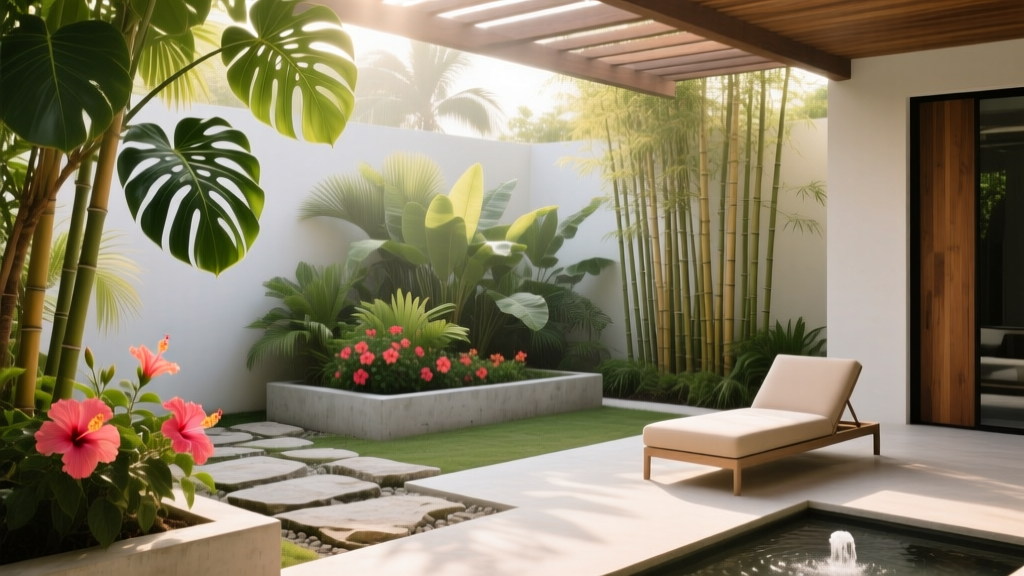
Courtyard Tropical Jungle Vibe Design
The courtyard is only 12 feet by 18 feet, boxed in by fences and a back wall that throws shade like a curtain. The patio feels a little loud—hard surfaces, reflected heat, neighbors close enough to hear a spoon clink. You want lush privacy, soft movement, and that “jungle” feeling you get in a conservatory: layered leaves, humidity, scent, and a winding path that makes a small space feel bigger. The trick is making it look abundant without turning it into a cramped plant hospital.
Let’s design it the way a landscape designer would: start with structure and circulation, build a canopy and understory, then finish with lighting, irrigation, and maintenance you can actually keep up with.
Design Principles That Create a Jungle Feeling (Even in a Small Courtyard)
1) Layering: canopy, mid-story, groundcover
A tropical “jungle” reads as jungle because your eye moves through layers. In a courtyard, you can fake a canopy with tall, narrow plants in corners (clumping bamboo, dwarf palms, columnar evergreens), then use big-leaf mid-story plants at eye level (philodendrons, fatsia, gingers), and finally groundcovers and pots that spill over the edges (fern, dichondra, mondo grass).
Plan on at least 3 layers in every sightline. If you can stand at your back door and see plain fence for more than 18 inches at any point, add a layer there—trellis, tall pot, or a hanging element.
2) The “edge-to-center” rule: keep the middle breathable
A common mistake is packing plants everywhere, then realizing you’ve created a damp, dark maze that’s hard to water. A jungle vibe still needs airflow. Keep the center open for a small path or stepping stones, and pack plants along the perimeter where they visually “erase” boundaries.
As a baseline layout in a 12' x 18' courtyard, aim for:
- 2.5–3 feet clear walking route (minimum) from door to seating.
- 18–24 inches planting depth along at least two walls using raised planters or large containers.
- A seating pad around 6' x 6' (bistro set) or 7' x 9' (two lounge chairs + side table).
3) Borrowed shade and controlled sun
Most courtyard tropicals prefer bright indirect light or morning sun. Track your light for a weekend: count the hours of direct sun hitting the ground plane. If you get 2–4 hours (especially morning), your plant palette opens up dramatically. If you get 0–2 hours, lean into shade-tolerant “tropical-look” plants (fatsia, ferns, cast iron plant, hardy schefflera in mild climates).
For reference, the RHS notes that Fatsia japonica thrives in shade and is suited to sheltered spots (Royal Horticultural Society plant profile, 2024). That’s gold for courtyards.
4) Texture beats flowers for jungle realism
In tight spaces, flowers can feel spotty. Texture reads from a distance and makes the courtyard immersive. Mix:
- Large, glossy leaves (philodendron, fatsia)
- Feathery fronds (Boston fern, tree fern where climate allows)
- Vertical blades (carex, dwarf bamboo)
- Architectural spikes (cordyline, bromeliads in pots)
Layout Strategies: Three Proven Courtyard Plans
Plan A: The Perimeter Jungle + Central Clearing
Best for: renters, anyone who needs access to drains, hose bibs, or doors. This is also the easiest to maintain.
Layout: Line two long sides with containers/raised troughs; build corners tall; keep the center as gravel, decking, or large pavers.
- Use 3 corner “anchors” (tall plants 5–10 gallon pots).
- Add a 12–18 inch wide trellis strip on the brightest wall for climbers.
- Run a simple dripline along the perimeter so you water once, not pot-by-pot.
Plan B: The Winding Path Illusion
Best for: long, narrow courtyards (like 8' x 20') where you want it to feel wider.
Layout: A stepping-stone path that gently arcs, with plants “pinching” the path at two points to force a slow walk and create discovery.
Keep pinch points at 36 inches wide (still comfortable), and widen the path to 48 inches near seating. Use low uplights at the pinch points—your eyes follow light, and the space feels intentionally designed.
Plan C: The Mini-Canopy Courtyard (for privacy)
Best for: overlooked courtyards. If upstairs windows stare into your space, you need vertical screening fast.
Layout: Two tall, narrow “canopy” plants in large pots (20–24 inch diameter), a pergola panel or overhead sail, and mid-story plants that fill gaps.
Think of it like a living room ceiling: you’re creating a green “lid” so you feel enclosed without building walls.
Step-by-Step Setup: Build the Jungle Without Chaos
- Measure and sketch. Mark doors, drains, and any utility access. On a 12' x 18' courtyard, reserve a 36-inch access path to every functional point.
- Track sun for two days. Note direct sun hours on the ground and on the brightest wall. Write it down: “Wall A = 3 hours morning sun” is design-changing information.
- Choose a layout plan (A, B, or C). Commit before buying plants. Plants are easier to swap than hardscape.
- Install the “bones” first. Planters, trellis, privacy screens, and a seating pad. If you’re on a budget, use stock tanks, food-grade barrels cut in half, or modular decking tiles.
- Run irrigation. A basic drip kit can cost around $35–$80 depending on courtyard size; add a battery timer for about $30–$60. Even hand-waterers love drip once summer hits.
- Place tall anchors. Corners first, then against the longest blank wall. Step back and check sightlines.
- Add mid-story mass. Repeat 2–3 plant types for cohesion (for example: fatsia + philodendron + ferns).
- Finish with groundcovers and “spill.” Trailing plants at pot edges create instant maturity.
- Mulch and top-dress. Use 1–2 inches of fine bark or coco coir in pots to reduce evaporation and give a forest-floor look.
Plant Selection: Specific Varieties That Sell the Tropical Illusion
True tropicals can be fussy in temperate climates, so I like a mix: some genuine tropicals for drama (often in pots you can move), plus hardy “tropical-look” plants for reliability. Spacing matters: overcrowding causes mildew and pests, especially in sheltered courtyards.
Canopy & tall screens (privacy + height)
- Fargesia robusta ‘Campbell’ (clumping bamboo): upright, non-running, excellent screening. Space pots or plants about 3–4 feet apart for a continuous wall of green. Works best with 3–6 hours bright light.
- Trachycarpus fortunei (windmill palm): hardy in many temperate regions, strong tropical silhouette. One specimen in a 24-inch pot becomes an instant focal point.
- Cordyline australis ‘Red Star’: spiky, architectural, reads “resort.” Give it 4+ hours sun if possible; in shade it stays looser and greener.
Mid-story big-leaf (the jungle heart)
- Fatsia japonica: glossy palmate leaves, thrives in shade, handles courtyard shelter. Plant or pot at 3 feet spacing; it needs elbow room to look lush rather than cramped.
- Philodendron ‘Xanadu’ (now often sold as Thaumatophyllum): dense, tropical form, great in containers with bright shade. Space about 2.5–3 feet.
- Canna ‘Tropicanna’: if you have sun (4–6 hours), cannas bring color and height. Use as seasonal drama in pots; feed monthly in summer.
Understory & ground layer (softness, fullness, “forest floor”)
- Nephrolepis exaltata (Boston fern): classic humidity lover; looks incredible spilling from raised planters. Keep soil evenly moist.
- Hakonechloa macra ‘Aureola’ (Japanese forest grass): not tropical, but the movement is perfect for a jungle vibe in shade. Space 18 inches.
- Ophiopogon planiscapus ‘Nigrescens’ (black mondo grass): dark contrast makes greens look greener; great for edging pots. Space 6–8 inches for a tight band.
Climbers and vertical green (to erase walls)
- Trachelospermum jasminoides (star jasmine): evergreen, fragrant, excellent on trellis; likes sun to part shade. Tie in young growth every 2–3 weeks in the growing season.
- Monstera deliciosa (container + support): in warm climates or indoors/outdoors seasonal patios, it’s the poster child of jungle style. Give a moss pole and bright indirect light.
“In small gardens, it’s often more effective to increase planting density at the boundaries and keep a clear central route—this strengthens enclosure without sacrificing usability.” — John Wyer, garden designer, discussed in relation to spatial structure in small gardens (RHS guidance and designer commentary, 2020)
For a practical, research-backed note on microclimates: courtyards can trap heat and reduce wind, altering plant performance compared to open gardens. The U.S. National Park Service explains that built surfaces and shelter change temperature and moisture patterns in microclimates (NPS, 2023). That’s why a plant that “needs sun” in a windy yard may tolerate brighter shade in a warm courtyard.
Comparison Table: Best Plants by Light and Maintenance
| Plant | Best Light | Typical Spacing | Container-Friendly? | Maintenance Level |
|---|---|---|---|---|
| Fatsia japonica | Shade to part shade (0–3 hrs sun) | 3 ft | Yes (large pot) | Low (prune once/year) |
| Fargesia robusta ‘Campbell’ | Part shade to sun (3–6 hrs) | 3–4 ft | Yes (big pot) | Medium (water + tidy canes) |
| Boston fern | Bright shade (0–2 hrs) | 18–24 in | Yes | Medium (consistent moisture) |
| Star jasmine | Part sun (3–6 hrs) | 18–24 in along trellis | Yes | Medium (training + trimming) |
| Canna ‘Tropicanna’ | Sun (4–8 hrs) | 18–24 in | Yes | High (feed, deadhead, winter care) |
Three Real-World Courtyard Scenarios (and What Actually Works)
Scenario 1: The shaded rental courtyard (10' x 14', 1 hour sun)
Goal: privacy and lushness without permanent changes.
Move: Use Plan A (perimeter jungle). Place two tall screening plants in 20-inch pots (clumping bamboo if allowed, or tall evergreen shrubs), then mass shade performers: fatsia, ferns, hakonechloa.
DIY alternative: Instead of built planters, use a row of inexpensive nursery tubs slipped into woven baskets. Add a tension-rod trellis panel so you don’t drill into walls.
Budget snapshot: You can get a convincing look with $350–$700 if you buy smaller plants (1–2 gallon), reuse containers, and focus spending on just two tall anchors.
Scenario 2: The sunny, heat-trap courtyard (12' x 18', 6 hours sun, reflective paving)
Goal: resort-like jungle with bold color, but plants can scorch.
Move: Use Plan C (mini-canopy). Add a shade sail to cut midday sun by positioning it over seating and the most sensitive plants. In pots, use cannas, cordylines, palms, and tough glossy-leaf plants. Underplant with black mondo and trailing sweet potato vine for contrast.
Hard numbers that matter: In heat-trap courtyards, containers can need watering 3–5 times per week in peak summer unless you install drip. Aim for pot sizes 18–24 inches wide for anything tall; smaller pots overheat and tip.
Scenario 3: The narrow pass-through courtyard (8' x 20', 3 hours morning sun)
Goal: keep it functional as a walkway but make it feel like a hidden garden.
Move: Use Plan B (winding path illusion). Shift the path slightly off-center with two “pinch points” planted up in troughs. Add a slim wall trellis with star jasmine so the fence disappears by year two.
Spacing rule: Keep troughs at 15–18 inches deep so roots have volume, and don’t let the pinch points go under 36 inches wide—moving furniture through becomes a headache.
Costs, Priorities, and Smart Places to Spend
If you want the jungle feeling fast, spend on height and repetition, not rare plants. Here’s a practical cost breakdown for a mid-range courtyard makeover:
- Large containers (4–6 pieces): $40–$120 each depending on material and size.
- Soil + amendments: $80–$160 for a courtyard’s worth of potting mix, compost, and drainage material.
- Anchor plants (2–3 specimens): $60–$180 each depending on size (palms and bamboo cost more at maturity).
- Mid-layer plants (8–14 plants): $12–$35 each (fatsia, ferns, grasses).
- Lighting: $25–$60 per uplight; even 2 lights can transform nighttime atmosphere.
DIY alternatives that still look designed:
- Use cedar fence boards to clad basic plastic pots into sleek cubes.
- Make a trellis from galvanized wire mesh stapled to a simple frame; paint it matte black so leaves pop.
- Top-dress pots with coco chips or fine bark for a uniform “rainforest floor” finish.
Maintenance Expectations: What You’re Signing Up For
A courtyard jungle should feel relaxing, not like a second job. With drip irrigation and smart plant choices, expect about 30–60 minutes per week from spring through early fall, and 10–20 minutes per week in cooler months (mostly cleanup).
Weekly rhythm (growing season)
- Water check: 10 minutes (even with drip, check one pot per zone).
- Grooming: 10–20 minutes (remove yellow leaves, tidy ferns, guide climbers).
- Pest scan: 5 minutes (look for scale on fatsia, spider mites on stressed plants).
Seasonal tasks
- Spring: refresh top 1–2 inches of potting mix, slow-release fertilizer, check trellis ties.
- Summer: increase watering frequency; feed cannas and heavy feeders every 4 weeks.
- Autumn: trim and thin for airflow; bring tender plants closer to walls for warmth.
- Winter: reduce watering; protect pots from saturation and cold snaps (pot feet + fleece wraps if needed).
If you want a low-maintenance jungle look, favor fatsia, clumping bamboo, star jasmine, hakonechloa, and tough evergreens—and treat truly tropical showpieces as movable accents in containers.
Small Details That Make It Feel Like a Jungle (Not Just “Lots of Plants”)
Sound: Add a small bubbling fountain. Even a tabletop recirculating feature masks neighbor noise. Place it within 6–10 feet of seating so you actually hear it.
Light: Use warm uplighting (around 2700K if you’re choosing bulbs) aimed through leaves, not at fences. Two uplights set 12–18 inches from a fatsia or bamboo clump creates shadow play that reads “rainforest” at night.
Scent: Star jasmine near the door or seating gives you a tropical evening payoff. Keep it on the sunniest wall for best bloom.
Humidity hack: Cluster pots and use saucers with gravel (where appropriate) to slightly raise local humidity around ferns—especially helpful in dry climates. Just avoid standing water against walls.
Once your anchors are in and the mid-layer is repeating, the courtyard stops feeling like a rectangle and starts feeling like a place. You’ll notice the shift when you sit down and the boundary lines disappear—fence becomes backdrop, hard surfaces fade under foliage, and the air feels quieter. That’s the courtyard jungle vibe done right: immersive, practical, and designed to thrive in the exact conditions you have.
Sources: Royal Horticultural Society (RHS) plant guidance on Fatsia japonica suitability and shade performance (2024); U.S. National Park Service explanation of microclimates and how built environments influence local temperature and moisture patterns (NPS, 2023); RHS small garden design guidance and designer commentary on spatial planning in compact gardens (2020).