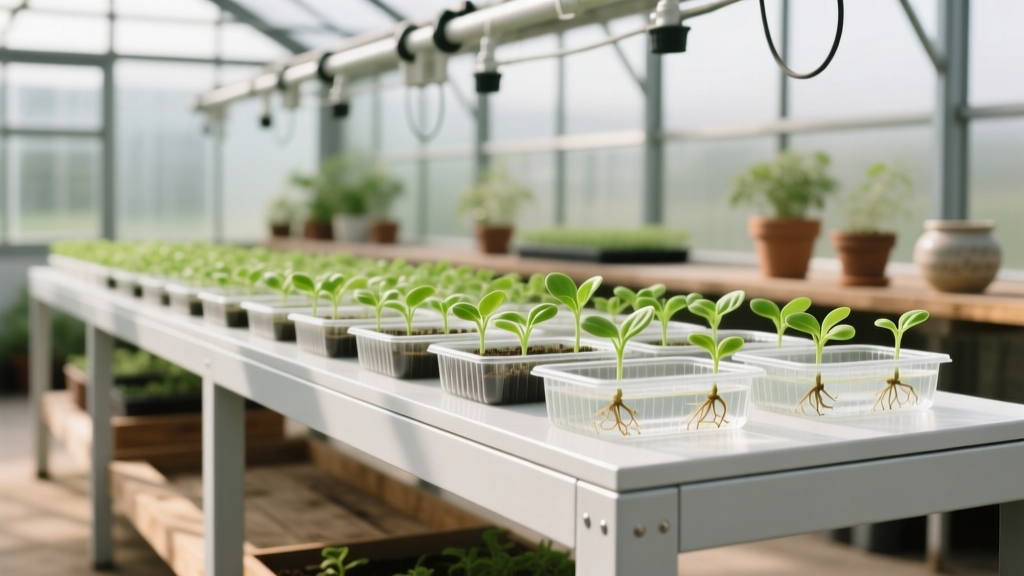
Greenhouse Grafting and Propagation Bench
It’s 7:10 a.m., and the greenhouse is already warm enough to fog your glasses. You’ve got a tray of rootstocks on one side, scionwood wrapped in damp paper on the other, and nowhere clean to set your knife down. The potting bench is buried under half-used media bags. The “just for a minute” pile of seed trays has become a permanent mountain. Grafting day turns into a juggling act—and propagation suffers when your work surface isn’t built for precision.
A grafting and propagation bench doesn’t need to be big or expensive. It needs to be stable, easy to sanitize, bright enough to see cambium lines clearly, and laid out so you can move from cutting to wrapping to healing without crossing the greenhouse like you’re running errands. Let’s design one like a landscape designer would: by reading the space, planning the workflow, and choosing materials and plants that behave well in your specific conditions.
Design principles: treat the bench like a workstation, not furniture
Start with the workflow triangle: cut → assemble → heal
Good greenhouse benches are laid out like efficient kitchens. You want three zones that don’t overlap:
1) Cutting zone (clean surface, bright light, tool storage) → 2) Assembly zone (clips/tape, labels, parafilm, alcohol wipes) → 3) Healing zone (humidity dome or healing chamber, bottom heat if needed).
If you can pivot from one zone to the next without taking a step, you’ll work cleaner and faster. That matters when scions are drying out or when your hands are sticky with grafting wax.
Bench height and depth: build for your elbows, not your eyes
A comfortable working height for fine handwork is typically higher than a potting bench. For most adults, 36–40 inches tall is a sweet spot for grafting because your wrists stay neutral and your shoulders relax. Depth should be shallow enough to reach the back without leaning: aim for 24 inches deep in tight greenhouses, up to 30 inches if you’re tall and have aisle space.
For renters or smaller structures, a bench that’s 48 inches long × 24 inches deep is enough for 2–3 standard 1020 trays. Homeowners with a permanent greenhouse often appreciate 72 inches long × 30 inches deep—room for a cutting mat, a tray, and a small healing dome.
Light: the bench should sit where you get consistent visibility
Grafting is detail work. Place the bench where you naturally get steady daylight without glare. In many hobby greenhouses, the best spot is along the north wall (so you face brighter south light) or under the brightest roof panel.
For propagation, seedlings and cuttings generally perform best with long, gentle light rather than harsh midday blasting. Many common propagation targets thrive with 12–16 hours of light when using supplemental LEDs. If you’re relying on daylight only, your bench should still receive at least 6 hours of bright indirect or filtered sun for stock plants and trays—more if you’re raising sun-loving annuals.
Sanitation is a layout issue, not just a habit
Bench design can either encourage clean technique or make it annoying. A smooth, non-porous top (sealed plywood, HDPE panel, stainless, or even a melamine shelf) wipes down quickly. Add a small “dirty zone” bin for spent leaves and failed cuttings so debris doesn’t creep back onto your cutting surface.
Sanitation matters because many plant pathogens spread mechanically. The Royal Horticultural Society notes that disinfecting tools helps reduce spread of disease between plants (RHS, 2023). The easier you make wiping and tool storage, the more likely you’ll do it mid-session rather than “later.”
“A well-designed work surface is one of the most effective disease-prevention tools you can add—because it makes clean technique the path of least resistance.” — Dr. Sarah A. White, horticulture professor (University Extension workshop notes, 2021)
Layout strategies that fit real greenhouses (and real lives)
The 3-foot aisle rule for comfort and safety
If you can, keep 36 inches of clear aisle in front of the bench. You’ll be carrying trays, moving soil, and occasionally stepping back to check labels. In narrow lean-to greenhouses, you may only have 24–30 inches. In that case, go shallower on bench depth (24 inches) and mount storage vertically instead of using deep shelves.
Use vertical space: pegboard, magnetic strips, and a “label rail”
Grafting supplies are small and easy to lose. A vertical tool wall keeps them visible and prevents cross-contamination (tools don’t roll into potting mix). Consider:
- 12-inch tall backsplash to stop trays sliding off the back
- Pegboard or slatwall for pruners, grafting knife sheath, alcohol spray
- A magnetic strip for razor blades (keeps them dry and out of soil)
- A “label rail” (a narrow strip of wood) to hold plant tags upright
Build a dedicated healing corner (even if it’s small)
Grafts and cuttings often fail in the hours after your perfect cut—not because the cut was wrong, but because humidity and temperature weren’t stable. A simple healing corner can be:
- A clear storage tote as a humidity chamber (18–30 quart size works well)
- A seedling heat mat under one half of the chamber (target 75–80°F for many tender grafts and cuttings)
- A small digital thermometer/hygrometer so you’re not guessing
Even a tiny chamber protects your work from sudden dry air or a vent fan kicking on.
Comparison table: choose a bench style that matches your space and permanence
| Bench option | Best for | Typical size | Approx. cost (USD) | Strengths | Watch-outs |
|---|---|---|---|---|---|
| DIY sealed plywood top on 2x4 frame | Homeowners, permanent setups | 72" L × 30" D × 38" H | $120–$250 | Rock-solid, custom height, easy to add shelves | Must seal well to resist moisture |
| Wire shelving unit + removable cutting mat | Renters, temporary greenhouses | 48" L × 18–24" D × 36–72" H | $60–$180 | Fast setup, adjustable shelves, good airflow | Not as stable for precise cuts; add bracing |
| Reused kitchen countertop on sawhorses | DIYers on a budget | 60" L × 25" D × 36–40" H | $40–$150 | Non-porous surface, wipes clean quickly | Sawhorses can wobble; secure to wall if possible |
| Metal potting bench (store-bought) | Anyone wanting turnkey | 44–60" L × ~24" D × ~36" H | $150–$400 | Durable, often includes shelf and hooks | May be too low for grafting; may need risers |
Step-by-step: set up a grafting and propagation bench that stays tidy
This is the layout I use when I want a bench to feel calm even on busy propagation days.
- Pick the location. Choose a spot with stable light and minimal drip from roof condensation. If possible, place the bench where it receives 6+ hours of bright daylight, but not directly under the hottest midday panel.
- Mark your footprint and aisle. Tape out a rectangle on the floor: try 72" × 30" for a permanent bench or 48" × 24" for small spaces, then confirm you still have a 36" aisle (or at least 30").
- Set the height for handwork. Aim for 38" tall if you mostly graft; 36" if you mostly pot and sow. If you share the bench, consider a 1.5" thick removable platform for shorter users.
- Install a wipeable top. Seal plywood with two coats of exterior polyurethane or use a repurposed countertop. Keep a dedicated cutting mat (at least 18" × 24").
- Add a backsplash and side lips. A 2" front lip keeps trays from sliding. A 12" backsplash creates a clean vertical zone for hanging tools.
- Create the three zones. Left: cutting mat + tool cup. Center: assembly (clips, parafilm, labels). Right: healing chamber footprint (24" × 18" is enough for many domes).
- Plan water access without splashing. Put mist bottles and a small watering can on a lower shelf, not the main surface. If you have a hose, add a hook so it never lies across the bench.
- Label like you mean it. Store labels at the bench and write immediately. Lost labels are the silent killer of propagation projects.
Plant selection: stock plants and grafting candidates that behave well on a bench
Your bench isn’t just for baby plants. It’s a production line, and the best production lines start with reliable “materials”: healthy stock plants, compatible rootstocks, and varieties that root or graft consistently.
Grafting candidates (home greenhouse scale)
Tomatoes (Solanum lycopersicum) are one of the most practical home grafting projects: quick healing, clear success/failure, and big payoff in vigor.
- Scion varieties: ‘Sungold’ (heavy producer, great flavor), ‘Brandywine’ (classic taste but can be less vigorous), ‘Cherokee Purple’ (strong flavor, benefits from vigor boost).
- Rootstock options: ‘Maxifort’ (very vigorous), ‘Beaufort’ (balanced vigor). These are widely used in tomato grafting because they handle stress and support yield.
- Spacing on the bench: keep grafted seedlings 2–3 inches apart in healing trays so leaves don’t mat together and trap moisture against stems.
Fruit trees (small-scale bench grafting) are ideal for late winter/early spring bench sessions, especially apples and pears.
- Apple varieties for homeowners: ‘Honeycrisp’ (popular, needs compatible pollinator), ‘Liberty’ (noted for disease resistance), ‘GoldRush’ (late-season, excellent keeper).
- Rootstocks: M.26 (semi-dwarf), M.111 (more vigorous, drought-tolerant). Choose based on your yard size and staking tolerance.
- Bench spacing: store finished grafts upright with 2 inches between bundles for airflow and easy labeling.
Propagation-friendly herbs and ornamentals (high success, high payoff)
For renters especially, propagating from cuttings gives you more plants without more purchases—and many herbs root quickly in a simple dome.
- Rosemary ‘Arp’: cold-hardy selection; semi-hardwood cuttings root reliably with bottom heat.
- Lavender ‘Hidcote’: compact, fragrant; prefers sharp drainage—use a gritty propagation mix.
- Coleus ‘Wizard Mix’: roots fast in water or media; great for quick success and filling containers.
- Pothos (Epipremnum aureum) ‘Golden’: forgiving houseplant cuts for indoor-outdoor crossover setups.
USDA reminds growers that clean propagation material and sanitary conditions are key in preventing the spread of pests and diseases in plant production systems (USDA APHIS, 2022). On a home bench, that translates to: start with healthy stock, label everything, and keep your tools clean.
Three real-world bench layouts (so you can copy the one that fits)
Scenario 1: The renter with a mini greenhouse on a patio
Space: 6' × 8' pop-up greenhouse. Constraint: everything must be removable with no wall anchoring.
Design move: Use a 48" × 18" wire shelf as the bench and add a removable 24" × 36" sealed board on top as your grafting surface. Put a lidded tote healing chamber on the lower shelf to stabilize temperature.
Budget: about $90 for shelving, $25 for a cutting mat, $20 for a hygrometer, and $30–$60 for a heat mat—roughly $165–$195 total.
Plant plan: Coleus cuttings, rosemary, and tomato grafts. These give quick wins and justify the setup without needing permanent infrastructure.
Scenario 2: The homeowner with a lean-to greenhouse that overheats
Space: 8' × 12' lean-to against a wall. Constraint: intense afternoon sun creates heat spikes.
Design move: Place the bench on the wall side where temperature swings are smaller. Keep the top 30" deep but add a shade cloth panel overhead for mid-summer. Your healing chamber goes on the coolest end of the bench, away from the door.
Budget: DIY 2x4 bench with sealed plywood top: $180–$250, plus $35 for shade cloth.
Plant plan: Bench-graft apples (late winter), then switch to tomato grafting and basil cuttings in spring. Grow stock plants like basil ‘Genovese’ and rosemary ‘Arp’ in 1-gallon pots near the bench so you always have clean material.
Scenario 3: The shared household greenhouse (two gardeners, two styles)
Space: 10' × 10' freestanding greenhouse. Constraint: one person starts seeds; the other grafts and propagates perennials.
Design move: Build a 72" bench and split it intentionally: left half for seed-starting trays and soil tools, right half is a “clean bench” with a dedicated cutting mat and a small drawer unit for grafting supplies. Use painter’s tape on the bench edge to mark zones—simple, surprisingly effective.
Plant plan: Start peppers and flowers on one side while the other side runs lavender ‘Hidcote’ cuttings and tomato graft batches. This avoids the classic problem: potting mix scattered where you need a sterile surface.
Budget planning and DIY alternatives (so the bench matches your priorities)
If you want the bench to feel professional, spend money on stability and a wipeable surface, not fancy accessories.
- Lowest-cost functional setup ($60–$120): used desk or table + vinyl table cover + clip-on LED light. Add a plastic bin healing chamber.
- Midrange ($150–$300): DIY 2x4 frame + sealed top + pegboard + heat mat. This is the “sweet spot” for most homeowners.
- Higher investment ($350–$700): commercial metal bench, dedicated LED bar lighting, thermostatic heat mat controller, and storage drawers.
DIY alternatives that work well in damp greenhouse air:
- Countertop offcuts (often cheap or free): already moisture-resistant and easy to sanitize.
- HDPE cutting board sheet as a bench top insert: pricey upfront, but it’s durable and truly wipe-clean.
- Repurposed kitchen drawer organizers for grafting clips, labels, and blades—small items stop disappearing.
Maintenance expectations: keep it clean enough that you’ll actually use it
A propagation bench shouldn’t add chores; it should reduce them by preventing mess creep. Here’s a realistic rhythm that works for most home greenhouses:
Weekly (30–45 minutes total): wipe bench surface with soapy water or a suitable disinfectant, empty the debris bin, launder or replace a bench towel, check heat mat function, and cull any trays showing rot so problems don’t spread.
During active propagation (10 minutes per session): quick tool wipe-down and a bench reset—clips back in the container, labels stacked, blades stored safely.
Seasonal (2–3 hours per season):
- Late winter: reorganize scionwood storage, sharpen grafting tools, check lighting timers.
- Spring: deep-clean domes and trays, refresh propagation media, calibrate thermometer/hygrometer.
- Summer: monitor overheating; add shade cloth if greenhouse exceeds your target range; increase airflow.
- Fall: sanitize benches and pots before bringing in houseplants or overwintering stock plants.
If you’re grafting tomatoes, plan on 60–90 minutes for a batch of 10–20 plants once your bench is set. The point of this design is to make that time calm and repeatable, not frantic.
Small details that make the bench feel “designed”
Edge lighting: A 2-foot under-shelf LED bar aimed at the cutting mat reduces shadows—helpful when aligning scion and rootstock.
One-handed trash: A swing-top bin or a bucket clipped to the bench keeps you from setting sticky leaves down “just for a second.”
A dedicated drying spot: Hang pruners and knives so they dry fully. Wet tools corrode; corroded tools tear tissue; torn tissue heals poorly.
Clipboard station: One hook and a clipboard can transform your success rate because you’ll actually record dates, varieties, and methods—especially for fruit tree grafting and rooting trials.
The bench as a space-maximizer, not just a surface
When your greenhouse bench is planned around the work—clean cuts, quick assembly, predictable healing—you suddenly have more “space” even if the square footage didn’t change. You’ll start fewer trays that fail. You’ll keep stock plants healthier because they’re not shoved into corners. You’ll do the fiddly tasks (labeling, tool cleaning, humidity checks) because they’re built into the layout instead of being afterthoughts.
Set your bench height so your shoulders drop. Give yourself a clean zone that stays clean. Add a small healing chamber that protects your best work. Then choose varieties that reward you: a ‘Sungold’ graft that powers through summer, a tray of lavender ‘Hidcote’ that roots steadily, a bench-grafted ‘Liberty’ apple that becomes a backyard staple. The greenhouse will still be warm at 7:10 a.m.—but you won’t be juggling anymore.
Sources: Royal Horticultural Society (RHS), “Hygiene: Keeping Tools Clean” (2023); USDA APHIS, plant health and sanitation guidance for preventing spread of pests and diseases in plant production systems (2022).