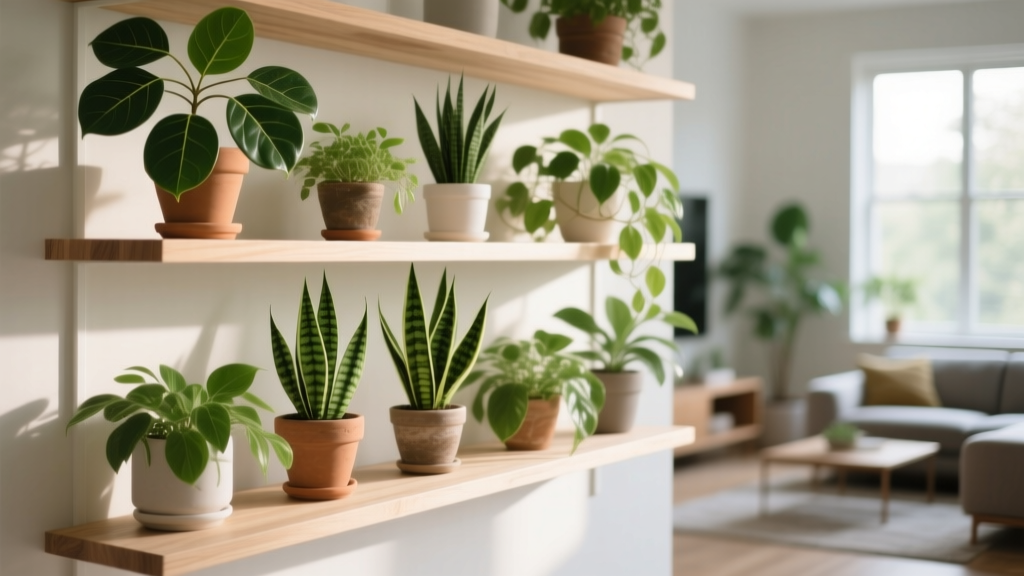
Indoor Plant Shelf Styling Guide
You bought the cute plant shelf. Maybe it was a late-night “add to cart,” maybe it was a hand-me-down bookcase you swore you’d paint. Either way, it’s sitting there now—half full of pots, half full of guilt. The top shelf is scorched because it’s too close to the window. The middle looks cluttered. The bottom is dim, dusty, and home to a single struggling pothos you keep forgetting to water. If this feels familiar, good: we’re starting in the real world.
Let’s style your shelf like a designer would—using light, scale, and repetition—not just “more plants.” The goal is a shelf that looks intentional, keeps plants healthy, and fits the way you actually live (and how often you want to fuss with it).
Start with the room’s reality: light, traffic, and moisture
Measure light the way a plant experiences it
Before you move a single pot, stand where the shelf will live and note two things: direction and hours of direct sun. A south-facing window often gives the strongest light; north-facing is gentler. As a practical baseline, most bright-indirect houseplants are happiest with about 6–8 hours of bright, indirect light (not sunbeams directly on leaves), while true low-light tolerant plants can cope with 2–4 hours of weaker daylight.
If you want a data-backed approach, the University of Georgia Extension notes that indoor plant performance is strongly tied to light intensity and duration, and recommends matching plants to available light rather than forcing conditions (UGA Extension, 2019).
Check the “bump zone” and protect your edges
Shelves in tight hallways and near door swings need fewer trailing plants and fewer breakable ceramics. If people brush past the shelf, keep the outer 3–4 inches clear of fragile pots. Put sturdier plants (snake plant, ZZ plant) on corners and anything delicate (string of pearls, begonias) deeper on the shelf.
Humidity: stop fighting your HVAC
Most common houseplants tolerate typical indoor humidity, but ferns and calatheas sulk near vents. If your shelf sits above a radiator or under an AC register, choose tougher plants or plan for a small humidity strategy (like a pebble tray). The Royal Horticultural Society emphasizes that stable conditions and avoiding hot/cold drafts is key for many houseplants (RHS, 2023).
Design principles that make a plant shelf look “done” (and keep plants thriving)
Use the “three heights” rule for instant structure
Every shelf vignette looks more deliberate when it has height variation. Aim for three layers:
- Tall: upright or architectural (snake plant, cane begonia, small dracaena)
- Medium: mounded or leafy filler (peperomia, philodendron, pilea)
- Trailing: soft edges (pothos, heartleaf philodendron, hoya)
On a typical shelf that’s 10–12 inches deep, keep tall plants toward the back so leaves don’t get snapped by passersby.
Repeat materials and shapes, not just species
Instead of collecting random pots, pick two pot finishes to repeat (for example: matte white + terracotta). Repeat a leaf shape too—like alternating round-leaf plants (pilea, peperomia) with strappy plants (spider plant, dracaena). This creates a rhythm even if your plants are all different shades of green.
Build negative space into the layout
Overcrowding is the fastest way to make a shelf look messy—and it blocks light and airflow. A reliable guideline: leave at least 20–30% of each shelf surface empty. Practically, that’s one “breathing zone” per shelf—about the size of a dinner plate.
Plan spacing by pot size (so you don’t repaint later)
Use these spacing baselines to prevent leaf pileups and to make watering easier:
- 4–6 inch pots: space 3–4 inches apart
- 8–10 inch pots: space 5–7 inches apart
- Trailing plants: allow 8–12 inches of “drop zone” below the shelf edge
Group by water needs (your future self will thank you)
A shelf is a mini ecosystem. If you mix a thirsty fern beside a cactus, you’ll either overwater one or underwater the other. Create zones:
- Dry zone: succulents, cacti, snake plant, ZZ plant
- Moderate zone: pothos, philodendron, hoya, peperomia
- Moist zone: ferns, calathea, fittonia (only if your room supports it)
“Design is not just what it looks like and feels like. Design is how it works.” — Steve Jobs (quoted widely, 2003)
That quote applies perfectly here: a shelf that looks great but fails your plant care routine is not good design.
Choose a shelf format that matches your space (with costs and dimensions)
Plant shelves fall into a few practical categories. Pick the format first; styling becomes much easier afterward.
| Shelf Type | Best For | Typical Size | Light Access | Budget Range (USD) |
|---|---|---|---|---|
| Ladder shelf | Renters; corners; easy to move | 60–72 in tall, 12–18 in deep | Good near windows; top shelf gets strongest light | $80–$220 |
| Wall-mounted ledges | Small rooms; kid/pet safety | 24–48 in long, 4–8 in deep | Excellent if installed beside/around a window | $30–$150 |
| Bookcase-style shelving | Large collections; grow lights | 72 in tall, 10–14 in deep | Needs grow lights unless placed very bright | $60–$300 |
| Wire rack (utility style) | Max plants; airflow; humidifiers | 48–72 in tall, 18 in deep | Great with clip-on lights; adjustable shelves | $45–$180 |
If you’re counting dollars closely, a wire rack plus simple LED bars is often the best “plants per square foot” value. If you’re styling for a living room, ladder shelves and bookcase shelves hide gear better.
Step-by-step setup: from empty shelf to styled and stable
- Place the shelf and mark the sun path. Note where sunlight hits at 9 a.m., 12 p.m., and 3 p.m. for one day. If any shelf gets more than 2 hours of direct sun, reserve it for sun-tolerant plants or filter with a sheer curtain.
- Protect surfaces. Add waterproof trays or clear shelf liner. Budget: $10–$25 for a roll of liner, or DIY with cafeteria trays from a thrift store.
- Decide your zones by shelf level. Top = brightest/driest; middle = moderate; bottom = lowest light/highest humidity retention.
- Set your anchor plants first. Use 1–2 larger plants (typically 8–10 inch pots) as visual anchors on the middle shelves.
- Add medium plants, then trailers. Keep a clear watering lane so you can lift pots without snagging vines.
- Finish with two non-plant elements per shelf max. A small framed photo, a stone, a watering can—choose pieces that support the palette. Too many objects make plant care harder.
- Test stability. Push gently. If it wobbles, anchor it. For renters, use anti-tip straps when allowed, or place heavier pots low to reduce top-heaviness.
Plant selection: specific varieties that earn their spot
Bright, window-adjacent shelves (4–6 hours of strong light)
These plants handle brightness and look crisp in styled groupings:
- Hoya carnosa ‘Krimson Queen’: Thick leaves tolerate missed waterings; variegation brightens dark shelves.
- Peperomia obtusifolia: Compact, glossy, forgiving; stays neat in 4–6 inch pots.
- String of hearts (Ceropegia woodii): Beautiful trailing; put it on the top shelf so it can drop 12–24 inches without tangling.
- Jade plant (Crassula ovata): Architectural silhouette; ideal for shelves that get a bit of sun.
Medium-light shelves (bright indirect, no harsh sun)
This is the “easy mode” zone where most interiors can succeed:
- Pothos (Epipremnum aureum ‘Golden’ or ‘Marble Queen’): Trailing, fast, forgiving—perfect for softening shelf edges.
- Heartleaf philodendron (Philodendron hederaceum): Similar toughness, slightly more velvety; great for repetition across multiple shelves.
- Spider plant (Chlorophytum comosum): Adds movement and “spray” texture; place where babies can cascade.
- Pilea peperomioides: A sculptural, modern look; rotate weekly for even growth.
Lower shelves and dim corners (2–4 hours of low light)
Not “no light,” but less. Choose plants that stay attractive without stretching:
- ZZ plant (Zamioculcas zamiifolia): One of the most tolerant; strong upright form for bottom-shelf structure.
- Snake plant (Dracaena trifasciata, formerly Sansevieria): Handles low light and irregular watering; looks clean in simple pots.
- Cast iron plant (Aspidistra elatior): Slow-growing but steady, with broad leaves that read “lush” even in shade.
If you want flowers indoors (and you’re willing to earn them)
- Phalaenopsis orchid: Best on a bright shelf out of direct sun; keep it away from drafts. Water sparingly but consistently.
- African violet (Saintpaulia): Great for a dedicated bright shelf with stable warmth; bottom watering reduces leaf spotting.
Three real-world shelf scenarios (and exactly how to style them)
Scenario 1: The renter’s narrow windowsill zone (12 inches deep, high traffic)
The problem: You have light near the window, but not much floor space, and you can’t drill into the wall freely.
The layout strategy: Use a 60–70 inch ladder shelf placed 6–12 inches from the window so curtains can still move. Put the most sun-tolerant plants on the top tier and keep the outer corners clear.
Plant palette: Hoya ‘Krimson Queen’ (top), peperomia (middle), pothos (middle trailing), ZZ plant (bottom). This mix tolerates missed watering and won’t collapse into the walkway.
Budget notes: Ladder shelf $120, four pots $40, saucers/liners $15. DIY alternative: thrift a small bookcase for $25–$50 and paint it satin white to bounce light.
Scenario 2: The dim apartment corner that needs grow lights (no direct sun)
The problem: You want a lush shelf, but your windows face a brick wall. Plants stretch, drop leaves, or simply stall.
The layout strategy: Go utilitarian and embrace it: a 48-inch wide wire rack with adjustable shelves, plus LED grow bars. Keep lights 8–12 inches above plant tops and run them on a timer for 10–12 hours per day.
Plant palette: Philodendron hederaceum, pothos, peperomia, spider plant, and a small fern if you can maintain humidity. You’ll get dense growth and consistent color under lights.
Cost reality: Wire rack $70, two LED bars $40–$80, timer $10. This setup often costs less than replacing “mystery dying plants” every few months.
Scenario 3: The family living room shelf (kids/pets, style-forward)
The problem: You want something beautiful, but a wagging tail or a flying toy can ruin your day. Also: you don’t want dirt on the rug.
The layout strategy: Use wall-mounted ledges installed 50–60 inches above the floor to keep plants out of reach. Choose ledges 6–8 inches deep so pots sit securely. Add a discreet lip or rail if possible.
Plant palette: Snake plant (upright), ZZ plant (upright), peperomia (compact), hoya (controlled trailing). Avoid very brittle succulents on the edge. Use heavier ceramic pots so nothing tips easily.
DIY alternative: If you can’t drill, choose a tall bookcase with doors on the bottom (to hide supplies) and keep the most fragile plants up high. Add waterproof trays to every shelf.
Styling details designers use: color, texture, and “visual rest”
Pick a palette: green + one accent color
Indoors, plant styling can become chaotic fast. Choose one accent—black pots, brass mister, terracotta, or a single color like deep green. Repeat it 3 times across the shelf so it feels intentional.
Mix leaf textures for depth (not just different plants)
A strong combo is: one glossy plant (peperomia), one matte/velvety plant (philodendron), and one narrow-leaf plant (snake plant or dracaena). That contrast reads “designed” even when everything is green.
Use risers to fix awkward height gaps
If two plants are the same height, the shelf looks flat. Slip a plant stand or an upside-down bowl under one pot for a quick lift of 2–4 inches. Budget: $8–$20 for a small riser, or DIY with a sealed wood block.
Maintenance expectations (so the shelf stays styled)
A well-planned plant shelf should take about 20–40 minutes per week once it’s established. Here’s what that time usually includes: checking moisture, watering, quick leaf wipe for dusty plants, and rotating plants for even growth.
Weekly rhythm
- Watering: Most shelves need watering every 7–14 days, depending on light and pot size. Dry-zone plants may go 2–4 weeks.
- Rotate: Turn plants a quarter turn weekly if they lean toward light.
- Quick clean: Wipe shelf drips immediately; water stains are what make a styled shelf look tired.
Seasonal tasks
- Spring: Repot fast growers if roots circle the pot; refresh topsoil. Expect $8–$15 for a bag of quality potting mix.
- Summer: Watch for faster drying; increase checks to twice weekly during heat waves.
- Fall: Reduce watering as growth slows; move plants slightly closer to windows if daylight drops.
- Winter: Keep foliage off cold glass; protect from drafts. Consider a small humidifier if leaves crisp.
Budget-smart choices and DIY upgrades that look high-end
You don’t need expensive pots and rare plants to get a polished shelf. You need consistency and a system.
- Thrift matching pots: Buy a mismatched set and spray them the same color (use a primer suitable for ceramics/plastic). You can transform a shelf for $20–$35.
- Use cachepots: Keep plants in plain nursery pots and drop them into prettier outer pots. It makes watering at the sink much easier.
- DIY drip control: Clear plastic saucers are cheap and invisible. Or use baking sheets on lower shelves as hidden plant trays.
- Propagate to fill gaps: Pothos and heartleaf philodendron cuttings root easily in water, giving you extra plants to repeat across shelves without buying more.
Once your shelf is set, you’ll notice the difference immediately: plants stop struggling because they’re finally matched to the right light, and the styling looks calmer because you’ve built in spacing, repetition, and a clear maintenance routine. That’s the moment your “random plant storage” becomes an indoor garden feature—and it keeps working long after the first photo.
Sources: University of Georgia Extension (2019), guidance on matching indoor plants to available light; Royal Horticultural Society (RHS) (2023), houseplant care emphasizing stable temperatures and avoiding drafts.