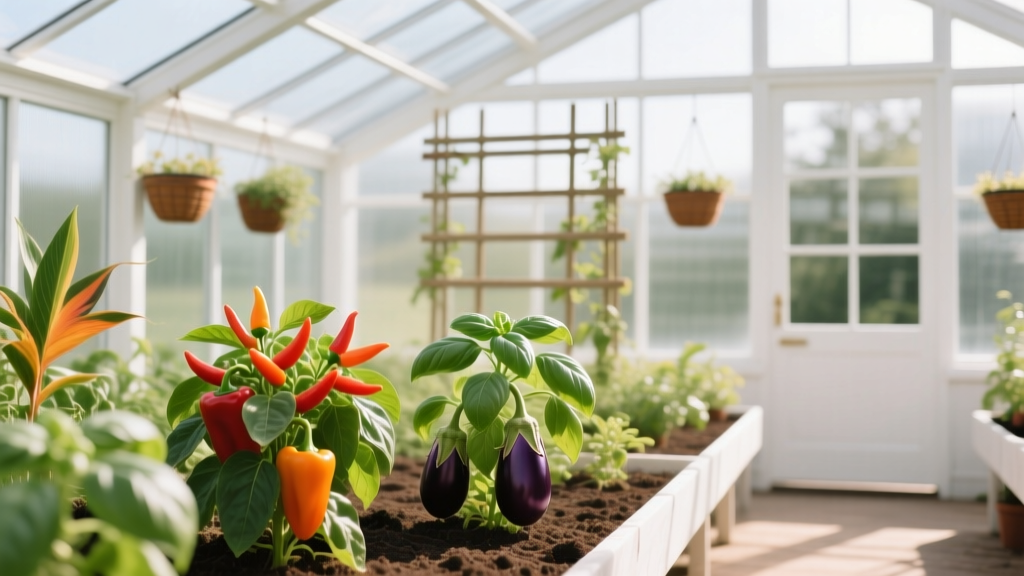
Greenhouse Heat-Loving Crop Zone
The first cold night of fall has a way of making gardeners bargain with their plants. You stand in the doorway—half inside the warm greenhouse, half outside in the sharp air—holding a flat of peppers that still look determined to ripen. The tomatoes are loaded with green fruit, the basil is lush, and your hands are full. The question isn’t “can I grow heat-loving crops?” It’s “how do I design a greenhouse zone that actually supports them—without turning into a daily rescue mission?”
This layout plan treats your greenhouse like a small, high-performing room: it needs a sunny “window wall,” a warm core, predictable walkways, and places where heat and humidity can rise and fall without stressing your plants. We’ll build a practical heat-loving crop zone you can run in a 6 ft x 8 ft hobby house, a 10 ft x 12 ft freestanding greenhouse, or even a rented patio structure—using smart placement, efficient spacing, and a few proven varieties.
Design goals for a heat-loving crop zone
Heat-lovers—tomatoes, peppers, eggplant, cucumbers, basil—want long bright days, warm nights, and steady moisture. In greenhouse terms, that means you’re designing for thermal stability more than peak heat. A greenhouse that hits 100°F at 2 pm and drops to 50°F at 4 am is harder on crops than one that holds 75–85°F reliably.
Plan around three goals:
- Keep the warmest planting area in the sunniest, least drafty location. South side (or the brightest wall) becomes your “fruiting crop spine.”
- Create ventilation that’s controllable, not all-or-nothing. Heat-loving crops still need airflow to prevent fungal issues.
- Design for access. If you can’t reach a cucumber vine or tomato truss, you’ll prune less, harvest late, and invite pests.
Layout strategies that make heat predictable
Start with a simple greenhouse “floor plan”
Picture your greenhouse as three bands:
- Hot Zone (sun side): Fruiting crops in large containers or beds—tomatoes, peppers, eggplant, cucumbers.
- Service Zone (center aisle): A walkway wide enough for a bucket and a watering can.
- Buffer Zone (cooler edge): Herbs, seedlings, tools, water storage, and a small work surface.
Concrete dimensions that work in real greenhouses:
- Main aisle: 24–30 inches wide so you can turn with a harvest bin. (30 inches feels luxurious in a 10 ft wide house.)
- Tomato spacing: 18–24 inches between plants when trained to a single leader on a string.
- Pepper spacing: 12–18 inches; tighter spacing increases humidity, so compensate with airflow.
- Cucumber spacing: 12 inches for trellised parthenocarpic types; 18 inches for vigorous slicers.
- Target sunlight: Aim for 8+ hours of direct sun in peak season for best fruit set.
Use height to keep heat-lovers productive
Heat collects high, so tall crops belong where you can give them both headroom and trellising. If your greenhouse ridge is 8 ft tall, plan trellis wires around 7 ft, leaving room above for air movement. Put shorter peppers and eggplants in front of tall tomatoes so they don’t get shaded by mid-summer.
One designer trick: keep the tallest crops north in a freestanding greenhouse so they don’t shade the rest. In a lean-to against a wall, place tall crops toward the wall side if that wall is the brightest and warmest, but watch for shade lines.
Thermal mass: the quiet hero of the hot zone
Heat-loving crops benefit when nights don’t plunge. Thermal mass helps by storing warmth during the day and releasing it overnight. A simple, budget-friendly method is water storage.
- Option A: Two 55-gallon barrels painted black along the back wall (110 gallons total).
- Option B: Four 5-gallon jugs tucked under benches (20 gallons total).
Water barrels can also function as your irrigation reserve. A pair of 55-gallon barrels typically costs about $60–$120 each depending on whether they’re new food-grade or reused (check local listings). Even smaller containers help smooth temperature swings in compact structures.
Ventilation that doesn’t sabotage your warmth
Heat-lovers want warmth, but stagnant air invites problems. The UMass Extension notes that greenhouse ventilation is essential for controlling temperature and humidity (UMass Extension, 2015). Use ventilation like a dimmer switch, not a light switch.
“Air movement and ventilation are key tools for managing humidity and disease pressure in greenhouses; good airflow reduces leaf wetness duration.” — UMass Extension, Greenhouse Management guidance (2015)
Practical ventilation specs for home setups:
- Roof vent(s): automatic wax openers (often $35–$70 each) to dump peak heat.
- Low intake vent: a cracked door or louver on the opposite end for crossflow.
- Circulation fan: a small greenhouse-rated fan, 8–12 inches, running on a timer 4–8 hours/day during humid periods.
For heat-loving crops, a common temperature target is 70–85°F daytime and not much below 60°F at night for consistent growth and fruit set. When nights drop, row cover inside the greenhouse (a “greenhouse within a greenhouse”) gives you a surprisingly big boost with minimal cost.
A practical layout you can copy (and adjust)
Sample layout: 6 ft x 8 ft greenhouse (renter-friendly)
This is the “tiny but mighty” plan—mostly containers, minimal permanent fixtures.
- Right side (Hot Zone): 3 containers (10–15 gallons each): 1 tomato, 1 cucumber, 1 eggplant.
- Left side (Warm Zone): 4–6 containers (5–7 gallons): peppers + basil.
- Back wall (Buffer + thermal mass): 1–2 water jugs (or a slim 15–30 gallon barrel) plus a narrow shelf for tools.
- Aisle: 24 inches clear.
Costs (typical DIY range): 6 fabric pots at $4–$8 each, potting mix $12–$20 per 2 cu ft bag, plus twine and clips. If you already have containers, your biggest expense becomes good soil.
Sample layout: 10 ft x 12 ft greenhouse (homeowner “production” zone)
This plan supports a real summer harvest rhythm—enough tomatoes for weekly salads and sauce, peppers for grilling, cucumbers for fresh eating.
- Two side beds: each 18 inches wide x 10 ft long (leave room at ends for turning).
- Center aisle: 30 inches wide.
- North end: potting bench 18 inches deep + storage underneath.
- South end: door/vent and a small staging area for watering.
Planting density example:
- Bed A: 5 tomatoes at 24 inches spacing (trained single leader).
- Bed B: 8 peppers at 15 inches spacing + basil in between (1 basil per pepper).
- One end trellis: 2 cucumbers at 12–18 inches spacing.
Plant selection: heat-lovers that actually perform in a greenhouse
Greenhouse heat is a gift—until it’s too much. Choose varieties that set fruit in warmth, resist common greenhouse diseases, and trellis cleanly. Below are reliable options and why they’re good candidates for your hot zone.
Tomatoes (trellis stars)
- ‘Sungold’ (cherry): Fast, heavy producer; great for extended seasons. Handles greenhouse vigor well when pruned to one leader.
- ‘Climber’ (indeterminate): Bred for greenhouse-style training; long trusses and consistent set with pruning.
- ‘Marglobe’ (determinate/slicer): Good if you want a more compact plant with a defined season and less trellis fuss.
Greenhouse note: pollination matters. A gentle shake of the trellis line or a dedicated tomato pollinator tool 3–4 times/week during flowering improves set.
Peppers (heat lovers that hate cold nights)
- ‘Ace’ (sweet bell): Sets fruit more reliably in cooler shoulders; good if your greenhouse isn’t heated.
- ‘Carmen’ (sweet Italian): Excellent greenhouse flavor; heavy yields on a well-fed plant.
- ‘Jalapeño M’ (hot): Productive and forgiving; stays manageable in containers.
Peppers thrive when root zones stay warm. Dark containers, mulch, and avoiding cold irrigation water are small details that make a big difference.
Cucumbers (choose greenhouse-friendly types)
- ‘Diva’: Parthenocarpic (sets without pollination), smooth fruit, great for protected culture.
- ‘Socrates’: Strong greenhouse performer, parthenocarpic; productive with trellising and steady watering.
Training: keep cucumbers to one main vine, remove lateral shoots for the first 12–18 inches, then allow limited laterals up the trellis depending on space.
Eggplant (compact and dramatic)
- ‘Ichiban’: Slender fruits, earlier and more consistent in protected culture.
- ‘Orient Express’: Reliable set and quick maturity—helpful when your season is shorter.
Basil and companions (the understory that earns its keep)
- ‘Genovese’ basil: Classic, fast regrowth; harvest weekly to prevent flowering.
- ‘Prospera DMR’ basil: Downy mildew resistant—valuable in humid greenhouse conditions.
For pest management, tuck in a pot of sweet alyssum near the door to encourage beneficial insects, and consider sticky cards for monitoring.
Comparison table: crops vs. space, training, and payoff
| Crop | Recommended spacing (trellised) | Container size | Training style | Best reason to include |
|---|---|---|---|---|
| Tomato (indeterminate) | 18–24 in | 10–15 gal | Single leader on string | High yield per sq ft when pruned |
| Pepper | 12–18 in | 5–7 gal | Staked; light pruning | Consistent harvest, compact footprint |
| Cucumber (parthenocarpic) | 12–18 in | 7–10 gal | Single vine on trellis | Fast payoff, loves greenhouse warmth |
| Eggplant | 18–24 in | 7–10 gal | Staked; moderate pruning | Thrives in heat; fewer disease issues under cover |
| Basil | 8–12 in | 1–3 gal | Pinch and harvest weekly | Fills gaps; continuous harvest |
Step-by-step setup: build your heat-loving zone in a weekend
- Map your sun and shade for one clear day. Note the brightest wall and any afternoon shade. Heat-lovers go where you get 8+ hours of direct light in summer.
- Mark your aisle with painter’s tape. Commit to 24–30 inches minimum. Your future self will thank you when vines explode in July.
- Install overhead support. Add a sturdy ridge wire or greenhouse trellis line rated for at least 40–60 lb of load (tomatoes get heavy). Use proper anchors—this is not the place for flimsy hooks.
- Place thermal mass. Start with at least 20 gallons of water storage (more if you have space). Put it where it won’t block airflow.
- Set containers/beds and add irrigation. A simple drip line kit often runs $25–$60 for small greenhouses and saves hours. If you hand-water, group plants by thirst (cucumbers together; peppers together).
- Plant tall crops first, then understory. Tomatoes/cucumbers at the back or north, peppers/eggplant in front, basil at edges.
- Mulch and label. Use 1–2 inches of clean straw or shredded leaves (avoid hay with seeds). Add durable labels now—later everything looks the same.
Three real-world scenarios (and how the layout shifts)
Scenario 1: The renter with a small greenhouse and no power
You’ve got a 6 ft x 8 ft greenhouse on a patio, and running electricity is a non-starter. Your design lever is simplicity: fewer plants, larger containers, and passive heat buffering.
Best layout move: one trellis line for a single tomato and a single parthenocarpic cucumber, then surround them with 4–6 peppers in 5-gallon pots. Add two 5-gallon water jugs (10 gallons total) along the back wall. At night when temperatures dip below 55°F, throw a lightweight frost cloth over the tomato and cucumber inside the greenhouse.
DIY alternative: instead of a fancy bench, flip a plastic storage tote upside down as a pot stand. It keeps pots off cold ground and gives you a tiny bit of thermal separation.
Scenario 2: The homeowner who wants summer abundance but hates daily watering
This is common: you want a greenhouse harvest, but you also want weekends back. The design solution is water efficiency plus access.
Use two side beds in a 10 ft x 12 ft greenhouse and add drip irrigation on a timer. A basic battery timer plus drip lines often costs less than a single season of impulse plants. Group cucumbers at one end with their own drip zone because they drink more; peppers can run slightly drier.
Spacing that prevents a jungle: tomatoes at 24 inches, pruned weekly; peppers at 15 inches. Keep the aisle at 30 inches, even if it feels like “wasted space”—it’s what allows you to prune and harvest fast.
Scenario 3: The shoulder-season grower extending spring and fall
If your main goal is earlier tomatoes and later peppers, design for night warmth and quick cover. Thermal mass becomes more valuable than extra plants.
Add at least one 55-gallon barrel (or equivalent) and create an inner low tunnel over the hot zone using hoops and plastic. This can buy you precious degrees on cold nights. According to USDA plant hardiness zone guidance, average annual extreme minimum temperatures define zones and help gardeners anticipate cold risk (USDA ARS, 2012). Use that as your reality check: if your outdoor nights regularly drop into the 40s, your greenhouse needs a plan beyond “close the door.”
Practical planting shift: choose earlier varieties (‘Sungold’, ‘Ichiban’) and reduce total plant count so each plant gets more light during low-sun months.
Budget choices and DIY alternatives
You can build a strong heat-loving crop zone at different budget levels. What matters is putting money into the parts that affect plant health daily: soil volume, trellising strength, and manageable watering.
- Low budget ($75–$200): Fabric pots, DIY trellis twine, repurposed containers for thermal mass, hand-watering, homemade shade cloth (old sheer curtains clipped to the frame during heat spikes).
- Mid budget ($200–$500): Add drip irrigation, automatic vent opener, sturdier clips and tomato hooks, better potting mix in bulk.
- Higher budget ($500+): Double-wall polycarbonate upgrades, thermostatic fan, more thermal mass, heated propagation mat for seedlings.
DIY shading tip: heat-loving crops still suffer above 95°F if airflow is poor. Instead of buying greenhouse shade cloth immediately, start by whitewashing the outside (a removable greenhouse shading compound) or clipping lightweight fabric on the sunniest panel during extreme weeks.
Maintenance expectations: what it really takes
A heat-loving greenhouse zone is productive, but it’s not “set and forget.” The good news: with a clean layout, the weekly rhythm is quick.
Time estimate: plan for 30–60 minutes per week for pruning, tying, scouting, and harvesting in a small-to-mid greenhouse. Add watering time if you don’t use drip (often another 10 minutes/day in peak summer).
Weekly tasks (in season)
- Prune and tie: tomatoes and cucumbers trained to trellis (10–20 minutes).
- Scout pests: check undersides of leaves for aphids and spider mites; replace sticky cards.
- Vent management: confirm vents open and close correctly; heat spikes happen fast.
- Feed: container crops often need regular fertilizing once fruiting begins (follow your fertilizer label; underfeeding is a common greenhouse failure point).
Seasonal tasks
- Spring: sanitize pots and tools; check trellis anchors; start basil after nights stay above 50–55°F.
- Mid-summer: add shade during heat waves; increase airflow; keep cucumbers picked to maintain production.
- Fall: remove declining vines promptly; keep peppers and basil in the warmest band; use inner covers at night.
- Winter: scrub glazing, tidy irrigation lines, and plan next season’s layout changes while the structure is empty.
Small design moves that improve harvest quality
Keep foliage dry when possible. Water early in the day, and aim at the soil, not the leaves. This is one reason drip irrigation is so effective in a greenhouse.
Control the “humidity corner.” Every greenhouse has a spot where air stalls—usually the back corner opposite the door. Put your least disease-prone plants there (basil is often fine; cucumbers usually aren’t), and consider a small circulation fan aimed across that zone.
Design for the harvest path. Place the most frequently harvested crops (cucumbers, cherry tomatoes, basil) closest to the aisle entrance. If you have to squeeze past vines every day, you’ll break stems and compact soil.
Once your heat-loving crop zone is dialed in, you’ll feel the shift: instead of reacting to wilting leaves and midday temperature spikes, you’ll walk in with a plan—tie up a tomato leader, pick a bowl of cucumbers, pinch basil for dinner, and step back out while the rest of the yard is still deciding whether it’s summer or fall.
Sources: UMass Extension (2015) greenhouse ventilation and management guidance; USDA Agricultural Research Service Plant Hardiness Zone Map (2012).