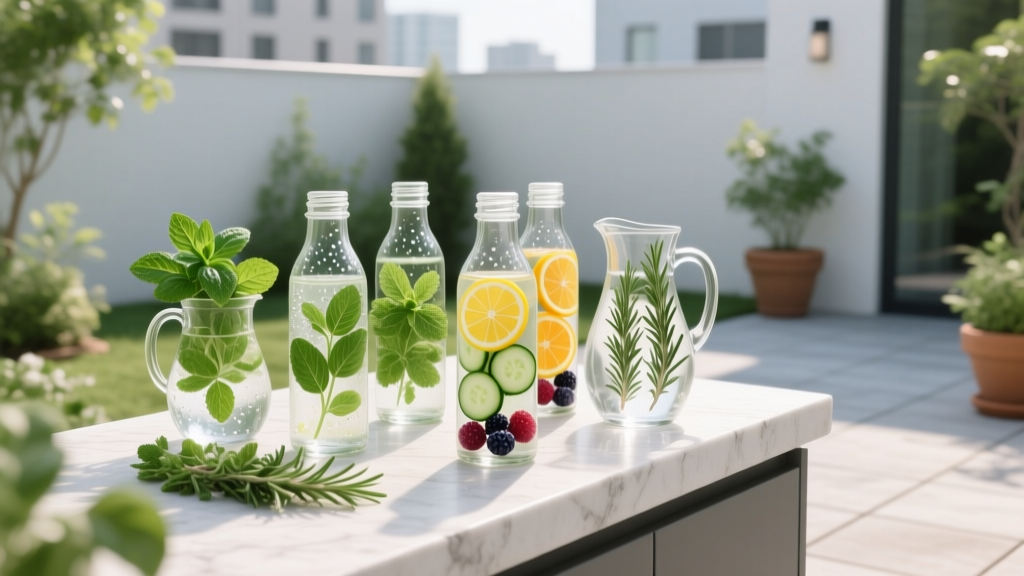
Patio Herb Infused Water Garden
The July heat has settled in, and your patio is doing that familiar thing: a couple of chairs you don’t sit in much, a grill that’s too hot to use until evening, and a thirsty pot of basil that keeps collapsing by 2 p.m. You want something lush and useful—something that earns its footprint. You also want a daily ritual that feels like a small luxury: stepping outside, clipping a sprig of mint, dropping it into a glass of cold water, and letting the patio smell like citrus and herbs instead of sun-baked concrete.
This is where a Patio Herb Infused Water Garden shines: a compact layout that pairs culinary herbs (especially the ones that make infused water taste bright) with a small water feature or water-harvesting element. The goal isn’t a fussy showpiece. It’s a practical, designerly setup that looks intentional, fits real-life patios, and pays you back with flavor, fragrance, and cooling ambience.
Design principles: make it feel like a “room” and work like a kitchen
Start with the triangle: door, sun, and faucet
Before you buy anything, stand at your patio door and note three points:
- Door-to-garden distance: You’ll use this daily, so keep the primary herb cluster within 6–10 feet of the door if possible.
- Sun pocket: Most sun-loving herbs perform best with 6+ hours of direct sun. A spot that gets 4–6 hours can still work if you lean into partial-shade herbs (more on that below).
- Water access: If you have a hose bib or kitchen sink access, place the thirstiest pots within 12 feet to avoid dragging hoses across seating.
In landscape design, frequency of use dictates proximity. Herbs are high-frequency plants—treat them like your outdoor pantry, not background decor.
Use the “three-layer” layout for small spaces
Even a 6 ft x 8 ft patio can feel planted if you layer vertically:
- Low layer (0–12 inches): creeping thyme, strawberries, trailing rosemary.
- Mid layer (12–30 inches): basil, mint (contained), parsley, cilantro, chamomile.
- High layer (30–72 inches): a narrow trellis with lemon cucumber, a columnar citrus (in warm climates), or a tall pot with lemongrass.
This structure keeps the center open for feet and chairs, while the perimeter reads as “garden.”
Anchor with water: sound, reflection, or storage
Your “water” element can be one of three practical forms:
- Circulating bowl fountain (sound + cooling feel): choose a basin around 18–24 inches wide so it doesn’t dominate.
- Mini wildlife dish (still water you refresh daily): a shallow bowl 12–16 inches wide works well and is easy to clean.
- Rain-catch container (function-first): a slim rain barrel or lidded storage can tucked near a downspout (for homeowners).
Small note, big impact: in mosquito-prone areas, avoid standing water unless you refresh it every day or keep it circulating.
“A small water feature can mask urban noise and create a restorative micro-environment even in compact gardens.” — Royal Horticultural Society (RHS), 2020
Layout strategies you can copy (with real dimensions)
Plan A: The 6' x 8' renter-friendly rail-and-pots layout
Best for: apartment patios and rentals with no drilling allowed.
Footprint: Keep a clear path at least 30 inches wide for comfortable movement. Arrange everything along two edges in an L-shape.
- Rail planters: 3 planters at 24 inches long each for light herbs (thyme, chives, small basil).
- Main herb cluster: 4 containers, each 12–14 inches in diameter, grouped within 2 feet of your door.
- Water element: one 18-inch glazed bowl fountain (plug-in pump) placed in the corner to visually “finish” the L.
Spacing rule: leave 3–4 inches between pots to improve airflow and reduce mildew on basil and mint.
Plan B: The 10' x 10' “hydration courtyard” with a center bowl
Best for: homeowners or long-term renters who can commit to a focal point.
Place a low water bowl in the center (22–24 inches wide), then ring it with 6–8 herb pots. This is a classic courtyard move—one focal element, a walkable circle, and everything within arm’s reach.
- Center: bowl fountain on a 16-inch pedestal (optional) for easier cleaning.
- Ring pots: 8 pots at 10–12 inches diameter; set them 10–12 inches apart rim-to-rim so foliage can touch slightly by midsummer without overcrowding.
- Seating: one bistro set; keep 36 inches clear behind chairs so you can stand up without shuffling pots.
Plan C: The 3' x 12' narrow balcony run
Best for: long, skinny balconies where width is the limiting factor.
Go linear. Use rectangular planters (36 inches long x 12 inches wide) placed end-to-end along the railing side, and keep the walking lane clean.
- Planter run: three 36-inch troughs for thyme, parsley, basil, and edible flowers.
- Vertical: one tension-rod trellis or freestanding ladder shelf (no wall fasteners) for lemon balm and trailing rosemary.
- Water: a slim circulating wall fountain is tempting, but a safer balcony choice is a 14-inch shallow basin you refresh daily (less splashing, less weight).
Plant selection for infused water (with varieties that behave well in pots)
Infused-water herbs should be fragrant, non-bitter, and productive with frequent pinching. You also want plants that tolerate container life: steady moisture, warmer roots, and periodic trimming.
Top herbs for bright flavor (and why they work)
- Spearmint (Mentha spicata): the classic “fresh” taste. Keep it in its own pot—mint spreads aggressively in beds. Choose a 10–12 inch pot minimum.
- Lemon balm ‘Quedlinburger Niederliegende’ (Melissa officinalis): lemony, calm, and forgiving in partial shade. Great for balconies with 4–5 hours sun.
- Pineapple mint (Mentha suaveolens ‘Variegata’): softer mint flavor and variegated leaves that read bright in design. Slightly less aggressive than some mints, still container-only.
- Thai basil (Ocimum basilicum var. thyrsiflora): holds up better to heat than some sweet basils, and the anise note pairs well with citrus slices.
- Sweet basil ‘Prospera’: a downy mildew resistant variety; helpful in humid summers where basil can fail fast.
- French tarragon (Artemisia dracunculus): subtle anise; use sparingly in water infusions. Needs sharp drainage—think gritty potting mix.
- Chives (Allium schoenoprasum): not a typical infused-water herb, but the purple blooms attract pollinators and make the patio feel alive. (Use blooms as garnish, not the oniony leaves, for water.)
Edible flowers and “bonus” infusers
- Nasturtium ‘Jewel Mix’: peppery flowers; best as garnish with cucumber and citrus.
- Calendula ‘Pacific Beauty’: petal confetti for pitchers; handles containers well.
- Lemongrass (Cymbopogon citratus): dramatic vertical accent. One plant can fill a 16–18 inch pot by late summer.
- Lemon cucumber (Cucumis sativus ‘Lemon’): climb it up a trellis; you get edible fruit plus shade dappling. Needs consistent watering.
Sun and spacing cheat sheet
Most culinary herbs prefer sun. According to Penn State Extension (2019), many common herbs perform best with 6–8 hours of sunlight daily. Use that as your benchmark, then adjust by microclimate (reflective walls and warm paving can add heat stress).
| Plant | Container Size | Sunlight | Spacing in a Trough | Infused Water Pairings |
|---|---|---|---|---|
| Spearmint | 10–12 in pot (solo) | 4–6+ hrs | Not recommended (spreads) | Lime, cucumber |
| Sweet basil ‘Prospera’ | 10–12 in pot | 6–8 hrs | 10–12 in apart | Strawberry, lemon |
| Lemon balm | 10 in pot | 4–6 hrs | 12 in apart | Lemon, blueberries |
| Lemongrass | 16–18 in pot | 6–8+ hrs | One per trough section | Ginger, lime |
| Creeping thyme | 8–10 in pot / edge | 6+ hrs | 6–8 in apart | Orange, honey (served separately) |
Three real-world patio scenarios (and how I’d design each)
Scenario 1: The shaded rental patio with one bright corner
You have a north-facing patio, but there’s a sun spill near the railing for about 4 hours a day. In this case, I’d design for “freshness” rather than heavy basil production:
Use lemon balm, chives (for flowers), parsley ‘Italian Flat Leaf’, and mint in separate containers. Add a small reflective water bowl (14–16 inches) to bounce light upward. Place basil only in the sunniest corner in a dark-colored pot you can move—basil likes heat, but it needs consistent moisture.
Scenario 2: The full-sun concrete patio that bakes plants
South or west exposure plus concrete can push pot temperatures high. The fix is less romantic but very effective: bigger soil volumes and morning watering.
I’d move you toward 14–16 inch pots (instead of 10-inch) for basil and lemongrass, and I’d add a drip tray and mulch the surface with 1 inch of fine bark or straw to slow evaporation. A circulating bowl fountain earns its keep here—the sound cools the mood, and the humidity micro-bump helps herbs handle afternoon stress.
Scenario 3: The tiny balcony where weight and wind matter
Balconies are a design puzzle: you want abundance, but you can’t overload the structure or create wind sails. Use fewer, better pieces.
I’d specify two 36-inch trough planters instead of six small pots. Choose shorter herbs (thyme, parsley, compact basil) and one vertical accent (lemongrass is great if the pot is stable). For water, skip heavy ceramic fountains; use a lightweight composite bowl and refresh it daily, or use a sealed self-watering reservoir planter to keep herbs steady without open water.
Step-by-step setup (a designer’s sequence that avoids common mistakes)
- Map your usable rectangle. Measure the patio and mark a “no-plant” walking lane of 30–36 inches. This one step prevents the classic cramped-pot obstacle course.
- Choose your water element first. If you’re doing a fountain, confirm you have a nearby outlet and a cord path that doesn’t cross traffic. Aim for a basin around 18–24 inches wide.
- Pick 6–10 plants max to start. Overplanting looks lush for two weeks, then turns into a pruning job. Start with: 2 mints (in separate pots), 2 basils, lemon balm, thyme, calendula, and lemongrass.
- Size containers for roots, not the shelf label. For basil and mint, use 10–12 inch pots. For lemongrass, use 16–18 inch. Bigger pots buffer heat and missed waterings.
- Use quality potting mix and add drainage insurance. Fill pots with a peat-free or standard potting mix; for herbs that hate wet feet (thyme, tarragon), blend in 20–30% pumice or perlite.
- Plant at the same depth as the nursery pot. Herbs resent being buried too deep. Firm in gently, then water until it runs out the bottom.
- Group by water needs. Put thirsty plants (basil, cucumbers) closer together so you can water efficiently, and keep drought-tolerant herbs (thyme, rosemary) slightly apart.
- Finish with a functional garnish station. A small tray table or shelf near the herbs holds scissors, a pitcher, and a basket of citrus. This is what makes the garden get used.
Budget, costs, and smart DIY alternatives
You can build this garden on a modest budget or make it feel like a boutique hotel patio—your choice. Here are realistic cost ranges (in USD) that match typical retail pricing:
- Herb plants: $4–$8 each for 4-inch pots; a starter set of 8 plants often lands around $40–$60.
- Containers: basic plastic or resin pots $6–$15 each; nicer ceramic/glazed pots $25–$60 each.
- Potting mix: a 2 cu ft bag typically covers several medium pots and often costs $12–$20.
- Small pump fountain kit: commonly $25–$50 (pump + tubing); decorative bowls vary widely.
- Rail planters (set of 3): often $30–$70 depending on material and brackets.
DIY alternatives that look intentional:
- Fountain on a budget: use a watertight bowl you already have, add a small submersible pump, and hide the cord behind a pot. You can build a convincing feature under $40 if the bowl is already in your house.
- Self-watering hack: convert a 5-gallon food-safe bucket into a reservoir planter with a wicking cup. This is especially useful for basil if you travel on weekends.
- Upcycled trough: an old window box lined with heavy pond liner becomes a lightweight “herb bar.” Just punch drainage holes where you want them.
Keeping it thriving: maintenance rhythms you can actually stick to
This garden is designed to be used, which means it needs simple, repeatable care. Expect about 20–40 minutes per week in peak season once everything is set up.
Weekly care (growing season)
- Water: check containers 3–5 times per week in summer; daily during heat waves. The smaller the pot, the faster it dries.
- Harvest/prune: pinch basil tips weekly to prevent flowering and keep leaves tender.
- Clean water element: refresh and wipe the bowl 1–2 times per week; if circulating, rinse the pump intake every 2 weeks.
Seasonal tasks
- Spring (setup and reset): top-dress pots with fresh mix or compost; replace weak plants. If basil struggled last year, swap to a resistant variety like ‘Prospera’.
- Mid-summer (heat management): add shade cloth on extreme days or move the most tender pots back from reflective walls.
- Fall (extend the harvest): bring basil indoors before nights drop below 50°F. Mint, thyme, and chives can often handle cool weather outdoors depending on your zone.
- Winter (patio editing): drain fountains if freezing is likely; store pumps indoors to extend lifespan.
For food safety, rinse herbs before using them in pitchers. The CDC (2022) emphasizes rinsing produce under running water to reduce contaminants—especially important when you’re harvesting from a patio that collects dust and city grime.
Infusion recipes that guide the planting plan
Design works best when it supports real habits. If your goal is infused water, plant for combinations you’ll actually crave:
- Classic patio pitcher: spearmint + cucumber + lime.
- Heat-day refresher: lemon balm + strawberry + lemon slices.
- Evening calm: chamomile flowers + a sprig of pineapple mint (lightly bruised).
- Bold and citrusy: lemongrass + ginger (kitchen) + lime.
One practical note: strongly flavored herbs (tarragon, rosemary) can go medicinal fast. Use them as accents—one small sprig per pitcher is plenty.
Small design upgrades that make it feel “finished”
After the plants settle in, the difference between a collection of pots and a designed patio is usually three details:
- Repetition: repeat one pot color or material at least 3 times so the eye reads a pattern.
- A boundary edge: a slim outdoor rug or a line of rectangular planters creates a “garden zone” without construction.
- Lighting: one warm LED uplight aimed through thyme and mint makes the patio usable after sunset and highlights texture.
If you build this with an honest walking lane, right-sized pots, and a small water note, the patio stops being leftover space. It becomes a place you step into for a glass of something cold, made better by what you grew five feet from your door.
Sources: Royal Horticultural Society (RHS), 2020; Penn State Extension, 2019; Centers for Disease Control and Prevention (CDC), 2022.