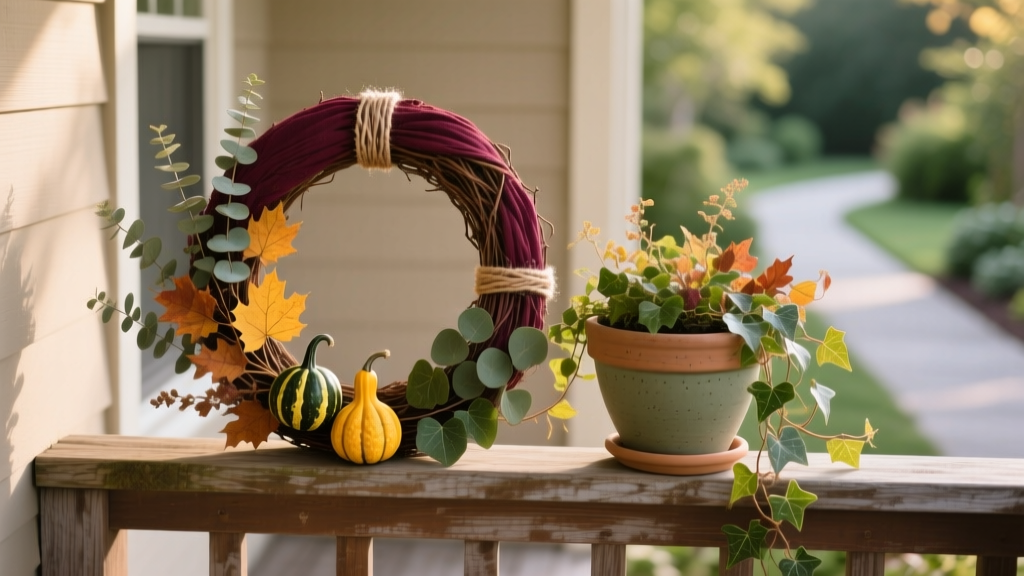
Porch Seasonal Wreath and Planter Combo
It’s 6:30 p.m., the sun is dropping behind the neighbor’s roofline, and your porch light makes everything look a little flatter than you remembered. The front door is fine. The railing is fine. But the entry still feels unfinished—like it’s missing a “hello.” You’ve tried a single pot, maybe a lonely mum in fall, but it never quite connects with the door. The trick is not buying more decor; it’s designing one coordinated moment: a seasonal wreath paired with planters that echo its color, texture, and scale.
This project is built for homeowners and renters because it’s modular. You can do it with two planters and a wreath on a 4 ft-wide stoop, or scale it up to a full porch run. The goal: create a welcoming focal point from the sidewalk while keeping the setup easy to swap seasonally—without storing a garage full of stuff.
Start With the “Triangle”: A Simple Layout That Reads as Designed
Designers rely on a visual triangle because the eye loves a stable composition. Your porch version is:
- Top point: the wreath (eye level, centerline of the door).
- Bottom points: two planters (left and right of the door, or one planter + one lantern/bench if space is tight).
A good baseline for a standard entry: hang the wreath so its center sits at about 57–60 inches from the porch floor (roughly average eye height), and place planters so their outer edges sit 6–12 inches from the door trim. This keeps the door swing clear while still feeling “framed.”
Dimension Rules That Prevent the “Undersized” Look
Most porch decor fails because it’s too small for the architecture. Use these proportions as guardrails:
- Wreath diameter: aim for 22–28 inches for a typical 36-inch-wide front door. A very tall door (8 ft) can handle 28–32 inches.
- Planter height: choose containers 16–24 inches tall for presence. Shorter pots can work, but you’ll need a taller “thriller” plant to compensate.
- Planter width: 14–20 inches wide is a sweet spot for stability and soil volume.
- Walkway clearance: maintain at least 36 inches of clear walking space on the porch/stoop for comfortable passing (especially important for rentals and multi-family entries).
Light and Exposure: Design for the Sun Hours You Actually Get
Before you pick plants, watch your porch for one day. Many “full sun” plant failures happen because porches are shady by design. Track direct sun on the spot where planters will sit:
- Full sun: 6+ hours direct light (rare on covered porches).
- Part sun/part shade: 3–6 hours direct light.
- Shade: 0–3 hours direct light (common on north-facing or deep porches).
Plan for wind, too. Elevated porches and corners create gusts that dry containers quickly. If your planters are exposed, consider heavier pots (or add gravel in the bottom only if the container is so light it tips—otherwise use soil volume for stability).
Color Echoing: Tie the Wreath to the Planters With 3 Repeats
To make the wreath-and-planter combo feel intentional, repeat three elements across both:
- One main color (e.g., burgundy, chartreuse, icy white).
- One texture (glossy leaves, fine grass blades, twiggy stems).
- One shape (round berries, spiky foliage, trailing vines).
Example: a winter wreath with eucalyptus (cool green), pine cones (rough texture), and red berries (round shape) pairs beautifully with planters using dwarf conifers (cool green), birch branches (rough), and winterberry stems (round red berries).
Choosing Containers: The Quiet Backbone of the Design
Containers do more than “hold plants.” They set the style language: modern, cottage, farmhouse, coastal. They also determine how often you water.
Material and Cost Benchmarks
For a practical starting budget, assume:
- Resin composite planters: $35–$80 each (lightweight, good for renters).
- Terra cotta: $25–$60 each (classic; dries faster; can crack in freeze/thaw).
- Glazed ceramic: $60–$150 each (beautiful; heavier; often best on stable porches).
- Wreath base and seasonal materials: $25–$90 depending on faux vs fresh.
Container sizing matters for plant health. A 16-inch pot holds enough volume to buffer heat and reduce watering stress compared with a 10–12-inch pot, which can dry out in a day during summer.
Plant Selection That Performs (and Looks Designed)
Use the classic “thriller, filler, spiller” approach, but tailor it to porch viewing. Your plants will be seen from the street and close-up at the door, so choose one bold structural element and then layer finer texture around it.
Spring Combo (Part Sun: 3–6 hours)
Wreath: grapevine base with faux or fresh tulips and seeded eucalyptus accents.
- Thriller: Salix integra ‘Hakuro Nishiki’ (dappled willow) trained as a small standard (1 per pot; airy spring look).
- Filler: Viola ‘Sorbet Mix’ pansies (plant 6–8 inches apart; cold-tolerant, early color).
- Spiller: Lysimachia nummularia ‘Aurea’ (creeping Jenny) (1–2 plants per pot; chartreuse spill echoes fresh greens).
Why it works: pansies handle chilly nights; creeping Jenny softens pot edges; dappled willow adds height without needing full sun.
Summer Combo (Sun: 6+ hours)
Wreath: preserved or faux citrus + greenery for a crisp, heat-season look.
- Thriller: Canna ‘Pretoria’ (1 per large pot; bold striped foliage).
- Filler: Pelargonium ‘Calliope Dark Red’ geranium (2–3 per 18–20-inch pot; strong flowering).
- Spiller: Ipomoea batatas ‘Sweet Caroline Light Green’ sweet potato vine (1 per pot; dramatic trailing).
Why it works: cannas read from the curb; geraniums handle heat; sweet potato vine connects planter to porch floor line.
Shade Summer Combo (0–3 hours)
Wreath: deeper greens + white flowers (hydrangea-style faux blooms) to brighten shade.
- Thriller: Begonia ‘Whopper Rose with Bronze Leaf’ (1–2 per pot; big presence without sun).
- Filler: Coleus ‘ColorBlaze El Brighto’ (2–3 per pot; vibrant foliage in shade).
- Spiller: Bacopa ‘Snowstorm’ (1–2 per pot; small white flowers cascade nicely).
Why it works: shade porches need foliage contrast more than flowers; these varieties hold color with limited sun.
Fall Combo (Part Sun to Sun)
Wreath: dried grass plume accents + mini pumpkins (or faux for durability).
- Thriller: ornamental pepper Capsicum annuum ‘Black Pearl’ (1 per pot; dark foliage + glossy fruit).
- Filler: garden mums (Chrysanthemum) in one color family—e.g., bronze or burgundy (1–2 per pot depending on size).
- Spiller: Hedera helix ‘Needlepoint’ ivy (1 per pot; trailing texture that feels “harvest-season”).
Why it works: mums provide the seasonal signal; ornamental pepper adds designer-level contrast; ivy ties everything together.
Winter Combo (All exposures, with the right materials)
Wreath: fresh evergreen base (fir, pine, cedar) with pine cones and weatherproof ribbon.
- Thriller: bundled red twig dogwood (Cornus sericea) stems (3–7 stems per pot depending on thickness).
- Filler: mixed evergreen boughs (noble fir, cedar, pine) tucked into soil (a “cut arrangement” approach).
- Spiller: variegated boxwood or cedar garland draped slightly over the edge (secured with floral picks).
Why it works: you’re not relying on roots in frozen soil; cut greens stay attractive for weeks in cold weather.
“The right plant in the right place is the cornerstone of sustainable landscape design—reduce inputs by matching species to site conditions.” — Royal Horticultural Society (RHS), guidance on sustainable gardening (2021)
Comparison Table: Pick a Planter Strategy That Matches Your Lifestyle
| Strategy | Best For | Typical Cost (Pair of Planters + Wreath) | Watering | Seasonal Swap Difficulty |
|---|---|---|---|---|
| All-live plants (spring/summer/fall) + fresh winter greens | People who enjoy weekly care | $140–$320 | 2–4x/week in summer | Medium |
| Live planters + faux wreath | Renters who want less storage | $120–$260 | 2–4x/week in summer | Easy |
| Faux planters inserts + faux wreath | Frequent travelers, very low maintenance | $180–$450 | None | Very easy |
| Hybrid: one live “hero” pot + one styled decor pot (branches/lantern) | Very small porches, tighter budgets | $90–$210 | 1–3x/week | Easy |
Three Real-World Layout Scenarios (with Measurements)
Scenario 1: The 4 ft-Wide Apartment Stoop (Rental-Friendly)
You have a single step and a narrow landing. The door swings outward, so space is tight.
- Layout: one planter on the hinge side (so it doesn’t block your body as you enter), and a slim lantern or vertical house-number plaque on the other side.
- Planter size: one 14-inch diameter pot, placed 8 inches from the trim.
- Wreath: 22-inch diameter to avoid overwhelming the door.
- Best plants: shade coleus + bacopa, or sun geranium + sweet potato vine depending on exposure.
Budget move: use a lightweight resin pot ($40) and a faux wreath ($35) so you can move out easily without worrying about damage or storage.
Scenario 2: The Classic Suburban Porch (6–8 ft Wide) with Two Planters
You have room to frame the door properly. This is where symmetry shines.
- Layout: two matching pots, each centered about 18–24 inches from the door trim to give breathing room.
- Planter size: two 18–20-inch wide containers for stability and scale.
- Wreath: 26–28 inches diameter for strong curb read.
- Planting density: in each pot, 1 thriller + 3 fillers + 1 spiller (a reliable, full look).
Budget expectation: two decent containers at $70 each + plants around $45 per pot (nursery prices vary) + wreath materials $60 puts you near $290 for a porch that looks professionally styled.
Scenario 3: A Covered North-Facing Porch (Brighten the Shade)
The porch is deep, so you get little direct light—maybe 1–2 hours in the morning. Flowers can look tired here unless they’re shade-adapted.
- Layout: keep planters slightly forward, near the porch edge, where they catch more ambient light.
- Planter color: choose lighter pots (cream, light gray) to lift the scene visually.
- Plant palette: big-leaf begonias, coleus, and trailing bacopa or creeping Jenny.
Designer trick: use a wreath with higher contrast—white blooms, pale ribbon, and clear negative space—so it reads under a porch light at night.
Step-by-Step Setup: Build the Combo Like a Designer
- Measure your door zone. Note door width (often 36 inches), available porch width, and where the door swings.
- Pick a seasonal color story. Choose one main color + one accent + one neutral (example: burgundy + copper + evergreen).
- Select the wreath size. Use 22–28 inches as your typical range; larger doors can go bigger.
- Choose containers first. Match height and material; aim for 16–24 inches tall for presence.
- Stage before planting. Put empty pots in place, hang the wreath, and step back to the sidewalk. Adjust spacing until it feels balanced.
- Plant with a clear structure. Place the thriller off-center (not dead center) to create movement; space fillers 6–10 inches apart depending on mature spread.
- Mulch the top. Add a 1-inch layer of fine bark or compost to reduce evaporation and make it look finished.
- Water deeply. Water until it runs out the drainage holes; shallow watering trains roots to stay near the surface.
- Finish with one unifying detail. Repeat ribbon color from the wreath on the pots (small bow on each planter handle, or a matching doormat stripe).
Budget-Smart and DIY Alternatives That Still Look Intentional
You don’t need boutique materials to get a designed look—you need repetition and scale. Here are practical swaps:
- DIY wreath base: buy a 14–16 inch grapevine base ($10–$18) and build up with seasonal stems from a craft store. Add one quality ribbon and reuse it all year.
- Nursery pot “drop-in” method: set grower pots inside a nicer outer cachepot. You can swap plants fast without dumping soil—great for renters.
- Branch foraging (where permitted): use fallen evergreen boughs or twigs to bulk up winter pots. The design looks high-end even when the materials are free.
- One hero pot approach: invest in one large statement planter and keep the other side minimal (a small stool + lantern). Symmetry is optional if the balance feels intentional.
Also, remember that healthy plants are a cost saver. According to the University of Illinois Extension, containers require more frequent watering than in-ground beds because they dry out faster (University of Illinois Extension, 2020). Spending a little more on a larger pot can reduce plant loss mid-season.
Maintenance Expectations: What It Really Takes Week to Week
Plan on 20–40 minutes per week for two planters during the growing season. In peak summer heat, watering can jump to 10 minutes per day if your porch is hot and windy.
Weekly Tasks (Spring to Fall)
- Watering: check soil with a finger; water when the top 1 inch is dry.
- Grooming: pinch off spent blooms (especially geraniums and pansies) to keep the look crisp.
- Rotate pots: if you get one-sided sun, rotate each pot a quarter turn weekly for even growth.
Monthly Tasks
- Fertilizer: use a slow-release fertilizer at planting, or a liquid feed every 2–4 weeks depending on product label and plant vigor. Container plants deplete nutrients faster (RHS container gardening guidance, 2021).
- Pest check: inspect undersides of leaves for aphids or whiteflies, especially on begonias and coleus in warm weather.
Seasonal Swap Rhythm
- Spring: cool-season color (pansies, bulbs in pots) as early as your last frost window allows.
- Summer: heat lovers after nights stay reliably above 50°F.
- Fall: mums, ornamental kale, peppers when nights cool; add lights as days shorten.
- Winter: remove tender plants; switch to cut evergreens and branches; refresh greens every 4–8 weeks depending on exposure and drying.
Small Details That Make It Feel Professionally Finished
Use lighting as part of the composition. A warm LED porch bulb (around 2700K) flatters greens and makes berries/pumpkins glow at night. If you use string lights, keep them tight and intentional—wrapped through winter branches or around the wreath—rather than draped randomly.
Mind the door hardware. If you have brass hardware, pull a little gold into ribbon or pot accents. If you have matte black hardware, choose charcoal pots or black lanterns so everything belongs together.
Keep a “seasonal kit.” Store one small bin: ribbon spools, floral wire, hooks, and a few reusable picks. This makes seasonal swaps feel like a 30-minute refresh instead of a full shopping trip.
When your wreath and planters share the same design language—repeated color, repeated texture, and the right scale—the porch stops feeling like a pass-through. It becomes a composed entry that looks good in daylight, holds up under porch lights, and adapts to the season without starting from scratch every time.
Citations: Royal Horticultural Society (RHS), guidance on sustainable gardening and container care (2021). University of Illinois Extension, container gardening/watering considerations (2020).