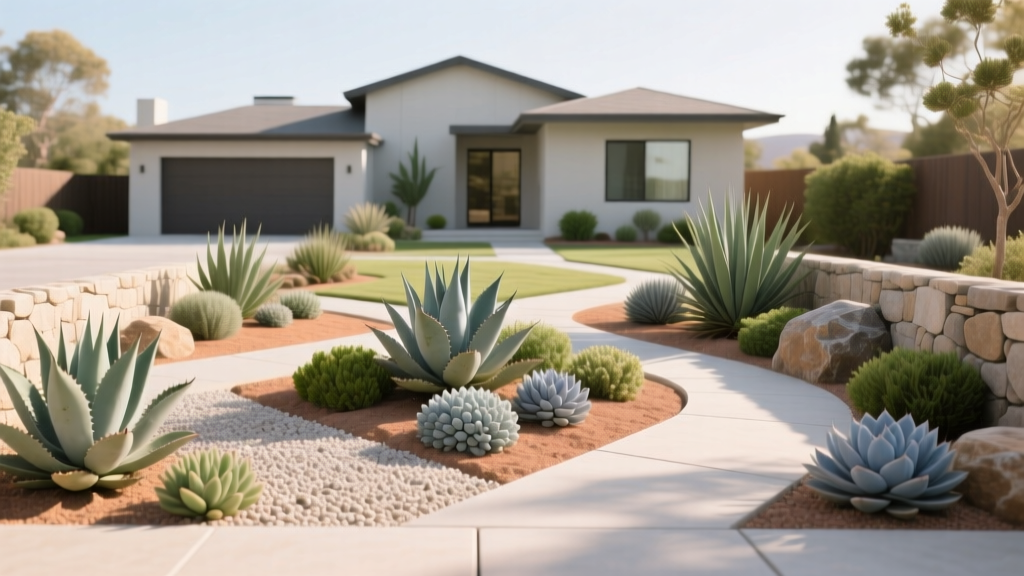
Front Yard Xeriscape Design Guide
The hose is still coiled on the driveway, but you already know it’s not going to save this front yard. It’s mid-summer, the sun hits the curb like a skillet for 7–9 hours a day, and the strip of lawn between sidewalk and porch has turned into a patchy, thirsty quilt. Meanwhile, the water bill keeps creeping up, and the front door view—your home’s first impression—feels more stressful than welcoming.
Let’s redesign it the way a landscape designer would: start with the bones (layout), then layer in durable plants, then finish with mulch and stone so it looks intentional—not like a “no-lawn” experiment. Xeriscape isn’t a specific style; it’s a water-wise strategy. Done well, it reads as clean, modern, and cared for.
Start with the site: measure, map, and notice the “microclimates”
Before you pick a single plant, grab a tape measure and spend 20 minutes in observation mode. Front yards are full of microclimates: heat reflecting off the driveway, shade from a porch roof, wind tunnels between houses. Those little differences decide which plants thrive.
Quick baseline data to collect
- Dimensions: Measure the total planting area. Example: a 20 ft x 30 ft front yard is 600 sq ft.
- Sun: Note how many hours of direct sun the main bed gets. Many xeric plants prefer 6–8+ hours.
- Slope: Even a gentle 2–5% grade changes runoff; steeper spots need erosion control.
- Water access: Identify spigots and existing irrigation lines.
- Soil: Do a simple drainage test: a 12-inch-deep hole should drain in 2–4 hours for many drought-tolerant plants (fast-draining is fine; soggy is not).
If you want a data-backed reason to prioritize soil and irrigation efficiency, the EPA notes that residential outdoor water use can be substantial, and irrigation efficiency matters for saving water (U.S. Environmental Protection Agency, 2023). And once you’re planning, remember the core xeriscape guidance—group plants by water needs, improve soil where needed, and mulch—long emphasized in extension programs like Colorado State University Extension (2022).
Design principles that keep xeriscapes from looking “random”
The biggest visual mistake in front-yard xeriscaping is scattering single plants like confetti. The fix is structure: clear lines, repeated shapes, and purposeful negative space (mulch or gravel).
1) Create a strong path and a clear “arrival” moment
If your current walk is a skinny concrete strip, you can still make the approach feel designed by widening the planting zones along it and anchoring the entry with a pair of larger forms (a small tree + bold grass, for example). A front walk that’s 4 ft wide is comfortable for two people to pass; if it’s only 3 ft, add planting pockets to visually widen it.
2) Use the 70/20/10 rule for a calm planting composition
As you lay out plants, aim for:
- 70% “background” plants (grasses, shrubs, groundcovers)
- 20% seasonal bloomers (perennials)
- 10% accents (architectural plants, boulders, specimen containers)
This ratio keeps the front yard tidy from the street even when flowers aren’t in peak bloom.
3) Group by water needs (hydrozones)
Xeriscape isn’t “never water.” It’s “water where it counts.” Place thirstier plants closer to the house or near a downspout where they’ll get incidental moisture, and keep the driest zone out near the curb where heat and reflected light are worst.
“The most successful water-wise landscapes are designed with hydrozones—grouping plants with similar water needs—so irrigation can be targeted instead of wasted.” — Colorado State University Extension, 2022
4) Design in layers: canopy, mid-layer, ground layer
Even a small front yard benefits from a simple three-layer structure:
- Canopy: one small tree or large shrub (visual anchor, shade, scale)
- Mid-layer: shrubs and grasses (the “body” of the design)
- Ground layer: low groundcovers + mulch/gravel (weed suppression, cohesion)
Layering is what makes a xeriscape look like a finished landscape instead of a collection of tough plants.
Layout strategies: three proven front-yard templates
Pick a template that matches your yard shape and how you actually use the space. Then customize the plant palette to your climate zone and sun exposure.
Template A: The “Curb-to-Entry” ribbon (great for narrow yards)
Best for: homes with a straight walk and a strip of lawn on each side.
Layout idea: Run a sweeping bed from curb to porch on one side of the walkway, and keep the other side simpler (gravel + a few repeating grasses). This asymmetry feels modern and reduces planting complexity.
Dimension cue: Make the main bed at least 5–6 ft deep so plants can layer without crowding.
Template B: The “Island beds” approach (great for renters or phased installs)
Best for: anyone who wants to convert lawn slowly without tearing everything out at once.
Layout idea: Create two or three mulched islands (think kidney shapes) with stepping stones between them. Each island becomes its own hydrozone.
Dimension cue: Keep at least 36 inches of clear path space between islands so mowing or walking doesn’t feel cramped.
Template C: The “Courtyard feel” (for small front yards and patios)
Best for: townhomes, compact lots, or a front yard that functions like a sitting area.
Layout idea: Use decomposed granite or gravel as the main surface, then soften edges with raised planters or boulders and a few statement plants in clusters.
Cost cue: Decomposed granite installed DIY typically runs about $1.50–$3.00 per sq ft for materials depending on region and depth; professional installation is often higher.
A practical comparison: mulch, gravel, or living groundcover?
The “floor” of your xeriscape matters as much as the plants. Here’s how the common options stack up for front yards.
| Surface option | Best use | Typical depth / spacing | Maintenance | Notes for curb appeal |
|---|---|---|---|---|
| Shredded bark mulch | Planting beds with shrubs/perennials | Apply 2–3 inches | Top up 1x/year; quick weeding | Warm, inviting look; great around foundation plants |
| Gravel (3/8" or 1/2") | Hot, sunny curb zones; modern designs | Install 2 inches over fabric (optional) or compacted base | Blow debris; spot-weed | Looks crisp with steel edging; reflects heat (choose plants accordingly) |
| Living groundcover | Slopes and areas you want cooler + greener | Plant plugs 12–18 inches apart | Weed early; trims 2–3x/year | Softens the yard; takes time to fill in but reads lush once established |
Plant selection: reliable xeric favorites (with spacing and design roles)
Choose plants the way you’d cast a room: a few “furniture” pieces (structural shrubs/grasses), then supporting characters (perennials), then details (groundcovers). The list below includes widely available varieties that perform well in many water-wise landscapes; always cross-check with your USDA hardiness zone and local recommendations.
Structural anchors (the bones)
1) Desert willow (Chilopsis linearis)
Why it works: Airy shade, long bloom season, thrives in heat once established.
Placement: 10–15 ft from the house for mature spread.
Spacing: Allow 12–18 ft width depending on cultivar.
2) Red yucca (Hesperaloe parviflora)
Why it works: Architectural form, coral flower spikes, handles reflected heat near driveways.
Spacing: 3–4 ft apart for a rhythm along a walk.
3) Little bluestem (Schizachyrium scoparium ‘Standing Ovation’ or similar)
Why it works: Upright habit, blue-green summer blades, copper fall color; looks designed in masses.
Spacing: Plant 18–24 inches on center for a full drift.
Mid-layer shrubs (shape and year-round structure)
4) Lavender (Lavandula x intermedia ‘Grosso’ or ‘Phenomenal’)
Why it works: Drought-tolerant once established, strong scent, pollinator-friendly, tidy mounds.
Sun: Needs 6+ hours of direct sun.
Spacing: 30–36 inches apart for airflow.
5) Rosemary (Salvia rosmarinus ‘Arp’ or trailing types)
Why it works: Evergreen, edible, tough; trailing rosemary spills over walls beautifully.
Spacing: Upright 3–4 ft; trailing 4–6 ft spread depending on type.
6) Texas sage (Leucophyllum frutescens)
Why it works: Silvery foliage that reads clean and bright; blooms after humidity/rain in many regions.
Spacing: 4–6 ft depending on cultivar.
Perennials for seasonal color (repeat these for cohesion)
7) Salvia (Salvia nemorosa ‘Caradonna’ or ‘May Night’)
Why it works: Strong vertical bloom spikes, long season, drought-tolerant once established.
Spacing: 18 inches apart.
8) Blanket flower (Gaillardia aristata)
Why it works: Heat-proof blooms, cheerful curb appeal, thrives in lean soil.
Spacing: 12–18 inches.
9) Yarrow (Achillea millefolium ‘Moonshine’)
Why it works: Ferny foliage, flat-topped blooms, handles drought and poor soils.
Spacing: 18–24 inches.
Groundcovers (to reduce weeds and soften edges)
10) Creeping thyme (Thymus serpyllum)
Why it works: Low, fragrant, fills between stepping stones; good for sunny edges.
Spacing: 8–12 inches.
11) Ice plant (Delosperma cooperi)
Why it works: Succulent groundcover with bright flowers; excellent for hot, dry strips.
Spacing: 12–18 inches.
12) Sedum (Hylotelephium ‘Autumn Joy’ and low sedums)
Why it works: Drought-tolerant, reliable, good texture contrast with grasses.
Spacing: 18 inches.
Three real-world front yard scenarios (and how to design each)
Here are three situations I see constantly—each needs a slightly different xeriscape approach.
Scenario 1: The hellstrip (parkway strip) that bakes all day
Typical conditions: 3–5 ft wide strip, reflected heat from asphalt, dog traffic, inconsistent watering.
Design move: Keep it simple and tough: one repeating grass + one repeating flowering perennial + gravel mulch. Use metal edging to make it look intentional.
Example layout for a 4 ft x 25 ft strip (100 sq ft):
- 5 Little bluestem planted 24 inches apart (a rhythmic line)
- 7–9 Blanket flower planted 14–16 inches apart between grasses
- Gravel mulch at 2 inches depth for weed suppression
Budget note: If plants average $12 per 1-gallon perennial and grasses are $15 each, you’re roughly in the $170–$250 range for plants plus gravel.
Scenario 2: A small front yard where you want a seating moment
Typical conditions: 200–400 sq ft total, you want it to feel like a mini courtyard without adding a big patio.
Design move: Replace lawn with a decomposed granite “outdoor rug,” then plant around the edges with two strong focal points.
Example for a 12 ft x 20 ft area (240 sq ft):
- DG area: 160 sq ft for a chair + small table zone
- Planting beds: 80 sq ft around edges
- One Red yucca on each side of the “entry” to the seating area (2 total)
- A drift of lavender: 5 plants at 30 inches spacing
Budget note: A DIY DG area at $2.25/sq ft for materials puts 160 sq ft around $360 (materials). Add $150–$300 for plants and edging, and you can create a very finished look under $700 if you do the labor.
Scenario 3: Rental-friendly front yard upgrades (low risk, high impact)
Typical conditions: You can’t tear out everything, or you may move in 1–2 years.
Design move: Think “layers you can take with you”: large pots, mulched islands, and removable drip lines.
Example plan:
- 2 large containers (at least 18–22 inches wide) flanking the steps with rosemary or dwarf olive (if climate allows)
- One mulched island bed 6 ft x 8 ft using cardboard sheet mulch underneath
- Repeat one tough perennial (salvia) in groups of 3 or 5 for a designed feel
Budget note: You can often build a clean container-and-island refresh for $200–$450 using mid-priced pots, a few shrubs, and mulch.
Step-by-step: a designer’s install sequence (DIY-friendly)
This is the order that keeps projects efficient and prevents you from trampling fresh plantings while you’re still moving rock and mulch.
- Draw your base map with measurements (even a rough sketch). Mark the house, walk, driveway, utilities, and where downspouts drain.
- Decide your hydrozones: driest near curb/driveway, moderate near entry, highest water near downspout or shaded foundation pockets.
- Lay out bed lines with a garden hose or marking paint. Step back to the curb and adjust until the curves look calm, not wiggly.
- Remove turf using a sod cutter, shovel, or sheet mulching (cardboard + mulch). If you sheet mulch, plan a lead time of 6–10 weeks for best breakdown before planting.
- Improve soil only where needed. Many xeric plants dislike rich, wet soil. In heavy clay, add mineral grit or compost sparingly and focus on drainage and grading.
- Install irrigation (optional but smart): a simple dripline with 1/2-inch tubing and emitters (or inline drip) lets you water deeply during establishment with minimal waste.
- Place plants in pots first and check spacing from the street view. Group in odd numbers (3, 5, 7) and repeat the same plants to make it feel designed.
- Plant and water in. Water deeply on planting day to settle soil around roots.
- Add mulch or gravel: 2–3 inches of mulch in planted beds; keep mulch a few inches away from shrub trunks.
- Edge for a finished look (steel, brick, or a clean shovel-cut edge). This one detail often determines whether xeriscapes look crisp or messy.
Budget planning: where to spend, where to save
If you’re trying to keep costs controlled, prioritize the parts that are hard to change later: layout lines, paths, and the anchor plants.
Smart splurges
- One small tree (shade and scale payoff is huge)
- Edging (steel edging can be transformative for clean lines)
- Quality drip parts (leaks and clogs are frustrating and wasteful)
Good places to save (DIY alternatives)
- Sheet mulching with cardboard instead of hauling sod
- Start perennials from smaller pots (4-inch or 1-quart sizes fill in by year two)
- Use gravel strategically only in the hottest zones; mulch elsewhere to cut rock costs
As a rough planning number, many DIY front yard xeriscapes land between $3–$8 per sq ft depending on how much hardscape you add and the size of plants you buy. If you’re converting 600 sq ft, that’s roughly $1,800–$4,800 DIY; professional installs can exceed that depending on labor and materials.
Maintenance expectations: what you’ll do each week and each season
The promise of xeriscape isn’t “no maintenance.” It’s “less mowing, smarter watering, and calmer upkeep.” For most established front yard xeriscapes, expect about 20–40 minutes per week during the growing season for quick weeding, checking irrigation, and deadheading where you care about continuous blooms.
Seasonal rhythm
- Spring: Cut back ornamental grasses before new growth; refresh mulch; check drip emitters for clogs.
- Summer: Deep water on a schedule during establishment (often 1–2x/week at first, then taper); spot-weed after watering or rain.
- Fall: Light pruning for shape; plant new perennials so roots establish in cooler weather.
- Winter: Minimal; leave some seed heads for birds; plan any layout tweaks.
In year one, your job is establishment: consistent deep watering and weeding before weeds seed. By year two, plants shade the soil, roots go deeper, and your maintenance drops noticeably.
Details that make it look “designed” from the street
When I’m polishing a front yard xeriscape, I look for three finishing moves:
- Repeat 2–3 plants across the yard rather than using 15 different species once each.
- Keep sightlines open: don’t block windows with tall shrubs. A good rule is to keep foundation plants below the window sill line unless they’re meant to screen.
- Add one bold focal point: a boulder, a specimen yucca, or a clean container grouping near the entry.
One last design reality: the first month after installation can look a little sparse. That’s normal. Xeriscape plants need spacing for airflow and mature size. If you want instant fullness, fill gaps with annuals or small gravel areas—then let the perennials grow into the composition.
As you stand back at the curb, you’re aiming for a front yard that looks intentional at a glance: a clear path to the door, repeated shapes, and plants that belong in your climate. When the next heat wave hits, you’ll still have a welcoming entry—and the hose can stay neatly coiled, used only when the landscape actually needs it.
Sources: U.S. Environmental Protection Agency (EPA), 2023; Colorado State University Extension, 2022.