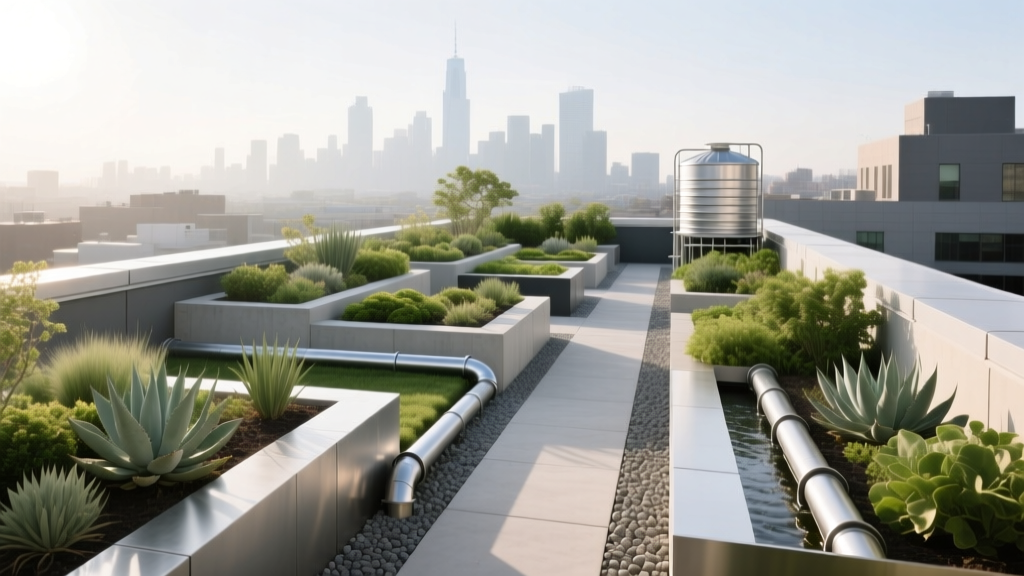
Rooftop Stormwater Management Garden
The first time you notice it, it’s not the view that grabs you—it’s the sound. Rain hits the roof, rushes toward the drain, and in minutes the downspout is roaring like a small waterfall. If you’re in a rowhouse, condo, or apartment building, you may also notice what happens next: puddles at the foundation, a slick alley, or an overloaded gutter that spills exactly where you don’t want it. A rooftop stormwater management garden turns that frantic “all at once” runoff into a slower, cleaner release—while giving you a living, usable outdoor room.
I’m going to walk you through a practical layout that treats your roof like a tiny watershed: catch the water, store it briefly, filter it through plants, and release or reuse it at a controlled pace. You’ll see how to do this with modular planters, a shallow “blue-green” tray bed, and simple plumbing that can be renter-friendly.
Start with the roof’s limits: load, drains, and access
Before sketching anything pretty, confirm what the roof can safely carry. Wet soil is heavy—very heavy. Extensive green roofs commonly run around 15–35 lb/ft² saturated depending on system depth; deeper “intensive” systems can exceed that quickly. If you don’t have structural documentation, a quick call to a building engineer is money well spent (often $250–$600 for a site consult, region-dependent). If you’re renting, ask the building manager for allowable loads and restrictions on penetrations.
Two non-negotiables:
- Water must always have an overflow path to a roof drain/scupper so nothing ponds against the parapet.
- Keep inspection access to drains, HVAC units, and roof edges—plan a 24–36 inch clear walkway.
For performance expectations, note that green roof media and vegetation can meaningfully reduce runoff in many storms, though results vary by climate, depth, and storm intensity. The U.S. EPA summarizes green roof benefits including stormwater retention and delayed peak flows (EPA, 2023). For design-level guidance, FLL’s Green Roof Guidelines are widely used for system layers and performance testing (FLL, 2018).
Design principles: treat the roof like a mini watershed
Principle 1: Capture first flush, then slow-release
Your roof sees “first flush” water that picks up dust and debris. The goal is to keep that water on-site long enough to be filtered by media and roots, then let clean(er) water overflow. Practically, that means combining:
- Storage volume (a shallow reservoir layer, sump, or rain barrel)
- Infiltration/filtration (engineered roof media in trays/planters)
- Controlled overflow (scupper/drain connection or overflow standpipe)
Principle 2: Separate “wet zone” plants from “dry edge” plants
Rooftops dry fast from wind and sun, but stormwater planters can create brief wet spells. Design for both: place moisture-tolerant species in the receiving zones, and drought-tough species on the edges and higher points.
Principle 3: Make maintenance a path, not a chore
If you can’t reach it comfortably, it won’t get cared for. Plan a loop path with stable pavers and enough room to carry a watering can. A 30-inch route works for most people; 36 inches is friendlier when turning or carrying containers.
A layout you can build: the “blue-green spine” system
Here’s a reliable arrangement for a typical flat roof deck area of about 12 ft × 20 ft (240 ft²). We’ll create one main stormwater capture strip and surround it with seating and lighter modular planters.
Layout concept with dimensions
Blue-green spine: a long, shallow tray bed that intercepts runoff before it reaches the roof drain.
- Spine size: 2.5 ft × 12 ft (30 ft²) placed slightly uphill of the drain.
- Media depth: 6 inches engineered green roof media (lightweight, fast draining).
- Reservoir layer: 1 inch drainage mat/reservoir board below media (adds temporary storage).
- Overflow: a standpipe or side overflow set 1 inch below the top of the tray to route to the roof drain.
Walkway: set a 3 ft wide paver path along the parapet side for maintenance and circulation.
Perimeter planters: use 18–24 inch wide planters at corners to reduce wind turbulence and create privacy. Keep them at least 12 inches from the parapet/edge for inspection and safety.
How much water can this actually hold?
Let’s use an easy planning number. A storm dropping 1 inch of rain on 240 ft² produces roughly 150 gallons of water (because 1 inch over 1 ft² ≈ 0.623 gallons). You won’t retain all of it, but your system can shave the peak flow by storing a portion temporarily in the tray reservoir and media pore space.
If the spine’s reservoir+media effectively holds even 0.5 inches of that roof area’s runoff equivalent, that’s about 75 gallons delayed and filtered before overflow. That delay is often the difference between a calm drain and a surging one.
“Green roofs can reduce stormwater runoff volumes and delay peak flows, helping relieve pressure on urban drainage systems.” — U.S. Environmental Protection Agency (EPA), Green Roofs overview (EPA, 2023)
Step-by-step setup (DIY-friendly)
- Map drainage in a real rain. Watch where water sheets and where it pools. Mark the primary drain/scupper and the low point.
- Confirm sunlight and wind exposure. Most rooftops deliver 6–10 hours of direct sun in summer. If you get less than 4 hours, choose more shade-tolerant plants (see plant section).
- Lay down protection. Add a walkway-rated roof mat under pavers and under any tray system to protect membrane (no fasteners through the roof unless engineered).
- Install the spine tray. Use modular green roof trays or build a shallow framed bed with a waterproof liner, root barrier, drainage layer, filter fabric, then media.
- Set the overflow. Add a standpipe or side bulkhead fitting so water exits to the drain once it reaches the designed height (typically 1 inch below tray rim).
- Connect a diverter if allowed. If you have a downspout terminating on the roof, you can route it to the spine first; otherwise rely on surface sheet flow.
- Plant in zones. Wet zone in the center/receiving end; dry-tolerant on edges. Follow spacing guidance below.
- Top-dress and mulch lightly. Use pea gravel or expanded shale as a wind-resistant top-dress (avoid wood mulch on windy roofs).
- Add a simple irrigation plan. Even stormwater gardens need backup water during heat. A battery timer + drip line is ideal, but hand watering can work at this scale.
Plant selection that earns its keep (with specific varieties)
Rooftop stormwater planting is about resilience: heat, wind, and quick drainage—plus occasional saturation after storms. Think in layers: low groundcovers to protect media, upright plants to slow water and add habitat, and a few structural accents.
Wet-zone performers (tolerate brief saturation)
Place these where water enters the spine or in the lowest portion of a tray.
- Iris versicolor (Blue Flag Iris): Handles wet feet, tough perennial structure. Space 12–18 inches. Good for a “receiving corner” where water arrives.
- Carex stricta (Tussock Sedge): Strong roots, great filtration feel. Space 12 inches. Stays upright in wind.
- Juncus patens ‘Elk Blue’ (Blue Rush): Tolerates wet-dry swings, architectural. Space 12–15 inches.
- Deschampsia cespitosa (Tufted Hairgrass): Adaptable grass that handles moisture and wind. Space 12 inches.
Dry-edge anchors (wind, sun, and drought tolerant)
Use these along the perimeter of the spine and in lighter planters where media dries faster.
- Sedum album ‘Coral Carpet’: Classic green roof species; handles heat and drought. Space plugs 6–8 inches for quick knit.
- Sedum spurium ‘Dragon’s Blood’: Dense groundcover, good erosion control. Space 8 inches.
- Allium schoenoprasum (Chives): Edible, pollinator-friendly, surprisingly tough. Space 8–10 inches.
- Thymus serpyllum (Creeping Thyme): Fragrant, low, wind-tolerant. Space 8 inches.
Pollinator and color layer (for the “garden” feel)
- Echinacea purpurea ‘PowWow Wild Berry’: Compact coneflower; handle sun and wind if watered to establish. Space 12–18 inches.
- Nepeta ‘Walker’s Low’ (Catmint): Long bloom, drought tolerant once rooted. Space 18 inches.
- Achillea millefolium ‘Moonshine’ (Yarrow): Great for hot roofs; feathery foliage moves wind well. Space 18 inches.
Planting density tip: On a roof, “over-planting” slightly reduces wind scour and evaporation. Aim for roughly 1 plant per 1–2 ft² in mixed beds, and plug sedums more densely on the windward edge.
Media, materials, and costs (realistic ranges)
Costs vary wildly by city and roof access (stairs vs. freight elevator). For a DIY modular approach on a 240 ft² roof area, here are common line items:
- Green roof media: about $12–$25 per 2 cu ft bag. A 30 ft² spine at 6 inches depth needs ~15 cu ft (~8 bags) = $96–$200.
- Drainage/reservoir mat: $3–$8 per ft² for specialty products; for 30 ft² = $90–$240.
- Modular trays (optional): $15–$35 per ft² if bought as a system; DIY framed bed can be cheaper but needs careful waterproofing.
- Plants: plugs at $3–$6 each; 1-gallon perennials $10–$18. A mixed planting of ~35–50 plants often lands around $200–$600.
- Pavers + pedestals/mats for a 3 ft × 12 ft path (36 ft²): often $250–$700 depending on material.
A reasonable DIY build for the stormwater spine + a simple path often comes in around $900–$2,500, assuming no crane rental. If materials must be lifted by crane for a larger project, add $400–$1,200 for a short lift window in many markets.
Comparison table: three rooftop stormwater garden approaches
| Approach | Stormwater handling | Weight (relative) | Best for | Typical DIY cost |
|---|---|---|---|---|
| Modular green roof trays | Good retention + easy overflow planning | Medium | Renters/HOAs (removable) | $20–$45/ft² |
| Framed “blue-green spine” bed (liner + reservoir) | Very good peak-shaving if overflow is tuned | Medium-high (depends on depth) | Owners wanting a custom shape | $12–$30/ft² |
| Planter-only rain garden (no tray bed) | Moderate; depends on how runoff is routed in | Low-medium | Small roofs, tight budgets | $8–$25/ft² |
Three real-world scenarios (and how the design shifts)
Scenario 1: Renter on a flat roof with strict “no penetrations” rules
You can still manage stormwater without touching the membrane. Use modular trays and a freestanding overflow that simply directs water toward the existing drain. Place the tray garden so it intercepts sheet flow—think of it like a speed bump for water. Keep everything movable: trays, pavers on pads, and planters.
Design tweak: Favor sedums, thyme, chives, and compact perennials. Use a lightweight mix and smaller containers (18-inch diameter max) to keep loads conservative.
Scenario 2: Townhouse owner with a downspout that dumps hard during storms
If you have a roof downspout outlet, you can route it into the spine first. Add a simple leaf screen and a spreader (even a perforated section of pipe) so inflow doesn’t blast a hole in the media.
Design tweak: Create a “receiving pocket” at the inlet end: a 2 ft × 2 ft gravel splash zone with wet-zone plants just downstream (Iris versicolor and Juncus are excellent here).
Scenario 3: Sunny roof deck used for entertaining (stormwater garden must look intentional)
Here, the stormwater garden needs to read like a designed border, not utility infrastructure. Keep the spine narrow and crisp, align it with the furniture axis, and repeat plants in drifts for calm. Put the tallest plants (Echinacea, yarrow) at the far end to frame views and keep seating areas open.
Design tweak: Use a consistent edging material (powder-coated aluminum or composite) and limit the palette to 6–8 species for a clean look.
DIY alternatives when budget is tight
If you can’t swing specialty green roof components right away, you can still make meaningful stormwater gains with smart container choices.
- Use “wedge planters” as micro-bioswales: Line up three 2 ft × 4 ft troughs in series with overflow holes drilled at a consistent height. Water fills the first, then spills to the next.
- Build a simple reservoir: In a large planter, create a 2–3 inch reservoir using upside-down nursery pots or milk crates (covered with landscape fabric), then add media. This increases storage without deeper soil.
- Choose plugs over gallons: Plugs cost less and establish quickly in dense plantings; expect a fuller look by midseason with regular watering for the first 6–8 weeks.
Maintenance expectations (honest, manageable numbers)
Rooftop stormwater gardens aren’t “set and forget,” but they can be low-drama if you plan access and plant tough species.
- Weekly time: about 20–40 minutes/week during the first growing season (watering, quick weeding), dropping to 10–20 minutes/week once established.
- After heavy storms: take 5 minutes to check that overflow is clear and water isn’t ponding where it shouldn’t.
- Spring: cut back grasses/sedges, top-dress thin spots, check irrigation emitters.
- Summer: deep water during heat waves—especially if you’re getting 8+ hours of sun and steady wind. A good rule: one slow soak rather than daily sprinkles.
- Fall: remove leaves before they mat over the media; clear drains and strainers.
- Winter: avoid salt near plantings; confirm freeze-thaw won’t block overflow outlets.
Plant replacement rate: Expect to lose a few plants in year one—roofs are intense. Keep 3–5 spare sedum plugs to patch bare spots quickly, which prevents erosion and weed invasion.
Layout strategies that make stormwater visible (in a good way)
Use a “readable” water path
I like to make the water route obvious: a small gravel inlet, then a planted band, then a clean overflow point. When you can see how it works, you’ll actually check it—and guests will understand it’s a feature, not a random planter line.
Edge for wind control
Wind is the hidden designer on rooftops. Use heavier planters or a low parapet-side hedge of sedums and thyme to reduce media blow-off. If your roof is very exposed, add a permeable wind screen and keep taller plants closer to it.
Design for overflow, not perfection
Every stormwater system needs a safe failure mode. That means: overflow that can handle a big event, a clear path to the drain, and planting that won’t collapse if it gets a surprise soak.
Source-backed notes for credibility (and better decisions)
The U.S. EPA documents green roofs as a stormwater management practice that can reduce runoff and delay peak flow (EPA, 2023). For technical standards around layers, drainage, and system testing, the FLL Guideline for the Planning, Construction and Maintenance of Green Roofing remains a common reference in the industry (FLL, 2018).
References:
U.S. Environmental Protection Agency (EPA). Using Green Roofs to Reduce Heat Islands and related Green Roof resources, 2023.
Forschungsgesellschaft Landschaftsentwicklung Landschaftsbau e. V. (FLL). Green Roof Guidelines, 2018.
When the next rain hits, you’ll still hear it—but instead of that urgent rush to the drain, you’ll see water pause, spread, and sink into a planted strip that’s doing real work. The roof becomes less of a hard lid and more of a living sponge: a place where sedums stitch the edges, rushes stand like little filters, and the whole layout quietly makes your building—and your block—a bit more resilient.