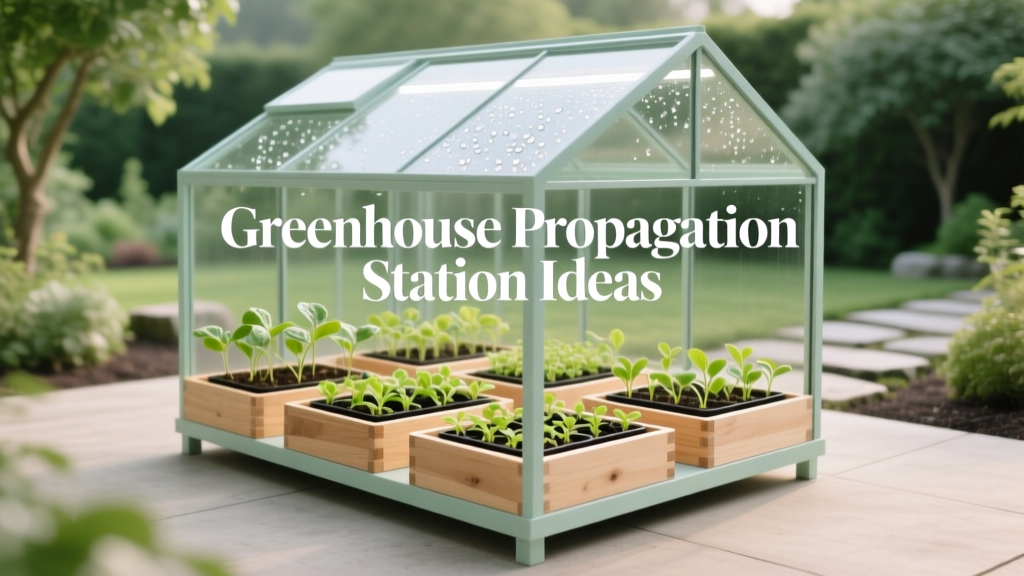
Greenhouse Propagation Station Ideas
You step into the greenhouse with a tray of cuttings balanced on one palm and a spray bottle in the other. The air smells like damp potting mix and tomato leaves. Somewhere behind you, a hose drips—slowly, steadily—right onto the floor where yesterday’s seed flats were supposed to be. You can make plants here, sure, but you’re spending more time hunting for labels, wiping puddles, and shuffling trays than actually propagating.
A propagation station fixes that. Think of it as a compact “work triangle” inside your greenhouse: a clean surface for sowing and sticking cuttings, a predictable place for water and tools, and a controlled zone for heat/light/humidity. The goal isn’t perfection—it’s a layout that makes repeating small tasks easy, day after day.
Design principles that make propagation feel effortless
1) Put the “dirty work” near the door, and the “baby plants” deeper inside
Propagation creates debris: spilled mix, perlite dust, old leaves, algae. Place your potting/soil handling zone within 3–5 feet of the greenhouse door so you can sweep or dump easily and carry in supplies without crossing the entire space. Then locate your germination and rooting zone farther in, where temperatures and drafts are more stable.
If you only change one thing, change this: keep your clean propagation bench away from the main traffic line. Seedlings hate getting bumped, and you’ll stop resowing trays that got knocked to the floor.
2) Build to ergonomic dimensions (your back will thank you)
Benches that are too low turn every sowing session into a backbend. For most adults, a comfortable standing workbench height is 34–36 inches. If you prefer sitting to seed, aim for a bench height around 28–30 inches with knee clearance.
Depth matters as much as height. A bench depth of 24 inches lets you reach the back without leaning; 30 inches is workable if you can access from both sides. Leave an aisle of at least 24 inches; 30–36 inches feels calm and functional when you’re carrying trays.
3) Separate microclimates: heat + humidity on purpose, not by accident
Propagation succeeds when you can control a few key variables: warmth at the root zone, consistent moisture, and appropriate light intensity. A propagation station is essentially a set of microclimates:
- Germination zone: warm, evenly moist, moderate light once sprouted.
- Cutting/rooting zone: high humidity, gentle light, slightly warmer roots.
- Hardening zone: brighter light, more airflow, less frequent misting.
Bottom heat is one of the biggest levers you can pull. University of Massachusetts Extension notes that bottom heat around 70–75°F is commonly used for rooting many cuttings (UMass Extension, 2020). You can achieve this with heat mats on a waterproof surface or with a heated propagation bench if you’re building bigger.
4) Use light strategically (and know your hour count)
Most seedlings and cuttings don’t need scorching midday sun; they need consistency. If your greenhouse gets 6+ hours of direct sun in spring, plan for shade cloth or place propagation benches where they receive bright morning light and filtered afternoon light. For winter propagation, supplemental LED lighting can stabilize growth. A practical target is 12–16 hours of light per day for seedlings under lights, depending on what you’re growing.
For evidence-based lighting guidance, Michigan State University Extension emphasizes that seedlings grown under insufficient light become leggy and weak, recommending bright light and close placement of fixtures when using artificial lighting (MSU Extension, 2021).
“Propagation is a game of consistency—uniform moisture, uniform temperature, uniform light. Design your space so uniformity is automatic, not something you fight for every morning.” — Adapted from greenhouse production teaching principles commonly emphasized in extension education (e.g., UMass Extension, 2020)
Layout strategies: three station styles that fit real homes
Station A: The one-wall bench (best for narrow lean-tos)
If your greenhouse is a narrow lean-to—say 6 ft x 10 ft—a single, continuous bench along the longest wall is the cleanest solution. Make it 24 inches deep and run it 8–9 feet long, leaving room near the door for a small “mess zone” tub or lidded bin.
Under-bench storage is the secret weapon here. Use weatherproof totes for potting mix and stackable trays. Add two hooks for a hand sprayer and your favorite snips so they stop wandering.
- Install a wall ledger and bench frame at 34–36 inches high.
- Top it with a waterproof surface (sealed plywood, recycled HDPE sheet, or a cafeteria tray-style laminate panel).
- Mount a 4-foot shop light or LED grow bar above the center portion if winter sowing is planned.
- Add a heat mat zone sized for standard 1020 trays (10" x 20").
- Create a “dry shelf” above for labels, markers, and clean trays.
Station B: The island bench with a “wet edge” (best for 8x12 or larger)
In an 8 ft x 12 ft freestanding greenhouse, you can build an island bench that you can reach from both sides. This is propagation luxury: fewer contortions, better airflow, and a simple way to split zones.
Try an island bench footprint of 30 inches wide by 6 feet long. Along one long edge, integrate a shallow “wet edge” tray area—something that can catch runoff from misting and watering. On the other side, keep a clean, dry work surface for filling cells and labeling.
- Mark a center aisle clearance of 30–36 inches on both sides of the island.
- Build the island frame with rot-resistant lumber or metal shelving components.
- Place heat mats on one half (germination/rooting) and keep the other half unheated (hardening).
- Hang shade cloth above the propagation half if the greenhouse exceeds 6–8 hours of harsh summer sun.
- Position a small oscillating fan to create gentle airflow (aim it away from fresh cuttings).
Station C: The rolling cart “pop-up station” (best for renters or shared spaces)
If you rent, share a greenhouse, or simply don’t want permanent construction, build your propagation station on wheels. A 24" x 48" stainless-steel kitchen cart or heavy-duty wire shelving unit becomes a mobile bench. Roll it into the sun on bright days and tuck it away when you need floor space.
Pair it with clip-on lights and a lidded humidity dome so you can create a stable rooting environment without modifying the greenhouse structure.
- Choose a cart with at least 200 lb capacity if you’ll store mix and water on the lower shelf.
- Add a waterproof boot tray on the top shelf as a runoff catcher.
- Use a plug-in heat mat and route cords upward with zip ties to prevent puddle contact.
- Clip on an LED bar light and set a timer for 14–16 hours as needed.
- Store labels, dibber, and disinfectant wipes in a small caddy attached to the handle.
Propagation station components (and what they cost)
You can build a functional station with a few basics. Costs vary by region, but these ballpark numbers help you plan:
- Heat mat (for one 1020 tray): typically $25–$60.
- LED grow light bar (2–4 ft): often $30–$120.
- Wire shelving unit (heavy duty): around $60–$150.
- Shade cloth (40–60% for propagation area): roughly $20–$60 depending on size.
- Humidity dome + 1020 tray set: about $10–$25.
DIY alternatives: repurpose an old metal baker’s rack as a vertical propagation tower; use cafeteria trays or mortar mixing tubs as waterproof bench liners; and convert clear storage totes into humidity chambers by drilling a few adjustable vent holes near the lid.
Comparison table: three station builds at a glance
| Station style | Best greenhouse size | Footprint | Typical DIY cost | Strength | Tradeoff |
|---|---|---|---|---|---|
| One-wall bench | 6x8 to 6x12 | 24" deep x 8–9 ft long | $120–$350 | Simple, efficient traffic flow | Less flexibility for separating zones |
| Island bench + wet edge | 8x12 and up | 30" x 6 ft (centered) | $250–$700 | Two-sided access; easy microclimate zoning | Needs more floor space and clear aisles |
| Rolling cart pop-up | Any (especially rentals) | 24" x 48" | $90–$400 | Portable; no permanent modifications | Less surface area; can feel crowded during peak sowing |
Plant selection that actually suits greenhouse propagation
A smart station isn’t just benches and lights—it’s choosing plants that match your space, your patience level, and your heat/light reality. Below are reliable performers with specific varieties and the reason they’re well-behaved in a home propagation setup.
Fast, satisfying seeds for cool-season runs
Lettuce ‘Salad Bowl’ germinates quickly and tolerates cooler greenhouse shoulder seasons. Sow shallowly and thin or transplant at 6–8 inches spacing for baby heads. It’s ideal for testing your station early in the year because it forgives small temperature swings.
Kale ‘Red Russian’ is another confidence-builder: strong germination, sturdy seedlings, and it hardens off beautifully. Transplant at 12–18 inches spacing depending on how large you want plants.
Warm-season seedlings that benefit from heat mats
Tomato ‘Sungold’ (F1) is famously vigorous and a great candidate for indoor-to-greenhouse seedling starts. Bottom heat speeds germination and gives you uniform trays—less staggered growth, less shuffling. Provide bright light to prevent legginess.
Pepper ‘Jalapeño M’ appreciates consistent warmth at the root zone; it’s exactly what heat mats are for. Expect slower germination than tomatoes, so label carefully and keep moisture steady rather than soggy.
Cuttings that root reliably in a humidity zone
Pelargonium (geranium) ‘Calliope Dark Red’ roots readily from cuttings and rewards you quickly. It likes bright shade during rooting—perfect for a bench under 40–60% shade cloth.
Coleus ‘ColorBlaze’ series is almost too easy: fast rooting in water or mix, vivid payoff, and an ideal “practice plant” if you’re refining misting habits and sanitation routines.
Herbs worth propagating for real savings
Rosemary ‘Arp’ is a practical variety for many climates, but it’s slower from seed—cuttings are the better route. Keep cuttings in high humidity and avoid overwatering the mix. The payoff is long-term: one healthy mother plant can supply dozens of starts over time.
Thyme ‘German Winter’ can be divided or rooted from cuttings; it stays compact and transitions well to containers—great for renters building a portable herb collection.
Three real-world station scenarios (and how to lay them out)
Scenario 1: The renter with a mini greenhouse and a single outlet
You’ve got a 4 ft x 6 ft pop-up greenhouse on a patio and one exterior outlet. Go with the rolling cart approach, but keep it simple: one heat mat, one light, one shelf of tools.
Plan: place the cart on the brightest side, but not pressed against the plastic wall (cold nights can chill trays). Keep 2–4 inches of air gap from the wall. Use a humidity dome to reduce water demand when you can’t check it midday.
Budget move: skip a big fan; instead, open the greenhouse door for 10 minutes on mild days to refresh air. That tiny habit prevents fungal issues surprisingly well.
Scenario 2: The homeowner with an 8x12 greenhouse and spring seedling overflow
If you start vegetables, annuals, and a few perennials, you’ll hit the “April traffic jam” where every flat wants prime real estate. The island bench solves it by allowing you to work from both sides and split by stage.
Plan: one end of the island is a heated germination area holding 4–6 1020 trays; the other end is unheated for hardening seedlings in brighter light and airflow. Add a narrow wall shelf (even 8–10 inches deep) for labels and bottom-watering supplies.
Budget move: rather than automated misting, use a pump sprayer and a timer habit—mist cuttings lightly 2–3 times per day for the first week, then taper as roots form. The station design (wet edge + runoff control) keeps this manageable.
Scenario 3: The busy household that wants fewer failures and less daily fuss
If you travel or you’re simply not able to check seedlings constantly, design for “forgiveness.” That means bottom-watering trays, capillary mats, and clear zoning so nothing gets missed.
Plan: install a shallow basin area where 1020 trays can sit and wick from below for 20–30 minutes once or twice a week, rather than frequent overhead watering. Keep a dedicated disinfecting station (spray bottle with labeled solution and a small brush) right at the entry to your propagation bench.
Budget move: a simple mechanical timer for lights (often under $15) is one of the highest impact “set-and-forget” upgrades you can make.
Step-by-step: set up a greenhouse propagation station in one weekend
- Map your workflow. Stand in the greenhouse and mime the tasks: bring in mix, fill trays, label, water, place under light/heat, check daily. Mark where you bump into things.
- Choose a bench location with stable conditions. Avoid the coldest wall and the drip line from the roof. Aim for bright indirect light or morning sun.
- Build or place your bench at 34–36 inches high. Keep depth around 24 inches if it’s against a wall.
- Add waterproofing. Use a boot tray, pond liner, or sealed panel so spills don’t become wood rot.
- Create three zones. Left to right works well: potting/filling, germination/rooting (heat mat + dome), and staging/hardening.
- Install lighting (if needed). Set seedlings under lights for 12–16 hours daily; keep fixtures close enough to maintain compact growth without heating leaves.
- Set up a sanitation corner. Keep isopropyl alcohol wipes or a labeled disinfectant spray, plus a small trash container for leaf debris.
- Label like a pro. Put a marker on a string, keep tags in one container, and write dates. It’s the difference between “mystery tomato” and repeatable success.
Maintenance expectations: what this station asks of you
A well-designed propagation station should take 30–60 minutes per week in routine care for a small home setup, plus short daily check-ins during active rooting and germination. Here’s what that looks like in practice:
- Daily (5–10 minutes): check moisture, open vents on humidity domes if condensation is heavy, scan for damping-off or mold, rotate trays for even light.
- Weekly (20–40 minutes): disinfect bench surface, wash reused trays, clean algae from wet areas, sharpen snips, refill labeling supplies.
- Seasonal (1–2 hours per season): inspect cords and plugs for moisture safety, replace cracked domes, launder shade cloth, deep clean fans, and flush any irrigation parts if used.
Also plan for spacing shifts. Seedlings that were happy leaf-to-leaf as sprouts need air as they size up. A common greenhouse bottleneck is not light—it’s overcrowding. When true leaves appear, give trays a little breathing room or pot up promptly.
Notes on safety, moisture control, and durability
Water and electricity can coexist safely, but design like you expect splashes. Keep power strips mounted higher than bench level, route cords with drip loops, and avoid setting plugs on the floor. If your greenhouse floor gets wet, a simple rubber mat in your standing zone reduces slip risk and makes longer seeding sessions more comfortable.
For humidity, remember: high humidity is for cuttings, not for everything all the time. Seedlings left under domes too long can develop weak stems and increased disease pressure. Vent gradually—propagation is a transition, not a switch.
Source-backed details you can trust
Bottom heat and environmental consistency are foundational to propagation success. University of Massachusetts Extension materials on propagation commonly recommend warm root-zone temperatures in the 70–75°F range for many cuttings (UMass Extension, 2020). For seedling light management, Michigan State University Extension emphasizes the importance of bright light to avoid weak, leggy growth, especially when using artificial lighting (MSU Extension, 2021).
Once your station is in place, you’ll notice a subtle shift: you stop “finding a spot” for trays and start moving plants through a system. The greenhouse becomes less of a storage room and more of a studio—one where your hands know where everything is, and your seedlings grow the way you pictured them when you carried that first tray through the door.