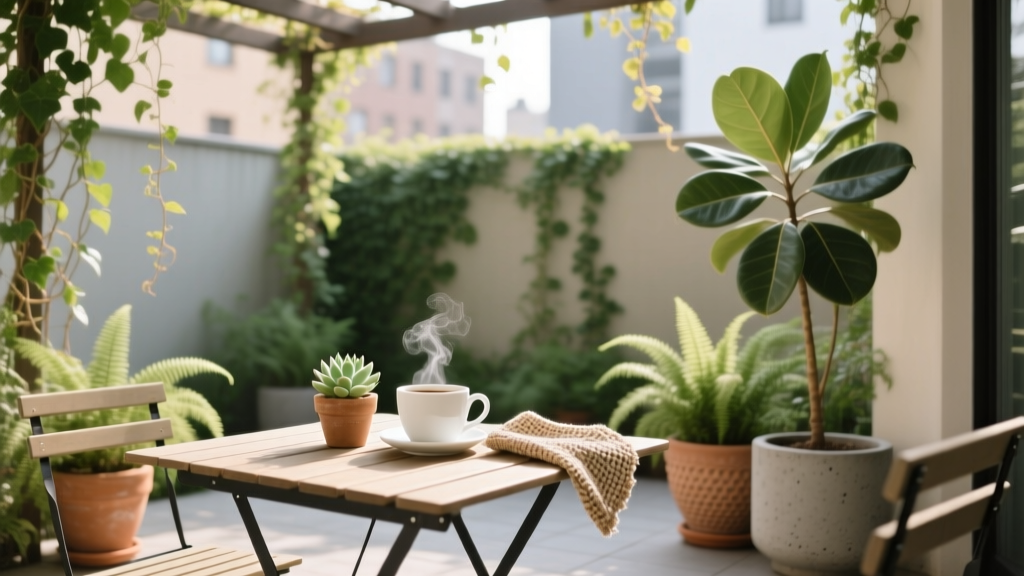
Patio Coffee Corner with Plants
It’s 7:12 a.m. and the coffee is finally ready—then you step outside and realize your “patio” is really just a hard slab that collects yesterday’s leaves, a wobbly chair, and a view straight into the neighbor’s recycling bins. The good news: a coffee corner doesn’t need a full backyard. It needs a clear landing spot for your mug, a little privacy, and plants placed like thoughtful furniture—close enough to soften the edges, not so close they snag your sleeves.
This project is a designer’s favorite because it’s small, satisfying, and immediately lived-in. Below, I’ll walk you through layouts that work for tiny balconies and roomy patios, plant choices that behave in containers, and the practical numbers—spacing, sunlight hours, costs—so you can plan confidently.
Design principles: build a “room” for one good habit
Start with the smallest functional footprint
A comfortable coffee corner can fit into a surprisingly small zone. Aim for a minimum footprint of 5 ft x 5 ft (25 sq ft) for a bistro set, or 3 ft x 6 ft if you’re doing a slim bench and a side table. Leave 24–30 inches of clear passage behind the chair so you’re not scooting sideways like you’re in an airplane aisle.
If your patio is tight, commit to a single seat plus a surface. One great chair beats two cramped ones. Treat the plants as the “walls” and “ceiling” of the room—layered heights create comfort even in full view of neighbors.
Use a three-layer plant layout (low, mid, tall)
Think of your coffee corner in layers:
- Low layer (0–12 inches): softeners at foot level—trailing plants, groundcover-style pots.
- Mid layer (12–30 inches): herbs, flowering containers, or compact shrubs to bring scent and color near your seat.
- Tall layer (36–72 inches): privacy and structure—clumping grasses, bamboo in a pot (with caution), or a slim trellis.
This layered approach matters because it changes how the space feels. You don’t need to block every sightline; you just need to interrupt the view enough to feel tucked in.
Plan for light: coffee corners are morning spaces
Most people use a patio coffee corner in the morning, so prioritize gentle light and comfort. Note how many hours of direct sun your spot gets:
- 2–4 hours: bright shade / part shade. Choose ferns, hardy herbs like mint (in a pot), and shade-tolerant bloomers.
- 4–6 hours: ideal “morning sun” range. You can grow lavender, compact roses, many herbs, and tougher houseplants outdoors in summer.
- 6–8+ hours: full sun. Great for Mediterranean herbs, citrus (in warm zones), and sun-loving annuals—but you’ll need a shade option (umbrella, pergola, or tall plants placed west/southwest).
As a practical check: if your chair seat feels hot by 10 a.m., you’re in a full-sun pocket. Add overhead shade or position tall plants to the west to soften late-morning heat.
Choose materials that make plants easier (not fussier)
Your surfaces and containers should help you succeed. For renters, weight and drainage matter more than looks. For homeowners, durability and irrigation matter more than trend.
- Pots with drainage holes: non-negotiable. Add pot feet or a thin riser so water doesn’t stain pavers.
- Soil: use a quality potting mix; don’t use straight garden soil in containers (it compacts).
- Watering strategy: if you hate daily watering, prioritize larger pots (they buffer moisture) and self-watering inserts.
“The small spaces we inhabit daily deserve the same design attention as larger landscapes—comfort, circulation, and a sense of enclosure.” — James van Sweden (as quoted in discussions of “room” principles in landscape design; van Sweden’s work is widely cited for outdoor room-making, 1990s–2000s)
And a plant-science note worth taking seriously: container plantings dry out faster than in-ground beds. The Royal Horticultural Society emphasizes consistent watering and good drainage for container success (RHS, 2023).
Layout strategies that work in real patios
Strategy A: The “L-corner” for privacy without building anything
This is my go-to for renters and for exposed patios. You create a corner using two tall planters set at right angles, then tuck your chair inside that L.
Dimensions: Place two tall planters (16–20 inches wide each) about 24 inches apart to form a corner. Set the chair so the back is 12–18 inches from the planters (close enough to feel protected, far enough for airflow and leaf clearance).
Best for: balconies, townhouse patios, anywhere with neighbor sightlines.
Strategy B: The “Green Rail” for narrow patios and apartment balconies
If you only have a 3–4 ft depth to work with, push planting vertical and linear. Use railing planters, a narrow shelf, and one statement pot at the end like a punctuation mark.
Dimensions: Keep floor pots at 10–14 inches diameter so you don’t lose walking space. Use a wall-mounted trellis panel around 18–24 inches wide and 48–60 inches tall.
Best for: renters, anyone who needs the floor clear (pets, kids, shared walkway).
Strategy C: The “Pergola-lite” for homeowners who want shade and structure
You don’t need a full pergola build to get the feeling. Two large planters can support a simple arch/trellis, creating a doorway into your coffee spot. Add a shade sail or outdoor curtain panel if needed.
Dimensions: Two heavy planters (18–22 inches wide) spaced 4 ft apart can hold a lightweight arch. Keep the seat area at least 6 ft away from a grill or high-traffic door so it stays calm.
Best for: sunny patios, homeowners who want a “designed” look fast.
Step-by-step setup (designer-style, no wasted moves)
- Mark your footprint: Use painter’s tape or a garden hose to outline your seating zone. Confirm you have 24–30 inches of clearance for walking.
- Place the seat first: Set your chair/bench where you actually want to sit—angle it toward the best view (even if that view is “not the neighbor’s bins”).
- Add a stable surface: Choose a small table 16–20 inches wide. Test it with your mug and a book; if it wobbles now, it will always annoy you.
- Build the tall layer: Add one or two tall planters or a trellis behind/side of the chair for enclosure. Keep foliage 6–12 inches away from where your shoulders will be.
- Fill the mid layer: Cluster two medium pots near the table—this is where fragrance belongs (lavender, jasmine, scented geranium).
- Finish with the low layer: Add one trailing plant at the base of the tall planter or at the corner edge to soften hard lines.
- Light it gently: Use warm LEDs (around 2700K)—string lights, a small lantern, or a rechargeable table lamp—so the corner works for evening tea too.
Plant selection: specific varieties that behave beautifully in patio containers
The best coffee-corner plants do at least one of these jobs: add scent, soften noise/visibility, stay tidy in a pot, or look good up close. Here are designer-reliable options by role.
For privacy and structure (tall layer)
- Fargesia rufa (clumping bamboo): Upright, non-running bamboo ideal for pots; creates a living screen without aggressive spread (still keep it container-contained). Works best with 4–6 hours sun or bright shade. Use a pot at least 18 inches wide.
- Miscanthus sinensis ‘Morning Light’: Fine-textured ornamental grass that moves in the breeze and doesn’t feel bulky. Full sun to part sun (5–8 hours). Give it 24–30 inches of visual space—don’t cram it against your chair.
- Trachelospermum jasminoides (star jasmine) on a trellis: Evergreen in many climates, fragrant, and great for a vertical panel. Sun to part shade. Train it on a 48–60 inch trellis for quick “wall” effect.
For fragrance (the reason you’ll sit down)
- Lavandula angustifolia ‘Hidcote’: Compact English lavender; scent and pollinators. Needs strong light—ideally 6+ hours—and fast drainage.
- Pelargonium ‘Attar of Roses’ (rose-scented geranium): Leaves release fragrance when brushed—perfect near arm level. Thrives in containers with 4–6 hours sun.
- Gardenia jasminoides ‘Veitchii’: For warm climates or sheltered patios; glossy leaves and strong perfume. Needs consistent moisture (not soggy) and bright light.
For edible “coffee companion” pots (mid layer)
- Mentha spicata (spearmint): Great for iced coffee/tea—always in a pot to prevent spreading. Part sun is fine. Pinch weekly to keep it bushy.
- Thymus vulgaris (common thyme): Low, tidy, drought-tolerant once established. Full sun. Excellent tucked near the edge where it can spill slightly.
- Fragaria ‘Mara des Bois’ (strawberry): A patio-friendly strawberry with great flavor; attractive leaves and small white flowers. Sun (6+ hours) and regular watering.
For shade/bright shade patios (low + mid layer)
- Polystichum setiferum (soft shield fern): Lush texture, comfortable “green room” feeling. Bright shade; keep evenly moist.
- Heuchera ‘Caramel’: Colorful foliage in part shade; great in pots. Pair with ferns for contrast.
- Begonia ‘Dragon Wing’: Reliable flowers in part shade; neat habit and long season.
Plant care credibility matters: the University of Minnesota Extension notes that container gardens require more frequent watering than in-ground beds and benefit from high-quality potting media (University of Minnesota Extension, 2020). That’s exactly why I push larger pots and fewer, better plants.
Comparison table: pick plants based on light and attention level
| Plant | Best sunlight | Container size suggestion | Water needs | What it does in a coffee corner |
|---|---|---|---|---|
| Lavandula ‘Hidcote’ | 6–8 hrs | 12–14 in pot | Low–medium | Fragrance, pollinators, tidy mound |
| Star jasmine (trellis) | 4–6 hrs | 14–18 in pot + 48–60 in trellis | Medium | Vertical privacy + scent |
| Clumping bamboo (Fargesia) | 3–6 hrs | 18–22 in pot | Medium | Fast screen, soft sound in wind |
| Soft shield fern | 2–4 hrs | 12–16 in pot | Medium–high | Shade-friendly lushness, calming texture |
| Thyme | 6–8 hrs | 10–12 in pot | Low | Edible, clean edging, drought tolerant |
Budget planning: what it costs and where to save
A patio coffee corner can be done with thrifted furniture and two strong plants, or it can be a mini hardscape project. Here are realistic ranges (prices vary by region, but these are common retail ballparks):
- Bistro chair + small table: $80–$250 (thrifted sets can be $40–$100)
- Two medium planters (12–16 inch): $30–$120 total
- Two tall planters (18–22 inch): $120–$300 total (DIY cedar boxes can be $60–$120)
- Potting mix: $15–$40 depending on volume
- Plants (3–7 total): $60–$220
- Solar or plug-in lighting: $20–$80
Designer trick for saving: Spend on the tall layer first (it changes the feeling fastest), then fill in with smaller pots over time. Also, one large pot often looks more “designed” than three small ones—and it’s easier to keep watered.
DIY alternatives that still look intentional
- Privacy screen: Use a 2 ft x 6 ft trellis panel zip-tied to a railing or fence, then add a vine (star jasmine in warm climates, clematis in cooler ones).
- Planter risers: Bricks or pot feet to lift containers 1–2 inches for drainage and stain prevention.
- Side table: A sturdy crate flipped on its side with a cut-to-size paver on top (stable, inexpensive, surprisingly chic).
Real-world scenarios: three coffee corners, three constraints
Scenario 1: The renter’s 6 ft x 10 ft balcony with harsh afternoon sun
The problem: Heat and glare make the balcony feel unusable after mid-morning, and there’s no privacy from neighboring windows.
Layout solution: Use the Green Rail strategy. Place one tall pot in the hottest corner with a grass like Miscanthus ‘Morning Light’ to filter sun. Add a trellis panel on the railing with a vine (or even faux greenery if your lease is strict, then anchor with real pots at the base).
Plant picks: Lavender ‘Hidcote’ (sun), thyme (sun), and rose-scented geranium (sun/part sun). Add one trailing plant—Calibrachoa—to soften the rail edge.
Numbers that matter: Keep pot diameters to 10–14 inches to preserve a 24-inch walkway. Add a small umbrella if you get 7–8 hours of direct sun.
Scenario 2: The townhouse patio (8 ft x 12 ft) that feels exposed to neighbors
The problem: You want to sit outside, but you feel like you’re on display. The space needs a “back wall.”
Layout solution: Build the L-corner with two tall planters. Place the chair inside the L, then add two mid-height herb pots near the table for scent.
Plant picks: Clumping bamboo (Fargesia rufa) for the tall screen, star jasmine on a slim trellis for fragrance, and mint in a pot for drinks. If light is lower (3–4 hours), swap lavender for heuchera and a fern.
Budget approach: Two tall planters can be the investment piece ($120–$300), while herbs can be started from small nursery pots ($5–$12 each).
Scenario 3: The homeowner’s wide patio that needs a destination (and a little romance)
The problem: Big patio, no anchor. Furniture floats and never feels intentional.
Layout solution: Use Pergola-lite: two substantial planters with an arch/trellis to define the “entry” to the coffee corner. Place a bench just inside, with two side pots for symmetry and a low trough for trailing plants.
Plant picks: Star jasmine or clematis on the arch (depending on climate), plus a structural evergreen in a pot (a compact boxwood or dwarf conifer suited to your region). Add strawberries in a shallow bowl planter for a breakfast-friendly detail.
Numbers that matter: Space your large planters 4 ft apart for a comfortable entry feel; allow at least 6 ft behind the seating zone if it’s near a main path so people aren’t brushing past your cup.
Maintenance expectations: keep it lovely in 20 minutes a week
A coffee corner should not become a chore corner. With smart plant choices and decent pot sizes, expect about 15–30 minutes per week on average during the growing season.
Weekly routine (growing season)
- Water check (5–10 minutes): Stick a finger into soil 2 inches deep. Water thoroughly when dry at that depth.
- Quick grooming (5 minutes): Snip dead blooms, pinch mint tips, remove yellow leaves.
- Rotate pots (optional, 2 minutes): Turn flowering pots a quarter turn for even growth if they lean toward sun.
Monthly tasks
- Feed (10 minutes): Container plants often benefit from a balanced fertilizer during active growth. Follow label rates; more isn’t better.
- Pest check (5 minutes): Look under leaves for aphids/spider mites, especially on jasmine and geraniums.
Seasonal tasks
- Spring: Refresh the top 1–2 inches of potting mix; prune back winter damage on grasses and vines.
- Summer: Mulch pot surfaces lightly with fine bark to slow evaporation; consider drip emitters if you travel.
- Fall: Reduce feeding; clean up leaf litter so pots don’t stay soggy.
- Winter: In cold climates, cluster pots against a wall for shelter; wrap sensitive containers or move tender plants indoors.
The RHS notes that containers can need daily watering in hot weather, especially in sun and wind (RHS, 2023). If that sounds like your patio, size up your pots or add a simple drip kit—your future self will thank you.
Small details that make the corner feel finished
Once the layout and plants are in place, the “designer finish” comes from a few quiet choices:
- Add one tactile element: a small outdoor cushion or a textured throw (stored in a waterproof bin).
- Use a saucer strategy: use saucers where needed, but avoid constant standing water—most patio plants dislike wet feet.
- Keep one spot clear: a 12-inch open zone on the table or bench so the space feels calm, not cluttered.
Set your chair, set your mug down, and notice what you instinctively want next: more shade, more scent, or more privacy. Let that answer guide the next plant you buy. A coffee corner is allowed to evolve—one pot at a time—until it becomes the part of your home that greets you gently every morning.
Sources: Royal Horticultural Society (RHS), “Container gardening” guidance, 2023. University of Minnesota Extension, container gardening and watering considerations, 2020.