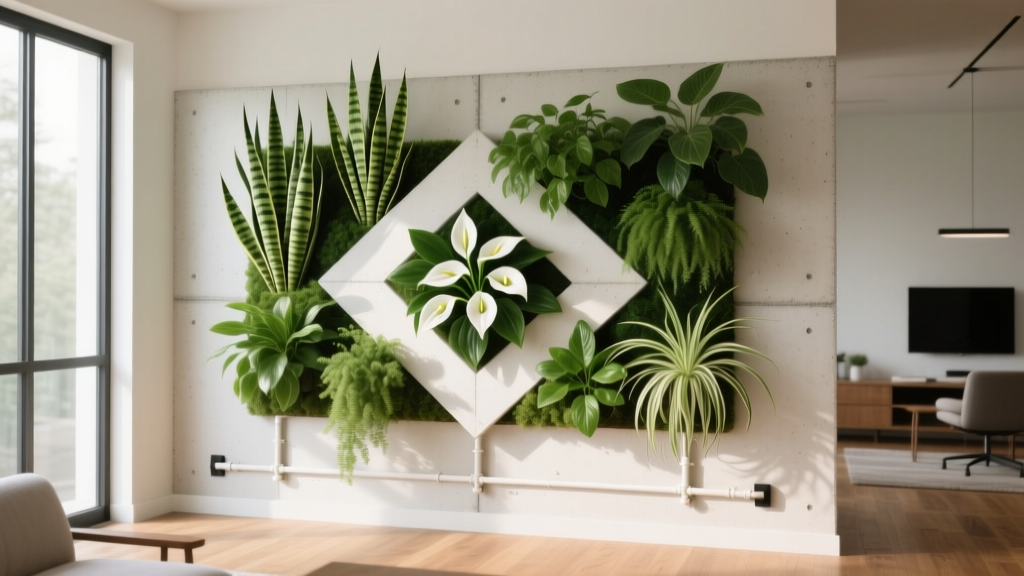
Indoor Air-Purifying Plant Wall
The moment you notice it, you can’t un-notice it: that slightly stale air that hangs in a closed-up apartment after a long winter, or the “new furniture” smell that lingers a little too long. You crack a window, but it’s noisy outside—or it’s 98°F, or the neighbor’s smoker bench is directly below. You want fresher air, but you also want the room to feel finished: alive, layered, designed. That’s where an indoor air-purifying plant wall shines. Done right, it doesn’t look like a science project or a row of sad pots. It reads like a living feature—one that earns its footprint.
I’m going to walk you through a plant wall design the way I would for a client: start with the constraints (light, wall structure, watering reality), then build a layout that looks intentional, and finally choose plants that are both forgiving and genuinely good at being indoor companions. Along the way, you’ll see three real-world scenarios—renter-safe, high-light, and low-light—and exactly what it costs, how big to build, and how much time it takes to keep it looking crisp.
Start with the wall you already have
Pick a wall that supports the life you want, not just the space you have
A plant wall is a small ecosystem attached to your home. Before you buy a single pothos, stand in the room at three times: morning, mid-day, and evening. Note the brightest patch of wall and how long it stays bright. For most homes, “bright” means you can read a book comfortably without turning on a light.
Use these practical light targets:
- Bright indirect: near an east window or a few feet back from a south/west window; aim for 6–8 hours/day of usable daylight.
- Medium: bright room, but not near windows; aim for 3–5 hours/day.
- Low: interior wall, hallway, or north room; expect 0–2 hours/day and plan on a grow light.
Also consider airflow and mess tolerance. A plant wall behind a sofa is gorgeous—until you realize you can’t reach the top row without moving furniture. I like a wall where you can stand 24–30 inches away to water and prune without gymnastics.
Size it for proportion (and your maintenance bandwidth)
Here’s a designer rule that works indoors: make the plant wall occupy roughly 1/3 to 1/2 of the visual width of the furniture it sits above (console, desk, couch). That keeps it from looking like a postage stamp or a green avalanche.
Two dependable starting sizes:
- Compact feature: 24 in W × 36 in H (good above a desk or entry console)
- Statement wall: 36 in W × 60 in H (good above a sofa or in a dining nook)
Depth matters more than people think. Most living-wall hardware projects 8–12 inches off the wall once you include planters and foliage. If this is a tight hallway, keep the system to 6–8 inches max by using slim wall planters and trailing plants that stay close.
Layout strategies that look designed (not accidental)
Choose your “grid” before you choose plants
Plant walls look chaotic when the container sizes and spacing fight each other. Choose one grid and stick to it:
- Modular grid: identical pockets/planters in rows and columns (clean, modern, easy to expand)
- Rail system: a few horizontal rails with pots that hook on (flexible, renter-friendly)
- Frame-and-shelf: a shallow shelving frame with plants arranged like art (best for mixed pots and decor)
For most homeowners and renters, a rail system is the sweet spot: simple install, easy plant swaps, and less risk of water damage. Plan for 10–12 inches of center-to-center spacing between pots for medium growers (pothos, philodendron, spider plants). For compact growers (small ferns, peperomia), you can tighten to 8–10 inches.
Design with three plant “roles”
To make the wall read like a landscape composition, assign each plant a job. This prevents the “all vines” look that turns into a tangled curtain.
- Anchors: upright plants that hold structure (snake plant, peace lily)
- Fillers: mid-size texture plants that create density (pothos, heartleaf philodendron, peperomia)
- Trailers: plants that spill and soften edges (pothos varieties, philodendron hederaceum ‘Brasil’)
A balanced ratio for a 36 in × 60 in wall is about 20% anchors, 50% fillers, 30% trailers. Visually, it mimics how we layer height in an outdoor border.
Plan a watering strategy you won’t resent
This is where beautiful plant walls go to die: watering that requires too many steps. Pick one:
- Hand-water in place: easiest for 6–12 plants; use catch trays and a squeeze bottle or small watering can
- Lift-off watering: pots unhook and go to the sink (best for renters; lowest wall risk)
- Self-watering reservoirs: higher upfront cost; steadier moisture; great for busy schedules
If you’re mounting over wood floors or a fabric sofa, add a waterproof layer. A simple approach: a 1/8-inch thick PVC panel cut 2 inches larger than the wall system on all sides, painted to match the wall. It’s not glamorous, but it’s the difference between “plant wall” and “insurance claim.”
Step-by-step setup (designer-style, with fewer regrets)
- Map your rectangle. Tape out the final size on the wall (e.g., 36 in × 60 in) and stand back. Adjust until it feels proportional to nearby furniture.
- Find studs or choose a no-stud system. For heavier setups, anchor into studs. For renter-friendly rail systems, use rated wall anchors and keep total load low.
- Install a waterproof backer. Mount a PVC panel or sealed plywood behind the system, leaving a 1/4-inch gap at the bottom for airflow and to spot moisture early.
- Mount your rails/shelves. Keep the lowest row at least 18 inches above a console/desk to avoid leaf crush and to create breathing room.
- Standardize your pots. Use 6-inch nursery pots inside cachepots (or slotted wall planters). This makes replacement and rotation simple.
- Pot with a consistent mix. A reliable indoor mix is 2 parts potting soil : 1 part perlite : 1 part fine orchid bark for most aroids. It drains well and resists gnats.
- Arrange by role. Anchors near the center and upper thirds; fillers in the mid-field; trailers on corners and outer edges.
- Add lighting if needed. If the wall gets under 3 hours/day of usable daylight, mount a bar grow light above the top rail on a timer set for 10–12 hours/day.
- Water once, then watch. Water thoroughly, let drain, then observe for a week. Adjust plant placement if one zone dries faster (often near vents).
Plant selection: varieties that work hard indoors
Air-purifying plants are often discussed through the lens of the NASA Clean Air Study (1989), which tested plants in sealed chambers. It’s important to be practical: a home isn’t a sealed chamber, and ventilation rates change the math. Still, indoor plants can contribute to perceived air freshness, humidity comfort, and—most reliably—psychological comfort. A 2019 review in Journal of Exposure Science & Environmental Epidemiology notes that while plants can remove VOCs under controlled conditions, real-world home air cleaning would require an impractically large number of plants for VOC removal alone (Cummings & Waring, 2019). So we design for a combination of resilience, surface area, and livability.
“While potted plants can remove VOCs in laboratory chambers, translating those results to real buildings is not straightforward because ventilation and pollutant sources dominate indoor concentrations.” — Cummings & Waring, 2019
With that grounded expectation, here are plant picks that perform well on a vertical system, tolerate indoor conditions, and give you the lush look most people want.
Anchors (structure and vertical rhythm)
- Snake Plant (Dracaena trifasciata ‘Laurentii’ or ‘Moonshine’): Upright, drought-tolerant, and visually architectural. Works well in medium to bright indirect light; survives lower light with slower growth. Keep in a stable pot—top-heavy foliage needs secure placement.
- Peace Lily (Spathiphyllum ‘Sensation’ or ‘Domino’): Broad leaves for visual mass and a clear “centerpiece” role. Likes medium light and evenly moist soil. Use on lower/middle rows for easier watering and to avoid drip over other plants.
- ZZ Plant (Zamioculcas zamiifolia): A low-light champion for renters with dim apartments. Slow-growing, tough, clean lines. Great anchor for the bottom corners.
Fillers (density, texture, color)
- Pothos (Epipremnum aureum ‘Golden’ and ‘Marble Queen’): Fast coverage, forgiving watering, easy to prune and propagate. Variegated types prefer brighter light to hold color.
- Heartleaf Philodendron (Philodendron hederaceum): Softer leaf shape than pothos; creates a calmer, layered mid-field. Try ‘Brasil’ for a lime stripe if you have brighter indirect light.
- Spider Plant (Chlorophytum comosum ‘Vittatum’): Adds fountain texture and produces plantlets that spill beautifully. Likes bright indirect light and moderate watering.
- Peperomia (Peperomia obtusifolia ‘Variegata’): Compact, glossy leaves; stays tidy in smaller pockets. More drought-tolerant than many tropicals.
Trailers (soft edges and movement)
- Scindapsus pictus ‘Argyraeus’: Velvet leaves with silver patterning—adds sophistication and contrast. Prefers medium to bright indirect light; let top inch dry between waterings.
- English Ivy (Hedera helix): Great trailer in cooler rooms with bright light, but can be finicky indoors (spider mites). If you run warm and dry, swap for pothos or philodendron.
- String of Hearts (Ceropegia woodii): Best for bright spots; elegant trailing. Use near the top to cascade down without shading everything else.
Plant spacing: In a wall system with 6-inch pots, plan 10–12 inches between pot centers, and expect foliage to knit together in 8–12 weeks for pothos/philodendron under good light.
Comparison table: choose the right system for your home
| System Type | Typical Footprint | Best For | Watering Style | Approx. Cost (DIY) |
|---|---|---|---|---|
| Rail + hook pots | 36 in W × 60 in H × 8–10 in D | Renters, frequent plant swapping | Lift-off to sink | $120–$280 (rails, anchors, 10–12 pots) |
| Frame + shallow shelves | 30 in W × 72 in H × 10–12 in D | Mixed decor + plants, easy styling | Hand-water in place | $150–$400 (frame, shelves, trays) |
| Pocket living wall panel | 24 in W × 48 in H × 6–8 in D | Compact walls, uniform look | Careful hand-water | $80–$220 (panel + liners) |
| Self-watering modular system | 36 in W × 60 in H × 10–12 in D | Busy schedules, steadier moisture | Fill reservoir | $250–$650 (modules + reservoir parts) |
Three real-world scenarios (with layouts that actually work)
Scenario 1: The renter’s “no-drill” plant wall above a desk
Space: 28-inch-wide desk in a bedroom, one east-facing window. Light: about 4–6 hours of gentle morning light.
Design move: Keep it narrow and vertical so it reads like art. Use a 24 in W × 36 in H rail panel or lightweight frame that can mount with removable hardware rated for the load (always check your wall type and weight ratings).
Plant list (8 plants in 6-inch pots):
- 2× Pothos (‘Golden’)
- 2× Philodendron hederaceum
- 1× Peperomia obtusifolia
- 1× Spider plant
- 1× ZZ plant (bottom corner anchor)
- 1× Scindapsus pictus
Budget: rails/frame $90, pots and cachepots $60, plants $12–$25 each (about $120–$200), soil/amendments $25. Total: roughly $295–$375.
Why it works: everything tolerates occasional missed watering, and the mix of leaf sizes keeps the wall from looking flat.
Scenario 2: The bright living-room statement wall with a grow-light “canopy”
Space: Above a 84-inch sofa, south-facing windows nearby. Light: strong but inconsistent due to overhangs—3–6 hours of bright indirect.
Design move: Go bigger for proportion: 36 in W × 60 in H. Add a discreet grow light bar at the top on a timer for 10 hours/day to keep variegated plants crisp and prevent legginess in winter.
Plant list (12 plants):
- 2× Snake plant (top third anchors, slightly off-center)
- 3× Pothos (‘Marble Queen’ + ‘Golden’ mix)
- 2× Philodendron ‘Brasil’
- 2× Peace lily (lower middle, easy access)
- 1× Spider plant (lower corner for fountain effect)
- 2× Scindapsus pictus (trailers at edges)
Cost reality check: a good full-spectrum light bar and timer can run $60–$140. It’s not just a plant expense—it’s an insurance policy against winter slump.
Why it works: the anchors keep the wall from turning into a single vine mass, and the light makes maintenance easier because plants grow compact instead of reaching.
Scenario 3: The low-light hallway that needs greenery (and can’t drip)
Space: A narrow hallway with a blank wall and no direct window. Light: effectively 0–1 hour/day of decent ambient light.
Design move: Choose a shelf-frame system with saucers/trays and plants that tolerate lower light. Add a slim grow light at the top; otherwise, you’ll be replacing plants every few months.
Plant list (9 plants):
- 3× ZZ plants (repeat for a tailored, architectural look)
- 2× Snake plants (‘Moonshine’ reads modern in dim halls)
- 2× Heartleaf philodendron (for soft fill)
- 2× Pothos (trail edges; easy to prune away from the walking path)
Spacing and safety: keep the entire system to 8 inches deep max so shoulders don’t brush foliage. Install a waterproof backer and use trays under every pot. In hallways, I also recommend placing the lowest shelf at 40–44 inches high so bags and elbows don’t collide with leaves.
Budget choices and DIY alternatives (where to spend, where to save)
If you’re watching costs, spend money where it prevents damage or saves time:
- Spend on: sturdy mounting hardware, waterproof backing, and a timer for lights (set-and-forget)
- Save on: propagation (pothos and philodendron root easily), basic nursery pots hidden in cachepots, and DIY shelves
Three DIY swaps that keep the look high-end:
- DIY waterproof backer: paint a cut-to-size panel with leftover wall paint; seal edges with clear silicone. Materials often under $30–$45.
- Use one pot color: matching cachepots (even inexpensive ones) make the wall feel designed. Mixed pots are fine, but they require a more careful eye.
- Propagate to fill gaps: take 6-inch cuttings of pothos/philodendron, root in water for 2–4 weeks, then tuck into sparse areas.
Maintenance expectations (the real schedule)
A healthy indoor plant wall should not eat your weekends. For a wall of 10–12 plants, expect:
- Weekly: 20–35 minutes total (check moisture, water what’s dry, remove yellow leaves, quick wipe of any drips)
- Monthly: 30–45 minutes (rotate pots for even growth, light pruning to maintain shape, inspect for pests)
- Seasonally (4×/year): refresh top 1 inch of soil, check mounting hardware tightness, adjust grow light timer for winter growth slowdowns
Watering rhythm: Most aroids (pothos, philodendron, scindapsus) like to dry slightly between waterings. In an average heated/cooled home, that’s often every 7–10 days. Peace lilies may want closer to every 5–7 days. Snake plants and ZZ plants can go 14–21 days depending on light and pot size.
Fertilizer: A gentle approach prevents salt buildup on a vertical display. Use a balanced liquid fertilizer at 1/4 strength every 4 weeks during spring and summer, then back off in winter.
Design details that make it feel like a living mural
Repeat one thing, vary one thing
Repeat container color and size, then vary leaf shape. Or repeat leaf shape (all heartleaf forms) and vary color (solid green vs variegated). If everything varies, the wall feels busy; if everything repeats, it feels flat.
Use negative space on purpose
Not every pocket needs a plant on day one. Leaving 10–15% of the grid open gives you room to grow into the design. It also makes watering easier while plants establish.
Keep plants off the ceiling line
Leave at least 8–12 inches between the top of the foliage and the ceiling. Crowding the ceiling makes the wall look accidental and complicates light placement.
Notes on “air-purifying” claims (and what to expect at home)
The original NASA Clean Air Study (Wolverton et al., 1989) demonstrated that certain houseplants can remove VOCs in sealed chambers. That work inspired decades of interest, but modern reviews caution against expecting houseplants to replace ventilation in real homes. The 2019 analysis by Cummings & Waring emphasizes that real indoor air change rates and pollutant sources make it hard for a typical number of plants to move the needle on VOCs without an impractically large installation (Cummings & Waring, 2019).
So what’s the practical promise of an indoor plant wall? A calmer room, a subtle humidity boost, a living focal point, and a space that encourages you to open windows, care for something, and slow down. And yes—plants do interact with indoor air. Just treat “air-purifying” as a meaningful bonus, not the only reason to build.
When you finish your wall, you’ll feel it immediately: the room has a center of gravity. The blank drywall stops shouting. And the best part is that this feature gets better with time—vines knit together, anchors mature, and you can edit the planting like you would a border outside. If you start with a sensible grid, a realistic watering plan, and a plant palette matched to your light, your indoor air-purifying plant wall becomes what every good design should be: a daily pleasure that fits the way you actually live.
Sources: Wolverton, B.C. et al. Interior Landscape Plants for Indoor Air Pollution Abatement (NASA/ALCA study), 1989. Cummings, B.E. & Waring, M.S. “Potted plants do not improve indoor air quality: a review and analysis of reported VOC removal efficiencies.” Journal of Exposure Science & Environmental Epidemiology, 2019.